Tactics (book review)

TacticsI am a big fan of Christian apologetics: defending what I believe as a Christian. But until reading Tactics by Greg Koukl, I have found very few books which discuss how to present what I believe.

Tactics isn’t about parlor tricks, or playing games with words. It is truly a mindset to keep a conversation going with someone who wants to know (or challenge) what you believe. When we make a statement, the conversation comes to a screeching halt or explodes into an intense argument. But if we continue to ask questions, a dialogue can continue.

Greg Koukl uses some insights from TV detective Columbo to give Christians some strategies for productive conversations. Peter Falk’s character was an intuitive detective who got his information by asking people to clarify what they were saying, and getting them to open up and talk more. In similar fashion, Greg gives us some ideas of how to find out not only what the other person believes, but why they believe it, by asking some strategic questions.

From the moment I began reading this book, I have been able to immediately use the tactics Greg outlines. I have recommended this book to a couple of other people, and they are also reporting back to me that they are experiencing similar results. So I wholeheartedly recommend this book to any Christian who wants to have more meaningful conversations with others about their faith.

Links & Quotes

link quote

Great reading (and watching) today.

[VIDEO] John Maxwell reminds us of the value of delays.

Dr. James Dobson defends his comments at the National Day of Prayer address.

[VIDEO] Dr. Brian Mattson discusses the place of the Apocrypha.

[INFOGRAPHIC] Exercise helps your memory.

“The surprise comes for many people that such a tiny little brain is able to form such a rich memory described as a cognitive map,” says co-author Randolf Menzel. Actually, the surprise for me is that many people refuse to believe this amazing little brain was created by an amazing Creator. See how bees build mental maps to get back home.

Links & Quotes

link quote

[VIDEO] Brilliant! The Bible’s place in our worldview.

“The most common remedy for most behavioral and mental disorders today is some form of self-worth enhancement. It pervades our educational institutions, the psychotherapeutic and counseling system, the personnel and motivational industry, advertising, and even the church. I think the remedy is flawed. … What is the root of mental health? My answer is, God. Or seeing God as God and enjoying Him as God, which involves being forgiven by God and welcomed with utterly free grace. I personally believe that these truths are hijacked when they are used to make self-esteem the root of mental health.” —John Piper

[COMIC] What the parishioners think the clergy think the parishioners think the clergy do.

15 great G.K. Chesterton quotes.

Why America doesn’t need Planned Parenthood.

Live Action releases a scathing 6-year investigation of Planned Parenthood.

How we glorify God by sleeping.

Links & Quotes

link quote

Some good reading (and watching) I found today.

“Humility is strong—not bold; quiet—not speechless; sure—not arrogant.” —Estelle Smith

[VIDEO] Ken Davis always cracks me up! When the doctor says, “Don’t drive” … don’t drive!

Feeling beat-up? Max Lucado reminds us to rest in Christ’s finished work.

[VIDEO] Greg Koukl answers the question: What Is Marriage Anyway?

Tim Elmore discusses communicating with youth using pictures, stories and steps.

Links & Quotes

link quote

Some readable reading from today.

I find the science driving “global warming” or “climate change” to be more philosophy than science. A new report notes, “Even if we were to stop emitting greenhouse gas emissions entirely, we would not moderate the Earth’s temperature more than a few tenths of a degree Celsius by the end of the century.” Read more in this post: Obama Hasn’t Healed The Planet.

I love the Bible Overview Project. Here is a cool infographic on the least popular book of the Bible.

“How could it [the Bible], assailed so strongly from every side, have resisted if it had relied upon human protection alone? Rather, by this very fact it is proved to be from God, because, with all human efforts striving against it, still it has of its own power thus far prevailed. Besides this, it is not one state, not one people, that has agreed to receive and embrace it; but, as far and as wide as the earth extends, it has obtained its authority by the holy concord of divers peoples, who otherwise had nothing in common among themselves. Such agreement of minds, so disparate and otherwise disagreeing in everything among themselves, ought to move us greatly, since it is clear that this agreement is brought about by nothing else than the divine will.” —John Calvin

I don’t agree with everything in this post ‘The Idol Of Church Growth,’ but I definitely agree with this statement: “The question churches should be asking is not ‘How do we grow our church?’ but ‘How do we grow His kingdom?’ Sadly, those interests are often kingdoms apart.” 

Ask to summarize his theology, Karl Barth said, “Jesus loves me this I know, for the Bible tells me so.”

“There must be illumination before revelation can get to a person’s soul. It is not enough that I hold an inspired Book in my hands. I must have an inspired heart.” —A.W. Tozer

Links & Quotes

link quote

Some interesting reading I found today.

“The Bible is not a book for the faint of heart—it is a book full of all the greed and glory and violence and tenderness and sex and betrayal that benefits mankind. It is not the collection of pretty little anecdotes mouthed by pious little church mice—it does not so much nibble at our shoe leather as it cuts to the heart and splits the marrow from the bone. It does not give us answers fitted to our small-minded questions, but truth that goes beyond what we even know to ask.” —Rich Mullins

As I have said before, tolerance is only afforded to those who say “anything goes.” Anyone who says there is a right/wrong, truth/lie is labeled intolerant, as illustrated in this story of the Benham brothers losing their TV show deal

…and to further prove the point, Yahoo Joins Google In Banning Pro-Life Ads.

It’s pretty obvious… that the Judeo-Christian concept of God held the key to the rise of the West, and that is the belief in a rational Creator God, because that had the implication, then, that the creation was itself rational—that is to say, it obeys rules” (Rodney Stark). Read more in How Christianity Created Science (And Why Atheism Wouldn’t Have).

Detroit Tiger fans (like me!) will enjoy this: A Numerical Guide To The History Of The Detroit Tigers.

“Has the enemy tried to tell you that God has bypassed you? Have you been tempted to conclude that the Lord isn’t with you? Have you almost given up your faith? Put your hope in the Lord’s Word to you: ‘I will never leave you, nor forsake you’ (Hebrews 13:5). ‘The Lord also will be a refuge for the oppressed, a refuge in times of trouble. And they that know Your name will put their trust in You: for You, Lord, have not forsaken them that seek You’ (Psalm 9:9-10).” —David Wilkerson

… this inscription from Jerusalem may signal widespread—if elementary—literacy during the time of David and Solomon.” Read more about this archeological discovery in Jerusalem.

“Let us meditate on the Lord’s holy name that we may trust Him the better and rejoice the more readily.” —Charles Spurgeon

7 Quotes From “Did Jesus Rise From The Dead?”

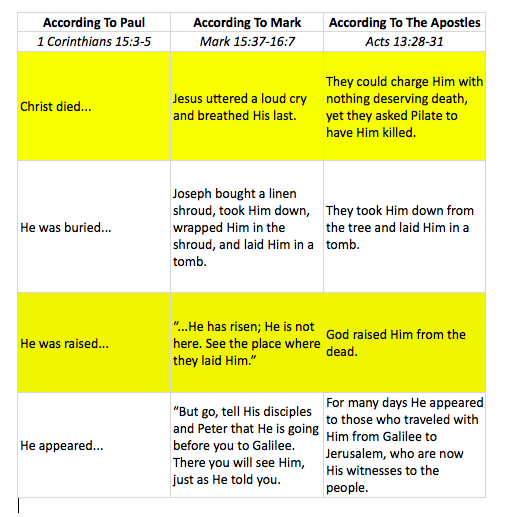
Did Jesus Rise From The DeadDid Jesus Rise From The Dead? is an excellent apologetic for both the biblical skeptic and the biblical student. You can read my full book review by clicking here. Below are seven noteworthy quotes and one infographic from this fascinating book.

“One of the most noteworthy facts about the early Christian belief in Jesus’ resurrection was that it flourished in the very city where Jesus had been publicly crucified. So long as the inhabitants of Jerusalem thought that Jesus’ corpse lay in the tomb, few would have been prepared to believe such silliness as the claim that God had raised Jesus from the dead.”

“We have the extraordinary number of at least five independent sources for Jesus’ burial, some of which are extremely early. The Gospels describe Joseph as a rich man, a member of the Jewish Sanhedrin. As a member of the Jewish Sanhedrin that condemned Jesus, Joseph of Arimathea is unlikely to be a Christian invention. The Sanhedrin was a sort of Jewish high court made up of seventy of the leading men of Judaism, which presided in Jerusalem. There was an understandable hostility among early Christians toward the Jewish Sanhe-drists, for Christians blamed the Sanhedrists for engineering a judicial murder of Jesus at the hands of the Romans. … Therefore, Jesus’ burial by Joseph is very probably historical, since it would be almost inexplicable why Christians would invent a story about a Jewish Sanhedrist who gives Jesus a proper burial.”

“Matthew is clearly working with an independent source, for he includes the story of the guard at the tomb, which is not derived from Mark and is unique to his Gospel; moreover, his comment that the rumor that the disciples had stolen Jesus’ body, ‘And this story has been spread among the Jews to this day,’ (Matthew 28:15) shows that the guard is not Matthew’s own creation, but was part of prior tradition. Luke also has an independent source, for he tells the story, not found in Mark, of two disciples’ inspecting the tomb to verify the women’s report that the tomb was vacant. This story cannot be regarded as Luke’s own creation, since the incident is independently reported in John’s Gospel. And, again, given John’s independence of the other three Gospels, we have yet another independent report of the empty tomb.”
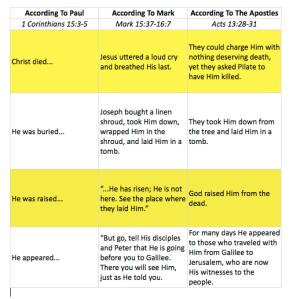
Did Jesus Rise From The Dead infographic

(click image for a larger view)

“To appreciate how restrained Mark’s narrative is, we need only read the account in the second-century apocryphal Gospel of Peter. It describes Jesus’ triumphant exit from the tomb as a gigantic figure whose head reaches above the clouds, supported by giant angels, followed by a talking cross, heralded by a voice from heaven, and all witnessed by a Roman guard, the Jewish leaders, and a multitude of spectators! This is how real legends look: They’re richly decorated with theological and apologetical motifs. By contrast, Mark’s account is stark in its simplicity.”

“Think about that: ‘His disciples came by night and stole Him away’ [Matthew 28:13]. The Jewish authorities did not deny the fact that Jesus’ tomb was empty; instead they entangled themselves in a hopeless series of absurdities, trying to explain it away. In other words, the Jewish claim that the disciples stole the body presupposes that the body was, in fact, missing. Therefore, we have evidence from the very adversaries of the early Christian movement for the fact of the empty tomb.”

“All the followers of those first century messianic movements were fanatically committed to the cause…. But in no case right across the century before Jesus and the century after Him do we hear of any Jewish group saying that their executed leader had been raised from the dead, and he really was the Messiah after all.” —N.T. Wright

“A supernatural explanation of the empty tomb, the resurrection appearances, and the origin of the Christian faith is not contrived given the context of Jesus’ own unparalleled life, ministry, and personal claims.”

Did Jesus Rise From The Dead? (book review)

Did Jesus Rise From The DeadDr. William Lane Craig is a brilliant Christian apologist. Part of his brilliance is in the way he can make complex subject matters so accessible for everyone. This is fully on display in his book Did Jesus Rise From The Dead?

This book is a fairly quick read, but it is packed with powerful information. Point-by-point Dr. Craig leads us through the evidence for the empty tomb of Jesus, laying out all of the independently-corroborated evidence for Christ’s resurrection, and dismantling the arguments against His resurrection.

Next he lists several hypotheses—including the conspiracy hypothesis, the apparent death hypothesis, the displaced body hypothesis and the hallucination hypothesis—and gives us the criteria to analyze each of these hypotheses on our own. These criteria include the explanatory scope, the explanatory power, plausibility, less contrived theories, and the disconfirmation factors. Quite fascinating!

The book is well footnoted to give the reader ample sources to dig deeper on any of the points Dr. Craig covers. I could see this being an ideal book for those skeptical of the biblical claims of Christ’s resurrection, as well as a good study tool for Christians to prepare themselves to answer the objections others may have about the good news of Jesus being raised from the dead.

Links & Quotes

link quote

Some great reading I found today.

[AUDIO] This is a fascinating lecture from Dr. Glenn Sunshine on Christians in history who changed history.

“This day my God will perform all things for me; what can I do for Him? My thoughts ought to run to Him, for He thinketh upon me.” —Charles Spurgeon

This is appallingPro-abortion group declares bloody, mangled babies are “safe” for women.

“There is no doctrine which I would more willingly remove from Christianity than this, if it lay in my power. But it has the full support of Scripture and, specially, of Our Lord’s own words; it has always been held by Christendom; and it has the support of reason. If a game is played, it must be possible to lose it. If the happiness of a creature lies in self-surrender, no one can make that surrender but himself (though many can help him to make it) and he may refuse. I would pay any price to be able to say truthfully ‘All will be saved.’ But my reason retorts, ‘Without their will, or with it?’ If I say ‘Without their will’ I at once perceive a contradiction; how can the supreme voluntary act of self-surrender be involuntary? If I say ‘With their will,’ my reason replies ‘How if they will not give in?’ … The doors of Hell are locked on the inside. I do not mean that the ghosts may not wish to come out of Hell, in the vague fashion wherein an envious man ‘wishes’ to be happy: but they certainly do not will even the first preliminary stages of that self-abandonment through which alone the soul can reach any good. They enjoy forever the horrible freedom they have demanded, and are therefore self-enslaved: just as the blessed, forever submitting to obedience, become through all eternity more and more free.” —C.S. Lewis

[VIDEO] A great way for Creationists to dialogue with evolutionists.

Thursdays With Oswald—Don’t Try To Persuade

ChambersThis is a weekly series with things I’m reading and pondering from Oswald Chambers. You can read the original seed thought here, or type “Thursdays With Oswald” in the search box to read more entries.

Don’t Try To Persuade

     You can’t persuade a man to believe in God; belief in God is not an act of the intellect, it is a moral creation produced by the interaction of God’s Spirit and my spirit in willing obedience; intellect comes in afterwards to explain what has happened. 

From Conformed To His Image

I love reading and studying apologetics, but it’s important to remember that I’m not reading these arguments to persuade someone to believe in Jesus. Oswald Chambers is right on target: no one can be be persuaded to believe.

The Bible says that faith in Christ comes through hearing God’s Word. So I unabashedly share as much Scripture as I can, refraining from adding my own commentary. The Word speaks for itself. As Charles Spurgeon said, “How do I defend the Bible? I treat it like a lion. I let it out of its cage and it defends itself.”

The apologetic training comes in handy after someone has already placed their faith in Christ to explain what has happened. It works like this:

The Bible → Faith in Christ. 

Apologetics → Understanding my faith.