Don’t Cross The Line

Listen to the podcast of this post by clicking on the player below, and you can also subscribe on AppleSpotify, or Audible. 

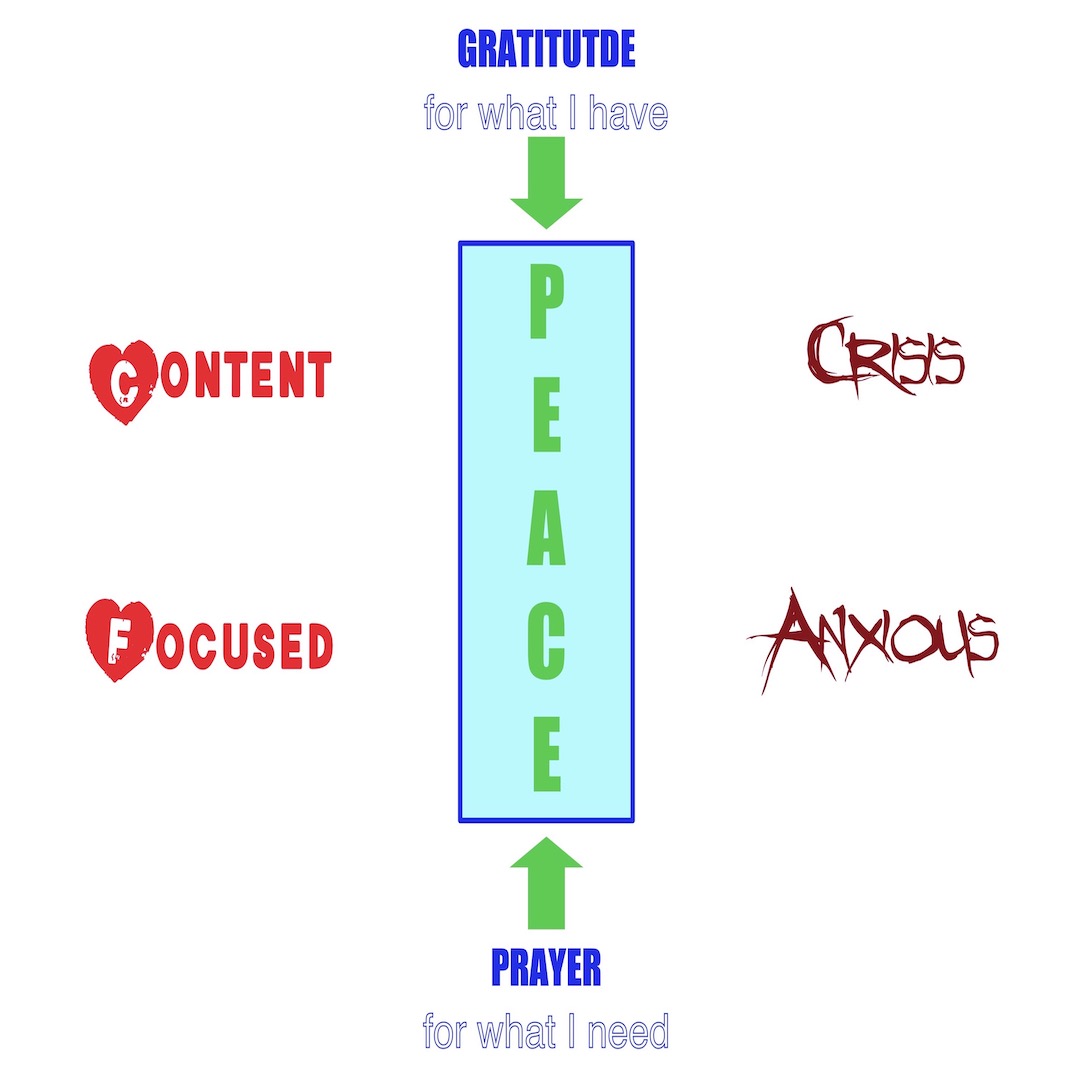
The apostle Paul writes something pretty straightforward: “Do not be anxious about anything” (Philippians 4:6). What might not seem so straightforward for us is this: What exactly is anxiety? 

The root word for anxious simply means to care for something or to care about something. Paul uses this word in a positive sense earlier in this letter when he praises Timothy for his concern for the wellbeing of the saints (2:19-22). In another letter, Paul told the Corinthians he had a deep concern for their spiritual growth (2 Corinthians 11:28) and that he desired for them to care in a similar way for their fellow saints (1 Corinthians 12:25). All of these instances use the same Greek word. 

(Check out all of the Scriptures in this post by clicking here.) 

The problem is when care crosses the line to become worry. 

A clear example of this is seen in the activities of Martha. She cared deeply about providing for the needs of Jesus, wanting to provide appropriate hospitality for Him, but her focal point switched from Jesus to food (Luke 10:38-42). Luke tells how Martha crossed the line from concern to anxiety by stating that “Martha was distracted by all the preparations.” Jesus redirected her to the one thing that “is better,” which was a devotion to Him. 

Care can turn to worry in the simplest of areas. 

Being careful about my physical health—food, clothing, shelter—is a legitimate concern, but Jesus warns about these things becoming a focal point and causing me to cross the line from concern to worry (Matthew 6:25-34). Wanting to answer well those who criticize my Christian faith is a noble concern, but obsessing over my word choices crosses the line (Matthew 10:19). Desiring to please my wife is perfectly natural and even commendable, but putting her on a pedestal crosses the line into worry (1 Corinthians 7:32-34). 

The crucial discipline to keep me from crossing the line from concern to worry and anxiety is to keep the right focal point. I am not my own provider; God is (James 1:17; Matthew 6:8; Luke 11:11-13). 

So in the same verse that Paul tells us “do not be anxious about anything” he also tells us to pray about everything. Peter says essentially the same thing this way, “Give all your worries and cares to God, for He cares about you” (1 Peter 5:7 NLT). God cares about me and the things I care about more than I do. He wants me to focus on Him, not on the things I care about, because He can provide for me perfectly. His provision keeps me from worrying about anything. 

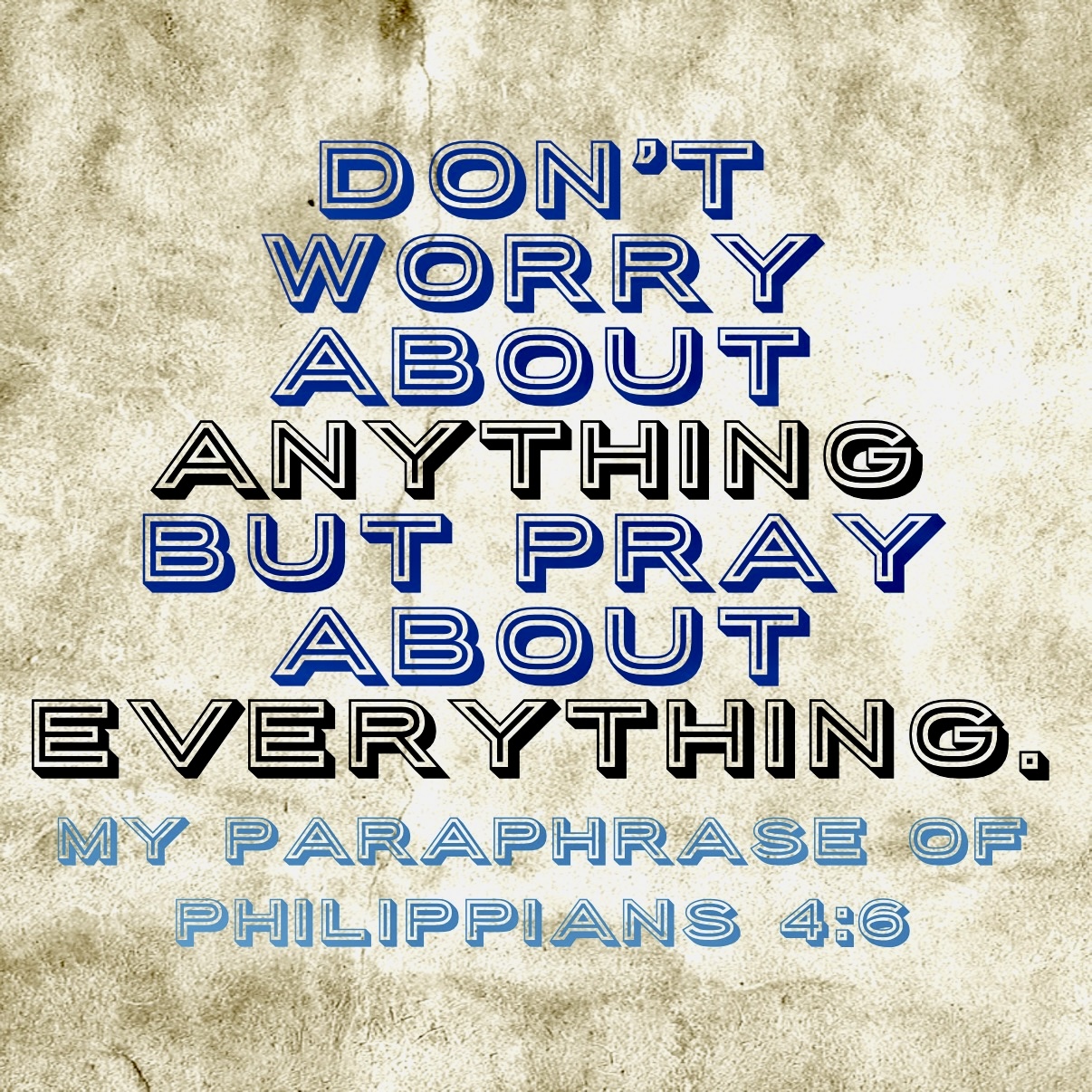
Don’t worry about anything; pray about everything. 

That is my safeguard against crossing the line from legitimate concern to anxiety-causing worry. 

►► Would you please prayerfully consider supporting this ministry? My Patreon supporters get behind-the-scenes access to exclusive materials. ◀︎◀︎

Links & Quotes

People need to know how much you love them before they will listen to any correction you may need to give them. “Real friends hurt each other.” Check out the full sermon here.

I have a lot of new video content on my YouTube channel every week. Please check it out and subscribe so you don’t miss anything.

David Mathis shares a faith-building message of confidence during times of crisis. He takes his text from Psalm 46—“Whatever trouble comes, Psalm 46 tells us, with its first word, where to turn. Not to a change in circumstances. Not to our best efforts to fix the problem. Not to our anxious strategies to avoid pain and loss. But rather, turn to God.”

“There is not a facet of our lives, not an interest or occupation, not a nook or cranny of the cosmos, where God does not intend that His glory should shine forth and be known. Indeed, even now He is showing His glory in created things, and even in much of the culture that human beings make to meet their own needs (Psalm 19:1-4; Psalm 68:18). God is manifesting His glory; it is there to be noted and pondered. The task of those entrusted with the Kingdom economy is to serve as docents of the glory of God, bringing His glory to light and making Him known for all to see in these last days. … Our mission in these last days is to glorify God by living out the reality of His indwelling Presence among the people to whom He sends us day by day (cf. Micah 4:1-8). In all our relationships, cultural activities, conversations, families, vocations, and diversions, what will it look like, and how will it appear to others when the glorious Presence of God is being refracted through us?” —T.M. Moore 

“The resurrection of Jesus from the dead was the one unvarying refrain of the apostles. This chapter [1 Corinthians 15] is the fullest discussion of it in the New Testament. It is one of the most significant and grandest chapters in the Bible because of the meaning it gives to human life. … The resurrection of Jesus from the dead is the one most important and most established fact in all history. And the story of it has come down to us through the centuries, beautifying human life with the halo of immortality; making us feel sure that because He lives again we too shall live; making our hearts thrill with the thought that we are immortal, that we have begun an existence that shall never end; that nothing can harm us; that death is merely an incident in passing from one phase of existence to another; that wether here or there we are His, doing the thing He has for us to do; that millions of ages after the sun has grown cold, we ourselves shall still be young in the eternities of God.” —Dr. Henry Halley

Would you like to get better sleep and lower your stress levels? Check this out: “If you share a bed with your sweetie, consider incorporating this step into your nighttime routine if you aren’t already: a snuggle sesh…. A study found that couples who cuddled prior to drifting off experienced less stress and more feelings of security in the relationship.”

“The Bible tells us to love our neighbours, and also to love our enemies; probably because they are generally the same people.” —G.K. Chesterton 

John Piper is asked an interesting question from Ephesians 6:12—are our adversaries merely flesh-and-blood humans or are demonic forces at work? “Flesh and blood apart from Christ is always under the sway of the spirit of the age, and it’s always under the sway of the prince of the power of the air, and it’s always acting out of its own bodily, mental desires. Therefore, in one sense, there is no separation in our warfare with human sinfulness and demonic schemes. They overlap; they’re intertwined.”

Multitudes Of Anxious Thoughts

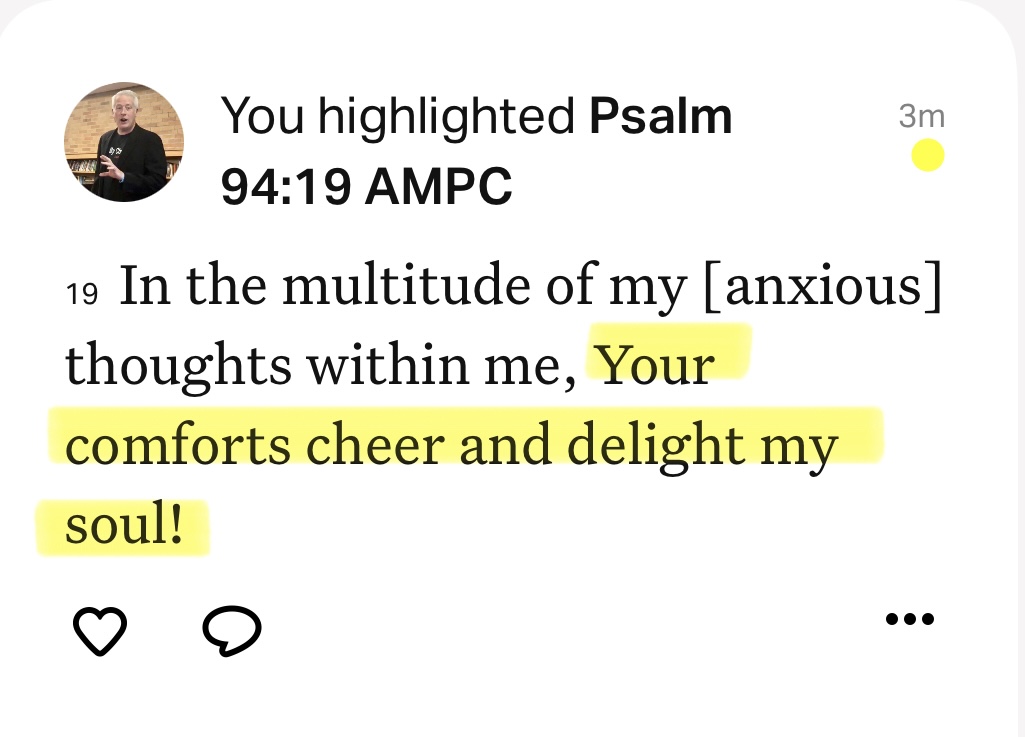
In the multitude of my anxious thoughts within me, Your comforts cheer and delight my soul! (Psalm 94:19 AMPC)

When anxious thoughts seek to grip our heart, our hope is found in the words of God. 

We have to think about what we’re thinking about, and then counteract the anxious thoughts with the words of truth.  

I presented a whole series of posts and videos on a Christian’s mental health. Please check it out here. You can replace your anxious thoughts with comforting and delightful thoughts!

Links & Quotes

Jesus didn’t teach us to pray for a lengthy supply, but for a daily supply. This keeps us dependent on our heavenly Father day after day after day.

I have lots of new content every week, which you can check out on my YouTube channel.

As if you needed more encouragement to control stress in your life, researchers have now found that stress can disrupt your brain’s ability to form memories, which can trigger more anxiety. Here is a surprising way for you to relieve stress in your life.

“The world cares very little what you or I know, but it does care a great deal about what you or I do.” —Booker T. Washington 

T.M. Moore is in the midst of sharing an eye-opening series of posts on what eternal life truly is. Here is a short snippet: “In Ephesians 1:15-23 Paul provides insight to how we may engage heavenly realities throughout our earthly and temporal sojourn. As he prayed for the Ephesians, so, we can believe, he would have prayed for us as well. But what did he pray? First, that God would give us His Spirit for ‘wisdom and revelation in the knowledge of Him’ (v. 17). The Spirit, we know, works with the revelation of God in Scripture to make us more like our Lord Jesus Christ (2 Corinthians 3:12-18). He uses the entire Bible to help us increase in our experience of eternal life. This is true for knowing more of our great salvation as well as for glimpsing more of our eternal life.”

“Comparison sabotages two relationships at the same time: your relationship with God, and your relationship with other people. You can’t fully love others when you’re jealous of them or trying to outperform them. And you can’t love God when you think maybe God has given you a bad deal.” —Practicing Gratitude reading plan on YouVersion 

Recent studies have shown a connection between rising boredom rates and increasing digital media usage. The Axis Culture Translator reported, “Most of us (including our teens) reach for a digital device when we feel boredom creeping in. We might logically assume that the near-constant stimulation we receive from our devices would reduce our experience of boredom—but the truth might be the opposite. Analysis and discussion based on ten years’ worth of data suggests that while boredom might drive us towards digital media, it isn’t actually satisfied by it. Many users find themselves in a loop where the perceived solution to restlessness and boredom actually amplifies those uncomfortable feelings. In other words, the ‘thirst’ of boredom leads us to the ‘water’ of digital media, but the water is salty.”

Links & Quotes

I shared this video last week with my Patreon supporters. When we’re unclear about all that God has asked us to do, the first step is to obey the part that is clear to us. Check out my blog post Clearing up the Confusion for more insight on how Peter handled this.

I have lots of new content every week, which you can check out on my YouTube channel.

T.M. Moore calls on Christians to recognize the God-given authority our leaders have. Not just recognize, but submit to that authority: “We show that we believe the Lord and trust in His Word, and we demonstrate the evidence of that faith when we submit to our church leaders as unto the Lord (Colossians 3:23-24). Submitting to proper authorities is an integral component of full faith. If we want to gain the benefit God intends for us from those appointed to lead, we’re going to have to learn to submit.”

“Talent is never enough. With few exceptions the best players are the hardest workers.” —Earvin Magic Johnson

“Take your job seriously, but don’t take yourself too seriously.” —Alex Trebek

The American Bible Society reports that Gen Z is engaged with Scripture less than any other generation. But here is a sad outcome: “Scripture Engagement is associated with significantly lower anxiety levels among all Americans, but especially among Generation Z. The anxiety score for Bible Engaged Gen Z respondents (3.4) is less than half that of the anxiety score for Bible Disengaged Gen Z respondents (7.1).”

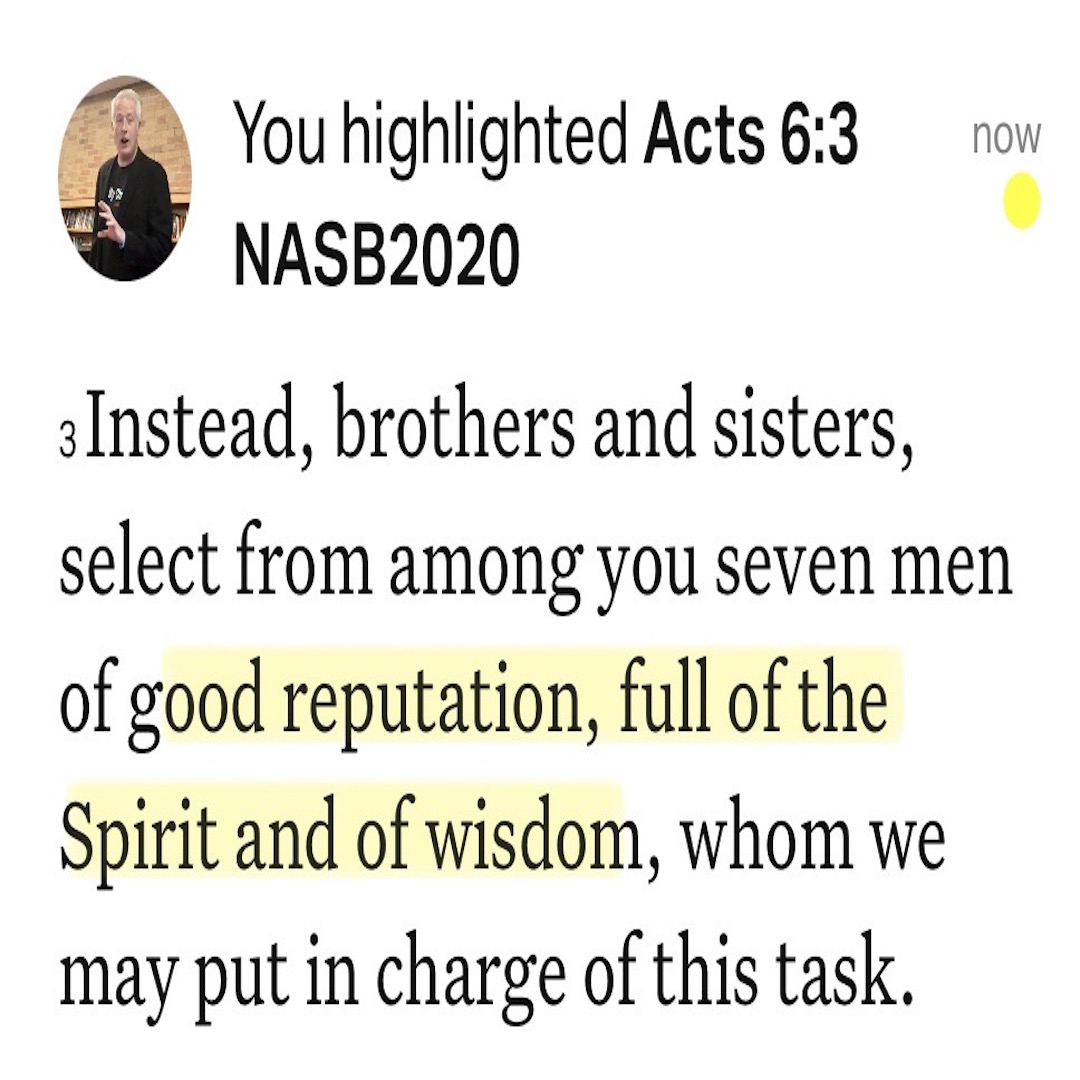
What if the qualifications in Acts 6:3 were the only qualifications we used for selecting folks for ministry assignments: (a) good reputation, (b) full of the Holy Spirit, and (c) full of wisdom?

Turn Off The News!

Listen to the podcast of this post by clicking on the player below, and you can also subscribe on AppleSpotify, or Audible. 

Anti-anxiety medications are prescribed at a higher rate than any other medication. As a nation, we have become—literally—a nervous wreck!

I think much of our handwringing and stomach churning is from our obsession with keeping up with “current events.” We have alerts endlessly dinging, screaming at us, “Look at this! Can you believe he said that?! Did you hear about this? We must do something about that!” 

Christian, where is your hope? In what are you trusting for relief?

God says through Isaiah that sinners are terrified and godless people tremble at the news—

Sinners in Zion are terrified; trembling has seized the godless. “Who among us can live with the consuming fire? Who among us can live with everlasting burning?” (Isaiah 33:14)

As these anxiety-plagued people are wondering how they can survive the latest deluge of terrible news, God answers the burning question of real security. He says it is…

…One who walks righteously and speaks with integrity, one who rejects unjust gain and shakes his hands so that they hold no bribe; one who stops his ears from hearing about bloodshed and shuts his eyes from looking at evil; he will dwell on the heights, his refuge will be the impregnable rock; his bread will be given him, his water will be sure. (Isaiah 33:15-16)

Did you catch what was in the middle of that list? Stop listening to the reports of bloodshed and stop watching all the news reports of evil people doing evil things. 

Instead, God says that we should be watching our own lives closely so that we are:

  • walking righteously 
  • speaking with integrity 
  • not falling for the latest fads 
  • not being “bribed” by so-called influencers to see things their way 

When we are focused on God and on living our lives according to His righteous standards, we won’t have any time or mental energy to give to the evil and bloodshed in the headlines. Rather, we will live securely—protected and blessed by our loving Savior and Lord! 

Isaiah 33 goes on to describe what we will notice when we turn off the world’s news and gaze at God: “Your eyes will see the King in His beauty” (v. 17), you will no longer be shaken by “fierce people” (v. 19), but you will know that “the majestic One, the Lord, will be for us…and will save us” (vv. 21-22). 

Turn off the world’s news and dive into God’s Good News instead. You will immediately feel God’s peace replacing any fearful trembling in your heart and mind. 

You may also want to check out:

►► Would you please prayerfully consider supporting this ministry? My Patreon supporters get behind-the-scenes access to exclusive materials. ◀︎◀︎
Moderate Stress Is Healthy

Listen to the podcast of this post by clicking on the player below, and you can also subscribe on AppleSpotify, or Audible. 

We do ourselves and the world around us a huge disservice if we are constantly striving for a stress-free life. 

First, I don’t think that is even possible! Adam and Eve in the perfection of the Garden of Eden faced a stressful decision. And Jesus, the Perfect Man, was constantly dealing with the stressors that pushed in on Him. 

But more importantly, stress is vital for healthy growth. In this case, I am talking about the healthy stress that doctors call eustress. This is the push against the forces that would ultimately pull down our physical health, our relationships, our mental health, and a host of other things if we simply opt to “go with the flow.” 

I read this in a recent article from Fight The New Drug

“In a world that often sells ways to avoid stress, it’s crucial to remember that stress can be healthy in moderation. Stress and anxiety can trigger neural and chemical processes in your body designed to help you respond to challenges. Stress researcher Daniela Kaufer explains that ‘some amounts of stress are good to push you to the level of optimal alertness for behavioral and cognitive performance.’ Her research on stress in rats has even demonstrated that intermittent stressful events can create new brain cells in the rats that actually improve their future mental performances.”  

The Bible makes it clear that persevering through the stressors that come against us can make us stronger, healthier, and better equipped for the next challenge. We are also fortified to help others through their times of stress (James 1:2-4; Romans 5:3-5; 2 Corinthians 1:3-5). 

As I’ve often said, easy, stress-free roads teach very few valuable lessons! 

The poet Epictetus noted this about the mighty Hercules—

“What would have become of Hercules do you think if there had been no lion, hydra, stag or boar—and no savage criminals to rid the world of? What would he have done in the absence of such challenges?
“Obviously he would have just rolled over in bed and gone back to sleep. So by snoring his life away in luxury and comfort he never would have developed into the mighty Hercules.
“And even if he had, what good would it have done him? What would have been the use of those arms, that physique, and that noble soul, without crises or conditions to stir into him action?” —Epictetus, The Discourses 

So the next time you are thinking about avoiding something that causes stress in your life, why don’t you reframe that thought. Instead, think about how you can become stronger, healthier, and more empathetic toward others because you are committed to successfully navigating that stressful situation. 

Don’t ask God to get you out of this situation, but ask Him to help you get something out of this situation. 

►► Would you please prayerfully consider supporting this ministry? My Patreon supporters get behind-the-scenes access to exclusive materials. ◀︎◀︎
Remembering Prompts Worship

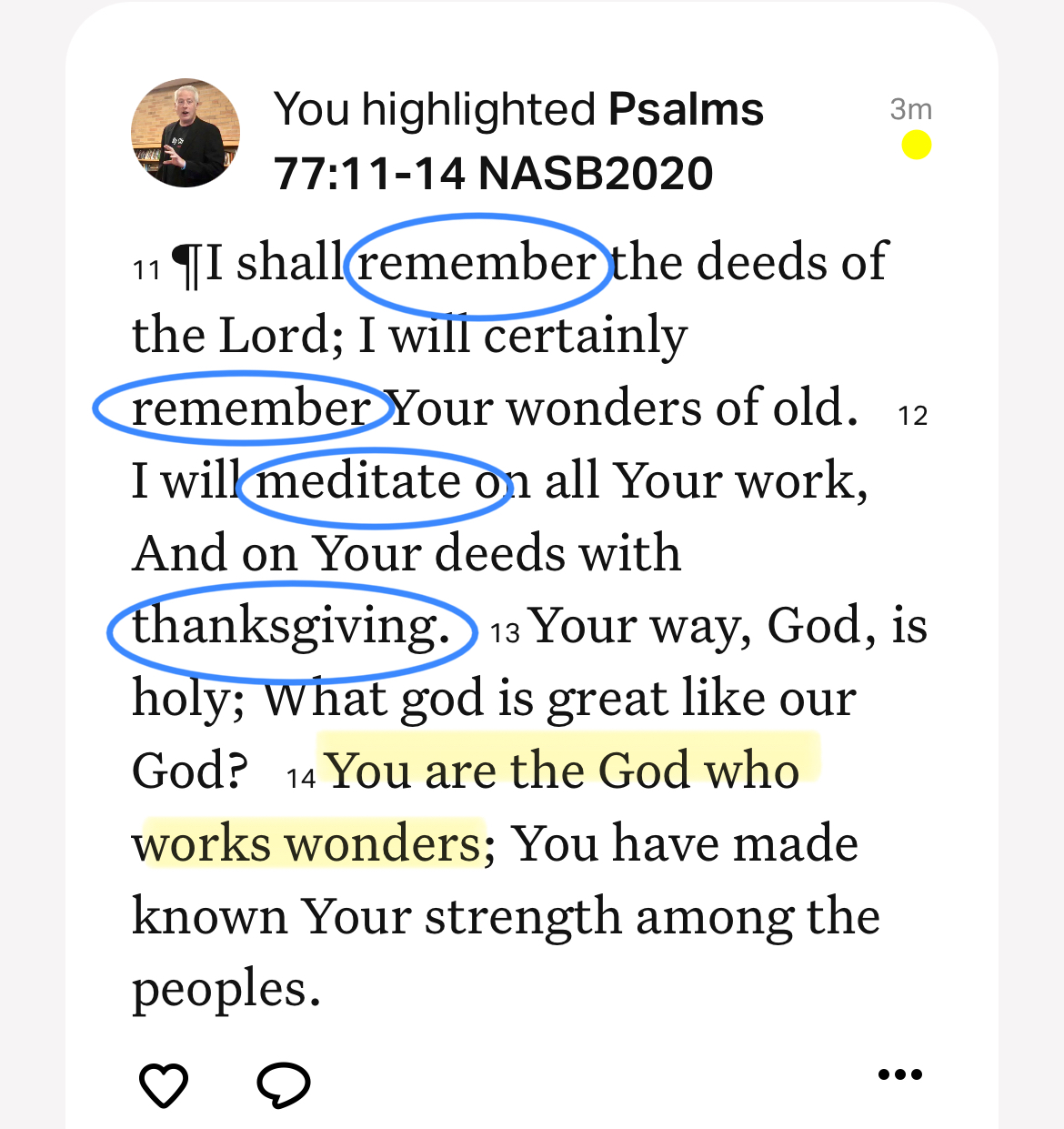
Remembering all God has done is the antidote to any fear or anxiety that we may feel. Recalling who God is and what He has done cannot help but lead us into worship of our awesome King! Then, as the words of an old chorus remind us—

🎶 In the presence of Jehovah
God Almighty, Prince of Peace
Troubles vanish, hearts are mended
In the presence of the King 🎶

I have shared a couple of other insights from Psalm 77 here:

The Danger In Plenty

Listen to the podcast of this post by clicking on the player below, and you can also subscribe on AppleSpotify, or Audible. 

Jesus is teaching us to pray as citizens of the Kingdom of Heaven, and each phrase of this prayer is a reminder of how we interact with the King of Heaven—Our Father in Heaven, hallowed be Your name. Your Kingdom come, Your will be done on earth as it is in Heaven.  

We all have a desire to feel secure—to feel our needs are going to be met. In fact, our anxiety level is usually tied directly to how insecure we may feel. The problem for many of us, however, is that we have mistaken wants for needs, and when those aren’t met as we think they should be, we again experience increasing levels of anxiety. 

We see this on full display in Luke 12. First, Jesus addresses a man who is greedily desiring his share of his father’s inheritance. Jesus says, “Life does not consist in an abundance of possessions.” 

To illustrate this point, Jesus tells a parable of a rich landowner who harvested more crops than he knew what to do with—a harvest which he calls “plenty.” His solution was to build bigger barns for his abundant harvest, to which God announced, “You fool” (Luke 12:13-21). 

This man was not called a fool because he was successful. He was not called a fool because he had plenty. Rather, he was called a fool because his “plenty” caused him to forget his heavenly Father.   

This is an invaluable lesson. Sadly, we tend to be a very forgetful people! 

After God delivered His people from their bondage in Egypt, and they almost immediately start worrying and then complaining about whether their needs will be supplied. God tells them that He will supply every day exactly what they need (Exodus 16:1-35). 

This provision of manna every single morning when they got up was intended to keep them reliant on God and thankful for His provision. But after a while they thought they deserved more—they wanted plenty (Numbers 11:4-6). Later on, Asaph would pinpoints the main culprit of the Israelites’ stumbled throughout their history: forgetfulness (Psalm 78:11, 22-25). 

Jesus taught us to come to God in prayer as Our Father. Just as Jesus was daily dependent on His Father, so He teaches us to have that same level of daily abiding. 

Jesus reminds us what the daily supply of manna really signified; namely, that He would be our Bread from Heaven for all of eternity (John 6:28-40)! 

So that’s why we pray, “Give us today our daily bread.” Once again, this is an acknowledgement that no one else can provide for us, and it is a request that we would stay daily dependent on Him. It’s not, “Give us today our weekly bread.” Or, “Give us today our daily wants.” Or even, “Give us today plenty of things.” 

We need our Father for daily bread so that we never, ever forget or vital, indispensable connection to Him!  

Even when we don’t have plenty, we are told not to worry but instead to look to our Heavenly Father for His daily supply (Luke 12:22; Philippians 4:6-7).

If you’ve missed any of the other messages in this series on prayer, you can check them all out here. 

►► Would you please prayerfully consider supporting this ministry? My Patreon supporters get behind-the-scenes access to exclusive materials. Like some exclusive quotes from a book I just reviewed. ◀︎◀︎

The Best Way To De-Stress

Listen to the podcast of this post by clicking on the player below, and you can also subscribe on AppleSpotify, or Audible. 

Of all the things that rob a Christian of peace and robust mental health, stress has to be near the top of the list. There are so many stressors in our lives that to not find a way to actively de-stress is to choose to remain stressed. This is sort of like fertilizing the weeds, as we learned in our second mental health strategy. 

A certain amount of stress is good for us—doctors call this eustress. Our bodies have been designed by God with a hormone called cortisol that helps us respond to stressful situations, and He also designed that the unused cortisol be flushed from our bodies as we sleep and exercise. However, when we become stressed, many times sleep and exercise are squeezed out of our lives. 

Men’s Health magazine reported, “You personally may dictate when you’ll die. After studying 1633 men for 30 years, Purdue scientists found that worrying takes 16 years off your life. Negative thinking triggers the release of cortisol, a stress hormone that can be dangerous when elevated for long periods of time.” 

The eustress can degrade into distress if we’re not attentive to this downward slide. The excess cortisol that is allowed to remain in our bodies leads to unhealthy responses—like sleeplessness, starvation or binge eating, and little to no exercise. These unhealthy factors are further exacerbated by our diminished coping skills that come from the damage done to the hippocampus in our brain. Lingering cortisol kills the neurons in this memory center of our brains, which makes it harder for us to recall past lessons that could help us resolve stress. 

Sadly, distress can become its own downward cycle as the unhealthy responses and diminished coping skills negatively impact our lives, creating even more stressors. 

Stress makes us:

  1. Self-focused 
  2. Short-sighted 
  3. Stingy with our time, possessions, and even God’s promises 

But there is a word of hope for us. William James noted, “The greatest weapon against stress is our ability to choose one thought over another.” 

I want to give you one thought—one word, one action—to combat stress: Bless. 

Blessing others takes the focus off myself. Blessing God puts the focus on Him. 

In the Gospels, we see people who had suffered the ravages of stress, encounter Jesus, find freedom, and then begin to bless others as a preventative to returning to their stress-filled lives. We can see a few examples in healed women, a man delivered from demons, and a woman who had lived a less-than-virtuous life (Luke 8:1-3, 26-39; 7:36-50). 

Frequently, the Old Testament psalmists shared how blessing God and others brought them out of their stressful situations. A great example comes from David when he chose to bless God in a stressful place, and ended up being a blessing to other afflicted people around him (Psalm 34:1-6). 

When you feel stress mounting, you need to get active. Feelings follow actions. We usually won’t feel ourselves into action, but we can act ourselves into feelings. 

The best way to de-stress is to bless! 

As we bless, look at the shifts that take place: 

  1. Instead of remaining self-focused we become others-focused 
  2. Instead of being short-sighted we get a big-picture orientation 
  3. Instead of being stingy with our possessions and God’s promises we become generous

Remember that in the distress cycle I mentioned earlier the brain cells in the hippocampus were being damaged? The excess cortisol literally kills those neurons. The good news is that the hippocampus is one of the few places in the brain that experiences neurogenesis after cortisol is flushed. When you replace stressing with blessing, and the cortisol is regularly flushed from your body, brain cells are regenerated in your hippocampus. In essence, you are developing both a new brain and a new mind. 

The apostle Paul wrote, “Put off, concerning your former conduct, the old man which grows corrupt according to the deceitful lusts, and be renewed in the spirit of your mind, and that you put on the new man which was created according to God, in true righteousness and holiness” (Ephesians 4:22-24 NKJV). 

Don’t let stress steal life from your years and years from your life. De-stress by blessing God and blessing those around you. 

If you’ve missed any of the previous eight mental health strategies that I have shared in this series, you can find them all by clicking here. 

►► Would you please prayerfully consider supporting this ministry? My Patreon supporters get behind-the-scenes access to exclusive materials, like this exclusive video in which I take my supporters behind the scenes of my thought process in designing my confrontation flowchart. ◀︎◀︎