John Opalewski’s short book is highly readable and easily applicable. I recommend this book to both help you get emotionally healthier and then to maintain that emotional health. You can check out my full book review here.
Here are a few quotes that especially caught my attention—
“Maybe you are reading this book and have no issues currently with depression. Be thankful to God for your health. But understand depression is easier to prevent than it is to cure. Educating yourself while healthy minimizes your future risk.”
“Emotional health is a choice. If you choose to ignore your emotional health, no one else will pay attention to it for you.”
“God used words to create the universe. They have the power to create or destroy, heal or wound. … Nobody talks to you more than you talk to yourself. Verbally assaulting yourself damages your emotional health—every time. Being kind to yourself with words enhances your emotional health—every time. … Loving yourself means you gain increasing control of your self-talk.”
“Learn to be assertive rather than aggressive or passive. Aggression includes foul language, yelling, or getting physical with people. Passivity is another word for repression. Here we stuff our anger and let it boil on the inside. An example of passivity is giving someone the silent treatment. Assertiveness, on the other hand, means standing up for yourself by expressing your needs to others with love and respect.”
“A depressed person often complains of having no energy to deal with people. Therefore, they tend to isolate themselves, which usually compounds a person’s distress. Depression thrives in isolation. Consequently, it is critical to surround yourself with the right kind of people during your battle with this affliction.”
I have shared another half-dozen quotes from this book with my Patreon supporters. Please become a supporter and get access to lots of exclusive content—videos, early-releases, study aids, and so much more!
Listen to the podcast of this post by clicking on the player below, and you can also subscribe on Apple, Spotify, or Audible.
The prayer that Jesus taught His follower is a prayer for citizens of the Kingdom of Heaven. These are not just some magical words to pray whenever we don’t know what to pray.
We come to a part of the prayer that has confused some people. Jesus instructed us to pray, “And lead us not into temptation, but deliver us from the evil one” (Matthew 6:13).
So some people have asked, “Does God tempt us?”
No, He doesn’t! The temptations flare up when the ungodly desires within us are given an opportunity to seize what we think will make us happy (see James 1:13-15).
All three of the synoptic Gospels tell us that Jesus was led by the Holy Spirit to the place where the devil would tempt Him (Matthew 4:1; Mark 1:12-13; Luke 4:1-2).
Jesus went through all of this so that He would be assured that He was fully equipped for the intense scrutiny He was going to undergo for the next 3+ years. At the end of that time neither the Sanhedrin, Pontius Pilate, nor Herod Antipas could find any semblance of sin in His life.
The word Jesus uses for temptation in Matthew 6:13 comes from the root word peirazo, which means to assay. We don’t use that word too often today, but it means a testing, an experiment, or a trial, to prove something’s fidelity, integrity, or virtue.
Just like an assayer would test a rock for the quality and quantity of a precious metal found in it, so we are tested to determine our fitness for what God has in store for us. Remember that the beginning of this prayer is a desire for God’s name to be hallowed and His Kingdom to be made visible through our lives.
Hebrews 5:9 says that Jesus was perfected (the Greek word is telios), which is exactly what Jesus wants for us—Be prefect [telios] even as your Heavenly Father is perfect [telios] (Matthew 5:48).
In order to know this perfecting process, we have to be tested and assayed (James 1:12, 2-4).
Like all of the other phrases in this prayer, this one is both an acknowledgment (I will face temptations) and a petition (I need Your help to overcome the temptation). This is not necessarily a prayer to keep us from temptation, but to keep us through the temptation. We want to be empowered to pass the test.
A loving teacher prepares us for the test, gives us the test, and then gives us the results so that we know we are prepared for the next level. So remember that this prayer is addressed to our loving Heavenly Father. He prepares us for the test so that we can pass the test. We never walk an unknown path—we never are given a test unless He has fully prepared us for it.
So let me give you four thoughts to consider:
Don’t rush ahead because that’s pride. Jesus went when the Holy Spirit led Him.
Don’t lag behind because that’s fear. Think of the Israelites who fearful of the “giants” in the land and wouldn’t move forward.
Don’t be discouraged by a temporary failure. The phrase immediately before this says, “Forgive us our debts.” If you fall short, ask for forgiveness and move forward again.
Do give in to the righteousness Jesus has made available for you. This is what will help you stand firm in your time of testing (1 Peter 1:6-7).
Just like Jesus, our Father wants to perfect you and lead you up to higher levels.
If you’ve missed any of the previous messages in this series looking at the model prayer Jesus taught us, you can find them all here.
Unforgiveness keeps our eyes on our offenders and off our God. Free yourself by forgiving those who have hurt you. You can check out this full sermon here. I have lots of new content every week, which you can check out on my YouTube channel.
“At the moment of truth, there are either reasons or results.” —Chuck Yeager
As I have shared before, I am so impressed with the He Gets Us social media campaign! Some people are still trying to figure out exactly what this campaign is. Sean McDowell and his podcast partner Scott Ray had a great conversation with Ed Stetzer about this. Check out the video!
Some people have been critical of the He Gets Us commercials that aired during the Super Bowl, but I thought they were outstanding! This is a social media outreach designed and funded by some of the most biblically-grounded, evangelistically-minded people I know. It is a social media campaign. It is not designed as a sermon (which is why there are no Bible verses shown in the commercial). The idea is to get past the barriers and misconceptions skeptics have come to believe about Jesus, and then be enticed to go to the hegetsus.com website. It is at this site that the Gospel message is introduced and visitors are given Bible verses and other materials to go deeper.
John Stonestreet wrote, “Before it was the corporate creation of greeting card companies, it was a day to remember third-century Christian martyr Valentinus of Rome.” This post is a good reminder of what Christians really should be remembering on Valentine’s Day, as well as the higher definition of love.
“The important thing is to learn a lesson every time you lose.” —John McEnroe
Mental health issues grab a lot of headlines, and they should! I believe mental health is at the foundation of all of the other aspects of our lives, so we should be paying attention to this core issue. John Opalewski helps us do this through his book Unshakable You.
The subtitle of this book—5 Choices of Emotionally Healthy People—gives you the outline of the entire book. John skillfully shares the importance of these five choices through a combination of recounting his own story, applicable biblical principles, and pertinent scientific discoveries. John concludes each chapter with an “I choose” statement.
I choose to love myself as Jesus commanded.
I choose to manage my anger instead of it managing me.
I choose to protect myself from abusive people.
I choose to refuel emotionally.
I choose to stay alert.
This is a short book, but you should spend a lot of time reading it, processing the “I choose” statements, discussing the concepts, and finally in implementing the principles John presents. I would strongly recommend reading this book with a friend who can help you in the implementation of each of the “I choose” statements.
P.S. I addressed many of the same points John did in my year-long series of messages A Christian’s Mental Health.
Listen to the podcast of this post by clicking on the player below, and you can also subscribe on Apple, Spotify, or Audible.
There is a way we can keep the door cracked open for the devil to whisper his slander to us, and there is a way to slam the door shut! Jesus said one of the best ways to shut the door on the slanderous lies of the devil is to forgive people who have injured us.
I believe that one of the main reasons His words had such authority and power to capture people’s attention was because He was so immersed in Scripture. As Jesus cleared the temple, He quoted from two Old Testament prophets. As He told a parable to the crowd in the temple—a parable that the religious leaders knew “He had spoken…against them”—He made a passage from Psalm 118 the foundational piece of His story.
The words of Jesus are…
Scriptural
authoritative
loving
unswervingly truthful
practical
challenging
unconventional (according to human standards)
God-glorifying
paradigm challenging
life changing
I want others to say of me what Charles Spurgeon said of John Bunyan, “Why, this man is a living Bible! Prick him anywhere—his blood is Bibline, the very essence of the Bible flows from him. He cannot speak without quoting a text, for his very soul is full of the Word of God.”
Wouldn’t you want that said of your life too? I sure would!
Our first step is to read the Word of God. Next, we need to allow the God of the Word to transform our minds. And then we can rely on the Holy Spirit to help us apply the Bible to everything we say and do.
Heavenly Father, I pray that people may hear the words of Jesus in all the words I speak. Holy Spirit, bring all of the Word I have read back to my mind (John 14:26; Mark 13:11) so that it is not my words that I am speaking but Yours. In the name of Jesus I ask this. Amen!
In January 1647, Oliver Cromwell captured King Charles I during the British Revolution. Within just a few months, Charles escaped and was able to raise another army. A year later, in August 1648, Cromwell’s forces once again defeated the army Charles had raised, and once again Charles was taken prisoner.
Oliver Cromwell put Charles on trial for his crimes, and after the guilty verdict was pronounced, Charles I was executed. A total of 59 people signed the former king’s death warrant.
Fast forward eleven years and Oliver Cromwell had died and his son Richard had taken his place as Lord Protector of England. Unlike his father, there was great discontent with Richard’s leadership. As a result, the Loyalists were able to sweep Charles II into power.
After assuming the throne of England, Charles II wanted the 59 death warrant signers put on trial, but fifteen of them had already died. That little fact didn’t stop King Charles II. He ordered that their bodies be exhumed, placed on trial, convicted of their crimes, and then hung.
I’m no psychologist, but I think it’s safe to say that Charles II might have had a slight problem with unforgiveness!
This is from a chapter I entitled “The ties that no longer bind.” The insidious nature of unforgiveness is that it ties us to the one who injured or offended us.
Jesus taught us to pray, “Forgive us our debts, as we also have forgiven our debtors” (Matthew 6:12). The word He uses for “debts” means something justly or legally due, or an offense or sin that has been committed. So a debtor is one who morally or legally owes another for the wrong committed.
So for these debts, we are taught to ask for forgiveness of God and to give that same forgiveness to others. Jesus uses the same root word for both “forgive” and “forgiven,” but there are nuances that make the picture quite clear.
When we ask God to forgive our debts, it is the active voice (I have to ask for it) and it is stated in the second person (I have to receive it). When I ask my Heavenly Father for this, my offense has been paid-in-full because the legal and moral requirements aren’t due any longer. I couldn’t pay this debt on my own, but Jesus paid it for me (2 Corinthians 5:21).
When I forgive someone who has wronged me, it is again the active voice (I have to give it), but it is now in the first person (I don’t wait around for the other person to ask for forgiveness). I let it go. I don’t hinder the other person or myself with waiting for the penalty to be paid any longer.
This is the only part of this model prayer for which Jesus gives a commentary afterwards (in Matthew 6:14-15). With this, Jesus is teaching us that to say, “I’m forgiven” is also to say, “I’m forgiving.”
Unlike Charles II, when we are forgiven and forgiving, the inevitable result is freedom for both ourselves and our offenders.
If we practice this relentlessly, we are both freed ourselves and freeing others!
When we pray, “Forgive as we also have forgiven,” we are both acknowledging His power to forgive us and requesting the faith need to be forgiving people. As C.S. Lewis noted, “To be a Christian means to forgive the inexcusable, because God has forgiven the inexcusable in you.”
The Bible describes satan’s activity as stealing, killing, and destroying. He’s called the father of lies, so he uses slander to try to steal, kill, and destroy. His slander is: “God can’t forgive that” and “You shouldn’t let them off the hook for what they did to you.”
These two thoughts are linked, just as “I’m forgiven” and “I’m forgiving” are linked. If I begin tothink that what someone did to me was too big for me to forgive, then I can also believe that there is a sin I have committed that is too big for God to forgive. But when I live both receiving and giving forgiveness, I can tune out this lie from hell.
Our anxiety is usually tied to our insecurity about our needs being met. Philippians 4:6-7 counsels us to turn those anxieties into prayer. It’s not what we can provide for ourselves, but trusting what our Heavenly Father has already provided for us. Check out this amazing series on prayer. I have lots of new content every week, which you can check out on my YouTube channel.
A recent post at the Institute for Creation Research says, “despite popular perception, the impact theory of dinosaur extinction has problems and is still a source of contention among even conventional scientists.” In fact, “Despite uniformitarian claims to the contrary, these rocks and fossils are best explained by the Genesis Flood that covered the earth about 4,500 years ago. All the air-breathing, land-dwelling creatures outside the Ark perished. However, the representatives of these animals that God brought on board the Ark, including dinosaurs, survived, reproduced, and spread across the Earth after the Flood. Many ancient peoples wrote about and described what appear to be dinosaurs, even though they called them by other names, e.g., dragons. In the creation Flood model, impacts may have hit the earth during the Flood, but none of them caused the dinosaurs to go extinct.” This article is a good overview of the geological and paleontological evidence that supports the biblical account of the Flood.
“Scripture teaches us that there are two points of view from which we may regard Christ’s death upon the Cross. The one is the redemption of the Cross: Christ dying for us as our complete deliverance from the curse of sin. The other, the fellowship of the Cross: Christ taking us up to die with Him and making us partakers of the fellowship of His death in our own experience. … O Christian, when the world crucified Christ, it crucified you with Him, when Christ overcame the world on the Cross, He made you an overcomer too. He calls you now, at whatever cost of self-denial, to regard the world, in its hostility to God and His kingdom, as a crucified enemy over whom the Cross can ever keep you conqueror. What a different relationship to the pleasures and attractions of the world the Christian has who by the Holy Spirit has learned to say: ‘I have been crucified with Christ;…[the crucified] Christ lives in me!’ (Galatians 2:20).” —Andrew Murray
Sullivan and Addie Chainey were both deaf, but that didn’t stop them from becoming premier missionaries in the Assembly of God fellowship. Their work with other deaf people was amazing! I love this concluding thought in this short biography of their ministry work: “The Chaineys’ story testifies that God can empower those who are marginalized in society to do redemptive work in their own communities and beyond.”
“Earth, I think, will not be found by anyone to be in the end a very distinct place. I think earth, if chosen instead of Heaven, will turn out to have been, all along, only a region in Hell: and earth, if put second to Heaven, to have been from the beginning a part of Heaven itself.” —C.S. Lewis, in The Great Divorce
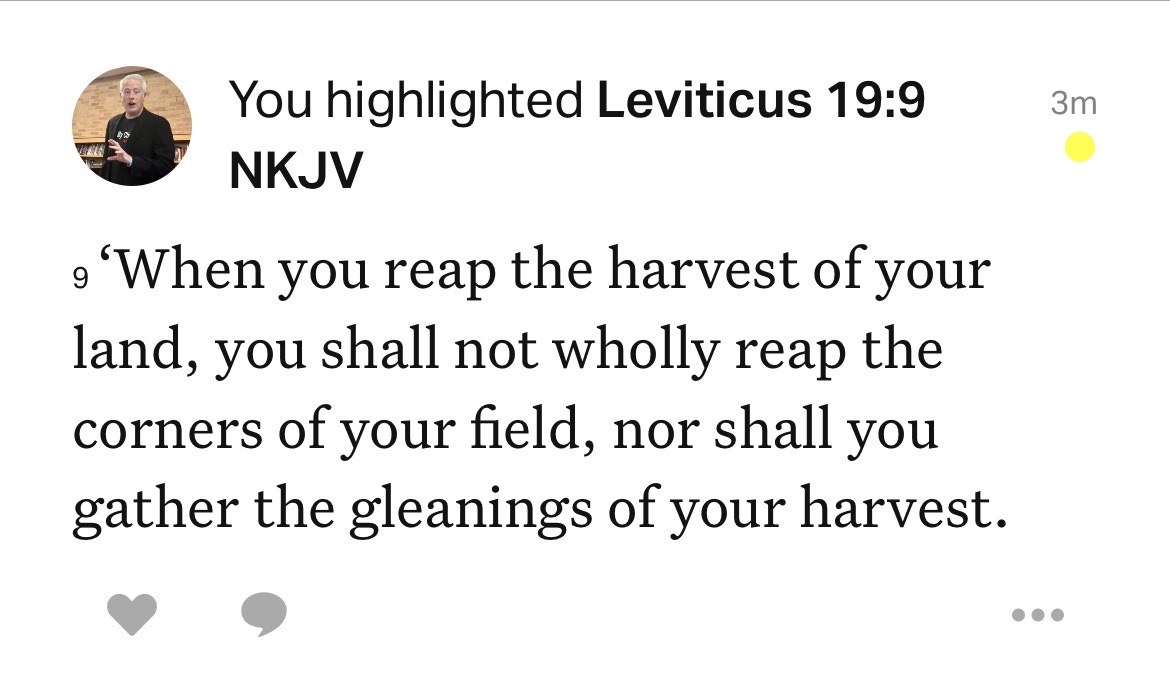
Years later, Boaz was obeying this commandment in Leviticus 19:9. That allowed Ruth to be in his field, which led to a marriage that began the family line of King David, which traces all the way to Jesus! Obedience matters. Just imagine if Boaz had been disobedient in this. The Messiah still would have come, but Boaz and Ruth (and their children and grandchildren) would have missed out on this blessing.












 Craig T. Owens
Links & Quotes
February 17, 2024 — Craig T. OwensUnforgiveness keeps our eyes on our offenders and off our God. Free yourself by forgiving those who have hurt you. You can check out this full sermon here. I have lots of new content every week, which you can check out on my YouTube channel.
“At the moment of truth, there are either reasons or results.” —Chuck Yeager
As I have shared before, I am so impressed with the He Gets Us social media campaign! Some people are still trying to figure out exactly what this campaign is. Sean McDowell and his podcast partner Scott Ray had a great conversation with Ed Stetzer about this. Check out the video!
Some people have been critical of the He Gets Us commercials that aired during the Super Bowl, but I thought they were outstanding! This is a social media outreach designed and funded by some of the most biblically-grounded, evangelistically-minded people I know. It is a social media campaign. It is not designed as a sermon (which is why there are no Bible verses shown in the commercial). The idea is to get past the barriers and misconceptions skeptics have come to believe about Jesus, and then be enticed to go to the hegetsus.com website. It is at this site that the Gospel message is introduced and visitors are given Bible verses and other materials to go deeper.
“The important thing is to learn a lesson every time you lose.” —John McEnroe
Share this: