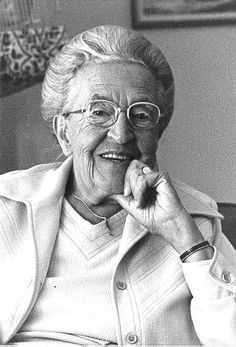
Charles Spurgeon On Quiet Confidence

C.H. SpurgeonIn quietness and in confidence shall be your strength (Isaiah 30:15).

“It is always weakness to be fretting and worrying, questioning and mistrusting. What can we do if we wear ourselves to skin and bone? Can we gain anything by fearing and fuming? Do we not unfit ourselves for action and unhinge our minds for wise decision?

“We are sinking by our struggles when we might float by faith. Oh, for grace to be quiet!

“Why run from house to house to repeat the weary story which makes us more and more heart-sick as we tell it? Why even stay at home to cry out in agony because of wretched forebodings which may never be fulfilled? It would be well to keep a quiet tongue, but it would be far better if we had a quiet heart. Oh, to be still and know that Jehovah is God!

“Oh, for grace to be confident in God! The holy One of Israel must defend and deliver His own. He cannot run back from His solemn declarations. We may make sure that every word of His will stand though the mountains should depart. He deserves to be confided in; and if we would display confidence and consequent quietness, we might be as happy as the spirits before the throne.

“Come, my soul, return unto thy rest, and lean thy head upon the bosom of the Lord Jesus.” —Charles Spurgeon

Thursdays With Oswald—Becoming A Real Saint

Oswald ChambersThis is a weekly series with things I’m reading and pondering from Oswald Chambers. You can read the original seed thought here, or type “Thursdays With Oswald” in the search box to read more entries.

Becoming A Real Saint

     The real life of the saint on this earth, and the life that is most glorifying to Jesus, is the life that steadfastly goes on through common days and common ways, with no mountain-top experiences. We read that John the Baptist “looked upon Jesus as He walked…”—not at Jesus in a prayer meeting or in a revival service, or Jesus performing miracles; he did not watch Him on the Mount of Transfiguration, he did not see Him in any great moment at all, he saw Him on an ordinary day when Jesus was walking in an ordinary common way, and he said, “Behold the Lamb of God!” That is the test of reality. …

     God’s purpose is to make us real, that is, to make us perfectly at one with all our own powers and perfectly at one with God, no longer children but understanding in our heads as well as in our hearts the meaning of the Redemption, and slowly maturing until we are a recommendation to the redeeming grace of our Lord Jesus Christ.

From The Philosophy Of Sin

Oh, how I want to be a real saint!

Not someone who only shines for Christ when I have a mountain-top experience, but one who shines brightly for Him every day, in every common setting. What an amazing thing for my life to be a recommendation to the redeeming grace of our Lord Jesus Christ!

9 Quotes From “Of Antichrist And His Ruin”

Of Antichrist And His RuinJohn Bunyan’s works are steeped in Scripture. His thoughts about the Antichrist and other end times events are either directly taken from biblical passages, or else his line of reasoning fits perfectly with the intent of the Scriptures. You can read my full book review by clicking here. Below are some quotes I found enlightening.

“Coercion, in anything connected with religion, whether it imposes creeds, liturgies, or modes of worship, is Antichrist: whom to obey, is spiritual desolation, and if knowingly persevered in, leads to death.” —George Offor, editor

“As God therefore did put it into the hearts of the wicked kings of Babylon, to distress in His church and people for their sins; so He put it into the hearts of the kings of the Medes and Persians, who were to be, in a sense, their saviors; to ease them of those distresses, to take off the yoke, and let them go free.”

“This twenty years we have been degenerating, both as to principles, and as to practice; and have grown at last into an amazing likeness to the world, both as to religion and civil demeanor.” 

“Take heed in laying the cause of your troubles in the badness of the temper of governors. … God is the chief, and has the hearts of all, even of the worst of men, in His hand. Good tempered men have sometimes brought trouble; and bad tempered man have sometimes brought enlargement to the churches of God: Saul brought enlargement (1 Samuel 14:28). David brought trouble (2 Samuel 12:10).) Ahab brought enlargement (1 Kings 21:29). Jehoshaphat and Hezekiah did both sometimes bring trouble (2 Chronicles 19:2; 20:35; 32:25). Therefore, the good or bad tempers of men sway nothing with God in this matter; they are the sins or repentances of His people, that make the church either happy or miserable upon earth.”

“Antichrist is the adversary of Christ; an adversary really, a friend pretendedly. So then, Antichrist is one that is against Christ; one that is for Christ, and one that is contrary to Him (and this is that mystery of iniquity [2 Thessalonians 2:7]). Against Him in deed; for Him in word, and contrary to Him in practice. … Christ prefereth His Father’s will above heaven and earth: Antichrist prefereth himself and his traditions above all that is written, or that is called God, or worshiped.”

“Nor can all the fallen angels, with all the members and limbs of Antichrist, cause that their brat should abide so much as one day longer than our God’s prefixed time.”

“Now, by ordinances of Antichrist, I do not intend things that only respect matters of worship in Antichrist’s kingdom, but those civil laws that impose and enforce them also; yea, that enforce that worship with pains and penalties, as in the Spanish Inquisition. … What could the king of Babylon’s golden image have done, had it not been for the burning fiery furnace that stood within view of the worshipers (Daniel 3)? Yea, what could that horrible command, to pray for thirty days to neither God nor man, but to the king, have done, had it not been for the dark den and the roaring lions therein ready to devour those that disobeyed it (Daniel 6)? … For as the furnace would have been next to nothing, if void of fire; and the den as little frightful, if destitute of lions; so these laws will be as insignificant, when Christ has slain that spirit that is in them; that spirit that causes that as many as will not worship the image of the beast, should be killed.”

“What say ye now, ye sons of God! Will you learn to make a judgment of things according to the mystery of the wisdom of God, or will ye longer conclude according to sense and reason?”

“Cold blasts in November are not received with that gentleness as are colder in March and April; for that these last cold ones are but the farewell notes of a piercing winter; they also bring with them the signs and tokens of a comfortable summer. Why, the church is now at the rising of the year; let then the blasts at present, or to come, be what they will, Antichrist is assuredly drawing towards his downfall.”

Jim Daly On Forgiveness

Jim Daly“Have you noticed? It can be a challenge to say, ‘I’m sorry.’ Oh, it’s not hard to speak the words, but it can be tough to say them with sincerity. Why? Probably because we understand that to apologize is to accept responsibility for ill-spoken words or misbehavior. It requires humility on our part, which can often be confused with giving someone else the upper hand over us. That’s why apologies tend to be viewed as a weakness.

“It’s also why people offer apologies that have been stripped of any real meaning. We minimize the severity of our actions; we blame our behavior on others; or maybe we say all the right words, but dilute them with sarcasm or humor. Whatever the method, we recognize a false act of contrition when we see it because the result is always the same: the appearance of an apology without the substance of one. And rather than healing, shallow platitudes often deepen a loved one’s wounds. Like a doctor’s empty syringe, an empty apology pierces the soul but offers nothing that can bring healing.

“That’s why, far from being a weakness, a heart-felt apology requires strength because it demands deep sincerity on behalf of the person offering it. That inner strength and humility often requires God’s grace to express. The Lord’s role is crucial because mending a relationship-gone-wrong has little to do with the specific words we use to express our contrition. The healing comes from the authenticity we pour into our words and actions.” —Jim Daly

Of Antichrist And His Ruin (book review)

Of Antichrist And His RuinAs I was finishing up reading through the Bible this time, I especially noticed in the last couple of books quite a few mentions of the Antichrist. Wanting to dig a little deeper on this subject, I turned to a man who so throughly knew Scripture: John Bunyan and his book Of Antichrist And His Ruin.

The Antichrist is not something we can just brush off and say, “Well, that’s end-times stuff and doesn’t really concern Christians. After all, won’t we already be in Heaven when the Antichrist appears on earth?” But John, in his first epistle warns us—

This is the spirit of the Antichrist, which you have heard is coming and even now is already in the world. (1 John 4:3, emphasis added)

Wow, even in the first century, John already saw the spirit of the Antichrist at work. How much more so should Christians today prepare themselves for this onslaught of evil!

I didn’t want any “pop theology” or well-intentioned ideas about the Antichrist, I wanted to know what the Bible said about it. Speaking of John Bunyan, Charles Spurgeon said, “Prick him anywhere—his blood is Bibline, the very essence of the Bible flows from him. He cannot speak without quoting a text, for his very soul is full of the Word of God.”

Indeed, Bunyan’s work in Of Antichrist is a compilation of all the biblical texts, put together in a way that makes sense. Of course, the English is sometimes a bit challenging to follow, since Bunyan wrote over 400 years ago. But if you are interested in the biblical facts about the Antichrist described in the Bible, this must be your go-to source!

How To Be An Active Listener

Travis Bradberry“To practice active listening:

  • Spend more time listening than you do talking.
  • Do not answer questions with questions.
  • Avoid finishing other people’s sentences.
  • Focus more on the other person than you do on yourself.
  • Focus on what people are saying right now, not on what their interests are.
  • Reframe what the other person has said to make sure you understand him or her correctly (‘So you’re telling me that this budget needs further consideration, right?’)
  • Think about what you’re going to say after someone has finished speaking, not while he or she is speaking.
  • Ask plenty of questions.
  • Never interrupt.
  • Don’t take notes.” —Dr. Travis Bradberry

Notes From The Global Leadership Summit

I had an amazing time last week at the Willow Creek Global Leadership Summit. Every year I came away with some many thoughts, and a brand new passion for the various leadership roles in which I get to serve.

Below are just a few of my notes that I jotted down during an intense two days.
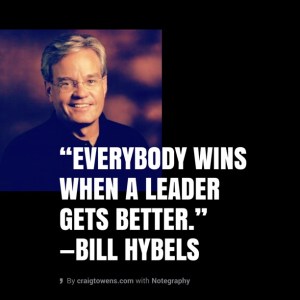
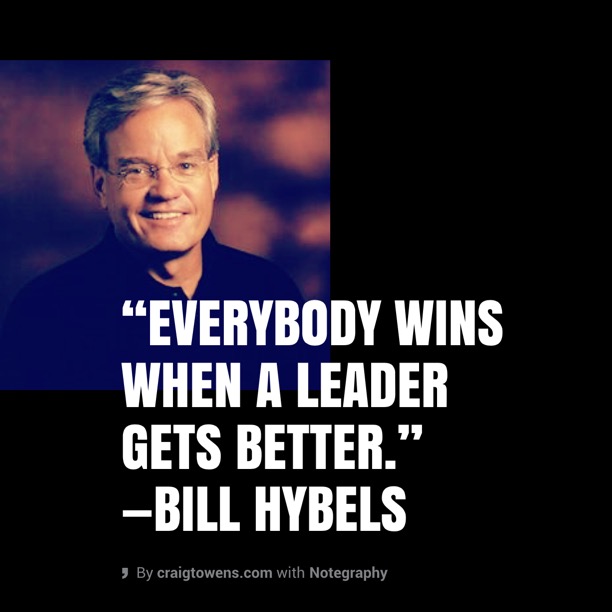
Hybels - everybody winsBill Hybels—The Lens Of Leadership

“Everybody wins when a leader gets better.”

“Armed with enough humility, leaders can learn from anyone.”

Hybels discussed four leadership lenses:

1.   Passionate leader (depicted by vibrant bright red frames)

  • They understand unbridled passion in leadership.
  • “Passion is like protein for the team.”
  • A motivated worked will outperform an unmotivated worker by 40%.
  • People are more motivated by working for a passion-filled leader than they are by compensation or perks.
  • Passion comes from a mountain-top dream, or a valley-deep frustration of current settings.

2.   People leader (cool frames, but cracked lenses)

  • An organization will only be as healthy as the top leader wants it to be.
  • This world needs more pastors of businesses, factories, medical offices, military units, etc.

3.   Performance leader (self-adjusting glasses)

  • Leaders ask: what progress should be made? how do we measure this? what doesn’t need to be measured?
  • Every worker wants to know how they are doing. For the leader, it’s cruel to hire someone and never let them know how they’re doing. Every staff member should get an update at least every six months.

4.   Legacy leader (sunglasses with a rearview mirror [cyclist])

  • Every once in awhile we need to look behind to see what legacy we’re leaving behind.
  • Leaders should reflect on this annually.
  • If my leadership assignment were to end today, what legacy would I leave?
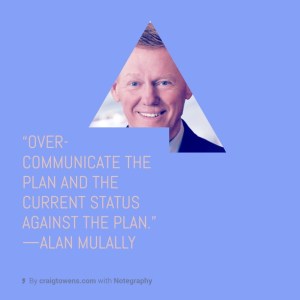
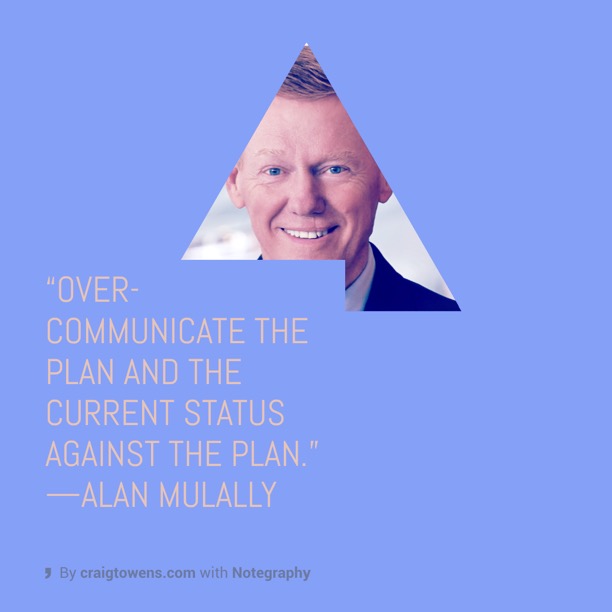
Mulally - overcommunicateAlan Mulally—CEO Boeing and Ford Motor Company

An average commercial airline has 4 million parts!

  • People first
  • Include everyone
  • Create a compelling vision
  • Present a workable strategy
  • Set clear performance goals
  • Relentless implementation
  • Share lots of data
  • “Over-communicate the plan and the current status against the plan.”
  • Instill a positive can-do attitude
  • Keep your emotional resilience
  • Have fun


Melinda Gates - hear the criesMelinda Gates—Gates Foundation

Melinda says of herself, “I am an impatient optimist. We are changing the world, but we need to change it faster.”


“At the end of the day, you have to hear the cries of those in need, let your heart break and act in courage.”

Jossy Chacko—Empart

“All of us have been entrusted with something. What are we doing to leverage it?”

In thinking about the parable of the talents … “To Jesus, faithfulness is not just sitting with what you have been given, but multiplying what you have been given. God’s mission is not maintaining.”

“Playing it safe is not enough for a follower of Jesus Christ.”

Three principles for expanding our leadership reach:

Jossy Chacko - faithfulness1. Enlarge your vision

  • “When people hear my vision, they should know the size of my God.”
  • “An enlarged vision should keep us driven.”
  • “Do not be confused about what people say about your vision; trust what God has said to you.”

2. Empower your people

  • “Leadership is about taking wise chances and giving people opportunities.”
  • “Your leadership reach will be determined by your empowerment choices.”
  • Three things to keep in mind: (1) Focus on building their character before empowering them; (2) Empowerment has to be through relationship; and (3) Make sure we have agreed on the right outcomes, and have the right way to measure them.

3. Embrace risk

  • Faith = risk. Without faith it is impossible to please God = without taking risks it is impossible to please God.
  • Paradigms to be changed: (1) See risk as your friend to love, not as your enemy to be feared; (2) See comfort and safety as your enemies; and (3) Increase your pain threshold.
  • “Your leadership capacity is in direct relationship to your pain threshold.”
  • “Don’t allow the fear of losing what we have to lose what God has in store for you.”
  • “By me not taking risks, who is missing out?”
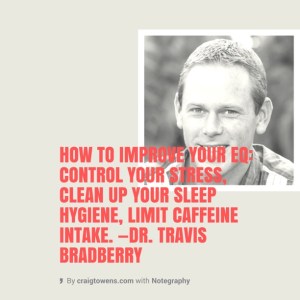
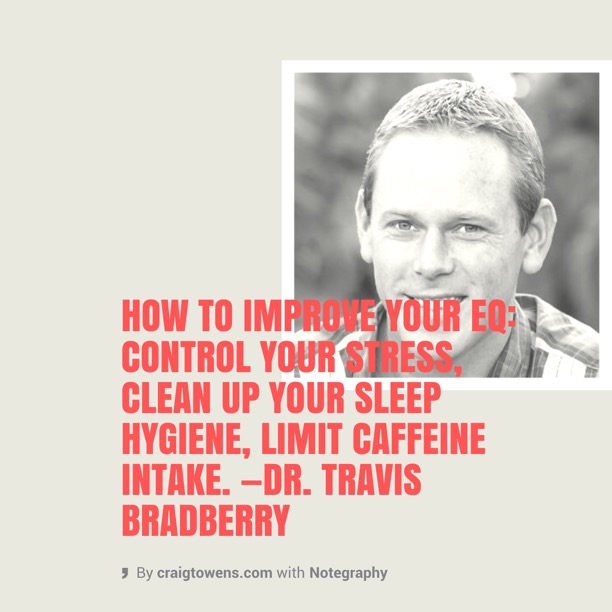
Bradberry - EQDr. Travis Bradberry—TalentSmart

All inputs into the brain travel through the limbic system first (emotional center) before the inputs travel to the frontal cortex. The EI (emotional intelligence) center is in the front of the brain, just above the left eye.

Only 36% of people are able to accurately identify their emotions as they happen.

EQ (the Emotional Quotient that measures emotional intelligence) is not IQ.

EQ can be improved all throughout life.

Four components of emotional intelligence:

 1. Self-awareness: knowing my emotions, and knowing my tendencies. I need to lean into my discomfort if I want to improve.

   2. Self-management: what I do with this increased self-awareness. This is not “stuffing” my feelings. The biggest mistake is only trying to manage negative emotions; positive emotions need to be managed too.

   3. Social awareness: focusing more on others than on myself.

   4. Relationship management: using the first three skills in concert. Seeing how my behavior is affecting the other person, and then adjusting accordingly.


How to increase my EQ:

  1. Control stress—stress under control is healthy; chronic stress is unhealthy. Gratitude reduces the stress hormone cortisol.
  2. Clean up my sleep hygiene—sleep cleans up toxic hormones in the brain. To get better sleep: (1) Don’t take any kind of sleeping pill; and (2) Reduce “blue lights” in the evening.
  3. Reduce my caffeine input—especially after noon.
Ideal team playerPatrick Lencioni—Author

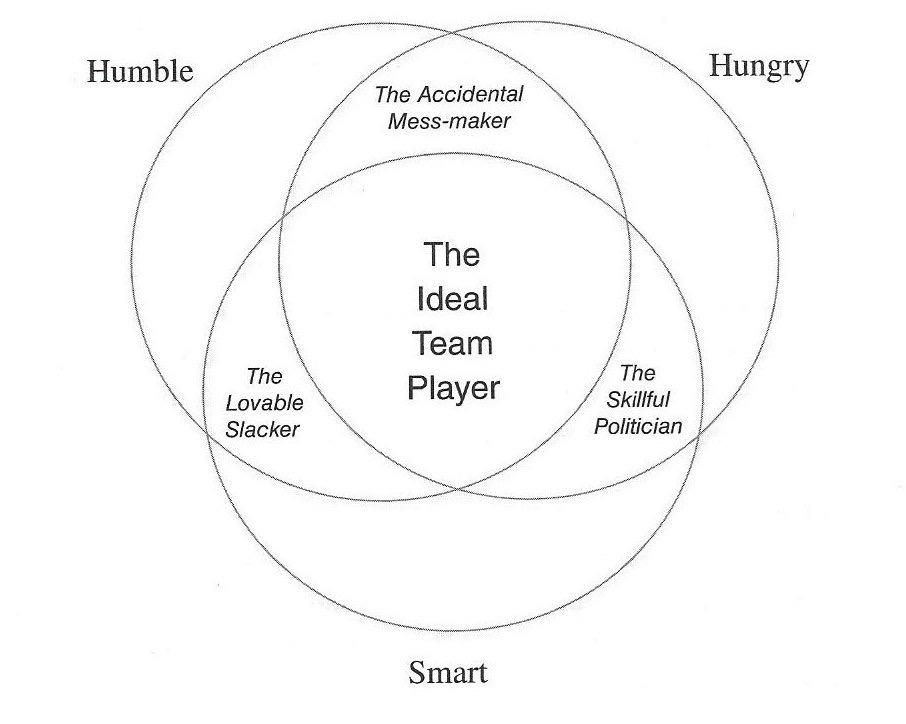
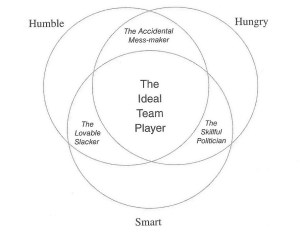
Three qualities of an ideal team player:

1.   Humble

  • Lacking self-confidence is not humility.
  • “Denying skills and downplaying abilities is not humility.”

2.   Hungry

  • Strong work ethic
  • Driving hard

3.   Smart

  • Not intellectual smarts, but people smarts = EQ

“To develop people, we have to have the courage to humbly and constantly talk to people about their ‘stuff.’”
McChesney - execution disciplinesChris McChesney—Franklin Covey

Rahm Charan asked:

  • Q: Do leaders struggle more with strategy or execution? A: Execution.
  • Q: Are leaders more educated in strategy or execution? A. Strategy.

“The hardest thing a leader will ever do is drive a strategy that changes someone’s behavior.”

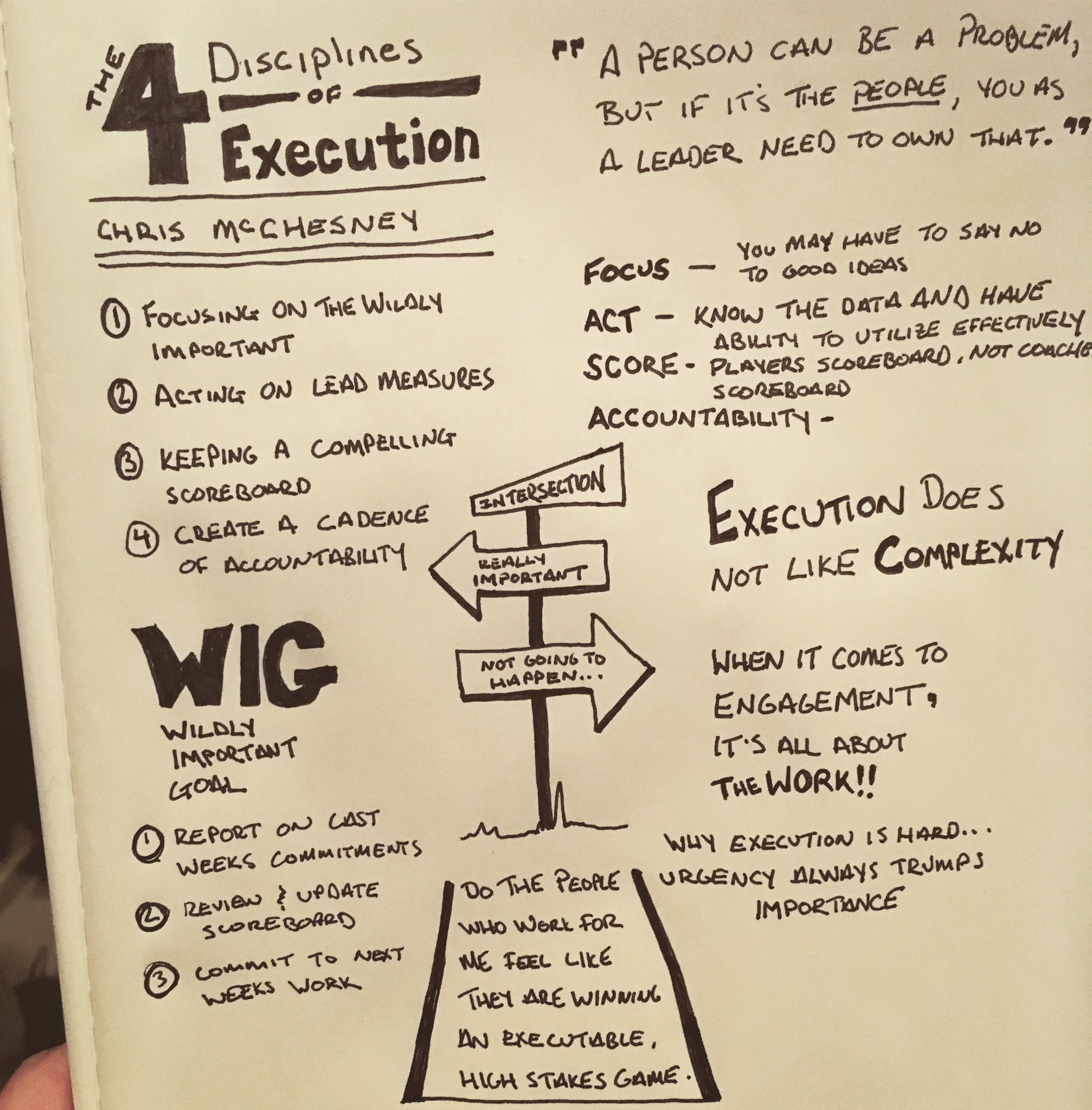
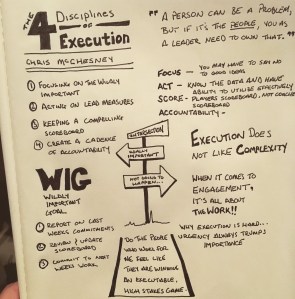
There are four disciplines for making changes in human behavior:

1.  Focus

  • “Focus on the wildly important.”
  • If a team focuses on 2-3 goals, they are likely to get them done. But if there are 4-10 goals, momentum is killed. At 11+ goals, the team is going backward.
  • We narrow the focus by coming up with a WIG: wildly important goal (this lives at the intersection of ‘really important’ and ‘not going to happen’).

2.  Leverage

  • “What are the fewest number of battles necessary to win the war?”
  • “When you want to go big, don’t think big, think narrow.”
  • One WIG per team at the same time. Everything else is in sustainment mode.
  • Make goals like this—“From x to y by when.”

3.  Engagement

  • “The biggest driver of engagement is when people feel like they’re winning.”
  • “Do the people who work for me feel like they’re playing a winnable game?”

4.  Accountability

  • Everyone needs to answer: “What are the things I do that have the biggest impact on the WIG?”
  • After sharing the scoreboard, allow people to determine what they need to do next. The people need to determine their own next moves, not the leader. The leader pulls this out of people.
Erin Meyer - contextErin Meyer—INSEAD

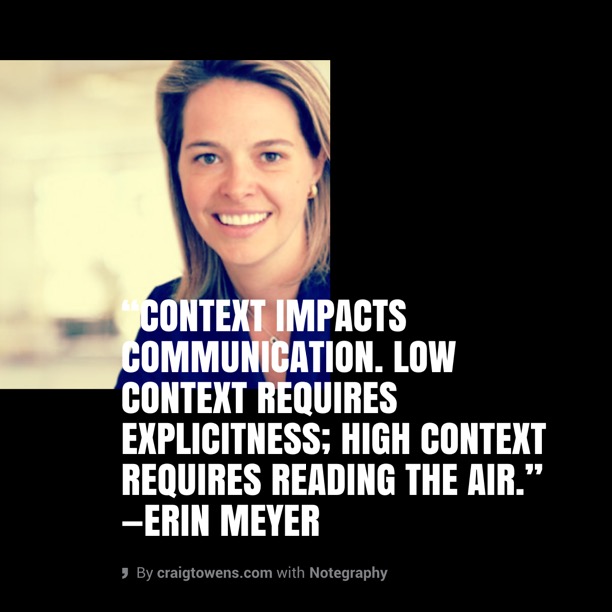
On The Culture Map communication is divided into Low vs. High Context:

  • Low = feel we don’t have the same context or relationship. We feel we need to explain things very simply and explicitly.
  • High = we assume we have a larger body of shared reference points. We feel communication is more implicit or nuanced.

Anglo-Saxon countries are typically low context.

Latin American are mid-low.

Asian countries are usually high context.

In low context we tend to nail things down in writing, where in high context we leave things more open to later interpretation.

“Context impacts communication. … We need to read both the messages ‘in the air’ as well as the explicitly stately messages.”

“In a high context culture, repeat things less, ask more questions, learn to ‘read the air.’”
 

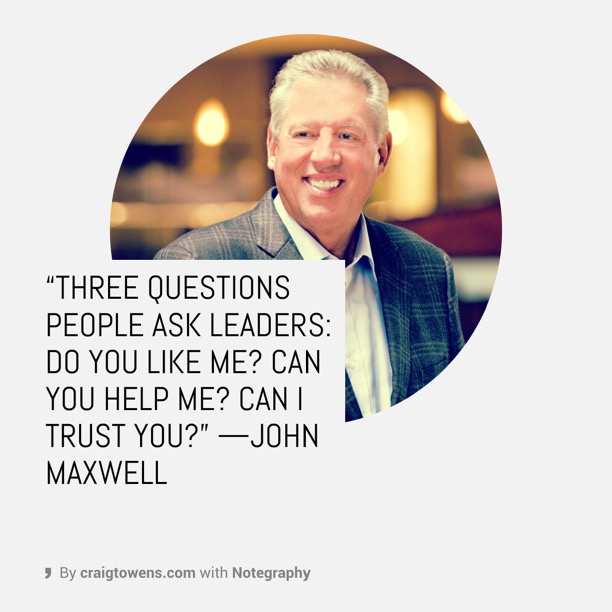
Maxwell - 3 questionsJohn Maxwell—Author 

“Good leaders lift.”

“You have to find the people before you lead the people.”

“The one thing leaders have to get right—they must intentionally add value to people every day.”


Five things that intentionally adds value to people:

  1. Value people—“God values people I don’t know; He even value people I don’t like.” “Are we going to spend our lives connecting with people, or correcting them?”
  2. Think of ways to add value to people—“Intentional living is thinking upfront on how to help people.”
  3. Look for ways to add value to people.
  4. Do things that add value to people.
  5. Encourage others to add value to people.

If you attended the GLS, please share in the comments below something amazing / challenging / paradigm-busting that you learned. Let’s all keep on learning!

Poetry Saturday—If We Could See Beyond Today

Field and sunIf we could see beyond today
As God can see;
If all the clouds should roll away,
The shadows flee;
O’er present griefs we would not fret.
Each sorrow we would soon forget,
For many joys are waiting yet
For you and me.

If we could know beyond today
As God doth know,
Why dearest treasures pass away
And tears must flow;
And why the darkness leads to light,
Why dreary paths will soon grow bright;
Some day life’s wrongs will be made right,
Faith tells us so.  

“If we could see, if we could know,”
We often say,
But God in love a veil doth throw
Across our way;
We cannot see what lies before,
And so we cling to Him the more,
He leads us till this life is o’er;
Trust and obey. —Norman J. Clayton

The Lesson Of The Lost Brooch

Corrie ten BoomCorrie ten Boom shares this memorable story about patience in her book I Stand At The Door And Knock

The old story of the lost brooch really helped me.

A lady lost a valuable brooch at the theater. She noticed it was missing when she arrived home. Early the next day she rang the caretaker of the theater and asked if he had found the brooch. “No,” he said, “but where was your seat? I will go and have a look if it is under your seat.”

“My seat was on the fifth row, number two.” The man went to have a look and found the brooch.

He went to the telephone and said, “Yes, I am pleased to tell you I found your brooch. Hello? Hello?”

There was no reply; she had impatiently hung up the phone. She will never know that her brooch was found.

The Holy Spirit teaches us to have great expectations for the Lord. Listen to the Lord. If you don’t hear His voice immediately, wait patiently. Waiting for the Lord is a blessing too. He is a good Shepherd. And a good Shepherd speaks to His sheep. Don’t put the receiver down too quickly. He loves you and has so much to say to you.

Thursdays With Oswald—Are You Self-Made Or God-Made?

Oswald ChambersThis is a weekly series with things I’m reading and pondering from Oswald Chambers. You can read the original seed thought here, or type “Thursdays With Oswald” in the search box to read more entries.

Are You Self-Made Or God-Made?

     It is possible to be perfectly real to ourselves but not real to God; that is not reality. It is possible to be perfectly real to ourselves and real to other people, but not real in our relationship to God; that is not reality. The only reality is being in harmony with ourselves and other people and God. That is the one great reality towards which God is working, and towards which we are working as we obey Him. … 

     The critical moment in a man or woman’s life is when they realize they are individually separate from other people. When I realize I am separate from everyone else, the danger is that I think I am different from everyone else. Immediately I think that, I become a law to myself; that means I excuse everything I do, but nothing anyone else does. ‘My temptations are peculiar,’ I say; ‘my setting is very strange; no one knows but myself the peculiar forces that are in me.’ … This sense that I know what other people do not know, that I have a special intuition that tells me things, is even more dangerous than the sense of individualism because it leads to spiritual deception in a religious nature and to hard intellectual conceit in a natural nature. … 

     Self-realization naturally cares nothing about God, it does not care whether Jesus lived or died or did anything at all. For ourselves we live and for ourselves we die; that is self-realization that leads to death and despair; it is absolutely and radically opposed to Christ-realization. True self-realization is exhibited in the life of Our Lord, perfect harmony with God and a perfect understanding of man; and He prays “that they may be one, even as We are one.” … 

     God’s purpose is to make us real, that is, to make us perfectly at one with all our own powers and perfectly at one with God, no longer children but understanding in our heads as well as in our hearts the meaning of the Redemption, and slowly maturing until we are a recommendation to the redeeming grace of our Lord Jesus Christ.

From The Philosophy Of Sin

Oswald Chambers says we have a choice: Will we try to be a self-made man or woman, OR will we allow the Holy Spirit to make us a God-made man or woman? Only the second option puts us in touch with ourselves, others, and God.