8 Quotes From “Culture”

cultureIn Culture, you will find a collection of chapters from various A.W. Tozer books all addressing the theme of how a Christian should behave in worldly culture. If you are concerned about influencing the culture for Christ (instead of being influenced by it), I urge you to read my review of this book, and then pick up a copy for yourself. Below are a few quotes from Culture that caught my attention.

“The sacred-secular antithesis has no foundation in the New Testament. … The Lord Jesus Christ Himself is our perfect example, and He knew no divided life. In the presence of His Father He lived on earth without strain from babyhood to His death on the Cross. God accepted the offering of His total life, and made no distinction between act and act. ‘I do always those things that please Him,’ was His brief summary of His own life as it related to the Father (John 8:29). As He moved among men, He was poised and restful.”

“A Christian is now living according to the will of God as he understands it from the written Word. Of such a one it may be said that every act of his life is or can be as truly sacred as prayer or baptism or the Lord’s Supper. To say this is not to bring all acts down to one dead level; it is rather to lift every act up into a living kingdom and turn the whole life into a sacrament.”

“Keep reminding God in our times of private prayer that we mean every act for His glory; then supplement those times by a thousand thought-prayers as we go about the job of living. Let us practice the fine art of making every work a priestly ministration. Let us believe that God is in all our simple deeds and learn to find Him there.”

“You cannot get miracles as you would get a chemical reaction. You cannot get a miracle as you get a wonderful act on stage by a magician. God does not sell Himself into the hands of religious magicians. I do not believe in that kind of miracles. I believe in the kind of miracles that God gives to His people who live so close to Him that answers to prayer are common and these miracles are not uncommon.”

“Our trouble is not that we refuse to believe right doctrine, but we refuse to practice it. We have the peculiar contradiction of believing the right thing and living the wrong way.”

“It seems that the average person spends more time and intellectual labor each year filling out income tax forms then he or she spends in a lifetime trying to learn from the Scriptures and from the light of the Spirit what the church is and what he or she ought to do about it.”

“I would also have in our body the power of the Spirit of Christ. I have said that the average gospel church could get along without the Holy Spirit—and many do. We are praying for revival. What is revival? It is when the Holy Spirit takes over the work that is His, instead of being pushed aside into the benediction. He now becomes the Chief Executive of the church, running it. ‘But ye shall receive power, after that the Holy Ghost is come upon you’ (Acts 1:8). That means that the Spirit of Heaven should come to a company on earth with His all-prevailing gifts, power, and grace, with His life, His illumination, and His discernment. This is not fanaticism; this is not any weird religion. This is just what the Bible teaches.”

“Did you read the Bible or watch TV more this week? Think of the time you have spent. How many half-hour periods did you spend with your Bible, and how many did you spend with amusements? We do not take our faith seriously enough.”

I will be sharing other quotes from Culture soon. If you will enter your email address in the “Subscribe” box to on the right side of the page, you will be notified as soon as new quotes are posted. You can also read Tozer’s quotes from this book, as well as other empowering quotes that I share daily in Twitter and Tumblr.

Culture (book review)

cultureThe dictionary defines culture as “a particular stage of civilization.” In other words, culture is constantly being molded by those who are exercising influence on it at a particular moment. What about Christians? How are they supposed to influence culture? That is a subject that can be so perfectly addressed by A.W. Tozer in a collection of insights in the book with the apropos title Culture.

A.W. Tozer was a man ahead of his time. Although born in 1897, he had a God-given knack for reading the current culture, ascertaining how the church was influencing or being influenced by civilization, and making accurate predictions of what was coming next. This amazing foresight was on display throughout his long and extensive preaching and writing ministry.

Culture is a collection of chapters from more than a dozen of his books. Time and time again you will read how accurately he read the trends in civilization and warned the church how she should respond. Today we have the advantage of looking around us to see how many of his unheeded warnings have come to make up our current culture.

I love the sub-title for this book: Living as Citizens of Heaven on Earth. Although Tozer is no longer with us, his wise words still are. And it’s still not too late for the church to heed his words and make the changes he outlined. Anyone who believes that Christians can still make a difference in our culture will enjoy reading Culture.

I am a Moody Press book reviewer.

Spurgeon: Rain Without Clouds?

C.H. Spurgeon“How can we have rain without clouds? Our troubles have always brought us blessings, and they always will. They are the dark chariots of bright grace. These clouds will empty themselves before long, and every tender herb will be gladder for the shower. Our God may drench us with grief, but He will refresh us with mercy. Our Lord’s love-letters often come to us in black-edged envelopes. His wagons rumble, but they are loaded with benefits. His rod blossoms with sweet flowers and nourishing fruits. Let us not worry about the clouds, but sing because May flowers are brought to us through the April clouds and showers.

“O Lord, the clouds are the dust of Thy feet! How near Thou art in the cloudy and dark day! Love beholds Thee, and is glad. Faith sees the clouds emptying themselves and making the little hills rejoice on every side.” —Charles Spurgeon (emphasis added)

Vegetables And Dessert

a-testimony-to-othersHave you ever noticed that kids would prefer to eat dessert more than vegetables? Well, maybe you’re an adult and you still feel the same way! But “veggies before dessert” is still a good motto to live by.

Why?

What happens if you eat only dessert? Do you eventually get healthier or are you setting yourself up for some unfavorable health conditions? What about if you only eat vegetables? The flavor may not be as good, but at least you’ll be getting healthier.

Jesus told His followers to expect the “veggie” times in time. He said, “In this world you will have trouble.” And He told us, “Then you will be handed over to be persecuted and put to death, and you will be hated by all nations because of Me.” There were no ifs or maybes in those statements!

As Christians living on Earth, the Apostle Peter calls us “aliens and strangers.” That means that both our attitude and our lifestyle should be, well, alien compared to Earthlings. Especially when we’re in a veggie time of life.

Jesus was the Perfect Man. He never said anything wrong, and He never did anything wrong. Yet He was insulted, persecuted, and eventually killed in the most horrific way imaginable. But here’s the amazing thing: Jesus went through all of this without retaliating or threatening judgment on His persecutors. Peter said that the way Jesus went through this was intended to be an example for us.

The writer of Hebrews agreedLet us fix our eyes on Jesus, the Author and Perfecter of our faith, Who for the joy set before Him endured the Cross, scorning its shame, and sat down at the right hand of the throne of God. Consider Him Who endured such opposition from sinful men, so that you will not grow weary and lose heart

Notice it says, “for the joy set before Him.” Other translations say “because of the joy awaiting Him” or “He never lost sight of where He was headed” or “He never lost sight of the joy ahead of Him.” In other words, Jesus knew what God’s plan was from before the beginning of time, so He—as Peter said—kept on entrusting Himself to God.

We have to do the same thing!

I have to confess something. When I quoted the “veggie” part of a couple of verses earlier in this post, I left off the “dessert” part…

  • “I have told you these things, so that in Me you may have peace. In this world you will have trouble. But take heart! I have overcome the world.” (John 16:33)
  • Blessed are those who are persecuted because of righteousness, for theirs is the kingdom of heaven. Blessed are you when people insult you, persecute you and falsely say all kinds of evil against you because of Me. Rejoice and be glad, because great is your reward in heaven….” (Matthew 5:10-12)

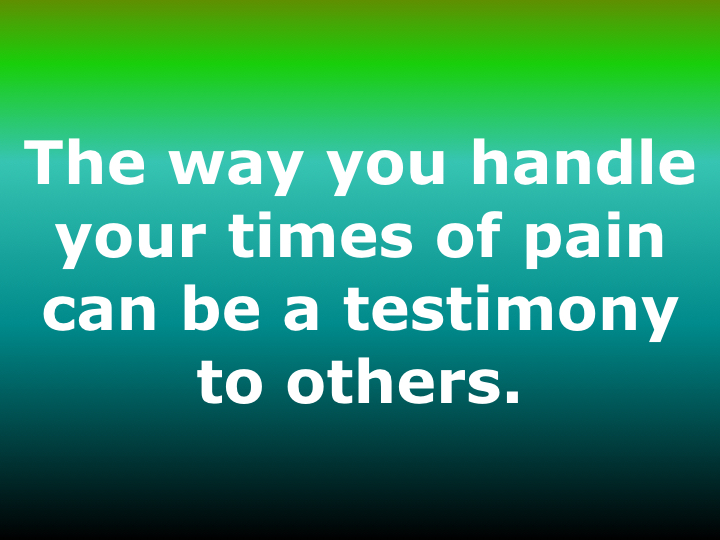
The way you handle your vegetable times—disease, insults, financial setbacks, outright persecution—can be a testimony to others. The way you go through these trials could help others turn to the Shepherd and Overseer of their souls.

Are you in a trial now? Keep on entrusting yourself to Him Whose plans cannot be thwarted

It might seem all “veggies” now, but you are getting healthier, and the “dessert” you cannot even imagine is on its way!

If you’ve missed any messages in this series, you may find the complete list by clicking here.

Poetry Saturday—His Word

fullsizerender-39I do not ask that He must prove
     His Word is true to me,
And that before I can believe
     He first must let me see.
It is enough for me to know
     It’s true because He says it’s so;
On His unchanging Word I’ll stand
     And trust till I can understand. —E.M. Winter

Ken Blanchard & Phil Hodges On Forgiveness

lead-like-jesus“Forgiveness is the way for a heart grounded in the unconditional love of God to respond to the imperfections of others. … EGO-driven leaders, impatient for results, are quick to judge and discount less-than-perfect efforts as failure rather than to forgive and redirect. Forgiveness is a supernatural act, not a natural response to being hurt or let down. It is an act of the will, a choice, of one who has surrendered control to a higher court of judgment. …

“The opposite of forgiveness is judgment. Your motivation for doing something is as important as what you do. In theological terms, judgment is pointing out a fault with a view to condemnation. On the other hand, discernment is pointing out a fault with a view to correction or restoration. When we withhold forgiveness, is it because we are sincerely trying to correct or restore—or is it because there is some benefit to us in condemning?” —Ken Blanchard & Phil Hodges

Thursdays With Oswald—Conscience

Oswald ChambersThis is a weekly series with things I’m reading and pondering from Oswald Chambers. You can read the original seed thought here, or type “Thursdays With Oswald” in the search box to read more entries.

Conscience 

     Conscience is that innate faculty in a man’s spirit that attaches itself to the highest the man knows, whether he be an atheist or a Christian. The highest the Christian knows is God: the highest the atheist knows is his principles. … 

     When conscience begins to be awakened by God, we either become subtle hypocrites or saints, that is, either we let God’s law working through conscience bring us to the place where we can be put right, or we begin to hoodwink ourselves, to affect a religious pose, not before other people, but before ourselves, in order to appease conscience—anything to be kept out of the real presence of God because where ever He comes, He disturbs. … 

     The majority of us have caught on the jargon of holiness without the tremendous panging pain that follows the awakening to holiness. The Spirit of God brings us to face ourselves steadily in the light of God until sin is seen in its true nature. If you want to know what sin is, don’t ask the convicted sinner, ask the saint, the one who has been awakened to the holiness of God through the Atonement; he is the one who can begin to tell you what sin is. … It is only as we walk in the light as God is in the light that we begin to understand the unfathomable depths of cleansing to which the blood of Jesus Christ goes (1 John 1:7). … 

     When a man begins his life with God there are great tracts of his life that he never bothers his head about, but slowly and surely the Spirit of God educates him down to the tiny little scruple. Every crook and cranny of the physical life, every imagination and emotion is perfectly known to God, and He demands that all these be blameless. … The marvel of the Atonement is just this very thing, that the perfect Savior imparts His perfections to me, and as I walk in the light as God is in the light, every part of bodily life, of affectionate life and of spirit life are kept unblameable in holiness; my duty is to keep in the light, God does all the rest.

From The Philosophy Of Sin

Quick question: What are you going to do the next time the Holy Spirit disturbs your conscience?

7 Quotes From “The Beauty Of Intolerance”

Beauty Of IntoleranceTolerance and intolerance are definitely the buzzwords of today’s culture. But depending upon whom you’re asking, the definition of these words may be dramatically different. This is where Josh McDowell and Sean McDowell’s book The Beauty Of Intolerance can help. Please be sure to check out my book review here, and then check out some of the quotes from this very important book below.

“It’s natural—and if done properly, even healthy—for the people of each new generation to establish a unique identity apart from their parents. Yet what we are experiencing today is far from the typical generation gap. We are seeing a cultural shift that is separating Christian parents from their children perhaps unlike anything seen before.”

“Your narrative about truth is probably based on your understanding of the Bible. Whether they realize it or not, our young people today largely derive their narrative about truth from a culture that says moral truth is found within the individual. These two narratives can be expressed in terms of the biblical narrative about truth and the cultural narrative about truth. When our young people accept the cultural narrative, it becomes the lens by which they interpret relationships and much of the world around them.”

“If each person is a valid, independent source of applied truth, then there can be no basis for external disapproval. There is no overarching standard by which to apply judgment. That means tolerance as the culture defines it is the only appropriate response to each individual’s moral choices. That kind of tolerance—what we will call cultural tolerance—propagates the notion that all moral truth is equal. From that perspective it only seems right to respect, accept, and approve of diverse views and the behavior of others, since doing otherwise would be intolerant and judgmental. … But what many of today’s young people don’t understand is that they have unwittingly bought into cultural tolerance, which is a faulty narrative about moral truth that fundamentally changes the traditional meaning of words like tolerance, acceptance, respect, and the like. They tend to think that they have the right to determine what is right and wrong for themselves.”

“God is not only the standard of what is true—He is truth—but He is also the perfect standard for tolerance. That is, He is the standard for tolerance in the original and traditional meaning of the word—a tolerance that loves us without approving of our sinful condition. Both truth and traditional tolerance reside in the character of God, and they are inseparable.”

“While the Incarnation is the personification of love and acceptance, God’s disdain for sin reflects His holy intolerance. What sin did to humans broke His heart. Separated from God, the human race wallowed in greed, lust, jealousy, hatred, and conflict. Human sin has rippled down from one generation to another with the same tragic results: pain and suffering, heartache and ruin, destruction and death. God’s hatred of evil and injustice—of everything that hurts us—prompted Him to be radically intolerant of sin and its devastating effects on His creation. His amazing love for us prompted Him to do something to save us from it. That something cost Him the death of His only Son, but He considered you and me worth it. God’s intolerance is an amazing and beautiful thing.”

“Moral truth isn’t simply an abstract concept; it originates in a Person who is the original and standard for morality. Jesus said, ‘I am the way, the truth, and the life’ (John 14:6). Moral truth ultimately finds its source in a ‘Who,’ not merely in a ‘what.’ In other words, moral claims are true if they correspond to the character of God—Who is the objective source for morality. God is the source of all moral truth.”

“The reason we think there are such concepts as ‘fair’ and ‘unfair’ is because our Maker is a just God and we have been made in His image (Genesis 1:27). The reason love is a virtue and hatred a vice is because the God of relationships who formed us is a God of love. The reason honesty is right and deceit is wrong is because God is true. The reason fidelity in marriage is honorable and infidelity is not is because God is faithful. The reason chastity is moral and promiscuity is immoral is because God is pure. … All truth claims cannot be equal because Jesus didn’t claim to be ‘a’ truth—one among viable others. His claim was exclusive.”

I will be posting more quotes from The Beauty Of Intolerance in the near future. If you would like to be notified when these quotes appear, please enter your email address in the form on the right to subscribe.

Also check out quotes from this and other books that I share daily on Twitter and Tumblr.

Religious Liberty In School

free-to-speakAs our students are heading back to their schools, it is a great time to be reminded of the religious liberties they have while in school. With all of the talk of so-called “separation of church and state,” I think many parents and students are reluctant to say anything that sounds remotely Christian, for fear of getting in trouble with the powers-that-be.

But we don’t have to tread so carefully!

Gateways To Better Education has some great resources. I ordered a couple hundred of their “Free To Speak” pamphlets. I gave them to our school superintendent, and as many parents as as I could. This short pamphlet summarizes the US Department of Education’s guidelines on what is allowed in school. In short, the Seven Freedoms are:

  1. Students can pray, read their Bibles or other religious material, and talk about their faith at school.
  2. Students can organize prayer groups and religious clubs, and announce their meetings like any other club.
  3. Students can express their faith in their class work and homework.
  4. Teachers can organize prayer groups with other teachers.
  5. Students may be able to go off campus to have religious studies during school hours.
  6. Students can express their faith at a school event.
  7. Students can express their faith at a graduation ceremony.

Don’t be intimidated. Don’t be uninformed. Know your rights as a US citizen.

The Beauty Of Intolerance (book review)

Beauty Of IntoleranceOur current culture sets tolerance as a high virtue, so those who exhibit the greatest levels of tolerance are upheld as the model for everyone else. On the other hand, intolerance is an ugly label for anyone to have. So what do you think when you hear that Josh and Sean McDowell have teamed-up to write a book called The Beauty Of Intolerance?

Many times there is a generational clash of worldviews: today’s grandparents and parents tend to hold to viewpoints which many of today’s youth find intolerant, mean, or even bigoted. Does that mean that the older generations are unenlightened, and the younger generations have seen the light? Or does it mean that the younger generations are rebelling, while the older generations are holding the line? Josh and Sean have become the “translators” between these two starkly-different worldviews.

It starts, the McDowells say, with an understanding of the word “tolerance.” It turns out that the this word has taken on a new meaning with younger generations, but that doesn’t mean that the younger generations don’t value what the older generations do. For example, consider a t-shirt that Josh McDowell designed. The front of the shirt says, “Intolerance is a beautiful idea.” But the back of the shirt clarifies this statement by reminding us:

  • Mother Teresa was intolerant of poverty.
  • Bono was intolerant of AIDS.
    Nelson Mandela was intolerant of apartheid.
  • Martin Luther King was intolerant of racism.
  • Jesus was intolerant of bigotry.

It turns out it’s not just the word “tolerance” that needs a tune-up, but also words like “respect,” “dignity,” “acceptance,” “morality” and “truth.” Fortunately for us, The Beauty Of Intolerance leads us through a modern-day understanding of all these terms.

Using true-to-life dialogue between parents and children, Josh and Sean help both generations see how intolerance really is a beautiful thing. The McDowells guide us through conversations we might encounter at home, in school, in the government, at church, and in day-to-day living. They give us the tools necessary to help everyone see that intolerance can be a beautiful thing!

For anyone who wants to speak the truth lovingly and convincingly across generational lines, The Beauty Of Intolerance is a must-read book.

I am a Shiloh Run Press book reviewer.