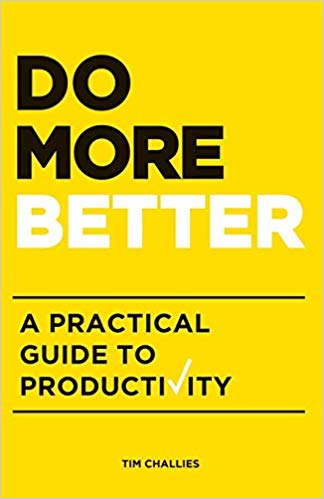
Tim Challies has a highly practical guide to helping you learn how to be more productive for God’s glory. Check out my full book review by clicking here.
“Productivity is not what will bring purpose to your life, but what will enable you to excel in living out your purpose.”
We all have the same 168 hours in our week, but why does it seem like some people get so much more done in the same amount of time? No, there isn’t a secret formula, but Tim Challies does share some insightful principles that can help all of us Do More Better.
Tim’s approach is a spiritual one. He wants us to be more productive and effective not so we can receive accolades, but so that God is glorified in our lives. If a Christian is disorganized or unproductive, a watching world can’t see God as clearly. But a thoughtful, purposeful, productive Christian gets others’ attention and points them to God’s glory.
Tim begins by helping us understand what productivity is and isn’t. From that foundation, he guides us through how to look at our lives in all its different roles, and then shares tools and techniques for doing more better in every area of our lives. Along the way, Tim shares both some online tools and some paper-and-pen tools that can be used to help us keep our productivity humming along.
This isn’t a long book nor a difficult book to process. In fact, you will be able to start making steps toward greater productivity right from chapter one! If you want to do more better—and glorify God in the process—check out Do More Better.
Check out some bonus resources that go along with this book by clicking here.
The minor prophets in the Bible are pretty cool! But we have to be careful with man-made titles. For example, the “old” in Old Testament doesn’t mean outdated; nor does the “new” in New Testament mean something updated to modern times.
In the same way, the minor prophets are only called “minor” because of the volume of their writing, not the quality of their message. In fact, their messages are actually quite major!
The minor prophets cover a span of about 300 years, from 760 BC (Amos) to 450 BC (Malachi). You can check out this side-by-side chart to see where these prophets fit in the history of Judah and Israel.
Here are some interesting tidbits about the minor prophets:
In the Hebrew Bible, these books are referred to simply as “The Twelve.”
All of these prophets identify themselves in the first verse of their writing except Jonah, but he is identified in 2 Kings 14:23-25.
The prophets consistently give us some historical context in their writings to help us place when, where, and to whom their ministry took place.
The Twelve also show up quite liberally in the New Testament. Every one of them has either direct quotations or has their writings implicitly referred to throughout the New Testament. Here’s just a small sampling…
Micah 5:2 tells us where Jesus would be born (Matthew 2:6)
Hosea 11:1 says Jesus would spend time in Egypt (Matthew 2:15)
Malachi 4:5 says an “Elijah” would precede Jesus (Matthew 17:10-11)
Zechariah 9:9 foretells Christ’s triumphal entry into Jerusalem (Mark 11:1-10)
Jonah 1:17 was used by Jesus to predict His own resurrection (Matthew 12:39-42)
Joel 2:28-32 was quoted by Peter on the Day of Pentecost (Acts 2:16-21)
Amos 9:11-12 foretold all peoples coming to Jesus (Acts 15:16-17)
Hosea 13:14 was quoted by Paul to show how death was defeated (1 Corinthians 15:53-57)
Habakkuk 2:4 was also quoted by Paul to tell how righteous people live (Galatians 3:11)
Haggai 2:6 foretells the end times (Hebrews 12:26-29)
I look forward to diving deep into the major lessons in the minor prophets over the next several weeks, but in preparation for that let me give you 3 overarching lessons for all Bible studies:
Christianity is rooted in history.The Bible is a historical record of real people, saying and doing real things in real places in the world. It’s not a collection of fables, myths, or legends.
We need to study the whole counsel of God’s Word. All of Scripture is interdependent on all the other parts of Scripture, and every part reinforces and amplifies every other part. Don’t limit your Bible reading to just one or two parts.
Looking back in wonder and gratitude builds faith for today and hope for tomorrow. When we see what God has done in the past, and we realize that He is still the same God today, it builds our faith for today. And when our faith today is strengthened, it gives us a bright hope for tomorrow.
I am standing upon the seashore. A ship at my side spreads her white sails to the morning breeze and starts for the blue ocean. She is an object of beauty and strength. I stand and watch her until at length she hangs like a speck of white cloud just where the sea and sky come to mingle with each other.
Then someone at my side says, “There, she is gone!”
“Gone where?”
Gone from my sight. That is all. She is just as large in mast and hull and spar as she was when she left my side, and she is just as able to bear her load of living freight to her destined port.
Her diminished size is in me, not in her. And just at the moment when someone at my side says, “There, she is gone,” there are other eyes watching her coming, and other voices ready to take up the glad shout, “Here she comes!” —Henry Van Dyke
This is a weekly series with things I’m reading and pondering from Charles Spurgeon. You can read the original seed thought here, or type “Thursdays With Spurgeon” in the search box to read more entries.
God’s Purpose Prevails
But He is in one mind, and who can turn Him? and what His soul desireth, even that He doeth (Job 23:13 KJV). But He is unchangeable, and who can turn Him? And what He wants to do, that He does (AMP).
Now the fact taught here is that in all the acts of God in providence, He has a fixed and a settled purpose. ‘He is in one mind.’ It is eminently consolatory to us, who are God’s creatures, to know that He did not make us without a purpose and that now, in all His dealings with us, He has the same wise and gracious end to be served. …
O believer, ever look, then, on all your sufferings as being parts of the divine plan and say, as wave upon wave rolls over you, ‘He is in one mind!’ He is carrying out still His one great purpose. None of these comes by chance; none of these happens to me out of order; but everything comes to me according to the purpose of His own will and answers the purpose of His own great mind. …
We sweat, we toil, and we fail. How often do we come back weeping because we have toiled, as we think, without success! Yet, Christian man, you have not been without success, for ‘He is still in one mind.’ All this was necessary to the fulfillment of His one purpose. You are not lost; your labor has not rotted under the clod. All, though you see it not, has been working together toward the desired end. …
From every evil, good has come. And the more the evil has accumulated, the more has God glorified Himself in bringing out at last His grand, His everlasting design. This, I take it, is the first general lesson of the text—in every event of providence, God has a purpose. ‘He is in one mind.’
Mark, not only a purpose, but only one purpose—for all history is but one. There are many scenes, but it is one drama. There are many pages, but it is one book. There are many leaves, but it is one tree. There are many provinces, yes, and there are many lords and rulers, yet there is but one empire and God the one Potentate.
From The Infallibility Of God’s Purpose
All of history is His story—and your life is a part of that Grand Story as well. God doesn’t miss a thing. He is working all things out to accomplish His purpose (see Romans 8:28). Even when it seems nothing is happening, turn your thoughts back to God Whose plans never fail, Whose purposes are never frustrated, Who is always working out His grand plan.
Kathy Koch has given parents, teachers, and anyone who works with younger children, and excellent resource to improve your relationship with your kiddos and empower them to greater success. Check out my full book review of Start With The Heart by clicking here.
“For your children to want what you want for them, for changes to occur, and for improvements to remain, your hearts must be intertwined. Your motivational power and influence over their obedience comes out of the love you have for each other.” [see Proverbs 23:26]
“Affirm your children when they do use the character qualities you’re emphasizing and correct them when they don’t. … Specifically, look for gratitude and joy. The lack of one or both of these emotions causes children (and adults) to use character qualities inconsistently.”
“Here is my list of understandings that can secure children’s hearts and increase your influence so you’ll be able to motivate them to be responsible, brave, and so much more.
Parent by faith
Parent with grace and mercy
Forgive quickly and often
Ask to be forgiven quickly and often
Tell your children you are confident in God
Prioritize children, not their behavior
You can dislike what children do while you still like and love them
Be who you want your children to be
Raise the children you were given, not the children you wish you had
Remember needs and wants are different
Listen when children are little if you want them to talk with you when they’re older
When children have a problem, remember they are not the problem
Teach children to fail well
Prioritize progress, not perfection”
“Children are even more susceptible to the influences around them. We should have and model solid character so our behavior, attitudes, and decisions glorify God. We should also prioritize our character so we don’t lead a child astray. Making every effort to use these qualities ourselves matters. And, of course, apologizing when we don’t is key to maintaining a positive relationship.”
“The desire to develop self-control is birthed in self-respect. Self-control makes it possible to use other character qualities successfully.”
“Do we choose to see our children’s circumstances and respond appropriately? Although consistency is usually appropriate when raising and motivating children, if we don’t have compassion and individualize our reactions and decisions when it’s appropriate, why would our children? Modeling this character quality matters tremendously.”
“Initiative: Children may never develop this quality if you remind them of everything they must do. Rather, it’s birthed when you help them grow in appropriate independence. … Is it possible that your children may not be motivated as you’d like because you rescue them to early, too often? … I know you value the things you worked hard for. Don’t rob children of that same satisfaction. Allow them to persevere.”
“Prayer is a powerful tool—use it! Your personal and specific prayers for your children communicate your deep love for them and your dependence on God. Your prayers are a significant way your children learn who you hope they’ll be and what you hope they’ll do. Pray they’ll develop a heart for Christ. Model and teach what they need for their heart to be transformed into His likeness. This will change their character and, therefore, their motivation and motives, too.”
“Just making statements like these can be empowering:
I need to take off arguing and put on first-time obedience.
I need to take off bullying and put on kindness.
I need to take off distractions and put on focus.
I need to take off ‘I don’t want to’ and put on ‘do it anyway.’”
“This might surprise you, but all children are motivated. … It doesn’t help to ask, ‘How do I get my kids motivated?’ Rather, we need to ask, ‘How can I redirect their motivation?’”
Sometimes the naming of things gives us an inaccurate picture of the thing being named. For instance, many people think the “old” in Old Testament means outdated or perhaps updated by the “new” in the New Testament. When in fact, both Testaments are needed to give us the full picture of God’s love and glory.
A similar thing happens with the headings “major prophets” and “minor prophets.” It makes it sound like the major prophets have something major to say to us, while we could take or leave the minor messages of the minor prophets.
In reality, they were given these headings simply because of the volume of writing—the five major prophets consist of 182 chapters, whereas the 12 minor prophets only have 67 chapters. The volume of their writing may be minor, but their content carries major messages of meteoric power!
If you missed any of the messages in this series, you can find them here:
Dr. Kathy Koch has parenting insights that are unlike few others. Her ministry is called Celebrate Kids, and that’s exactly what she teaches parents and teachers to do in her book Start With The Heart.
Not only does Dr. Kathy lean into her formal training in education—as an elementary teacher, a middle school coach, and a university professor—but she supports all of her instructional insights with an unabashed reliance on the wisdom found in the Bible. This is a winning combination!
Dr. Kathy explains the rationale behind the title and message of her latest book, “Capturing your child’s heart and parenting to keep it may be more important than anything else you do. Your love for your children and your desire for them to trust Christ for their salvation matters greatly. For you to have motivational power to help them make that commitment, mature in their faith, and love God more fully, you must start with their heart.”
Start With The Heart isn’t about manipulating children or coercing them into a more desirable behavior. The focus is on your child’s heart so that he or she will be internally motivated to make good choices even when you aren’t around.
Every chapter introduces a new concept which is built on the chapter before it. As the book progresses, you will begin to see how each parenting principle is interdependent and reinforcing with all the other principles. The close of each chapter turns the mirror back on us parents as Dr. Kathy asks, “What about you?” She also shares some helpful “Things To Do” and “Things To Think About” bullet points to wrap up each chapter.
I would recommend Start With The Heart for parents and teachers of younger children. And not just the book, but check out the Celebrate Kids website for ongoing insights from Dr. Kathy.
Listen to the podcast of this post by clicking on the player below, and you can also subscribe on Apple, Spotify, or Audible.
Twice the 80th psalm declares—Restore us, O Lord God Almighty; make Your face shineupon us, that we may be saved (Psalm 80:19).
But if we are already a Christian that has been saved from the penalty of our sin and saved to an eternal reward, then that also means that God’s face IS already shining on us, He HAS already restored us, and He HAS already given us His favor.
I like how the Amplified Bible renders this verse: Restore us, O Lord God of hosts; cause Your face to shine in pleasure, approval, and favor on us, and we shall be saved!
What we have received is too wonderful for us to keep to ourselves, so we must let His pleasure, approval, and favor now shine out of us!
“If the result of our experience of God does not compel and propel us into global mission, it is doubtful whether we have really encountered the God of the Bible.” —Dick Brogden
Jesus stated His mission simply and then sent us out on the exact same mission (Luke 4:18-19; John 20:21). We do this best by living closely among people so they can also see us shine with God’s favor.
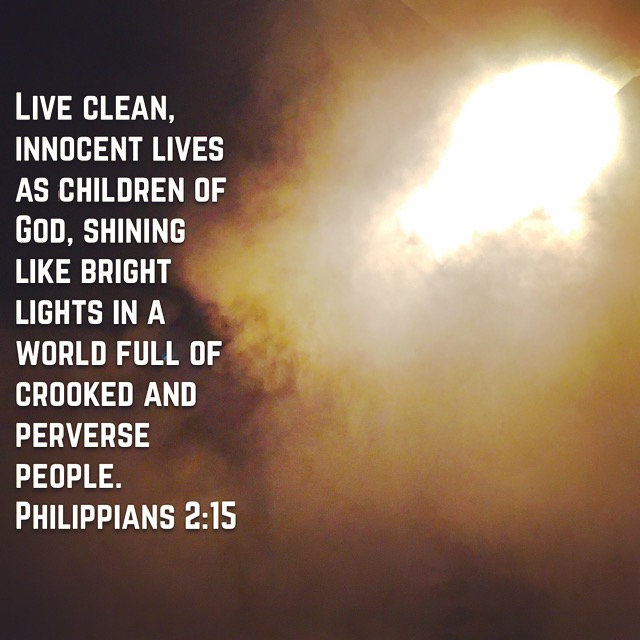
Paul called us to shine as well: Live clean, innocent lives as children of God, shining like bright lights in a world full of crooked and perverse people (Philippians 2:15). I believe this is a perfect definition of the word influence.The origin of the word meant the supposed flowing of ethereal fluid from the stars thought to affect the actions of men.Christians that let their good deeds shine in the darkness can influence the entire culture around them!
“Radical Christianity is not going on a missions trip or a big conference. Radical Christianity is staying steady for decades.” —Mike Bickle
Being a person that shines with favorable influence requires staying involved for the long haul so that you can build trustworthiness. It’s being in visible places not to get glory, but to let people see God’s glory. When they see His glory shine on you and out of you, they will want what you have too!
Solomon said, By the blessing of the influence of the upright and God’s favor—because of them the city is exalted (Proverbs 11:11). So, my fellow Christian, let me ask you:
Has God shined on you?
Are you letting Him shine out of you?
Are you living a noteworthy, trustworthy, visible life in your dark community?
“It’s your choice: You can be a part of your city’s elevation or its deterioration.”



 Tim Challies has a highly practical guide to helping you learn how to be more productive for God’s glory. Check out my full book review by clicking here.







 Craig T. Owens