For God so loved the world that He gave His one and only Son, that whoever believes in Him shall not perish but have eternal life. (John 3:16)
Then I said, “Here I am—it is written about Me in the scroll—I have come to do Your will, My God.” (Hebrews 10:7)
“How lowly did Jesus become to purge away our sins and that by Himself, too, using His own body to be the means, by His sufferings, of taking away our guilt. Not by proxy did He serve us, but by Himself. Oh, this is wondrous love!” —Charles Spurgeon
And by that will, we have been made holy through the sacrifice of the body of Jesus Christ once for all. (Hebrews 10:10)
Listen to the podcast of this post by clicking on the player below, and you can also subscribe on Apple, Spotify, or Audible.
Are you in touch with your emotions? While it might sound like something out of a Hallmark movie to some, having a robust emotional quotient is a vital skill for a leader. Join Greg and me as we get all emotional in this episode.
[0:32] There is something more important than IQ, and that’s EQ.
[1:51] Is EQ innate or is it learned?
[4:08] Is EQ a hard skill or a soft skill? How do we measure EQ?
[5:37] EQ is not necessarily emotional regulation, although it is an important component of EQ.
[6:36] Some thoughts on how we can grow our EQ.
[8:07] Humility is absolutely essential to growing in EQ.
[11:27] Leaders who strive to put others first can grow in EQ.
[15:01] We have to get better at truly seeing people and knowing where they are emotionally.
[16:40] Leaders have to be aware of their own emotional state.
[17:31] It’s invaluable to have a third-party who isn’t emotionally invested in your situation come alongside you to give you perspective.
[18:26] Mentors can help us see ourselves more clearly, which helps us see others more clearly.
[21:30] Leaders need to remember that people are no machines, so we cannot think of them in terms of efficiency.
[23:14] Greg and I share examples of people who taught us how to be more aware of our emotional interactions with people.
[27:05] People want to know that leaders see them and hear them. Remembering this will help leaders grow their EQ.
Listen to the podcast of this post by clicking on the player below, and you can also subscribe on Apple, Spotify, or Audible.
In Philippians 4, Paul links together two important words: God and peace.
And the peace of God, which transcends all understanding, will guard your hearts and your minds in Christ Jesus. … Whatever you have learned or received or heard from me, or seen in me—put it into practice. And the God of peace will be with you. (Philippians 4:7, 9)
In Greek it’s the same two words: eirene Theos and Theos eirene.
God gives me a peace that is beyond what my natural mind can conceive, and it’s a peace that guards me and accompanies me wherever I go. Given the fact that the verse between these two mentions of the God of peace are about our thought life, it would seem that we need peace in our mind more than anywhere else. That sandwiched verse says:
Finally, brothers and sisters, whatever is true, whatever is noble, whatever is right, whatever is pure, whatever is lovely, whatever is admirable—if anything is excellent or praiseworthy—think about such things. (v. 8)
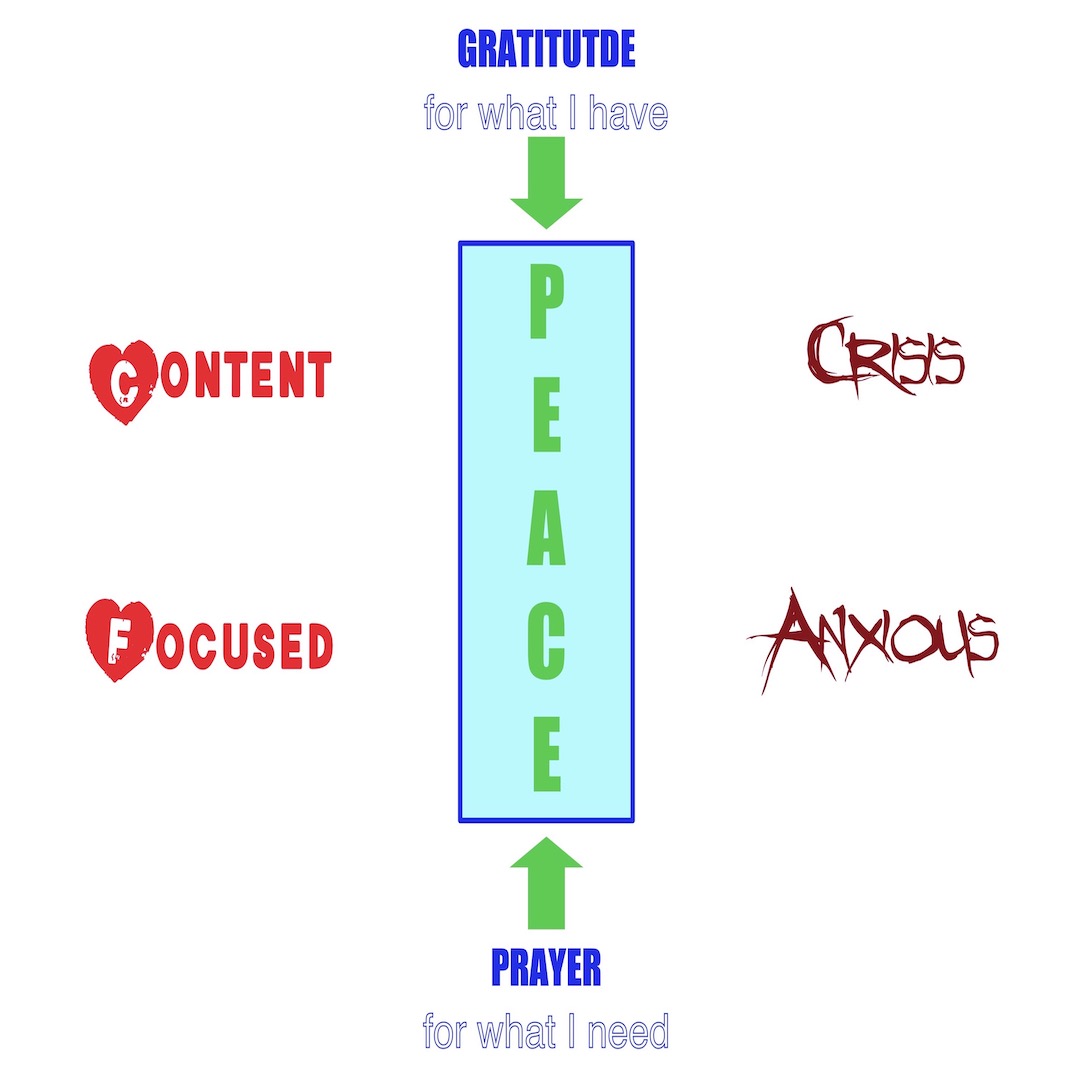
Peace is my protection from moving from contentment to crisis, or from focus on God to anxiety about His ability to provide for me. Crisis and anxiety are both peace robbers.
How is this protection of peace established? Verses 4-6 highlight two vital aspects:
Gratitude for what I have
Prayer for what I need
So if I find myself in crisis mode or feeling anxious, that means I have moved outside of the protection of peace that God wants to give me. In this place, if I were totally honest, my thoughts are probably the exact opposite of the list in verse 8. My peace-robbing thoughts are things that are false, feeble, and self-centered.
To step back into that place where peace protects me and guards my mind and heart, I have to focus on two vital aspects:
Gratitude for what I have
Prayer for what I need
God wants me to live in a place protected by His peace because it brings Him glory. Think of it this way: Is my life a better testimony when I live perpetually in crisis mode or when I am content with God’s blessings? When I am anxious about God’s ability to meet my needs, or when my attention is focused on the all-sufficiency of my loving Heavenly Father?
The next time you feel yourself slipping into a crisis or feeling anxious, check your thoughts: Are they good and lovely, or are they dark and ominous? If they are the latter, take time to intentionally express your gratitude for your blessings, and then expectantly take your needs to God in prayer. Then watch as the God of peace brings you back into a place where your contentment and your focus on Him becomes your protection and also a winsome testimony to draw others to the Prince of Peace.
Listen to the podcast of this post by clicking on the player below, and you can also subscribe on Apple, Spotify, or Audible.
In one of my favorite movies—The Princess Bride—one character believe himself to be very smart. In fact, Vizzini considers Plato, Aristotle, and Socrates to be morons compared to his massive intelligence. But in one section of the movie he keeps using a singular word over and over again, until Inigo says to him, “You keep using that word. I do not think it means what you think it means!” Sometimes I wonder if this is what people want to say to Christians!
Every family has its own unique lexicon—words and phrases mean something to them that they don’t mean to others. Every industry has shorthand for its products and services. Every friend group has their own inside jokes. And we Christians are just as guilty.
Sometimes instead of saying, “Yes” we say, “Amen.”
Instead of calling someone, “Mr. or Mrs.” we call them, “Brother or Sister.”
We soften some of our stronger language by saying, “I’m grieved in my spirit,” instead of saying more honestly, “I’m really ticked off!”
And sometimes, to sound super-spiritual when we pray, we begin to speak in Old English.
Is it any wonder that people outside of our church circles sometimes look at us like we’re a bit off?
So what do we mean by calling ourselves “Christian”? This was not the preferred name for followers of Jesus in the early Church:
Saints—60x (only 4x in Acts)
Believers—43x (26x in Acts)
Disciples—24x (all in Acts)
Christian—3x
The word originates in Acts 11:19-26 (v. 19 references the persecution of 8:1). The Greek language follows the Roman pattern of adding “ian” to the name of a great leader whom others were following. King Agrippa used this word in Acts 26:28, showing us how it has gained traction.
Christ is not a proper name, nor is it the surname of Jesus. Christ means the anointed One. So it’s more correct for us to say, “Jesus the Christ” (as in John 1:41).
So to be a Christian is to follow the Anointed One. To believe that He died to pay the penalty for our sins, and that He rose to life again to give us His eternal life.
To be a Christian is to live like Jesus, or to live as His ambassadors (2 Corinthians 5:11-21).
To be a Christian is to continue to live like Jesus even in the face of opposition (1 Peter 4:12-16; 2:21-23; 3:13-17).
Christians are being the Church when they are intentionally living in a way that makes Jesus known as the Christ—the One and Only Anointed One.
Some excellent questions for Christians to ponder:
What do you mean when you say, “I am a Christian”?
Do others see and hear Jesus in what you do and say?
Does your verbal confession and lifestyle confession compel others to come to Jesus?
Let’s make sure our lives are the best definition of what the Bible says a Christian truly is!
Check out all of the other messages in this series by clicking here.
If leaders want to get the best ideas and implement the best strategies, they must invite everyone on their team to share from their unique perspective. This is the only way to get the whole picture. Check out this full conversation from The Craig and Greg Show.
T.M. Moore writes, “We can know that we love our neighbors when, like Jesus, we go seeking them, in order to touch them with His love.”
This last week marked the 187th anniversary of the first time “O.K.” was first published as an abbreviation. The word’s origin is an interesting story, with some calling it “one of the most ubiquitous terms in the world, and certainly one of America’s greatest lingual exports.”
“Meekness and gentleness are two of the ornaments of our faith. I would that some professed Christians would understand that unholy contentiousness is not after the mind of Christ, it is not according to that gracious command, ‘Take My yoke upon you, and learn of Me; for I am meek and lowly in heart and ye shall find rest unto your souls.’ No, the Christian must be willing to suffer wrongfully, and to bear it in patience; he is never to be one who renders evil for evil, or railing for railing.” —Charles Spurgeon, commenting on Titus 3:2
“Then, since according to the Lord’s warnings the blood of so many will be sought for at the hands of their shepherds, careful watch must be kept, that is, the Word of the Lord must be often preached, and preached by the shepherds, by the Church’s bishops and teachers, that none may perish through ignorance; for he perishes through lack of heed, his blood will be on his own head.” —Columbanus, Letter to Pope Boniface
“Knowledge will forever govern ignorance.” —James Madison
“A good friend is like a four-leaf clover, hard to find and lucky to have.” —Irish proverb
“When a man is getting better he understands more and more clearly the evil that is still left in him. When a man is getting worse he understands his own badness less and less. A moderately bad man knows he is not very good: a thoroughly bad man thinks he is all right. This is common sense, really. You understand sleep when you are awake, not while you are sleeping. You can see mistakes in arithmetic when your mind is working properly: while you are making them you cannot see them. You can understand the nature of drunkenness when you are sober, not when you are drunk. Good people know about both good and evil: bad people do not know about either.” —C.S. Lewis, Mere Christianity
“If you want to win the day, you’ve got to flip the script. How? The Bible is a good starting point. Scripture is more than our script; it’s our script-cure. And that’s more than a play on words. Scripture confronts the false identities and false narratives perpetrated by the Father of Lies. It reveals the heavenly Father’s metanarrative and the unique role that each one of us plays in it.” —Mark Batterson, Win The Day
My books are for my fellow pastors. Shepherd Leadership will help us keep the biblical metrics in mind when we are thinking about our leadership roles. When Sheep Bite is an invaluable resource to help pastors continue to serve their flock, even after being painfully attacked. And Amen Indeed is a book of prayers for pastoral effectiveness.
If you are a pastor—or if you love your pastor—please pick up copies of these books today!
Listen to the podcast of this post by clicking on the player below, and you can also subscribe on Apple, Spotify, or Audible.
In Paul’s second letter to his friend Timothy, he has quite a bit to say about love—really about two kinds of love.
For the Spirit God gave us does not make us timid, but gives us power, love and self-discipline. (2 Timothy 1:7)
What you heard from me, keep as the pattern of sound teaching, with faith and love in Christ Jesus. (2 Timothy 1:13)
Flee the evil desires of youth and pursue righteousness, faith, love and peace, along with those who call on the Lord out of a pure heart. (2 Timothy 2:22)
But as he nears the end of this letter, he warns Timothy about an entirely different kind of love. The word “love” appears six times in a span of just three verses, with four of those times being words that are unique in all of the New Testament. This is his warning about the last days—
But mark this: There will be terrible times in the last days. People will belovers of themselves,loversof money, boastful, proud, abusive, disobedient to their parents, ungrateful, unholy, without love,unforgiving, slanderous, without self-control, brutal,not lovers of the good,treacherous, rash, conceited, lovers of pleasure rather than lovers of God. (2 Timothy 3:1-4)
In “the last days,” the negative characteristics of people will be driven by their misplaced love. They will be…
…lovers of themselves. This is a unique word in the New Testament meaning their only interest is self-interest.
…lovers of money. These people are ambitious in their pursuit of more, more, more. They are covetous people. Luke uses this same word to describe some Pharisees “who loved money” (Luke 16:14). Literally translated, it means lovers of silver.
…without love. People so self-focused on their pursuits that the needs of others around them scarcely enter their thoughts, even if those people are their own family members.
…not lovers of the good. Another unique word that goes beyond simply lacking love, but being antagonistic toward people who are attempting to be loving and kind to others.
…lovers of pleasure. This unique word means a friend of hedonism. Their pursuit is not just money, but anything that will scratch their itch. This mindset never considers whether their pursuit is healthy, worthwhile, or even injurious to others.
…[not] lovers of God. This final unique word that Paul uses describes people who have decided to pursue anything except God. Or as the psalmist might say, there is no room for God in any of their thoughts (see Psalm 10:4).
This is why Solomon told us to guard our heart, or to pay attention to what our heart longs for (Proverbs 4:23), and why Jesus told us to monitor our words that are revealing the pursuits that are truly in our heart (Matthew 12:34).
Jesus identified the fulfillment of all the requirements of the law as loving God with all our heart, soul, mind, and strength, and then loving our neighbor with the same care that we would love ourselves (see Luke 10:25-37).
What kind of lover are you?
Are you pursuing God or are you pursuing your own pleasure?
You could gauge your love by asking these questions:
What or whom do I think about the most?
What do I talk about the most?
What do I do more than anything else?
We are, as Paul told Timothy, living in “the last days,” with the imminent return of Jesus. Honestly answering those three questions will help you know whether you will hear Jesus say, “Well done! Enter into your Master’s happiness” or, “Depart from Me. I never knew you.”
I pray that your partnership with us in the faith may be effective in deepening your understanding…. (Philemon 6 NIV)
Faith works! As Dr. Henry Halley noted, “Working faith is a sharing faith.”
Faithful working deepens our understanding of all the good things Jesus has given us. Those good things should then fuel us to share the good things—and the Source of all good things—with others.
I pray that the faith you share with us may deepen your understanding of every blessing that belongs to you in Christ. (Philemon 6 NET)
A faith that merely believes without acting would be an ineffective faith. A faith that works becomes a lifestyle testimony that points others to Jesus.
And I keep praying that this faith we hold in common keeps showing up in the good things we do, and that people recognize Christ in all of it. (Philemon 6 MSG)
It is a double blessing to do good things for others:
Listen to the podcast of this post by clicking on the player below, and you can also subscribe on Apple, Spotify, or Audible.
Last week we saw that the essential confession is not just, “I believe You are the Christ the Son of the living God,” but also, “I will take up my cross and follow You!” (Matthew 16:16-18, 24). Notice that these are “red letter words”—words spoken by Jesus. They are not “they say” words (like v. 14; Matthew 7:21-23).
Look at the very next red letter words in Matthew 7:24-27. Notice the two parts: hears and puts them into practice. That’s our verbal and our lifestyle confession. What are we hearing and putting into practice? “These words of Mine.”
Jesus is our Cornerstone. The dictionary defines this as, “something that is essential, indispensable; the chief foundation on which something is constructed or developed.”
Some sandy things to build your life upon:
what your family practiced
what your pastor preached
what your friends believe
You know how you will know how sure your foundation is? When the storms come! I recently heard a well-known scholar and Christian apologist in an interview. He was asked by a skeptic of Christianity if he had doubts, and he responded, “Sure, I have doubts. But I choose to believe what the Bible says.” And I thought, “How sad to live this way.” We have a reliable, unshakable foundation in Jesus (2 Corinthians 1:18-22; 1 Corinthians 15:58).
Religions and philosophies have come and gone.
Spiritual giants have stumbled, and fierce tyrants have growled and then died.
Traditions and societies have changed through the millennia.
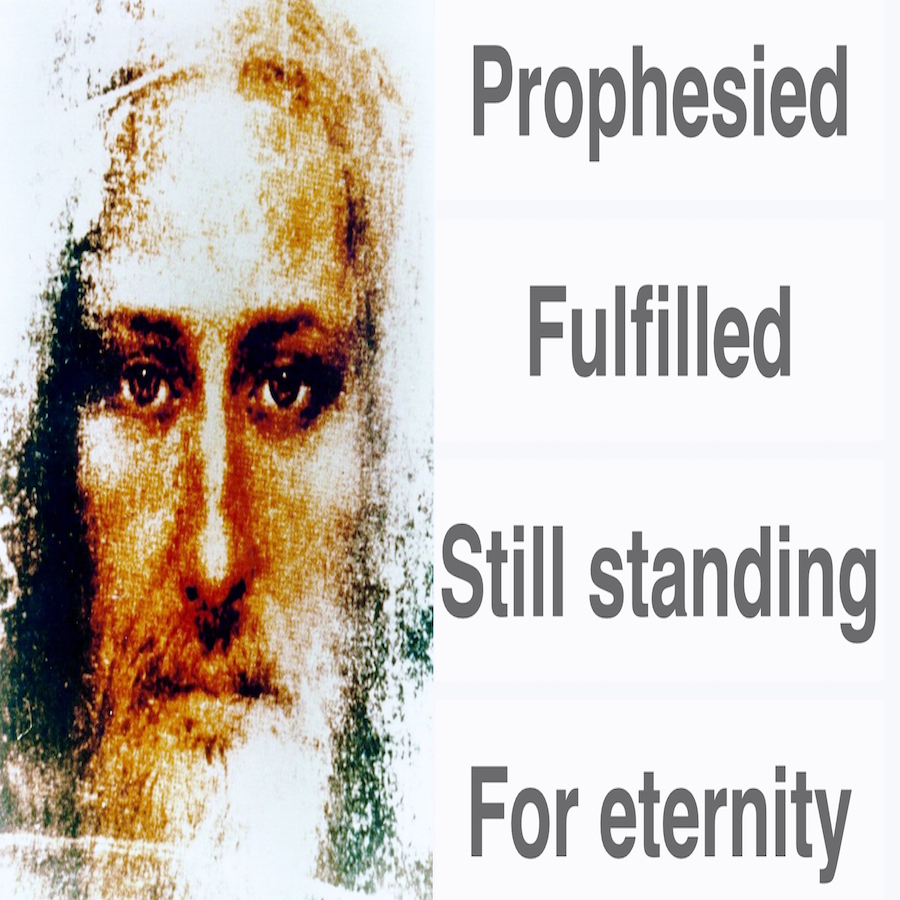
Our Cornerstone remains unmovable and we can stand on Him unshaken. This foundation…
…was prophesied—Isaiah 28:16; Psalm 118:22
…was fulfilled—Matthew 21:42; Acts 4:11-12
…is still standing today—Ephesians 2:19-20; 1 Peter 2:4-6
…will still be standing for all eternity—Revelation 21:5; John 14:1-4
So there is no need to be afraid. There is no need to get frustrated. There is no need to engage in meaningless debates with the “they say” crowd. Stand firm on the red letter words—our Cornerstone.
“On Christ the solid rock I stand, all other ground is sinking sand!”
Check out all of the other messages in this “I Will Build My Church” series here.
Comedian Brian Regan has a great bit about the “Me Monster.” Don’t be that person! John Maxwell wrote, “The problem is that interrupting translates to ‘What I want to say is more important than what you are saying.’” We probably can all do better at this.
“To bear the burdens of others we need to be careful to maintain an attitude of humility, coupled with a readiness to serve, according to the gifts and opportunities God gives us at any time (Romans 12:3-8). Even if it’s true that our fellow believers are acting like children, or like people who just need to ‘grow up’ in their faith, our responsibility is to humble ourselves and be ready to show them the love of Jesus however we may (Romans 14:1-18).” —T.M. Moore
“A cosmos one day being rebuked by a pessimist replied, ‘How can you who revile me consent to speak by my machinery? Permit me to reduce you to nothingness and then we will discuss the matter.’ Moral: You should not look a gift universe in the mouth.” —G.K. Chesterton [see Job 38:1-4]
“Moral principles do not depend on a majority vote. Wrong is wrong, even if everybody is wrong. Right is right, even if nobody is right.” —Fulton Sheen