Baruch was a faithful scribe and friend to Jeremiah. Not only did he transcribe all of Jeremiah’s dictation (twice!), but he also read all of Jeremiah’s words at the temple when the prophet was under house arrest. By identifying with Jeremiah, Baruch became the target of the false prophets’ vitriol.
Perhaps Baruch had big plans for his life, but those plans seemed thwarted because he was obedient to Jeremiah and to God. He was having a bit of a pity party which seemed to stem from his unrealized plans for himself.
I love the juxtaposition between two phrases in this chapter:
“You [Baruch] have said…” (v. 3)
“The Lord says…” (v. 4)
Baruch said, “My plans are failed.” God said, “My plans always prevail.”
Baruch said, “I’m done for.” God said, “Wherever you go, you will live.”
I have to stop listening to me. When I listen to me, my thwarted plans bring about a pity party. I have to keep listening to God. When I do, He brings life wherever He sends me.
I believe that shepherd leaders can learn a valuable lesson from Baruch’s life. In fact, in my book I talk about a time that God and my wife had to deal with me about my own pity party.
Shepherd Leadership: The Metrics That Really Matter is available in print or ebook, and in audiobook through either Audible or Apple.
Listen to the podcast of this post by clicking on the player below, and you can also subscribe on Apple, Spotify, or Audible.
Isaiah 52–53 contain a description of Jesus as a servant leader. One phrase describes Him like this: “See, My Servant will act wisely” (Isaiah 52:13).
That phrase “act wisely” is translated in some other translations of the Bible as “deal prudently.” I like that word prudently. It’s not a word that we use very often today, but it’s one that sets God’s servant leaders apart from worldly leaders.
Prudent can be described as…
circumspect
intelligently speaking and acting
teaching skillfully
having increasing understanding and insight
helping others grow in understanding
behaving appropriately
living wisely
guiding oneself and others willingly
What happens to the leader who lives and leads this way? Listen to the entire verse that I only quoted a portion of earlier—
See, My Servant will act wisely; He will be raised and lifted up and highly exalted.
Notice that this exalted person is described as a servant—not just anyone’s servant, but Jehovah’s servant. As a servant of God, Jesus becomes a servant of all. And as a servant of God, He is exalted and honored above all.
Jesus is every leader’s Ultimate Example of this. Jesus set aside every prerogative He had that would give Him the right to do things His way, in order to make Himself a servant of God and a servant of mankind (Philippians 2:6-11; Mark 10:45). Jesus gave all of His followers this example to emulate (John 13:15-17), so Paul tells us our “mindset should be the same as that of Christ Jesus” (Philippians 2:5).
I need to ask myself a question—and I would invite you to ask yourself this too: As a leader, am I growing in Christlike prudence?
A mark of a godly leader is one who can see his growth in prudence.
Jesus, may You be pleased as I follow Your example of living and leading prudently. Holy Spirit, help me see the areas in my life where I need to submit to You. Father, may You be pleased to bless my leadership as it aligns with Your heart. I want to act wisely, lead prudently, and help others to follow this example of Jesus for themselves.
This is part 61 in my series on godly leadership. You can check out all of my posts in this series by clicking here.
Listen to the podcast of this post by clicking on the player below, and you can also subscribe on Apple, Spotify, or Audible.
We saw that our beautiful Jesus became grotesque—taking our ugly sin on Himself so that He could clothe us with His perfectly righteous robe. In so doing, He became even more resplendent. His friend John saw Him in such radiant beauty that he crumbled to his knees at the sight of His majesty (Revelation 1:12-16)!
Just like John and others in the Bible, when we see ourselves in contrast to His awesome beauty, we often feel shabby and unworthy to be in His presence. Job expressed his desire to somehow get away from this Perfection (Job 7:11-21). Ultimately, in his desperation, Job utters something prophetic—
God is not a mere mortal like me that I might answer Him, that we might confront each other in court.If only there were someone to mediate between us, someone to bring us together,someone to remove God’s rod from me, so that His terror would frighten me no more.Then I would speak up without fear of Him, but as it now stands with me, I cannot.(Job 9:32-35)
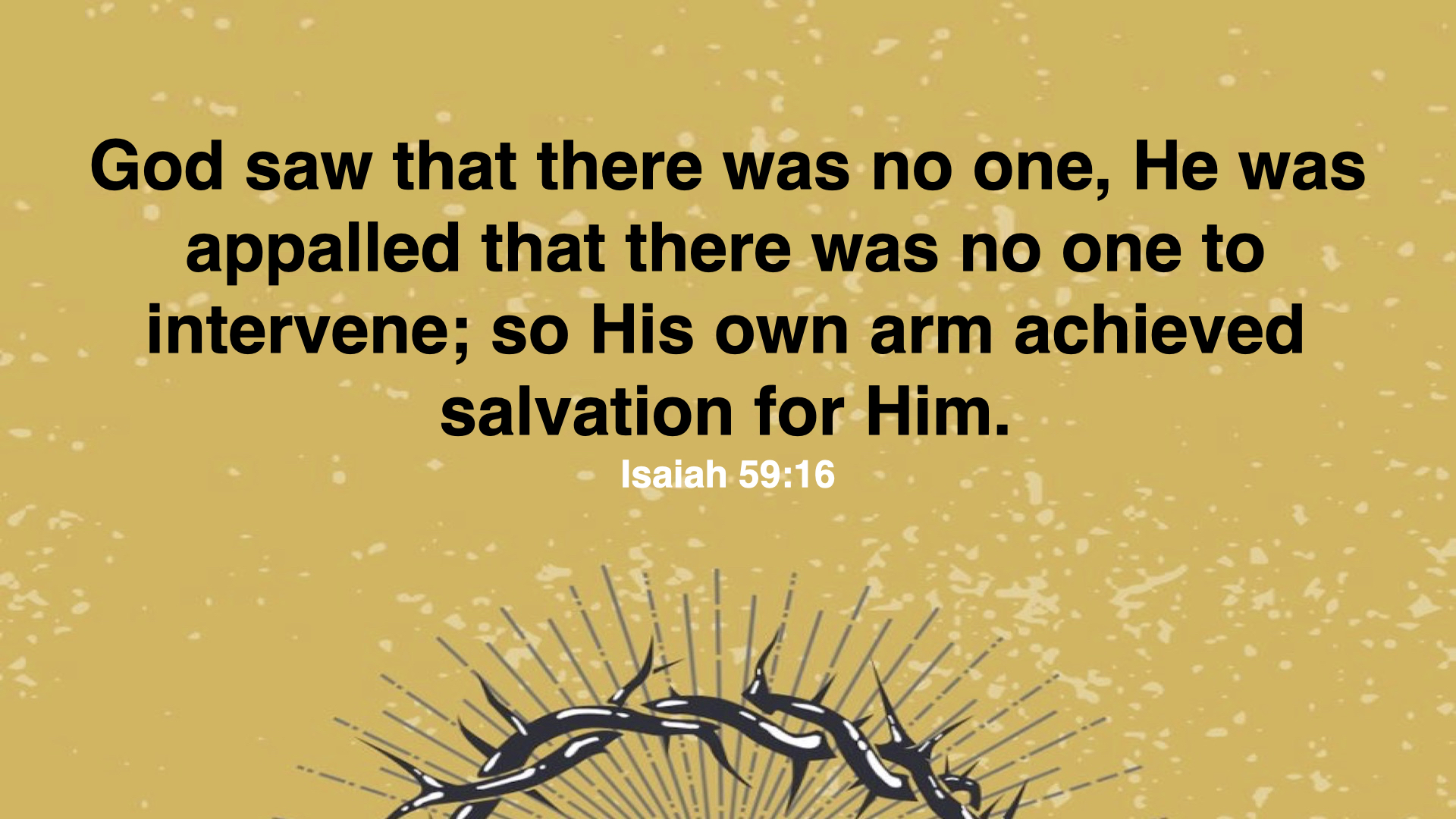
When we are confronted with the perfection of God, we all want “someone to arbitrate”—someone who will fairly represent both sides. We need someone both God and man. Since man cannot become God, only God can become man. Isaiah prophesied it this way, “God saw that there was no one, He was appalled that there was no one to intervene; so His own arm achieved salvation for Him” (Isaiah 59:16).
Christ or Messiah means “anointed by God” and is His divine title. Often His title is used with the definite article “the” to signify that Jesus is the One and Only Messiah (Luke 2:26-27; John 1:41; Matthew 16:16; Acts 10:38).
William Barclay commented on this: “Peter states [that Jesus was a human descendent of David] in the first recorded sermon of the Christian Church (Acts 2:29-36). Paul speaks of Jesus Christ descended from David according to the flesh (Romans 1:3). The writer of the Pastoral Epistles urges men to remember that Jesus Christ, descended from David, was raised from the dead (2 Timothy 2:8). The writer of the Revelation hears the Risen Christ say: ‘I am the root and the offspring of David’ (Revelation 22:16).”
Many times this human name and divine title are linked together. In Hebrews, the name Jesus is used more times than any other title (19x), and Christ is the second-most used title (15x).
Hebrews makes it perfectly clear how important it is that Jesus was made fully human just like us. We read phrases like…
“made a little lower than the angels,” which was David’s way of talking about humans (see Psalm 8:4-6)
“made perfect through suffering”—only humans can suffer
“flesh and blood”
“made like His brothers in every way”
“His life on earth”
Remember that I said the most-used titles in Hebrews were Jesus and Christ. The third-most used title in Hebrews is high priest (14x). Only the Human Jesus and the Divine Jesus could be the perfect High Priest and Mediator that Job longed for, and that you and I have to have!
This post is a part of a bigger series on prayer with the subtitle: “Learning to pray in the awesome name of Jesus.” So what does it mean that we can pray in the human name of Jesus?
It means we don’t have to pray majestic prayers in order for God to take notice. We can pray very human prayers, we can groan with real human pain, we can growl with real human anger. Our totally human Jesus understands us, and the totally divine Christ runs to help us!
Don’t try to sanitize your prayers to make them sound acceptable. Jesus didn’t! How awesome it is to have a High Priest who is both fully human and fully divine!
I love Charle Spurgeon’s definition of godliness: “God Himself is the power of godliness. The Holy Spirit is the life and force of it. Godliness is the power that brings a man to God and bind him to Him. Godliness is that which creates repentance toward God and faith in Him. Godliness is the result of a great change of heart and reference to God and His character. Godliness looks toward God and mourns its distance from Him. Godliness hastens to draw near and rests not till it is at home with God.
“Godliness makes a man like God. Godliness leads a man to love God and to serve God. It brings the fear of God before his eyes and the love of God into his heart. Godliness leads to consecration, to sanctification, to concentration. The godly man seeks first the kingdom of God and His righteousness and expects other things to be added to him. Godliness makes a man commune with God and gives him a partnership with God in His glorious designs. And so it prepares him to dwell with God forever.”
The folks at Axis Ministry provide some amazing insights for parents (and youth pastors) of pre-teens through the early college years. I would highly recommend subscribing to their free weekly email. Here is their Parent’s Guide To Teen Emotions, which is a free PDF for you to download.
Listen to the podcast of this post by clicking on the player below, and you can also subscribe on Apple, Spotify, or Audible.
I had a great time on the Thriving In Ministrypodcast with Kyle Willis and Dace Clifton.
Kyle asked me how I lead myself so that I can stay effective in my leadership roles.
Effective and long-lasting leadership really does start with the leader’s self-leadership practices. I have to know myself well, so I am a big proponent of taking as many assessments as I can. These give me a window of insight into how I’m thinking and how I’m communicating. As I get to know myself better, I can get to know the sheep around me better as well.
We all have a native way of thinking, speaking, and leading. It’s arrogant to think we can just “say it like it is” and everyone around us will immediately understand. Instead, I need to understand how my thinking and speaking “dialects” are unique to me, and that everyone on my team and every sheep in my pasture also have their own unique dialects. It’s as I get a window of insight into the way God has uniquely wired me, that I will also begin to appreciate the uniqueness of those around me. This will allow me to lovingly speak in their native dialect.
I’ll be sharing more clips from this Thriving In Ministry interview soon, so please stay tuned. Shepherd Leadership: The Metrics That Really Matter is available in print or ebook, and in audiobook through either Audible or Apple.
This is a weekly series with things I’m reading and pondering from Charles Spurgeon. You can read the original seed thought here, or type “Thursdays With Spurgeon” in the search box to read more entries.
Listen to the podcast of this post by clicking on the player below, and you can also subscribe on Apple, Spotify, or Audible.
Be Careful
Having a form of godliness but denying its power…. (2 Timothy 3:5)
Time was when to be a Christian was to be reviled, if not to be imprisoned and perhaps burned at the stake. Hypocrites were fewer in those days, for a profession cost too much. …Today religion walks forth in her velvet slippers. And in certain classes and ranks, if men did not make some profession of religion, they would be looked upon with suspicion. Therefore men will take the name of Christian upon them and wear religion as a part of full dress. …
I do not doubt that a form of godliness has come to many because it brings them ease of conscience and they are able, like the Pharisee, to thank God that they are not as other men are. …
Many who have the form of godliness are strangers to its power and so are in religion worldly, in prayer mechanical, in public one thing, and in private another. True godliness lies in spiritual power, and they who are without this are dead while they live. …
In the depths of winter, can you warm yourself before a painted fire? Could you dine off the picture of a feast when you are hungry? There must be vitality and substantiality—or else the form is utterly worthless and worse than worthless, for it may flatter you into deadly self-conceit. Moreover, there is no comfort in it. The form without the power has nothing in it to warm the heart, to raise the spirits, or to strengthen the mind against the day of sickness or the hour of death. …
If you tremble at God’s Word, you have one of the surest marks of God’s elect. Those who fear that they are mistaken are seldom mistaken. If you search yourselves and allow the Word of God to search you, it is well with you. …
If the Spirit of God leads you to weep in secret for sin and to pray in secret for divine grace, if He leads you to seek after holiness, if He leads you to trust alone in Jesus, then you know the power of godliness, and you have never denied it.
From The Form Of Godliness Without The Power
Spurgeon mentioned the Pharisee that said, “God, I thank You that I am not like other people. Especially like that tax collector over there.” Jesus said that the tax collector who humbly said, “God, be merciful to me, a sinner” is the one who went home justified by God (see Luke 18:9-14).
That’s where the warning comes in. When we begin to compare ourselves to others, when we begin to say, “I’m better than him” or “At least I don’t mess up as bad as she does,” instead of judging ourselves by God’s standard, we are in real danger of having merely a form of godliness without any real power.
Paul said, “So, if you think you are standing firm, be careful that you don’t fall,” and challenged each of us to “test their own actions. Then they can take pride in themselves alone, without comparing themselves to someone else” (1 Corinthians 10:12; Galatians 6:4).
I would challenge everyone that calls themself a Christian to be careful! Don’t fool yourself by saying, “I do all of the things a Christian is supposed to do, so I must be standing firm.” But ask the Holy Spirit to reveal to you even your hidden sins, and then just as the tax collector who experienced God’s reassurance in his heart did, pray: “God, be merciful to me. Help me to correct what’s wrong. May my life be godly not just in outward performance, but in the power that can only come from a vibrant, growing relationship with You!”
Let’s all strive to not only have the form of godliness, but to have the real energizing power of godliness on full display in our daily lives.
John Newton’s autobiography Out Of The Depths contains a very interesting closing chapter. They are not the words written by John Newton, but the words spoken by him to his friends and parishioners. Here are a few that especially caught my attention. You can check out my full book review of Out Of The Depths by clicking here.
“If two angels were sent from heaven to execute a divine command, one to conduct an empire and the other to sweep a street in it, they would feel no inclination to change employments.”
“A Christian should never plead spirituality for being a sloven. If he be but a shoe cleaner, he should be the best in the parish.”
Listen to the podcast of this post by clicking on the player below, and you can also subscribe on Apple, Spotify, or Audible.
All this also comes from the Lord Almighty, whose plan is wonderful, whose wisdom is magnificent (Isaiah 28:29).
Throughout the Scripture, God always makes clear the two options we have: Our way or His way.
Man’s way is described like this: “For it is: do this, do that, a rule for this, a rule for that, a little here, a little there” (v. 10). In other words, man says, “We’ve got this all figured out. We have a plan for everything.”
Until they don’t.
Until the world is not going according to plan, and worldwide panic sets in, and a new plan needs to be formulated. In the meantime, people are fearful, angry, confused, and panicking.
God describes His way like this: “See, I lay a stone in Zion, a tested stone, a precious cornerstone for a sure foundation; the one who relies on it will never be stricken with panic” (v. 16).
So here’s the decision everyone will have to make: Will I trust the puny plans of a finite human, and experience the panic that sets in when those plans fail? Or will I put my trust in the only One whose plans are never thwarted? One plan leads to panic, and the other leads to peace.
Listen to the podcast of this post by clicking on the player below, and you can also subscribe on Apple, Spotify, or Audible.
I’ve heard it reported (and I quite believe it) that “Amazing Grace” is the best-known song in the world. This song of God’s unfathomable grace was written by a pastor who was once a slave trader. Out Of The Depths is the autobiography of slave-trader-turned-pastor John Newton.
This story is told largely through the re-printing of letters that John Newton wrote to a friend over a lengthy correspondence. The original letters were not preserved, so as Mr. Newton wrote them again, he said that he added details that he hadn’t included in the first writing. Then the book closes with some remembrances of a dear friend, and a compilation of some short maxims that Pastor Newton used in his sermons and in conversations with friends.
One of the real benefits of Newton writing these letters so long after the actual events is his ability to look back at the lessons he learned through his various trials. Granted, many of his trials were brought on by his own stubbornness, but still the beginning of the message of grace from his memorable hymn is heard in the recounting of these stories.
Another key aspect of his story is his relationship with his wife. She and her family were much more committed Christians than Newton was at the time he began to show an interest in his bride-to-be, but neither she nor her family allowed the courtship to proceed until Newton had entirely surrendered his life to Jesus Christ. Their marriage was a source of great strength and encouragement to Pastor Newton.
I highly recommend this book to those who enjoy learning about the key figures of church history.



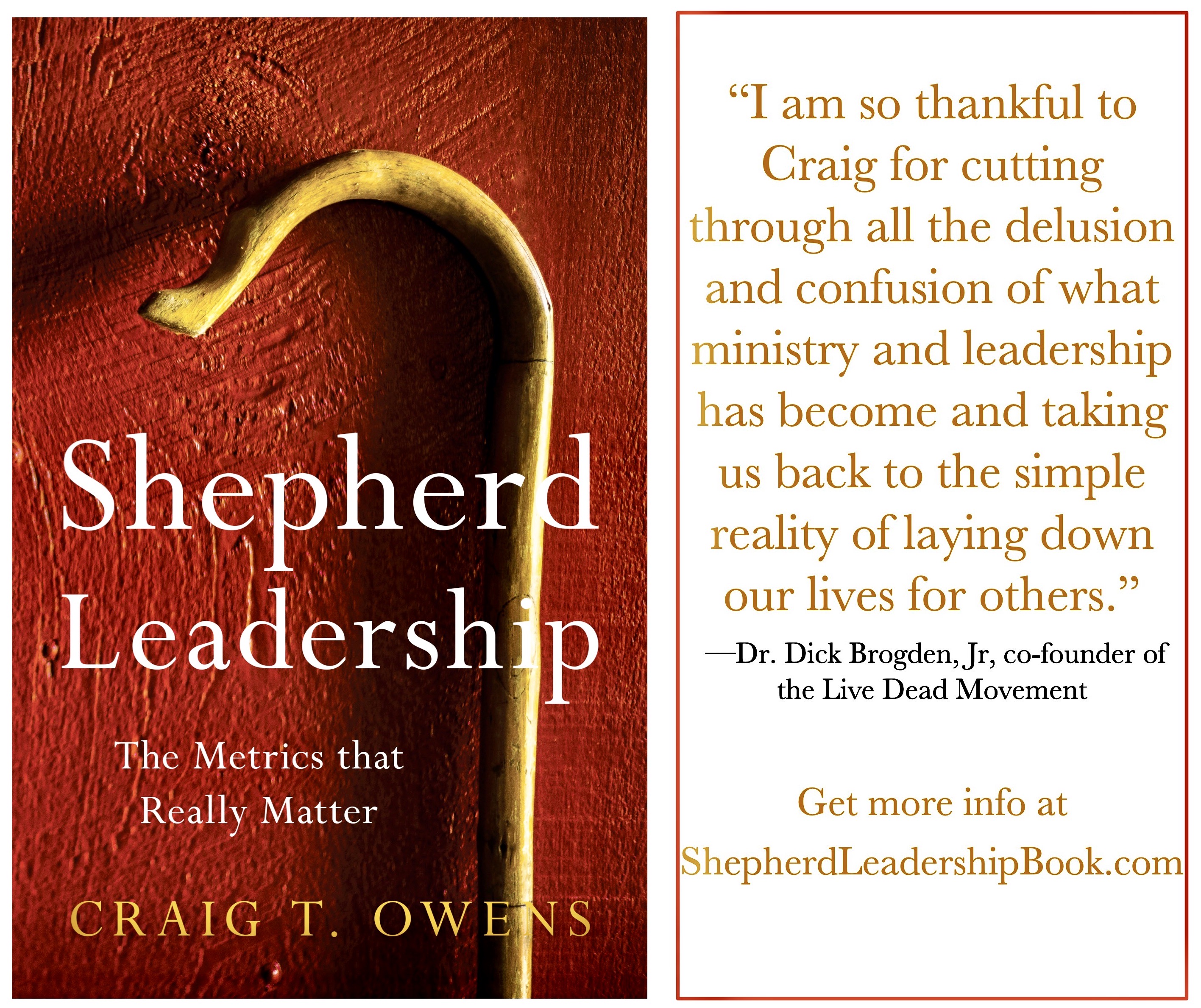 In my book Shepherd Leadership: The Metrics That Really Matter I talk about a man named Baruch. You can check out his story in Jeremiah 45 (it’s just five verses long).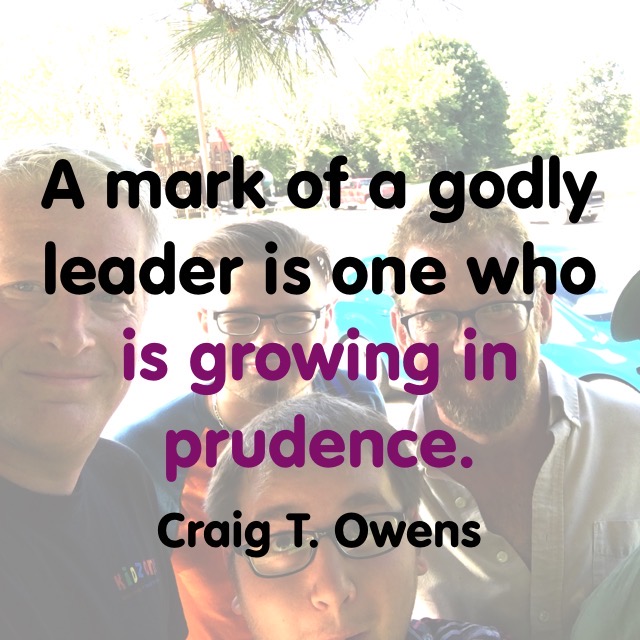








 Craig T. Owens
Links & Quotes
January 28, 2022 — Craig T. OwensI love Charle Spurgeon’s definition of godliness: “God Himself is the power of godliness. The Holy Spirit is the life and force of it. Godliness is the power that brings a man to God and bind him to Him. Godliness is that which creates repentance toward God and faith in Him. Godliness is the result of a great change of heart and reference to God and His character. Godliness looks toward God and mourns its distance from Him. Godliness hastens to draw near and rests not till it is at home with God.
“Godliness makes a man like God. Godliness leads a man to love God and to serve God. It brings the fear of God before his eyes and the love of God into his heart. Godliness leads to consecration, to sanctification, to concentration. The godly man seeks first the kingdom of God and His righteousness and expects other things to be added to him. Godliness makes a man commune with God and gives him a partnership with God in His glorious designs. And so it prepares him to dwell with God forever.”
The folks at Axis Ministry provide some amazing insights for parents (and youth pastors) of pre-teens through the early college years. I would highly recommend subscribing to their free weekly email. Here is their Parent’s Guide To Teen Emotions, which is a free PDF for you to download.
Share this: