Listen to the podcast of this post by clicking on the player below, and you can also subscribe on Apple, Spotify, or Audible.
God needed the Ninevites to hear the message of impending judgment, and He needed Jonah to deliver that message and call the Ninevites to repentance. In four short chapters, the phrases about God providing what was needed appear six times!
Because His messenger was running away and prejudiced against the Ninevites, God had to provide the means to get Jonah’s attention and provide a way to get him back on mission. So God provided…
…a great wind on the sea (1:4)
…a huge fish to swallow Jonah (1:17)
…the command to the fish of where and when to deposit Jonah (2:10)
…a green plant, a worm, and a scorching east wind to awaken Jonah to his prejudice (4:6-8)
The storm God provided caused the sailors to turn to God. The fish God provided caused Jonah to turn to God. And the sermon God provided Jonah to preach caused the Ninevites to turn to God.
What about the worm and the wind? Did those cause Jonah to turn his attention back to God? The Bible doesn’t tell us because I believe we each have to complete that story ourselves. When God provides trials, discomforts, and even disasters, they are intended to get our attention.
Let’s keep this in mind the next time things aren’t going the way we had planned. Instead of complaining—or even praying for God to remove us from those difficulties—let’s instead ask ourselves:
Have I been disobedient to something God has directed me to do?
Have I allowed myself to get off-track?
Is my attitude about my God-directed assignment God-honoring?
Is there something God is trying to bring to my attention?
God provides everything needed to keep us on mission for Him. Let’s not try to get out of these difficulties, but let’s ask Him what we need to get out of these difficulties.
Listen to the podcast of this post by clicking on the player below, and you can also subscribe on Apple, Spotify, or Audible.
Our cravings are implanted by God and are fulfilled solely in our relationship with Him. Sometimes the journey seems long. If you have been in the car with kids, you know they are infamous for asking, “Are we there yet?” just a couple of minutes into the trip. We adults aren’t much better. Perhaps we have a little more patience but if we’re honest we may find ourselves asking, “How long is this going to take? It seems like it’s soooo long!”
We’ve discussed that a maturing attitude shift for us is exchanging “have to” for “get to.” This is when we begin to understand that something good—something far better than what we have now—is coming. This is the starting point to help us to wait well, to not get frustrated and bail out.
Jesus did this: “For the joy set before Him He endured the Cross” (Hebrews 12:2). He could see what was coming so He wouldn’t accept any lesser substitutes. But that same verse also calls us to be “looking away from all that will distract to Jesus” (Hebrews 12:2 AMP).
This attitude exchange helps us in three ways:
Maturing self-control
Understanding the rewards of delayed gratification
Having a joyful expectation of both what’s coming and what’s happening now
Self-control, delayed gratification, and joyful expectation are also the key components of a satisfying relationship. These then allow me to make another important exchange: “don’t” for “won’t.”
For example, in my relationship with my wife Betsy, no one has to tell me, “Don’t speak to her unkindly.” I won’t speak to her unkindly because that would damage our relationship. No one has to tell me, “Don’t flirt with other women.” I won’t do that because I know that would jeopardize our relationship, perhaps causing me to look elsewhere to satisfy my craving for a meaningful relationship.
In the book called Song of Solomon, the word “lovely” is used frequently between lovers who only have eyes for each other. Paul uses this keyword when he talks about us only having our eyes, and heart, and mind on Jesus—“Whatever is true, whatever is noble, whatever is right, whatever is pure, whatever is lovely, whatever is admirable—if anything is excellent or praiseworthy—think about such things” (Philippians 4:8).
David, who is described as a man after God’s own heart, wrote several psalms expressing his longing to be in God’s presence both now and for all eternity. Especially in Psalm 16 and Psalm 37, David shows us the don’t-for-won’t exchange (Psalm 16:1-11; 37:1-4).
Sometimes we will experience some lovely things here on earth, but those are nothing compared to the eternal rewards awaiting us. C.S. Lewis wrote, “Our Father refreshes us on the journey with some pleasant inns, but will not encourage us to mistake them for home.”
Even if we experience unpleasant things here, the apostle Paul reminds us, “But what of that? For I consider that the sufferings of this present time—this present life—are not worth being compared with the glory that is about to be revealed to us and in us and for us and conferred on us!”(Romans 8:18 AMP).
The marshmallow test is a famous experiment. Kids were given the choice to eat one marshmallow immediately or be rewarded with a second marshmallow if they waited. Researchers found that those who practiced self-control, delayed gratification, and joyful expectation faired much better later in life.
So I would encourage you to keep your marshmallow somewhere you will see it often. It will harden, but it will not mold or spoil. Every time you look at it, let it remind you that what’s coming is so much more than anything you could ever find here! Let this reminder help you exchange don’t for won’t as the Holy Spirit helps you keep your eyes only on Jesus.
This is the most-viewed reel I have ever shared on Instagram! The Bible isn’t a bunch of “once upon time” stories but they are actual events at actual moments in history. Check out how Jesus verifies the historicity of the Bible.
“All obedient believers are near akin to Jesus Christ. They wear His name, bear His image, have His nature, are of His family. He loves them, converses freely with them as His relations. He bids them welcome to His table, takes care of them, provides for them, sees that they want nothing that is fit for them: when He died He left them rich legacies, now He is in heaven He keeps up a correspondence with them, and will have them all with Him at last, and will in nothing fail to ‘do the kinsman’s part’ (Ruth 3:13), nor will ever be ashamed of His poor relations, but will confess them before men, before the angels, and before His Father.” —Matthew Henry
Even skeptics of the claims of the Bible cannot help including biblical themes in their books, movies, plays, and TV shows. I discussed that in this apologetic video—
This is a weekly series with things I’m reading and pondering from Charles Spurgeon. You can read the original seed thought here, or type “Thursdays With Spurgeon” in the search box to read more entries.
Listen to the podcast of this post by clicking on the player below, and you can also subscribe on Apple, Spotify, or Audible.
Christians Shouldn’t Be Lazy
A man who wastes his time and his strength in sloth offers himself to be a target for the devil, who is a wonderfully good rifleman and will riddle the idler with his shots: In other words, idle men tempt the devil to tempt them. …
The Lord Jesus tells us Himself that while men slept the enemy sowed the tares. That hits the nail on the head, for it is by the door of sluggishness that evil enters the heart more often, it seems to me, than by any other. …
All are not hunters to wear red coats, and all are not working men who call themselves so. I wonder sometimes that some of our employers keep so many cats that catch no mice. …
I wish all religious people would take this matter under their consideration, for some professors are amazingly lazy and make sad work for the tongues of the wicked. I think a godly plowman ought to be the best man in the field and let no team beat him. When we are at work, we ought to be at it and not stop the plow to talk, even though the talk may be about religion. For then we not only rob our employers of our own time, but of the time of the horses, too.
From John Ploughman’s Talks of Plain Advice For Plain People
Listen to the podcast of this post by clicking on the player below, and you can also subscribe on Apple, Spotify, or Audible.
In my book Shepherd Leadership, I have two back-to-back chapters where I explore how leaders can properly leverage the way God has wired them to be successful. Check out this paragraph:
“God has created each of us uniquely—implanted with the temperament, talents, and personality He wanted each of us to have. God made you on purpose, and He made you for a purpose. But that being said, shepherd leaders are almost never perfectly balanced. If you’ve ever taken a temperaments assessment or any other kind of personality test, you know that you had some attributes that were more prominent than others. God never gives us weaknesses, but our areas of strength can become a self-imposed weakness if we rely on our strength instead of on our Strength Giver.”
When I was interviewed on the Leading From Alignment podcast, John Opalewski was especially interested in that line, “our areas of strength can become a self-imposed weakness if we rely on our strength instead of on our Strength Giver.” Check out the conversation that followed between John, his cohost Jim Wiegand, and me…
It’s true that having honest, loving feedback from a mentor, friend, or coach can be invaluable in helping us avoid getting tripped up by our God-given strengths. As I said in the interview, you are probably unaware of how your own strengths may be sabotaging your full potential as a leader. Don’t let your strengths become your weaknesses—allow a friend or coach to help you address these areas.
If I can be of assistance, please contact me. I believe Shepherd Leadership can also help you. As Jim mentioned, “That’s why I love your book and I hate your book!”
I’ll be sharing more clips from this Leading From Alignment interview soon, so please stay tuned. Shepherd Leadership: The Metrics That Really Matter is available in print or ebook, and in audiobook through either Audible or Apple.
Listen to the podcast of this post by clicking on the player below, and you can also subscribe on Apple, Spotify, or Audible.
This is what the Lord Almighty says: “Cut down the trees and build siege ramps against Jerusalem. This city must be punished…” (Jeremiah 6:6).
When I read these 2500-year-old words it makes me shudder. Why? Because if we changed “Jerusalem” to “Washington, D.C.” and “Judah” to “America,” the sins of the people sound eerily the same:
arrogantly closed ears refusing to listen to God’s Word
people calling the loving message of the Bible “offensive”
the predominance of greed
deceptive “prosperity” preachers who are only in it for their own personal gain
shameless, detestable lifestyles
open rebellion against God’s laws
constant slandering of God and of people created in God’s image (vv. 10-28)
God says, “This city must be punished.”
But still, a hope remains. God also says, “Take warning, Jerusalem [or America], or I will turn away from you” (v. 8).
There is still time for repentance! There is still time to take heed of this loving warning and turn away from sin. That’s what repentance truly means—seeing our sins as disgusting in God’s sight, asking for forgiveness, and turning away from those sins.
Repentance means an about-face, so that instead of the catalog of sins that I just listed, we instead see:
a humility that hears and obeys God’s Word
living in contentment with God’s blessings and not lusting for anything more
listening to preachers who faithfully, lovingly, and boldly speak exactly what God has spoken to their hearts
being ashamed of our former sinful lifestyle, and gratefully receiving the forgiveness that Jesus purchased for us
and having a passion to help everyone live in this God-glorifying way
Repent, America! There is still time before God’s judgment falls on us. The historical record is there for all to read: Unrepented sin received God’s righteous judgment. But in His mercy, God is still giving us time to repent today. Don’t miss this golden opportunity!
We also said that although we would all like to have the job that was wonderful, even the crummy jobs deserve our best attitude and our best effort.
This is very much the same for our relationships. We would all love to only have relationships in our lives that are energizing, fulfilling, and win-win. But the reality is that many of our relationships may be the exact opposite of this.
Jesus said our love for others would show the world that we are His disciples. Oh yeah, and the love we show is supposed to be a “10” on the Jesus Love Scale (John 13:34-35). Why? Because that’s how Jesus loved us:
Now it is an extraordinary thing for one to give his life even for an upright man, though perhaps for a noble and lovable and generous benefactor someone might even dare to die. But God shows and clearly proves His own love for us by the fact that while we were still sinners, Christ (the Messiah, the Anointed One) died for us. (Romans 5:7-8 AMP)
Remember we said that God is Love? But love needs to have both a lover and beloved—someone reaching out and someone receiving. God is Father, Son, and Holy Spirit so God is Relational. The Father loving the Son and Spirit, the Son loving the Spirit and the Father, the Spirit loving the Father and the Son. All loving and promoting the Other.
God is also Happy in this Relationship.
Because we are created in God’s image, we have a God-implanted craving to love and to be loved, to have meaningful companionships (Genesis 1:26; 2:18).
Remember that Jesus was all-in for us so that we could have this love relationship with God.This same passage calls us to have the same attitude as Jesus had. But we can also back up just a couple of more verses to find out what fuels the relationships that satisfy our craving for companionship and please God (Philippians 2:1-11). Those characteristics include:
being like-minded in striving to find agreement with others
having the same love as Jesus demonstrated
being one in spirit—this unique Greek word reminds us we all have immortal souls. As C.S. Lewis reminded us, “It is a serious thing to live in a society of possible gods and goddesses, to remember that the dullest and most uninteresting person you talk to may one day be a creature which, if you saw it now, you would be strongly tempted to worship, or else a horror and a corruption such as you now meet, if at all, only in a nightmare. All day long we are, in some degree, helping each other to one of these destinations.”
being one in purpose
giving up selfish ambitions as we trade “me” for “we”
not indulging in vain conceit, but thinking more highly of others
being humble
always striving to find the win-win
When Alexander Dumas wrote The Three Musketeers his Musketeers have been given a famous line: “All for one and one for all, united we stand divided we fall.” This is actually quite biblical because the Bible only has saints in the plural form, never in the singular. And the apostle Paul reminds us, “And if one member suffers, all the parts share the suffering; if one member is honored, all the members share in the enjoyment of it” (1 Corinthians 12:26 AMP).
God is pleased when our attitude about our fellow saints is all for one and one for all—when all the saints love and nurture the individual saint, and when each individual saint loves and supports all the other saints.
We were created for this. We crave this. God is pleased when we live and love like this. And this is the only way we will experience the joy of God’s favor on our relationships.
In reading Matthew 12:38-40 I notice something important about how Jesus answered a request. Be careful of quarreling with those skeptical of Christianity. When it gets to point that they aren’t looking for evidence to believe but another point to argue, do what Jesus did: point them to the empty tomb!
Some skeptics of the Bible want to make the argument that the Gospels were written at a much later date, thus they aren’t as accurate. Cold-case detective J. Warner Wallace addresses that topic in this video.
This is a weekly series with things I’m reading and pondering from Charles Spurgeon. You can read the original seed thought here, or type “Thursdays With Spurgeon” in the search box to read more entries.
Listen to the podcast of this post by clicking on the player below, and you can also subscribe on Apple, Spotify, or Audible.
Understanding Repentance
Repentance is an old-fashioned word, not much used by modern revivalists.
“Oh!” said a minister to me one day, “it only means a change of mind.” This was thought to be a profound observation. “Only a change of mind”; but what a change! A change of mind with regard to everything!
Instead of saying, “It is only a change of mind,” it seems to me more truthful to say it is a great and deep change—even a change of the mind itself. But whatever the literal Greek word may mean, repentance is no trifle. You will not find a better definition of it than the one given in the children’s hymn:
Repentance is to leave
The sins we loved before
And show that we in earnest grieve,
By doing so no more.
From The Soul Winner
The Greek word Spurgeon references that is rendered as repentance is metanoia. Many have translated this as a “new mind.” But a more literal translation is “with new understanding.” When my carnal mind has been replaced by a spiritual mind, I now see everything differently—I understand everything differently.
The Amplified Bible elaborates it like this: Bring forth fruit that is consistent with repentance—let your lives prove your change of heart (Matthew 3:11).
More than just an about-face away from my old sinful habits, repentance is a more profound understanding of just how grievous my sinful lifestyle was to God. It repulses me to even consider indulging in those sins again because now that I understand how joy-filled my relationship with Jesus is when I walk in righteousness, I never want to even dabble in that slime again!
Listen to the podcast of this post by clicking on the player below, and you can also subscribe on Apple, Spotify, or Audible.
Leaders will always get some pushback from the people on their team. It doesn’t matter how much the people love their leader, when the leader shares a change or a correction, there will always be some people that are uncomfortable with that.
And they will pushback.
I’ve already shared some thoughts for leaders to make sure the issues they are addressing are biblical issues, not getting caught up in non-biblical controversies that can result in some very unbiblical attitudes! But when a leader is promoting a biblical change, there is a right way to handle it.
Check out how I discussed this topic with some ministry interns—
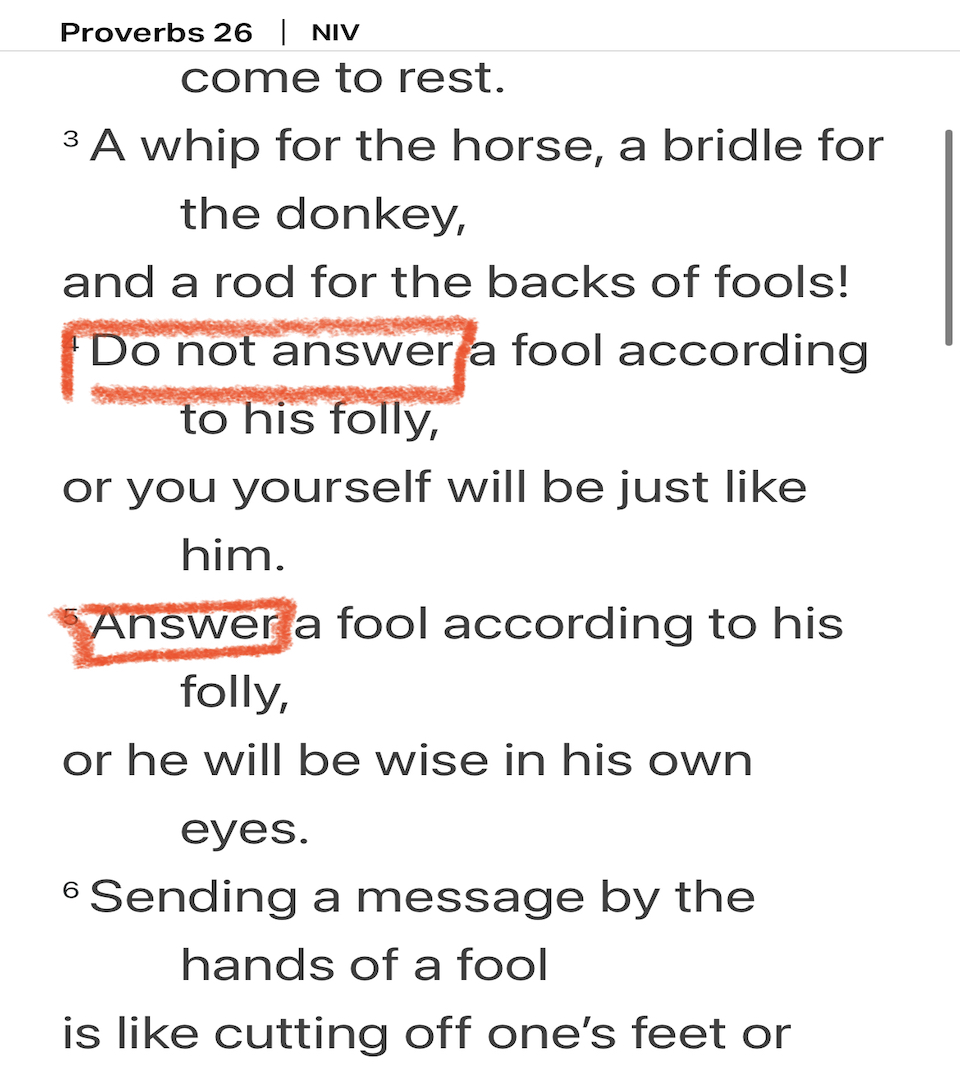
I really do like going back to those two verses in Proverbs:
Do not answer a fool according to his folly, or you yourself will be just like him. Answer a fool according to his folly, or he will be wise in his own eyes. (Proverbs 26:4-5)
Make sure you are not arguing just to argue. Good leaders only speak up for the good of the team and the individuals on the team. They never speak up just because they need to prove themselves right or they need to win an argument.
If you would like to go a little deeper into this, you may want to check out a couple of other posts and videos I’ve shared:
Handling pushback the right way is going to be an important component of your leadership, so take some time to get it right the first time. If I can help coach you through a leadership challenge you are facing, please don’t hesitate to get in touch with me.



 God needed the Ninevites to hear the message of impending judgment, and He needed Jonah to deliver that message and call the Ninevites to repentance. In four short chapters, the phrases about God providing what was needed appear six times!