Unforgiveness

moody-forgivenessFrom D.L. Moody’s book Prevailing Prayer

“I believe this is keeping more people from having power with God than any other thing—they are not willing to cultivate the spirit of forgiveness. If we allow the root of bitterness to spring up in our hearts against some one, our prayer will not be answered.” …

“It may be that you are saying: ‘I do not know that I have anything against anyone.’ Has anyone anything against you? Is there someone who thinks you have done them wrong? Perhaps you have not; but it may be they think you have. I will tell you what I would do before I go to sleep tonight; I would go and see them, and have the question settled. You will find that you will be greatly blessed in the very act.” …

“It is human to err, but it is Christ-like to forgive and be forgiven.” …

“As Matthew Henry says: ‘We do not forgive our offending brother aright nor acceptably, if we do not forgive him from the heart, for it is that God looks at. No malice must be harbored there, nor ill will to any; no projects of revenge must be hatched there, nor desires of it, as there are in many who outwardly appear peaceful and reconciled. We must from the heart desire and seek the welfare of those who have offended us.’”

Check out more quotes from Prevailing Prayer by clicking here.

Check out my review of Prevailing Prayer by clicking here.

Thursdays With Oswald—The Wisdom In Appearing Foolish

Oswald ChambersThis is a weekly series with things I’m reading and pondering from Oswald Chambers. You can read the original seed thought here, or type “Thursdays With Oswald” in the search box to read more entries.

The Wisdom In Appearing Foolish

     A man can kill his own wisdom by living a part; he can atrophy his real life by keeping up a certain role. … It takes a tremendous amount of relationship to God for a man to be what he is. … 

     A wise man who has built his life in confidence in God will appear a fool when he is amongst people who are sleek and cunning. … If you stand true to your faith in God, there will be situations in which you will come across extortioners, cunning, crafty people, who use their wits instead of worshiping God, and you will appear a fool. Are you prepared to appear a fool for Christ’s sake? …

     If you are going to be true to God, you will appear a fool amongst those who do not believe in God, and you must lay your account with this. Jesus said, “Every one therefore who shall confess Me before men…,” and it tests a man for all he is worth to confess Jesus Christ. 

From Shade Of His Hand

Oswald Chambers is referencing Solomon’s words—Extortion turns wise people into fools, and bribes corrupt the heart (Ecclesiastes 7:7).

True wisdom comes from a trusting relationship to God as He is revealed in His Word, which to cunning people “who use their wits instead of worshiping God” sounds like pie-in-the-sky foolishness. Much like satan did with Eve, they will ask you, “Did God really say that?” and you are faced with a decision: will you stand true to God’s wisdom and look like a fool in their eyes?

Jesus said it would take the courage that comes from a sold-out relationship to Him to be able to endure the bribes and barbs of the world’s cunning people.

I pray we can all be wise enough to be willing to appear as fools in the world’s eyes!

73-17

13 Quotes From “Prevailing Prayer”

prevailing-prayerD.L. Moody challenges all Christians to stick with prayer a little longer. Far too many of us give up too soon, and miss out on the miracle God wants to do. Check out my review of Prevailing Prayer by clicking here.

“The two first and essential means of grace are the Word of God and Prayer. … If we read the Word and do not pray, we may become puffed up with knowledge, without the love that buildeth up. If we pray without reading the Word, we shall be ignorant of the mind and will of God, and become mystical and fanatical, and liable to be blown about by every wind of doctrine.”

“The reason we so often fail in moving our fellowmen is that we try to win them without first getting power with God. Jesus was in communion with His Father, and so He could be assured that His prayers were heard.”

“It is not by eloquent sermons that perishing souls are going to be reached; we need the power of God in order that the blessing may come down.”

“Our Master’s prayers were short when offered in public; when He was alone with God that was a different thing, and He could spend the whole night in communion with His Father. My experience is that those who pray most in their closets generally make short prayers in public.”

“In Proverbs 28:9 we read, ‘He that turneth away his ear from hearing the law, even his prayer shall be abomination.’ Think of that! It may shock some of us to think that our prayers are an abomination to God, yet if any are living in known sin, this is what God’s Word says about them.” 

“There is a great deal more said in the Bible about praise than prayer; yet how few praise-meetings there are! David, in his Psalms, always mixes praise with prayer. Solomon prevailed much with God in prayer at the dedication of the temple; but it was the voice of praise which brought down the glory that filled the house. … However great our difficulties, or deep even our sorrows, there is room for thankfulness.”

“Even if nothing else called for thankfulness, it would always be an ample cause for it that Jesus Christ loved us, and gave Himself for us.”

“When the church, the pulpit, and the pew get united, and God’s people are all of one mind, Christianity is like a red-hot ball rolling over the earth, and all the hosts of death and hell cannot stand before it.”

“We are not told that Jesus ever taught His disciples how to preach, but He taught them how to pray. He wanted them to have power with God; then He knew they would have power with man.” 

“It is not the most beautiful or the most eloquent language that brings down the answer; it is the cry that goes up from a burdened heart.”

“Some people think God does not like to be troubled with our constant coming and asking. The only way to trouble God is not to come at all. He encourages us to come to Him repeatedly, and press our claims.”

“The Lord delights in hearing His children make their requests known unto Him—telling their troubles all out to Him; and then we should wait for His time.”

“Let our prayer be that God may advance His work, not for our glory—not for our sake—but for the sake of His beloved Son whom He hath sent.”

Wholly Healthy

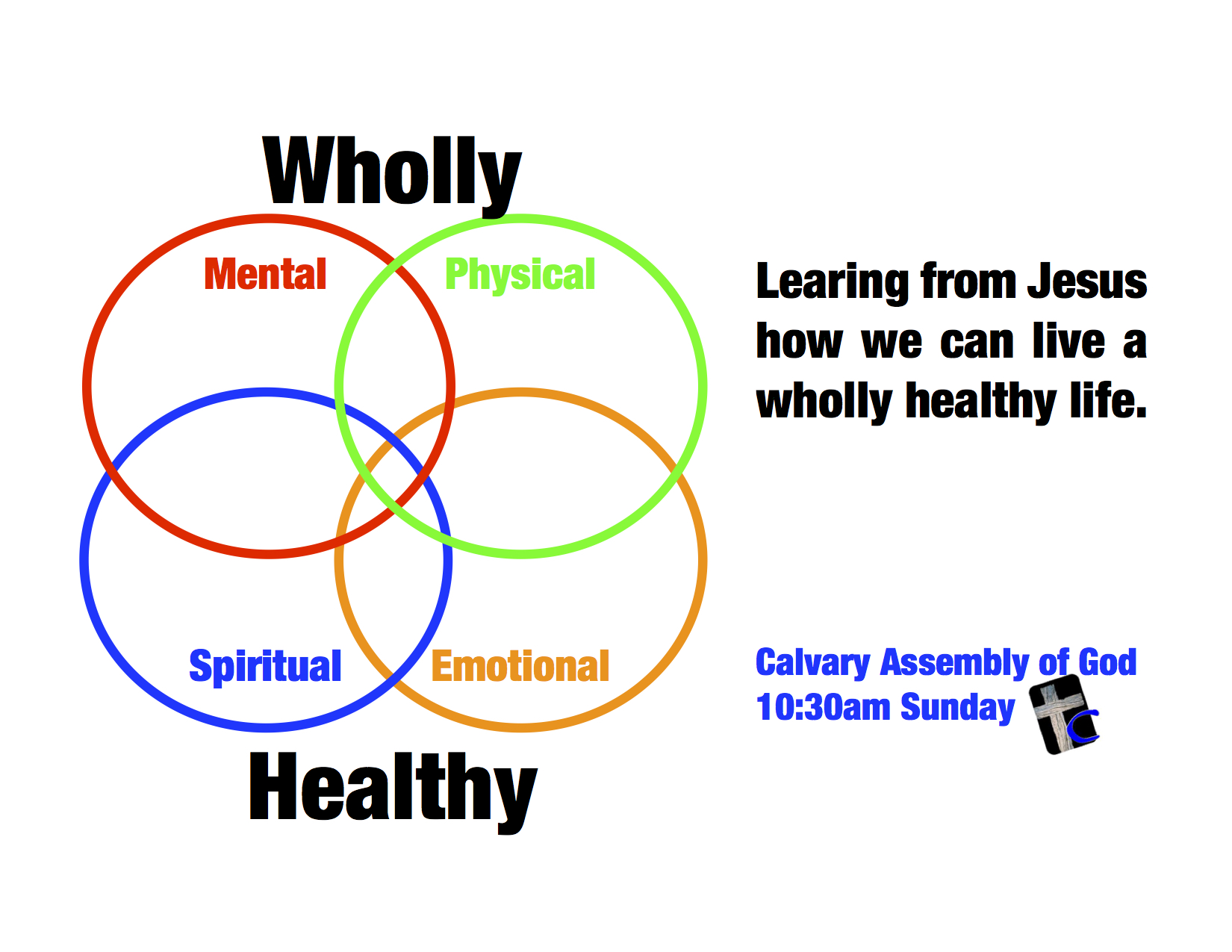
wholly-healthyHave you ever been tiptoeing through your house in the dark and stubbed your pinky toe? When that happens, is it only your pinky toe that hurts? No! It seems like your whole body gets into the action!

This is a simple way to understand that what affects one part of our life affects all parts of our life. We can’t simply quarantine one part that is having difficulty because that one part will eventually spread its pain everywhere else.

Humans were created as beings with several integrated parts. We have a physical body, we have a mind, we have emotions, and we have a God-breathed soul. If one of these parts becomes diseased, eventually all of the other parts will be affected, unless something is done to bring healing.

If we are dis-eased in any area, our health will be compromised in all areas.

Fortunately for us, Doctor Luke noted something about the health of Jesus during His earthly life. What Luke shows is how God intends for all of us to live—wholly healthy.

Modern medical science and psychology show us what the Bible pointed out long ago: We are integrated beings, and every part needs to be functioning optimally so that our whole being can function optimally.

Join us this Sunday as we begin a new series called Wholly Healthy. You will not only learn the importance of being aware of your health in four key areas, but you will also learn some practical thoughts for maintaining your optimal health.

If you missed any of the messages in this series, check them out here:

Prevailing Prayer (book review)

prevailing-prayerWhile I was growing up I heard an oft-repeated phrase around our church: “I prayed it through.” I think this would resonate with the heart of Dwight Moody, as he clearly articulates this concept in his book Prevailing Prayer.

Quite simply, Moody defines prevailing prayer as prayer that “involves the whole of our being. It affects our minds because we are occupied with God; it affects our wills because we desire to be yielded to God; and it affects our emotions because we are consumed with a love for God.” But many people—even seasoned Christians—wold probably confess that praying like this is challenging. Moody would agree with this, which is why he has given us such a practical book.

Moody not only lays out for us what will increase the likelihood that we will prevail in prayer, but he also diagnoses some of the roadblocks to this kind of consuming prayer. Each chapter links with the other chapters to build a convincing case that every Christian can learn how to prevail in prayer.

Moody uses stories from the Bible, stories from his own life and ministry, quotes from other Christian thinkers, as well as common-sensical ideas to create a desire to pray in this powerful, sustained way.

Whether you are a brand new Christian or a “seasoned saint,” Prevailing Prayer will energize your prayer life!

Don’t Miss God’s Greatest Blessings

T.M. Moore“One of the great mistakes of the people of Israel in the Old Testament was to seek and wallow in the temporal blessings of God so much that they missed the great blessing of God Himself. We are in danger of doing the same today. …

“Having failed to pursue the presence of the Lord, Israel ultimately came to despise His many blessings, attributing them instead to their own prowess or to the false idols and pagan deities of their unbelieving neighbors.

“Yet God promised that their highest pleasures and most lasting joys would be found in Him, and not in the conditions of their lives. Not in His blessings, but in Him. Israel completely missed the mark, and we today are in just the same place.

“As long as we continue to seek our happiness in the blessings God provides rather than in the God Who provides blessings, we will be in danger of falling short of the exceedingly great and precious promises of God. ‘Come to Me,’ Jesus insisted, ‘and I will give you rest’ (Matthew 11:28). We will never know complete contentedness in the presence of the Lord as long we count our blessings primarily in terms of conditions and things. …

“Until seeking Him, knowing Him, dwelling with Him, walking with Him, delighting in Him, and partaking of Him is the greatest blessing, richest pleasure, and surest joy we know, we will be in danger of falling into idolatry and failing at our Kingdom-and-glory calling from the Lord.” —T.M. Moore

Love Re-members

love-re-membersChristians often talk about God in terms of the “Trinity.” That is, the One True God revealed in three Persons: Father, Son, and Holy Spirit.

This is sometimes a difficult concept to grasp, especially since the word Trinity doesn’t specifically appear in the Bible. But make no mistake, just because the word isn’t there doesn’t mean it’s not true. Consider…

  • God’s Three-in-One nature is first exhibited when man is created (Genesis 1:26).
  • When the prophesy is given about Jesus being born in human flesh, He is given all the titles of the three Persons of the Godhead (Isaiah 9:6).
  • At Christ’s baptism we see Jesus in human form, we see the Holy Spirit descending as a dove, and we hear the Father’s voice announcing His approval of His Son (Matthew 3:16-17).
  • Jesus Himself said He would ask the Father to send the Holy Spirit to the Christians (John 14:16).
  • And just as Jesus ascended into Heaven, He told His followers to baptize people into all three Persons of the Godhead (Matthew 28:19).

But I think the best expression of the Trinity is revealed in three simple words. John talks about how all three Persons of the Trinity are involved in the life of a Christian. And then he sums it all up in three words—

“GOD IS LOVE”

Each Person of the Godhead is encouraging and illuminating and pointing to the other Persons in the Trinity. Love is perpetually being received and given. We humans are created in God’s image … we are created to receive and to give God’s love. That’s why John tells us that we know and rely on the love God has for us (that’s the receiving part), and that whoever lives in love lives in God, and God in him (that’s the giving part).

When Adam and Eve sinned, they were dis-membered from God. As a result, every human in their natural state longs for connection with God and others, but feels separated, isolated, unloved, and even unlovable.

Love re-members! 

Jesus came to be broken and crushed and to feel the pain of separation from God. It was out of this brokenness that He could do the work of re-membering us to the fullness of the Trinity.

When Jesus shared His last supper with His disciples, He took bread (which is made from broken wheat kernels) and wine (which is made from crushed grapes). He told us as often as we eat the bread and drink the wine we are to remember how He was broken and crushed for us.

Remembering Christ’s work on the Cross re-members us to the fullness of the Trinity. 

Sin and satan want to keep us feeling separated, unloved, and unloveable. But when we were the least worthy of His love, God—Who IS love—was broken and crushed to re-member us to Him.

If you feel lonely, separated, isolated, unloved or unloveable, I urge you to remember what Jesus did for you. He loved you enough to be broken and crushed for your re-membering to all of God’s love.

Check out this video where I explain this amazing thought in more detail…

Poetry Saturday—Confession

Horatius BonarNo, not despairingly 
Come I to Thee; 
No, not distrustingly 
Bend I the knee; 
Sin hath gone over me, 
Yet is this still my plea, 
Jesus hath died. 
Ah, mine iniquity 
Crimson has been; 
Infinite, infinite, 
Sin upon sin; 
Sin of not loving Thee, 
Sin of not trusting Thee. 
Infinite sin. 
Lord, I confess to Thee 
Sadly my sin; 
All I am, tell I Thee, 
All I have been. 
Purge Thou my sin away, 
Wash Thou my soul this day; 
Lord, make me clean! —Horatius Bonar

The Unusual History Of The King James Bible

on-this-day“How odd that the most famous Bible in history should bear the name of a hard-drinking, foul-mouthed, ego-driven homosexual who rejected all demands for reform within the church.

“James VI of Scotland, son of imprisoned Mary, Queen of Scots, was raised in drafty Scottish castles by self-serving lords. He grew up religious and well-trained in theology. He went to church every day. But he was rude, rough, loud, conceited, and bisexually immoral. He was also shrewd.

“At age 37 he managed to succeed his cousin, Elizabeth I, as England’s monarch. As he traveled from Scotland to London, he met a group of Puritans bearing a ‘Millenary Petition’ signed by nearly 1,000 pastors. It demanded renewal within the church. The Puritans, stirred by the Geneva translation of the Bible and by Foxe’s popular Book of Martyrs, wanted to purify the church. The established clergy opposed Puritan demands, and the new king realized his kingdom was torn.

“He convened a conference for church leaders at his Hampton Court estate on January 12, 1604, and the Puritans vigorously presented their concerns. James rejected their requests, sometimes thundering against them, white with rage. At the conclusion of the conference he flung his arm toward the Puritans, shouting, ‘I shall make them conform or I will harry them out of this land, or do worse.’ Many of the dispirited Puritans, abandoning hope for the Anglican Church, began worshiping in small groups as they felt the Bible taught them. They were tagged Separatists, but from these persecuted cells came the Baptists in 1611, the Pilgrims who fled to America in 1620, and other dissenting groups.

“But on one issue at Hampton Court the king and Puritans had agreed. When Puritan John Rainolds requested a new translation of the Bible, James promptly approved it, saying, ‘I have never yet seen a Bible well-translated. But I think the Geneva is the worst.’ Seven years later the Authorized Version was unveiled, ironically making vice-prone King James one of the best-recognized names in English church history.” —Robert Morgan, On This Day