4 Quotes On The Destructive Nature Of Pornography

“Pornography is based on and fed by always needing to see something new. It works neurologically to create an obsessive demand for more of something you’ve never seen before. The promise of something new is what gets you excited and interested, which means, by definition, that you can never be fully satisfied. That’s the opposite of cherish. Pornography works off volume, not individuality; it works off the novel, not the known. Learning to cherish a solo picture of a unique mate shapes our hearts and minds to cherish a particular individual above all others.” —Gary Thomas, in Cherish

“Pornography, by its very nature, is an equal opportunity toxin. It damages the viewer, the performer, and the spouses and the children of the viewers and the performers. It is toxic mis-education about sex and relationships. It is more toxic the more you consume.” —Dr. Mary Anne Layden 

“We can’t fill up our eyes with our wives if our eyes have been previously filled with someone else. One of the many dangers of porn is that it neurologically trains us to find our wives less beautiful.” —Gary Thomas, in Cherish

“When it comes to porn, it turns an intimate relationship love-connection into a rehearsed performance that’s less about the emotional bonding that happens when people have sex. No emotional connection, no commitment, no kissing and cuddling, just performing and self-focusing. Porn fails to emphasize the most real parts in relationships. It doesn’t depict real people with real bodies with real (and beautiful) flaws. In fact, it tries to sell the complete opposite—a photoshop fantasy that reality should never have to compete with. So it only makes sense that those who are exposed to porn have their perceptions of sex twisted and warped. Soon, real people don’t measure up, and partners are considered less exciting when compared to an exaggerated production on a computer screen.” —Fight The New Drug

Who Can Bridge The Gap Between God And Man?

Listen to the podcast of this post by clicking on the player below, and you can also subscribe on AppleSpotify, or Audible. 

Mankind was created good and upright in God’s image and given dominion over everything God had created (see Genesis 1:26-28; Psalm 8:3-8). But man was not given dominion over himself (Genesis 2:15-17).

As Oswald Chambers said, “The temptation came to him on this line—‘Disobey, and you will become as God.’ Man took dominion over himself and thereby lost his lordship over everything else. According to the Bible, the disposition of sin is my claim to my right to myself” (see Genesis 3:1-7).

“And sure enough, they then had knowledge of good and evil, but it was from the standpoint of becoming evil and remembering how good they once were” (Nancy Guthrie). Their disobedience created an unbridgeable gulf between God and man. 

There were other consequences of their sin too:

  • Consequence #1—They realized they were naked, making them ashamed of themselves and ashamed to be in God’s presence.
  • Consequence #2—They feared God and tried to hide from Him.
  • Consequence #3—They couldn’t accept responsibility for what they did because that acceptance would mean they would also be responsible for bridging the gulf, something they were utterly unable to do.
  • Consequence #4—They were completely separated from God. Now there was nothing that they could do except work, have children, raise a family, and try to make the best of things.

Even in the midst of this despair, God foreshadowed the hope that would be their salvation. First, God promised that their offspring would one day crush satan’s head. Then God sacrificed an innocent animal and used those skins to make more permanent clothes for Adam and Eve, foreshadowing what Jesus would do.

Adam must have glimpsed this ray of hope because he then named his wife Eve, which means life!

But who could bridge this chasm? Who could be a mediator between God and man? The only possible candidate would have to be Someone who was both fully God and fully Man—that is Jesus Christ!

Only Jesus can fully and eternally cover our nakedness, remove our fear and shame, and present us without sin before His Father (see Jude 24 and Romans 5:6-11).

If, as Oswald Chambers says, sin is my claim to my right to myself, then salvation is God’s right to myself because I have surrendered to the reconciling work of Jesus.

“Believers in Christ are seen by God exactly as Christ is seen by God,” wrote Ann Voskamp, because those who believe in Jesus are clothed in His righteousness!

If you haven’t surrendered yourself to God’s right to you, what’s holding you back from doing that today? If you have surrendered yourself to God, don’t ever let satan lie to you about your nakedness, shame, or unworthiness—you are “Christ’s friend, God’s child, Spirit’s home!” (Ann Voskamp).

►► Would you please prayerfully consider supporting this ministry? My Patreon supporters get behind-the-scenes access to exclusive materials. ◀︎◀︎

Poetry Saturday—Grace Great Enough

God’s grace is great enough to meet the great things—
The crashing waves that overwhelm the soul,
The roaring winds that leave us stunned and breathless,
The sudden storms beyond our life’s control.
His grace is great enough to meet the small things—
The little pinprick troubles that annoy,
The insect worries, buzzing and persistent,
The squeaking wheels that grate upon our joy. —Annie Johnson Flint

Killing Giants & Lifting Lids

… David … Abishai … Sibbechai … Elhanan … Jonathan …

What do these five men have in common? They all killed giants in one-on-one combat.

David went first.

Before he killed Goliath, there are no recorded giant killers in the Bible. But after David, four men followed David’s lead (see 2 Samuel 21:15-21).

What was once considered impossible became possible because David lifted the lid.

In 1954 Roger Bannister broke another “unbreakable” barrier—he ran one mile in under four minutes (3:59.4 to be exact).

As soon as the myth of the “impossible barrier” was broken, the limit was broken again and again and again in the following months.

Twenty-six different men broke the 4-minute mile 66 times in the following months all because Roger Bannister lifted the lid.

What giants are you taking on?

What “impossible” barriers are you breaking?

What lids are you lifting for other potential giant-killers and 4-minute-milers that are just waiting for you to show them the way?

Thursdays With Oswald—Teach Them While They’re Young

Oswald ChambersThis is a weekly series with things I’m reading and pondering from Oswald Chambers. You can read the original seed thought here, or type “Thursdays With Oswald” in the search box to read more entries.

Teach Them While They’re Young

      We need a personal knowledge of God through all our life. The time to discover Him for ourselves is in life’s earliest morning—“that from a child thou hast known the holy Scriptures, which are able to make thee wise unto salvation,” wrote Paul to Timothy (2 Timothy 3:15). “And ye fathers, provoke not your children to wrath: but nurture them in the chastening and admonition of the Lord” (Ephesians 6:4).

     We are so built that in childhood we can more easily come to a knowledge of God in simplicity than in later years. And in those formative years the personal life can be shaped and fitted to God’s standard more surely than later on.

From Shade Of His Hand

At the end of Ecclesiastes, Solomon wrote, “Remember your Creator in the days of your youth, before the days of trouble come” (Ecclesiastes 12:1).

Oswald Chambers notes that parents lay a much stronger foundation for their children’s future spiritual attainment by talking often of the love of God while those children are still young.

Parents—start early, keep at it often, and don’t ever quit telling your children about God’s love. 

These commandments that I give you today are to be on your hearts. Impress them on your children. Talk about them when you sit at home and when you walk along the road, when you lie down and when you get up. Tie them as symbols on your hands and bind them on your foreheads. Write them on the doorframes of your houses and on your gates. (Deuteronomy 6:6-9)

Train up a child in the way he should go: and when he is old, he will not depart from it. (Proverbs 22:6)

[Mom and Dad, be sure to check out Andrew Murray’s exceptional book Raising Your Child To Love God. You can read some quotes from Murray’s book here, and some of his prayers for children here.]

11 Quotes From “Shade Of His Hand”

The book of Ecclesiastes in the Bible can be a challenging read for many people. In Shade Of His Hand, Oswald Chambers walks us through this biblical book of wisdom chapter-by-chapter. Shade is a great companion for your personal Bible study time in Ecclesiastes. Check out my full book review by clicking here.

Below are just a few of the many (many!) passages I highlighted in Shade. Some of the longer passages I have already shared in my weekly “Thursdays With Oswald” posts. You can read those by clicking here.

“We always get out of touch with the Bible attitude to things when we come to it with our own conclusions.”

“The intellectual order of life does not take things as it finds them, it makes us shut our eyes to actual facts and try to live only in the ideal world. … Solomon is fearless in facing facts as they are. … It is not a question of living a blind life in the brain away from actuality, not of living in dawns or on mountain tops; but of bringing what you see there straight down to the valley where things are sordid, and living out the vision there.”

“Unless you bank your faith in God, you will not only be wrongly related in practical life and have your heart broken, but you will break other things you touch.”

“Almighty God does not matter to me, He is in the clouds. To be of any use to me, He must come down to the domain in which I live; and I do not live in the clouds but on the earth. The doctrine of the Incarnation is that God did come down into our domain. The Wisdom of God, the Word of God, the exact expression of God, was manifest in the flesh.”

“To serve God in order to gain heaven, is not the teaching of Christianity. Satisfaction cannot be found in gain, but only in a personal relationship to God. … A man is not to serve God for the sake of gain, but to get to the place where the whole of his life is seen as a personal relationship to God.”

“Whenever we put theology or a plan of salvation or any line of explanation before a man’s personal relationship to God, we depart from the Bible line, because religion in the Bible is not faith in the rule of God, but faith in the God Who rules.”

“Sometimes it is cowardly to speak, and sometimes it is cowardly to keep silence. In the Bible the great test of a man’s character is his tongue (see James 1:26). The tongue only came to its right place with in the lips of the Lord Jesus Christ, because He never spoke from His right to Himself. He Who was the Wisdom of God Incarnate, said ‘the words that I speak unto you, I speak not of Myself.’ … We are either too hasty or too slow; either we won’t speak at all, or we speak too much, or we speak in the wrong mood. The thing that makes us speak is the lust to vindicate ourselves.”

“The general history of Christianity is that it has been tried and abandoned because it is found to be difficult; but wherever it has been tried and honorably gone on with, it has never failed.”

“The Christian faith is exhibited by the man who has the spiritual courage to say that that is the God he trusts in, and it takes some moral backbone to do it.” 

“We reap terrific damage to our own characters when we vow and do not perform. … Promises are a way of shirking responsibility.”

“It is appalling to find spiritual people when they come into a crisis taking an ordinary common-sense standpoint as if Jesus Christ had never lived or died.”

More quotes from Shade Of His Hand are coming soon…

How John Newton Found God

“It took John Newton to write the hymn Amazing Grace. ‘Let me not fail to praise that grace that could pardon,’ he said, ‘such sins as mine.’

“Newton had gone to sea at age 11, apprenticed on his father’s ship. He spent his teen years learning to be profane, irreligious, and indulgent. Female slaves being transported from Africa were at Newton’s disposal, and even seasoned sailors were alarmed at his corruption. Newton’s life angered his father and disgusted his friends, and he was finally pressed into service for the British Navy. He deserted, but was arrested, stripped, and flogged. He became the property of a slave trader in Sierra Leone, who gave him to his sadistic mistress. John became a loathsome toy she tormented for over a year. He finally boarded ship for Britain.

“On March 9, as he carelessly read a Christian book to pass the time, the thought came to him, ‘What if these things are true?’ He snapped the book closed and shook off the question. ‘I went to bed in my usual indifference, but was awakened by a violent sea which broke on us. Much of it came down below and filled the cabin where I lay. This alarm was followed by a cry that the ship was going down. We had immediate recourse to the pumps, but the water increased against all our efforts. Almost every passing wave broke over my head. I expected that every time the vessel descended into the sea, she would rise no more. I dreaded death now, and my heart foreboded the worst, if the Scriptures, which I had long since opposed, were true.’

“The vessel survived the March 10, 1748, storm, and Newton began earnestly studying the Bible. He embraced Christ and eventually entered the ministry, becoming one of England’s best-loved preachers and a leader in the fight against slavery. He once recalled, ‘That tenth of March is a day much remembered by me; and I have never suffered it to pass unnoticed since the year 1748—the Lord came from on high and delivered me out of deep waters.’” —from On This Day

Shade Of His Hand (book review)

Most of Oswald Chambers’ books weren’t originally in book form, but were given as lectures or sermons which were recorded in shorthand by his wife. Shade Of His Hand contains the last messages given by Oswald Chambers before his death. It’s a series of lectures on each chapter of the book of Ecclesiastes.

For many people (even seasoned Christians) the message in Ecclesiastes in a challenging one. Solomon is the wisest man who ever lived, yet in this book of the Bible he records his observations of the world in what seems to be a very “non-Christian” (to use a New Testament term) sort of way. Then along comes Oswald Chambers with insight into this book unlike anything you’ve seen before!

One of Chambers’ longtime friends was David Lambert. Commenting on Shade Of His Hand, Lambert wrote, “Oswald Chambers interprets [Ecclesiastes’] message as being—Life is not worth living apart from Redemption. … Life apart from Redeeming Love is full of sin and sorrow, guile and cruelty, callous selfishness and numbing despair. This book takes full account of all that. It anticipates many of the problems facing the young life of today, and brings to their solution the one and only key, the realization of the Lord Jesus Christ in every relationship of life.”

Indeed, Chambers doesn’t flinch one bit in addressing the complex issues Solomon brings up, and he does so in a way that is easy to grasp for all of us. I read each chapter of Ecclesiastes before each chapter in this book, and then I re-read the same chapter in Ecclesiastes again afterwards. Wow, what a transformation in my understanding of the biblical text!

If you would like to gain some life-changing insight on this valuable book of biblical wisdom, I urge you to check out Shade Of His Hand.

What My Temper Tells Me

“Think for a moment of a clock and of what its hands mean. The hands tell me what is within the clock, and if I see that the hands stand still, or that the hands point wrong, or that the clock is slow or fast, I say that something inside the clock is not working properly. And temper is just like the revelation that the clock gives of what is within. Temper is a proof whether the love of Christ is filling the heart, or not.” —Andrew Murray, in Absolute Surrender

No Apathetic Christians Allowed!

Healthy love loves God and then serves God by loving and serving others. Quite simply—love loves.

But my question is how does love love?

Sometimes we can get a fuller definition of a word by looking at its opposite. So what’s the opposite of love? It isn’t hate because hate is actually the flip side of love. That means our hatred for anything that comes against the object of our love is just as strong as our love is.

The opposite of love is apathy.

Apathy means without pathos (or feeling). Specifically, without feeling that moves us to action. So in order for love to love, it needs pathos as its fuel.

For example. If you hear a coworker mention her frustration with construction slowing down her morning commute, apathy says, “Bummer!” and does nothing else. But love fuel by pathos says, “I found an alternate route that I can share with you.”

When a friend tells you about his frustration with trying to lose weight, apathy says, “Good luck!” Pathos love says, “Here’s the diet that worked for me” or “I’ll go to the gym with you.”

Love is fueled by pathos to: speak out, act out, and reach out.

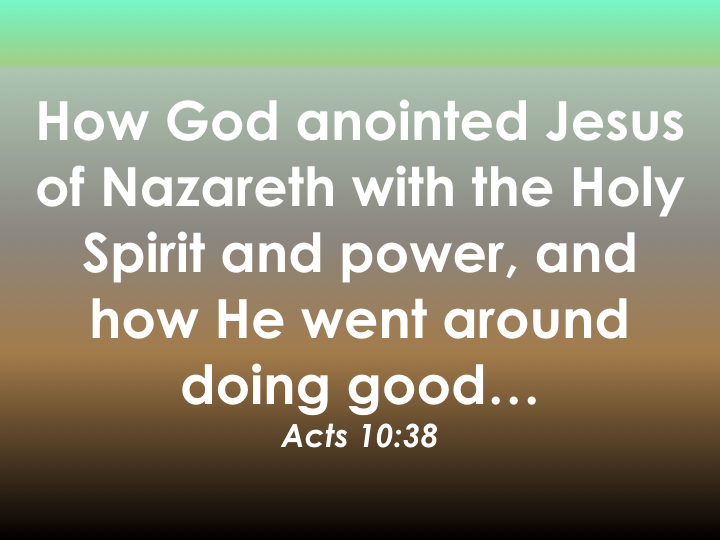
When Peter was describing the ministry of Jesus, he said, “He went around doing good and healing all who were under the power of the devil” (Acts 10:38).

As His follower, we are supposed to feel the needs of the hurting and confused around us, and then let that pathos fuel our love to go around doing good:

  • When you hear someone asking for help, offer help.
  • When you see someone who is down, be their friend.
  • When you don’t see a neighbor for a couple of days, check on them.
  • When you meet someone looking for answers, invite them to church with you.
  • When a friend is sick, send a card, bring a meal, or mow their lawn.

These kinds of good deeds make Jesus happy (see Matthew 25:40) because it’s a tangible way to love God and then serve God by loving and serving others.

BE LIKE JESUS—GO AROUND DOING GOOD! 

There should never, ever be such a thing as an apathetic Christian!