Your Incense…

…to God and the world.

Let’s follow this thread from the Old Testament into the New Testament—

“When Aaron trims the lamps at twilight, he shall burn incense. There shall be perpetual incense before the LORD throughout your generations.” (Exodus 30:8)

“Therefore I urge you, brethren, by the mercies of God, to present your bodies a living and holy sacrifice, acceptable to God, which is your spiritual service of worship.” (Romans 12:1)

“For we are a fragrance of Christ to God among those who are being saved and among those who are perishing.” (2 Corinthians 2:15)

“The incense which you shall make, you shall not make in the same proportions for yourselves; it shall be holy to you for the LORD.” (Exodus 30:37)

“Our lives are not to be about us, lived out in private and for self-glory. Our lives are to be about God, lived out in full view of the nations and for His name’s sake.” —Dick Brogden

What incense is your life—your witness, your testimony—sharing with those around you?

He Chose The Nails (book review)

Max Lucado has an inimitable style of writing that immediately draws us into his subject—in this book the focal point is what Jesus did for us on the Cross—gets us to look at it in a new light, and then helps us walk away with a fuller understanding. The title of this book is really the answer to the sub-title—Q: What did God do to win your heart? A: He Chose The Nails.

In keeping with the theme of God answering the book’s question of how He won your heart, all but two of the chapters use statements from God as their title. Statements like “I will bear your dark side,” and “I forgive you,” and “I understand your pain,” and “I will love you forever.” In each chapter, Max takes us nearer to the Cross and to the Savior who bled and died there to show us how much God loves us. 

This is a book that can easily be read together with your family or a group of friends; especially if you then utilize the study guide questions for each chapter at the back of the book. This is a book that could be read rather quickly, but because Max paints such a vivid picture of God’s unexpected love you will want to read slowly and savoringly. This is a book that could be read at any time, but I would recommend you read it during the days and weeks approaching Good Friday and Resurrection Sunday. 

Whether reading alone or with friends, reading quickly or slowly, reading it during the Lenten season or at another time, I can promise you that your heart will beat more strongly with the assurance of God’s overwhelming, mind-blowing love for you. 

Love Securely

Jesus is journeying toward the Cross. On Thursday, it’s His last opportunity to impart His most important thoughts to His disciples. He is about to be arrested, and everything is about to go sideways for the disciples—“this isn’t the way this is supposed to happen!”—and Jesus needs to prepare them with the truth they will need to sustain them through this. 

“I have eagerly desired to eat this Passover with you before I suffer,” Jesus says (Luke 22:15).  

So Peter and John are sent to make arrangements for the Passover meal, but one of the arrangements that they overlooked was the host duties—washing the feet of each guest, anointing them with perfume, and giving them a welcoming kiss. 

As they are eating dinner, Jesus makes four important statements:

  1. “One of you will betray Me”
  2. “All of you will abandon Me”
  3. “I will rise again and restore you”
  4. “I have prayed for you”

These statements get the disciples arguing about who’s going to betray Jesus—“It’s not me, is it?!”—and over how faithful they are—“I would never abandon Him!” Ultimately they begin to argue over who is the greatest disciple among them. 

Jesus not only explains to them how the servant is greater than the master in God’s sight (Luke 22:24-27), but He then becomes the living example of that when He washes their feet (John 13:1-5, 12-17). 

Here’s an important principle—Only secure people can lovingly serve others. 

Insecure people don’t like to serve others because they feel they are being misused, or taken advantage of, or that others will look down on them. 

Jesus “knew” (John 13:1, 3) how much power His Father had given Him, making Him secure enough to serve. Security really means, “I am loved by God, and I know who I am in Him.”

Jesus served out of love: the profound love that He knew His Father had for Him. He gave His disciples the same mandate: Serve others out of love for Me and show the world that you are My disciples (see John 13:34-35).

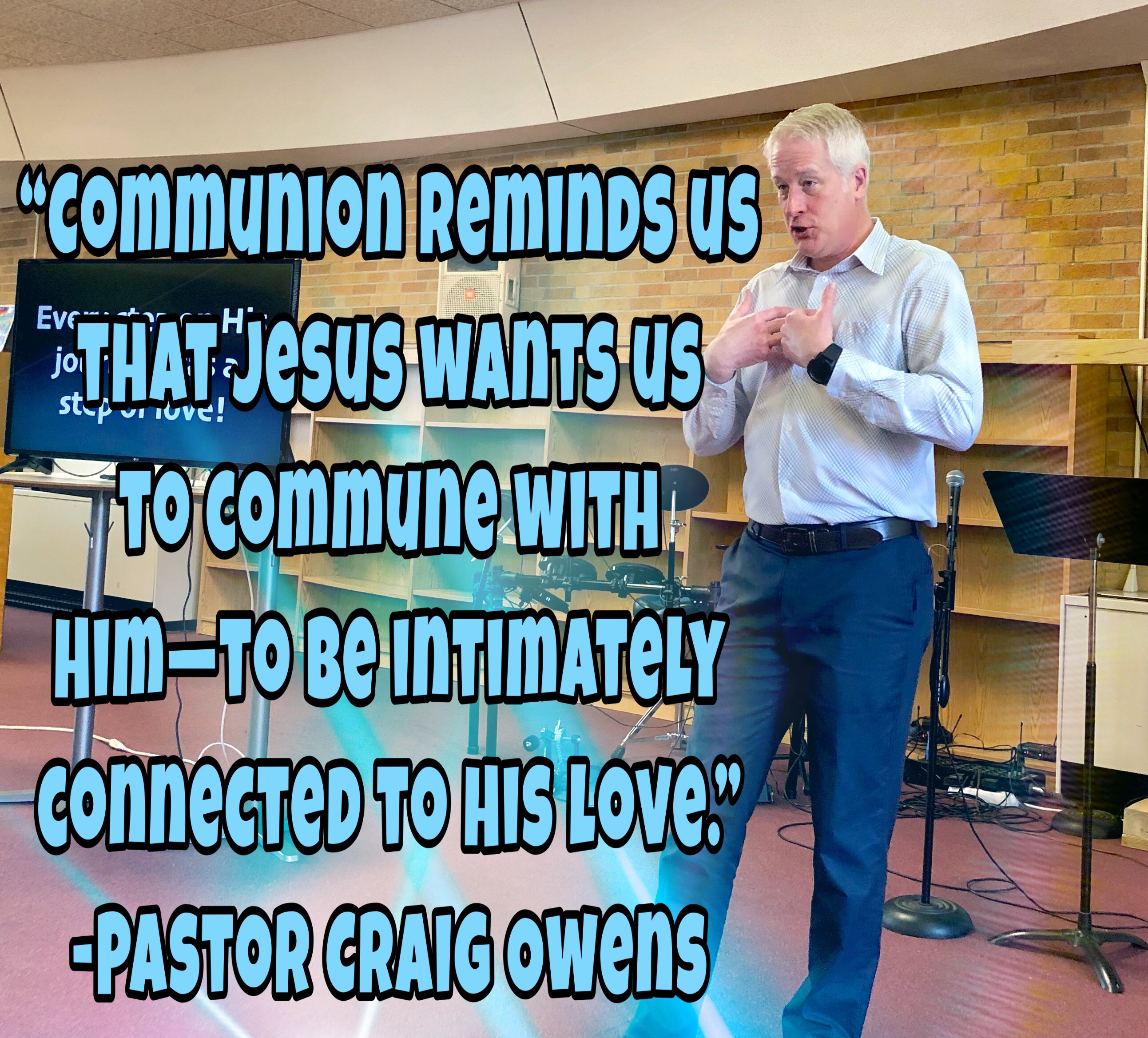
When Jesus ate this last supper with His disciples, He instituted a remembrance celebration that we now call Communion. The root word is “commune” which the dictionary defines as a “conversation with profound intensity and intimacy.” 

This is the type of intimate relationship Jesus had with His Father, and this is the type of relationship He calls us to with Him. The broken bread of Communion reminds us that Jesus can make whole any broken area that would keep us from communing with Him. The cup of Communion reminds us that Jesus can instantly and fully forgive any sin that would keep us from communing with Him. 

Jesus set the example—we are to commune with our Heavenly Father through the way He made by His broken body and His shed blood. It’s out of this communion that we are empowered by His love, and then feel secure enough to serve others in love too. 

Weeping And Rejoicing

“First, I would bid you stand and see the place where the Lord lay with emotions of deep sorrow. O come, my beloved brother, thy Jesus once lay there. He was a murdered man, my soul, and thou the murderer.

‘Ah, you, my sins, my cruel sins,
His chief tormentors were,
Each of my crimes became a nail,
And unbelief the spear.’
‘Alas! and did my Saviour bleed?
And did my Sov’reign die?’

“I slew Him—this right hand struck the dagger to His heart. My deeds slew Christ. Alas! I slew my best beloved: I killed Him who loved me with an everlasting love. Ye eyes, why do ye refuse to weep when ye see Jesus’ body mangled and torn? Oh! give vent to your sorrow, Christians, for ye have good reason to do so…. My soul was drowning. From heaven’s high portals He saw me sinking in the depths of hell. He plunged in.

‘He SANK beneath His heavy woes,
To raise me to a crown;
There’s ne’er a gift His hand bestows.
But cost His heart a groan.’

“Ah! we may indeed regret our sin, since it slew Jesus.

“Now, Christian, change thy note a moment. ‘Come, see the place where the Lord lay,’ with joy and gladness. He does not lie there now. Weep, when ye see the tomb of Christ, but rejoice because it is empty. Thy sin slew Him, but His divinity raised Him up. Thy guilt hath murdered Him, but His righteousness hath restored Him. Oh! He hath burst the bonds of death; He hath ungirt the cerements of the tomb, and hath come out more than conqueror, crushing death beneath His feet. Rejoice, O Christian, for He is not there—He is risen.” —Charles Spurgeon 

Thursdays With Oswald—Spiritual Grit

Oswald ChambersThis is a weekly series with things I’m reading and pondering from Oswald Chambers. You can read the original seed thought here, or type “Thursdays With Oswald” in the search box to read more entries.

Spiritual Grit

     Salvation is God’s “bit,” it is complete, we can add nothing to it; but we have to bend all our powers to work out His salvation. It requires discipline to live the life of a disciple in actual things. “Jesus knowing…that He was come from God, and went to God,…took a towel…and begin to wash the disciples’ feet” [John 13:1, 4]. It took God Incarnate to do the ordinary menial things of life rightly, and it takes the life of God in us to use a towel properly. … And we can do it every time because of the marvel of God’s grace. …  

     A stoot hairt tae a stae brae (i.e. a strong heart to a difficult hill). The Christian life is a holy life; never substitute the word “happy” for “holy.” We certainly will have happiness, but as a consequence of holiness. Beware of the idea that so prevalent today that a Christian must always be happy and bright, “keep smiling.” That is preaching merely the gospel of temperament. If you make the determination to be happy the basis of your Christian life, your happiness will go from you; happiness is not a cause but an effect that follows without striving after it. … 

     There is something in us that makes us face temptation to sin with vigor and earnestness, but it requires the stout heart that God gives to meet the cares of this life. I would not give much for the man who had nothing in his life to make him say, “I wish I was not in the circumstances I am in.” “In the world you will have trouble; but be of good cheer! I have overcome the world” [John 16:33]—“and you will overcome it too, you will win every time if you bank on your relationship to Me.” Spiritual grit is what we need.

From Studies In The Sermon On The Mount

If you have placed your faith in what Jesus did for you on Calvary, and if you have asked the Father to forgive you of your sins, then His Holy Spirit resides in you. 

Therefore, you have all that you need to be successful every single time. The question is: Am I using the spiritual grit that God gives me to be holy? Or am I merely looking for a way to be happy? 

Keeping In Step

But He needed to go through Samaria (John 4:4). 

Jesus was never late, never early, never out of position, never scrambling to catch up. 

He kept in step with the Holy Spirit so that He was exactly where He needed to be when He needed to be there. Whether it was battling satan, helping a soon-to-be-embarrassed wedding party, talking with a lonely Samaritan woman, raising a widow’s dead son to life, or walking toward Jerusalem (see Luke 4:1, 7:11, 19:1; John 2:1, 4:4). 

Others have experienced this too. Like when Ruth “happened” to be in the right farmer’s field at the right time, or when Philip was on the right road at the right time (see Ruth 2:3; Acts 8:27).

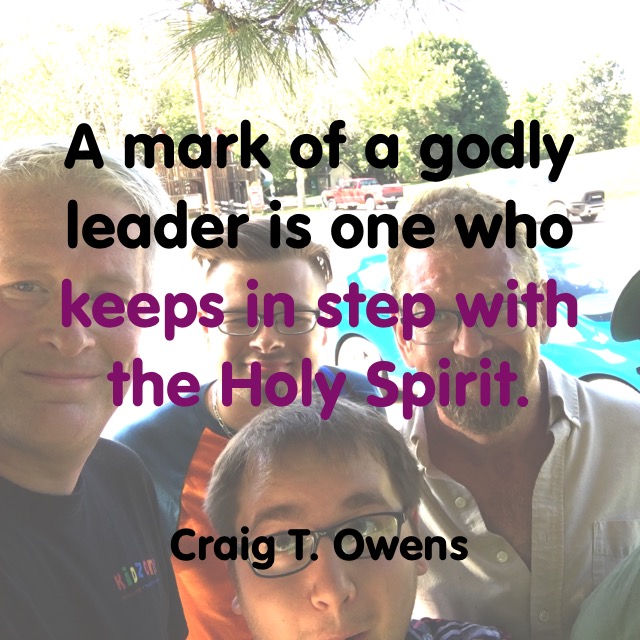
A mark of a godly leader is one who keeps in step with the Holy Spirit. 

If we live by the Holy Spirit, let us also walk by the Spirit. If by the Holy Spirit we have our life in God, let us go forward walking in line, our conduct controlled by the Spirit. (Galatians 5:25 AMP)

Holy Spirit, You know where I need to be today. Let me not grumble at what I may call “detours” or “delays,” but help me to submit to Your direction and Your timing. I want to keep in step with You. 

This is part 35 in my series on godly leadership. You can check out all of my posts in this series by clicking here.

What Are You Doing With God’s Story?

…You could have no power at all against Me unless it had been given you from above… (John 19:11)

As Daniel says, “The Most High is sovereign over all the kingdoms of the earth, and He gives them to whom He pleases.” 

God is sovereign. All of History is His story!

Pilate tried to change the story—twice he said, “I find no fault in Him” (vv. 4, 6). But still his caving in to the chief priests fulfilled His story.

The soldiers were looking for personal gain (v. 24), and yet their greed unwittingly fulfilled His story.

Jesus knew what was happening, and purposely let people treat Him a certain way to fulfill His story (vv. 28-30, 36-37). 

God is still telling His story today.

The question is—am I willfully fighting against it (like Pilate), or ignorantly fulfilling it (like the soldiers), or obediently submitting to it (like Jesus)?

The Essential Jonathan Edwards (book review)

Some have called Jonathan Edwards the greatest American theologian, and I think it would be very hard to dispute that. Not only was he a brilliant thinker, but Edwards was also a prolific speaker and writer. So Owen Strachan and Douglas Sweeney have taken on a monumental challenge in attempting to give us an accurate glimpse of this important man in their book The Essential Jonathan Edwards. 

The first part of the book is a short biography of Edwards’ life. The biography is told alternating between the biography of Strachan and Sweeney and the words Edwards recounted in his sermons and memoirs. 

The remainder of the book attempts to give the reader a sense of Edwards’ thoughts on topics such as the beauty of God’s creation, the joy of experiencing God’s pleasure, the essential nature of the Christian life, and the after-life. These topics are covered in the same way as the biographical portion—alternating between the actual words of Jonathan Edwards and the summation of Strachan and Sweeney. 

I found this book a bit frustrating. I would have preferred a more traditional biography of this great man or a collection of Edwards’ sermons verbatim. But the alternation between Edwards’ words and Strachan and Sweeney’s thoughts didn’t flow very well for me. 

My recommendation would be to either read George Marsden’s full or shortened biographies of Edwards, or simply read a collection of Edwards’ sermons. 

I am a Moody Press book reviewer.

Sabbathing

On the Wednesday of Christ’s Passion Week, all of the Gospel writers are in perfect agreement. Between all four of them, they write not one word about what happened on that day. That silence actually speaks volumes to us!  

Jesus is almost surely in Bethany (since that has become is nightly retreat this week), and He is taking a Sabbath rest. “Wait,” you might be saying, “sabbathing on Wednesday?! I thought that was supposed to be Saturday or Sunday?” 

The Sabbath is not a day; it’s an attitude of the heart. 

Jesus followed the example His Father set right at the beginning. 

The Israelites are to observe the Sabbath, celebrating it for the generations to come as a lasting covenant. It will be a sign between Me and the Israelites forever, for in six days the Lord made the heavens and the earth, and on the seventh day He rested and was refreshed. (Exodus 31:16-17)

Notice that God rested and was refreshed. The word rested means to stop working and celebrate. It’s a time to reflect on the work completed and celebrate what has been done. Then the Bible says God was refreshed, which literally means “God refreshed Himself.” He took a deep, satisfying, rejuvenating breath! 

Resting and being refreshed—or sabbathing—is not a luxury; it’s a necessity! 

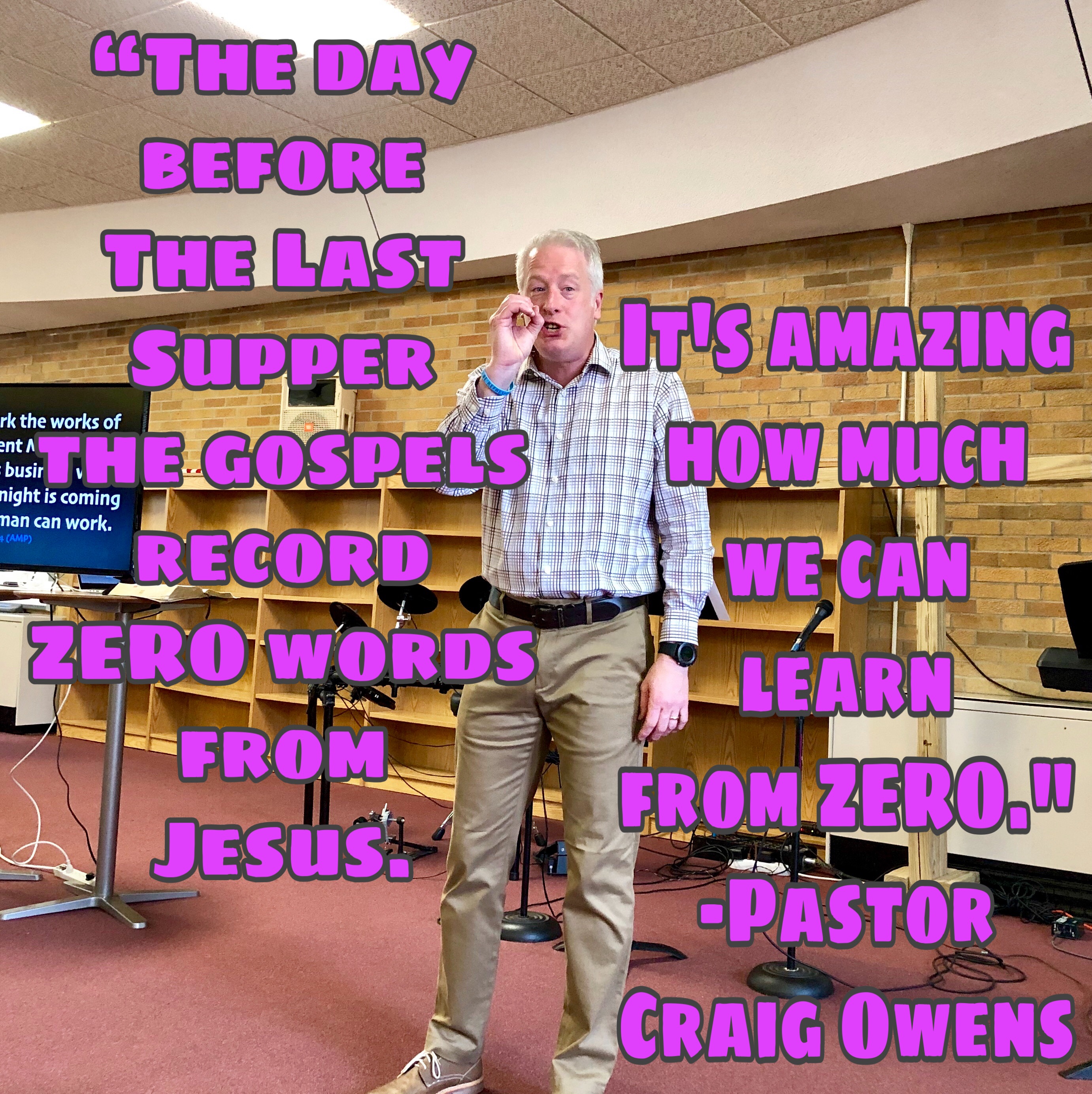
Jesus understood this principle of sabbathing. Remember that He had only a limited time to accomplish all that the Father had for Him: “We must work the works of Him Who sent Me and be busy with His business while it is daylight; night is coming on, when no man can work” (John 9:4 AMP). If anyone was a Man on a mission, it was Jesus, and yet rest was vital to Him…

  • …from the very beginning of His life, Jesus practiced healthy habits
  • …He started each day in prayer 
  • …He rested and refreshed after expending Himself in ministry, and encouraged His disciples to do so as well (see Luke 2:52; Mark 1:35; 6:30-32, 45-46) 

Now—just before the intense, horrific, inhumane experience He is about to go through—Jesus is sabbathing. He is resting and refreshing His body, soul, and spirit. 

So what keeps us from sabbathing? 

  1. Guilt—“I feel guilty taking time off.” Remember that if Jesus did it, we should too. 
  2. Misplaced priority—“If I don’t do it, it won’t get done.” But remember Who is in charge. The psalmist reminds us, “The Lord is king!” (Psalm 99:1). 
  3. Fear—“If I ‘tune out’ what might I be missing?” Remember: Your Father is watching over you every single moment (see Psalm 121).  

If you want to experience more productivity in your life, don’t try to go 24/7—take a sabbath break. Stop working and celebrate what God has done, then take a deep breath of worship in God’s presence. Jesus demonstrated that sabbathing was vital for ministry success. 

Poetry Saturday—Unanswered Prayers

Like some schoolmaster kind in being stern,
Who hears the children crying o’er their slates
And calling, “Help me, master!” yet helps not,
Since in his silence and refusal lies
Their self-development, so God abides
Unheeding many prayers. He is not deaf
To any cry sent up from earnest hearts;
He hears and strengthens when He must deny.
He sees as weeping o’er life’s hard sums;
But should He give the key and dry our tears,
What would it profit us when school were done
And not one lesson mastered?

     What a world
Were this if all our prayers were answered. Not
In famed Pandora’s box were such vast ills
As lie in human hearts. Should our desires,
Voiced one by one in prayer, ascend to God
And come back as events shaped to our wish,
What chaos would result!

     In my fierce youth
I sighed out breath enough to move a fleet,
Voicing wild prayers to heaven for fancied boons
Which were denied; and that denial bends
My knees to prayer of gratitude each day
Of my maturer years. Yet from those prayers
I rose always regirded for the strife
And conscious of new strength. Pray on, sad heart,
That which thou pleadest may not be given,
But in the lofty altitude where souls
Who supplicate God’s grace are lifted, there
Thou shalt find help to bear thy daily lot
Which is not elsewhere found. —Ella Wheeler Wilcox