the 3 Ts that help make teams stronger and more effective
how leaders can help teammates who make a mistake
the strategic importance of “timeouts”
the importance of a leader’s confident humility
the attractiveness of a team’s enthusiasm
an insightful quote from Rich DeVos
Check out this episode and subscribe on YouTube so you can watch all of the upcoming episodes. You can also listen to our podcast on Spotify and iTunes.
O Lord my God
When I in awesome wonder
Consider all the worlds Thy hands have made
I see the stars
I hear the rolling thunder
Thy power throughout the universe displayed
Then sings my soul
My Savior God to Thee
How great Thou art
How great Thou art (Carl Boberg)
Galaxies and snowflakes.
Volcanoes and water geysers.
Summer and winter.
Day and night.
Puppies and mosquitoes.
Red blood cells and white.
Me.
You made them all.
You know them all.
You are in them all.
How great Thou art!
I want to praise You more.
To praise You more,
I must know You more.
To know You more,
I must experience You more.
Give my eyes sharper sight.
My ears more attentive hearing.
Give my tongue better tasting.
My nose more acute smelling.
Give my skin more sensitive feeling.
All my senses more keenly aware of all Your creation.
More aware of my Creator in creation.
You are in every sight.
Sound.
Taste.
Smell.
Touch.
You are in all.
Today I want to experience You more.
To praise You more.
To know Your greatness more.
To realize Your love more.
How great Thou art! —Craig T. Owens
s
This is a weekly series with things I’m reading and pondering from Charles Spurgeon. You can read the original seed thought here, or type “Thursdays With Spurgeon” in the search box to read more entries.
God’s Part, Our Part
The lesson is clear to all: The wind turns mills that men make. It fills sails that human hands have spread. And the Spirit blesses human effort, crowns with success our labors, establishes the work of our hands upon us, and teaches us all through that ‘the hand of the diligent makes rich’ (Proverbs 10:4). And ‘if anybody will not work, neither shall he eat’ (2 Thessalonians 3:10). …
Let us do our part faithfully, spread every sail, make all as perfect as human skill and wisdom can direct, and then in patient continuance in well-doing await the Spirit’s propitious gales, neither murmuring because He tarries nor being taken unawares when He comes upon us in His sovereign pleasure to do that which seems good in His sight.
From The Holy Spirit Compared To The Wind
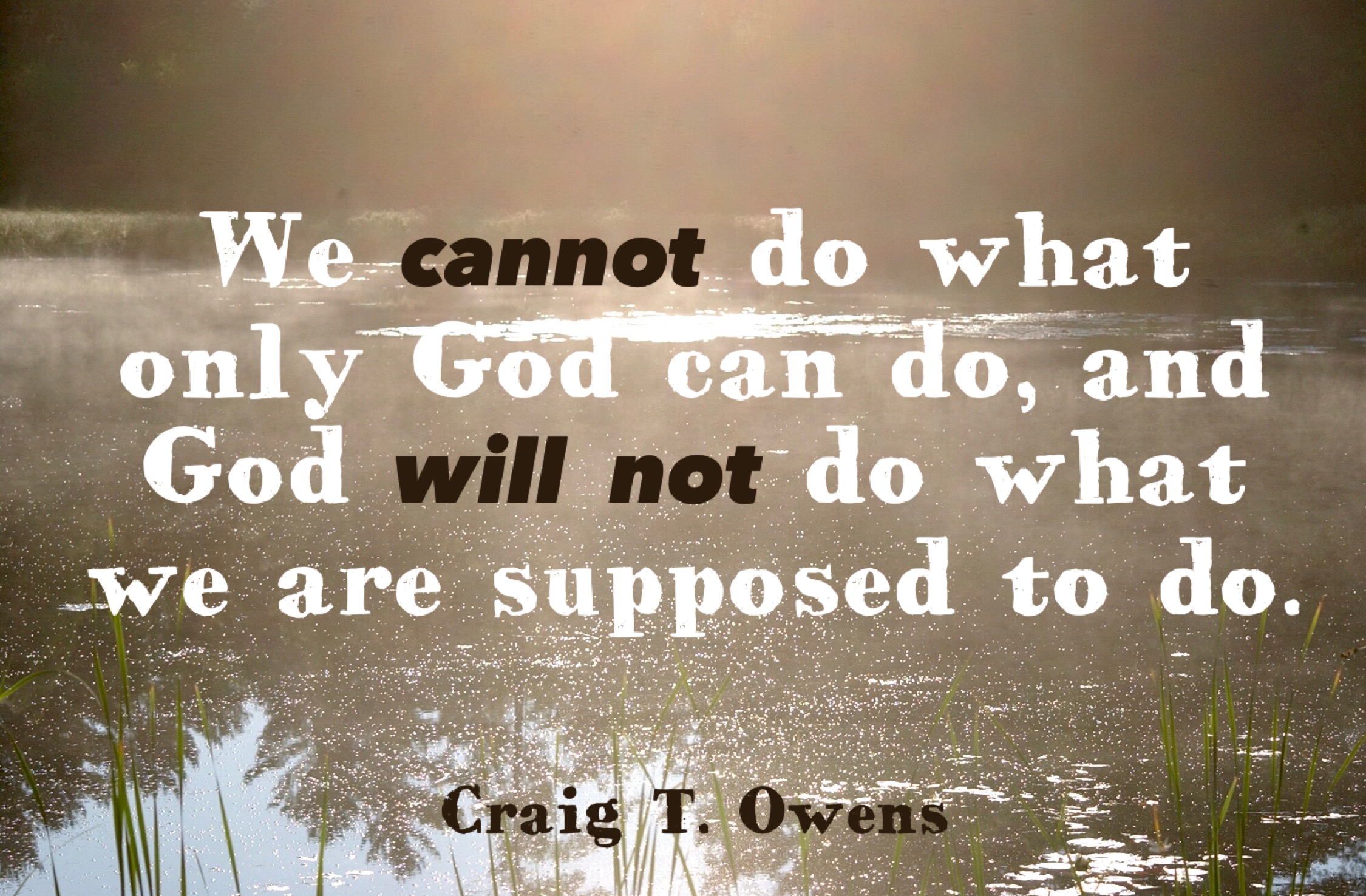
We cannot do what only God can do, and God will not do what we are supposed to do. It is the Holy Spirit who can help us keep those two thoughts clear.
It’s wrong to say, “God only helps those who help themselves.” But it’s equally as wrong to say, “I don’t need to do anything except wait for God.” In example after example in the Bible we see people doing their part while at the same time believing for God to do something miraculous:
King Josiah was the last God-fearing king Judah had. After Josiah died, “the peopleof the land” made Jehoahaz king of Judah. He only reigned three months.
After Jehoahaz died, “Pharaoh Necomade Eliakim son of Josiah king” after Egypt subdued Judah. Pharaoh changed his name to Jehoiakim, took all of Judah’s treasures, and imposed a tribute on Judah, forcing Jehoiakim to tax all the citizens.
Later on, Jehoiakim became a vassal king of Nebuchadnezzar. After Jehoiakim died, his son Jehoiachin only reigned as king for three months before he was deposed by Nebuchadnezzar.
Nebuchadnezzar then “made Mattaniah” king. He also imposed tribute and changed the king’s name to Zedekiah.
King Zedekiah rebelled and was executed, after which Nebuchadnezzar “appointed Gedaliah as governor.” Gedaliah was assassinated shortly thereafter, completing the collapse of Judah and sending the people into exile in Babylon for the next 70 years.
Oh, what misery for the people of Judah for this last 20-year span under these final kings! The consequences of the leaders’ continual rebellion against God brought such uncertainty and heartache for the citizens.
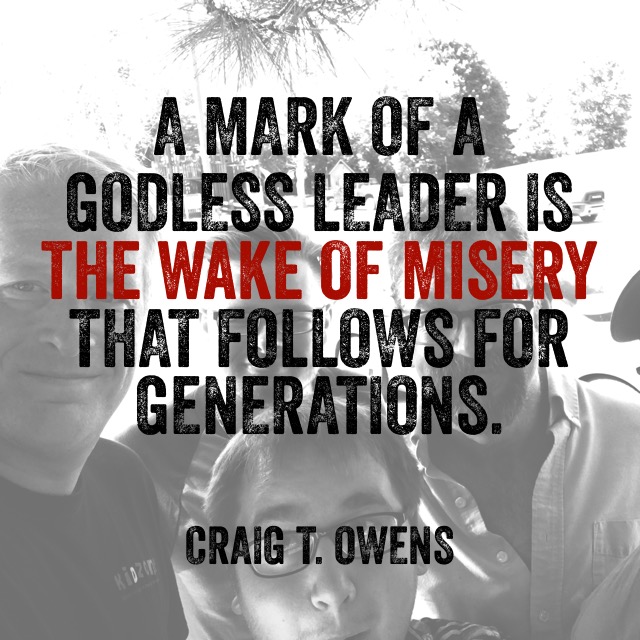
A mark of a godless leader is the wake of misery that follows him for generations afterward.
Lord God, help me to see that my actions today have consequences for tomorrow. I want to leave an empowering, God-honoring legacy for the next generations, but this can only happen as I remain obedient to You!
This is part 51 in my series on godly leadership. You can check out all of my posts in this series by clicking here.
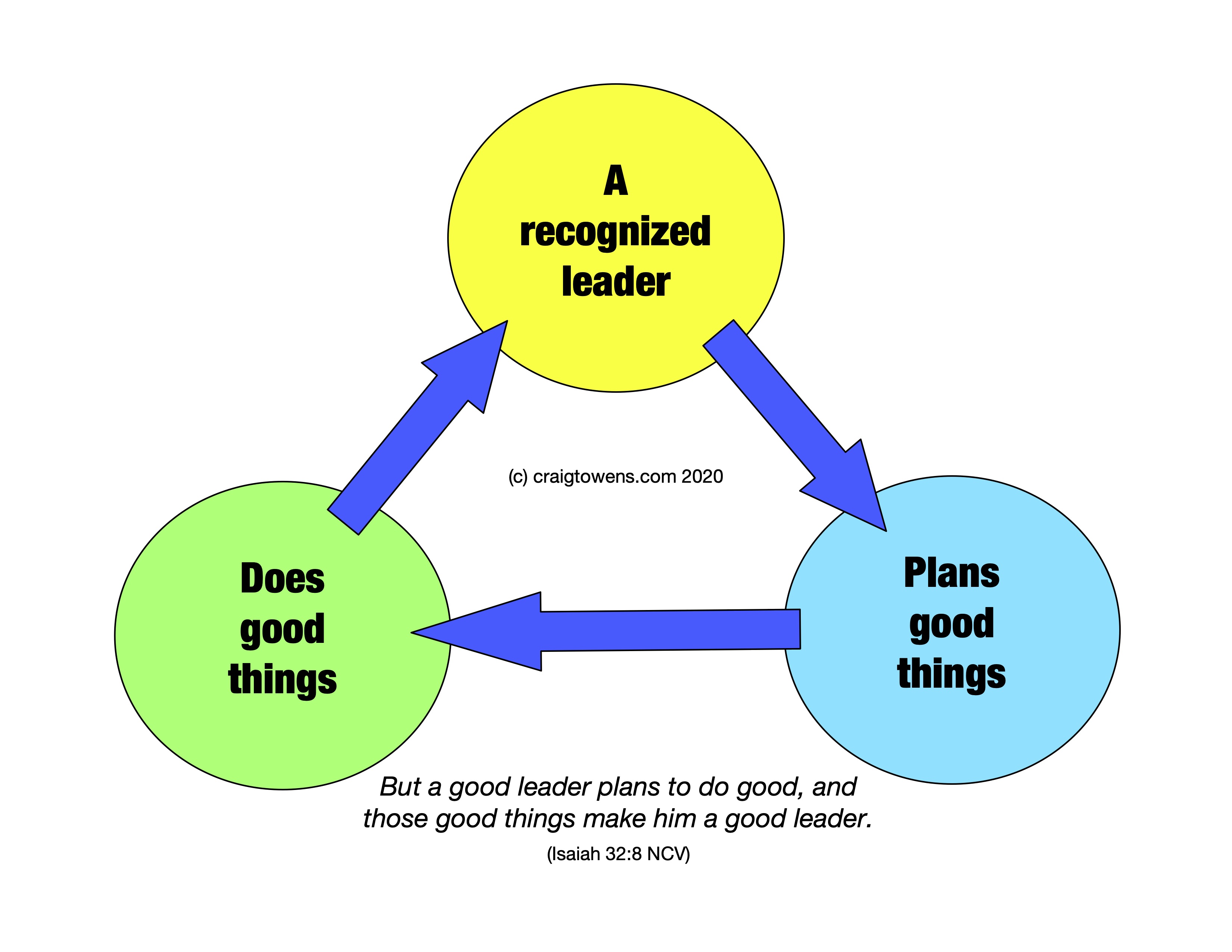
But a good leader plans to do good, and those good things make him a good leader. (Isaiah 32:8 NCV)
A recognized good leader → Plans good things → Does good things → which makes that leader more recognizable, and on and on it goes.
A good leader has to make good plans and has to followthrough on those good plans in a good way. The leader may have started off with just the title of “leader” but the good followthrough on good plans will help that leader be recognizedby others as a good leader.
That recognition of a leader by his/her teammates makes it that much easier the next time to make the good plans and then followthrough on them.
This is a virtuous cycle that pays dividends for everyone involved!
I was first introduced to Jay Milbrandt through his book The Daring Heart Of David Livingston. I was so captivated by Jay’s writing style that I had to seek out more of his books. They Came For Freedom is the story of the first pilgrims that came to this land we now call the United States of America.
Jay uses his training as an attorney to sift through the voluminous historical documentation that was available for him to use in the writing of this book. Just as an attorney is trained to evaluate the evidence to be presented in court in light of the biases of a witness, Jay does the same thing with the many people who documented the story of the pilgrims.
What Jay really wanted to try to capture in this history was the reasons why people wanted to come to this new world. Were there religious motivations? Were there commercial considerations? Were they just adventurers or maybe malcontents? So Jay goes back further into history to set the stage and give us some of the motivations that went into the decision to make such an arduous voyage across the Atlantic Ocean.
In reading this book, undoubtedly you will hear some names of people and places that sound familiar to you. But I’ll bet you are going to see these people and places in a way that your school history books never presented. I found this book absolutely fascinating! I felt about They Came For Freedom the same way I did about Jay’s book on Dr. David Livingston: This is history that reads like a novel.
You may think the story of the first pilgrims coming to these shores is so well known that this book isn’t going to be worth your time, but I can assure you that you are guaranteed to learn something you never knew before. Well done, Jay!
Micah the prophet’s name means who is like God, or more literally: “who but God?” The implied answer, of course, is no one!
Micah opens his letter by telling us his name, and then he closes his prophetic words with a play on his name when he says, “Who is a God like You?” (7:18-20). Who else but God could…
…pardon sin?
…forgive transgressions?
…not stay angry at sinners?
…delight to show mercy?
…have such boundless compassion?
…tread our sins under His foot?
…hurl our iniquities into the sea?
NO ONE!
In light of this, how should we respond to this amazing God? Micah asks a series of rhetorical questions about what sort of religious practices would somehow “balance the scales” for God’s amazing gifts to us. But here’s the deal: there is no way for us to balance the scales! Instead, Micah tells us this, “God has showed you what is good. What does the Lord require of you? To act justly, to love mercy, and to walk humbly with your God.”
In other words, our response to God’s invaluable gifts must transition from a have to lifestyle to a get to lifestyle! Micah makes it clear that God’s Spirit empowers us to live this way (Micah 3:8).
It is the Holy Spirit who empowers Christians to act justly, love mercy, and walk humbly with our God.
The apostle Paul agrees with Micah, even echoing some of Micah’s own phrases—God’s great love, His rich mercy, His unearned grace, His forgiveness of sin, His kindness, and His salvation (Ephesians 2:4-10). Why did God do all of this? So that we could “do good works”—like acting justly, loving mercy, and walking humbly—“which God prepared in advance for us to do”!
I am saved by graceSO THAT I am free to do grace-filled, Spirit-empowered, good things.
All of this prompts me to ask myself three introspective questions:
Do I continually remind myself that I was saved by grace and not by works? I need to check my have to vs. get to attitude.
Am I aware that people are watching me? What are they seeing? Do they see godly justice, loving mercy, and humility?
Am I living like Jesus? Peter explained that Jesus “went around doing good and healing all who were under the power of the devil, because God was with Him” (Acts 10:38). Can that be said of me too?
Who but God could call us, forgive us, and forget our sins? NO ONE!
Who but God could empower us to live in such a way that others see His greatness too? NO ONE!
Let’s never, ever become self-reliant or works-dependent (that’s have to living), but let’s stay so Spirit-reliant that we cannot help be get to people!
This is a weekly series with things I’m reading and pondering from Charles Spurgeon. You can read the original seed thought here, or type “Thursdays With Spurgeon” in the search box to read more entries.
Do Not Fear The Spirit’s Wind
The wind blows where it wishes, and you hear the sound of it, but cannot tell where it comes from and where it goes. So is everyone who is born of the Spirit. (John 3:8)
Sometimes the wind comes with a sweep as though it were going on forever. It comes past and dashes through the trees, sweeping away the rotten branches. Then away it goes across the Alps, dashing down an avalanche in its course, still onward. And as it flies, it blows away everything that is frail and weak. And on, on, on it speeds its way to some unknown goal. And thus it is sometimes the Spirit of God will come right through us, as if He were bearing us away to that spiritual heritage that is our sure future destiny, bearing away coldness, barrenness, everything before it. We do not lament then that we do not pray. We do not believe that we cannot pray. ‘I can do everything’ is our joyful shout as we are carried on the wings of the wind. …
The lower branches of the trees are scarcely moved, but the top branches are rocked to and fro by it. [The wind] is a great leveler! So is the Holy Spirit. He never sees a man high but He brings him down. He makes every high thought bow before the majesty of His might. … Now do not let this make you fear the Holy Spirit. It is a blessed thing to be rocked so as to have our hopes tested, and it is a precious thing to have our carnal confidences shaken. And how blessedly the wind purifies the atmosphere! …
So the Spirit of God comes and cleanses out our evil thoughts and vain imaginations, and though we do not like the hurricane, yet it brings spiritual health to our souls. …
The Holy Spirit is the great testing power, and the result of His operations will be to show men what they are. … Thus also we try the doctrines of men; we bring the breath of inspiration to bear upon them. … True Christians and sound doctrines have ballast and weight in them; they are not moved nor driven away. But empty professors and hollow dogmas are scattered like chaff before the wind when the Lord will blow up on them with the breath of His Spirit. Therefore examine yourselves; try the doctrines and see if they are of God.
From The Holy Spirit Compared To The Wind
We are wise to fear the Wind of God.
By fear I mean a holy reverencing, an appreciation of the awful weightiness of God’s presence, an ever-growing awareness of the awesomeness of the thought of standing before The Judge of the Universe—the All-holy and All-righteous King of kings. I don’t mean cowering in the corner, afraid to approach God, nor afraid of Him approaching us.
In the first Church in the book of Acts, we see a married couple trying to lie to the Holy Spirit, a sorcerer thinking he could learn “the tricks” of the Holy Spirit, and King Herod trying to claim the majesty of God’s presence for himself (Acts 5:1-11, 8:18-24, 12:21-23). The Holy Spirit dealt powerfully and decisively with all of these pretenders. The result: the power of the Holy Spirit was unmistakably and unquestionably acknowledged! So great fear came upon all the church and upon all who heard these things.
True Christians welcome the wind of the Spirit. He cleanses, purifies, prunes, fills, and empowers. He blows away what is impure so that He can impart more of Himself to us.
Let us never, ever treat the Holy Spirit lightly. Let us never, ever try to put the Holy Spirit in our own little boxes. But let us be open to whenever and however He wants to blow His wind through our hearts.
King David was a unifier. He took people that were territorial and possessive of their own tribes and unified them into the strong nation of Israel.
The way he responded to the murders of Saul, Abner, and Ish-Boseth prompted this response: “All the people took note and were pleased; indeed, everything that the king did pleased them. So on that day all the people there and all Israel knew that the king had no part in the murder of Abner son of Ner” (2 Samuel 3:36-37).
The leaders of Israel’s various tribes then followed the lead of Abner—“All the tribes of Israel came to David at Hebron” and “all the elders of Israel” joined with David (5:1, 3).
David accepted all of this in confident humility. He knew that it wasn’t his doing but God’s. He made sure to stay reliant on God (5:19, 23), keeping in mind that he was leading to win victories for all Israel: “Then David knew that the Lord had established him as king over [all] Israel and had exalted his kingdom for the sake of His people Israel” (5:12).
Result: “[David] became more and more powerful, because the Lord God Almighty was with him” (v. 10).
God delights to empower leaders who have a humble heart to unify God’s people. God will let self-made leaders struggle in their own ability, but He will unleash all His resources to help the humble, God-dependent leader.
These God-empowered leaders are the only ones who can bring lasting unity.





 Puppies and mosquitoes.
Red blood cells and white.
Puppies and mosquitoes.
Red blood cells and white.
 You are in every sight.
Sound.
Taste.
Smell.
Touch.
You are in all.
Today I want to experience You more.
To praise You more.
To know Your greatness more.
To realize Your love more.
How great Thou art! —Craig T. Owens
You are in every sight.
Sound.
Taste.
Smell.
Touch.
You are in all.
Today I want to experience You more.
To praise You more.
To know Your greatness more.
To realize Your love more.
How great Thou art! —Craig T. Owens





 Craig T. Owens