Listen to the podcast of this post by clicking on the player below, and you can also subscribe on Apple, Spotify, or Audible.
Isaiah 49 has an interesting phrase that appears twice: “But I said…” (vv. 4, 14).
Notice that first word: But. That conjunction means that “I” am saying something in contradiction to what someone else has said. Sadly, in this case the Someone Else that is speaking in this chapter is God Himself!
The phrase “this is what the LORD says” is used three times in this same chapter (vv. 8, 22, 25). Look at what God is saying to you and me:
I made you
I called you
you are My servant
I reward you
you have My favor
you have My comfort
I never forget you
I will never disappoint you
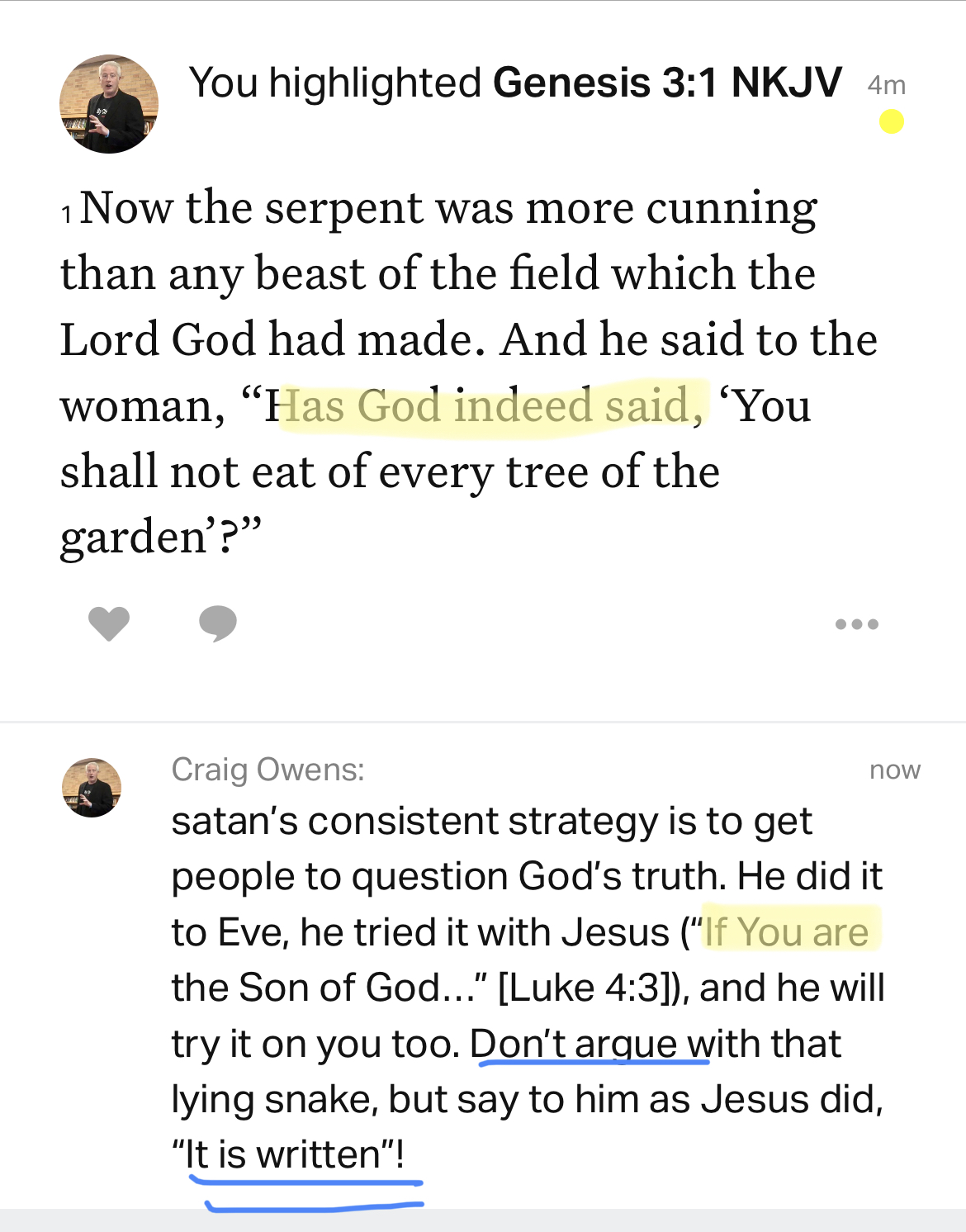
A consistent strategy of the devil is try to get us second-guessing or doubting God’s promises. He did this to Eve—“Did God really say that?”—and he tried it with Jesus—“Are You really the Son of God?”—and he’s still trying it today.
Jesus said the devil’s native tongue is lying. He lies and he slanders you. He wants you to simply listen to those lies without questioning them.
Someone once asked Smith Wigglesworth, “Smith, how do you feel?” He replied, “I never ask Smith how I feel. I tell him how he feels!”
That’s good counsel for us today!
Don’t listen to yourself, especially when you’re tired or lonely or anxious or scared, but talk to yourself. Remind yourself what God says to you and what He says about you. Remind those negative thoughts that God never lies, that He is all-loving, that He is all-powerful, and that He has a unique plan and purpose your life.
Whenever you feel like saying, “But I said,” change those thoughts around to, “But this is what God says!”
I’ve shared a couple of other posts that expand on this idea which you may want to read here and here.
Jesus told us that we could pray in His name and expect amazing things (see John 14:13-14, 15:16, 16:23-24). This does not mean that simply adding the phrase “in Jesus’ name, Amen” to the end of a prayer unlocks a secret code. Rather, it means that the more we understand just how awesome our Savior is, and that He is the Key to God’s storeroom, the more we will being to align our prayers with the will of God.
Jesus desires for His Father’s glory to be seen on earth through the answers to our prayers. The writer of Hebrews opens his letter by reminding us that Jesus is “the radiance of God’s glory and the exact representation of His being, sustaining all things by His powerful word” (Hebrews 1:3).
We will be working our way through the Book of Hebrews to learn just how awesome the name of Jesus truly is. As we do so, my prayer is that your prayer life will flourish into something far greater than it has ever been before!
Join us beginning this Sunday for our series on prayer called Awesome: Learning to pray in the awesome name of Jesus.
If you have missed any of the messages in this series, check them out here:
Listen to the podcast of this post by clicking on the player below, and you can also subscribe on Apple, Spotify, or Audible.
The Lord is angry with all nations… (Isaiah 34:2).
Perhaps that verse surprises you in light of the title of this post, “Everlasting, Unshakable Joy,” but stick with me.
These phrases from Isaiah 34 do sound like terrible news:
God is angry with all nations
His wrath is on all their armies
God will totally destroy them
Even all the starry host will fall
God Himself says, “My sword has drunk its fill”
All the world’s princes will vanish away
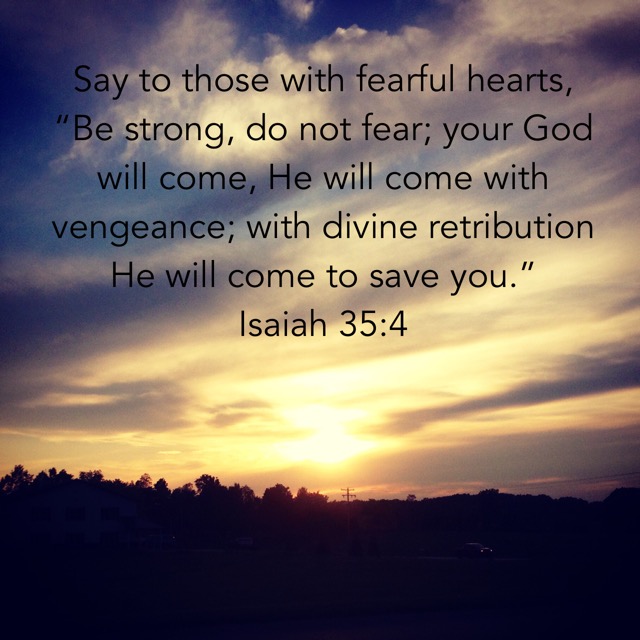
But please keep in mind that this is only bad news for those who don’t have their sins forgiven through a personal relationship with Jesus Christ. “For the Lord has a day of vengeance, a year of retribution, to uphold Zion’s cause” (v. 8). And, “He will come with vengeance; with divine retribution He will come to save you” (35:4).
So God’s anger is not at those whose sins have been forgiven, but at those who are not only unforgiven but hell-bent on attacking those who are forgiven.
These words are intended to “strengthen feeble hands, steady the knees that give away,” and to bring strength “to those with fearful hearts” (35:3-4).
The righteous have nothing to fear when the world is quaking in fear! “They will enter Zion with singing; everlasting joy will crowned their heads. Gladness and joy will overtake them, and sorrow and sighing will flee away” (v. 10)!
This is why Jesus told us, “I tell you, My friends, do not be afraid of those who kill the body and after that can do no more” (Luke 12:4 NIV), and, “Save your fear for God, who holds your entire life—body and soul—in His hands” (Luke 12:5 MSG). And also the apostle Peter reminds us that we do not fear what the world fears (1 Peter 3:14).
If your sins are forgiven, if you are walking in God’s paths, if you are seeking to savor the glory of God, and desirous that His glory be seen on earth as it is in heaven, there is not only nothing to fear, but you will have an everlasting, unshakable joy!
Get your eyes off the world’s bad news, and keep your eyes firmly on the Good News that only Jesus has made a reality!
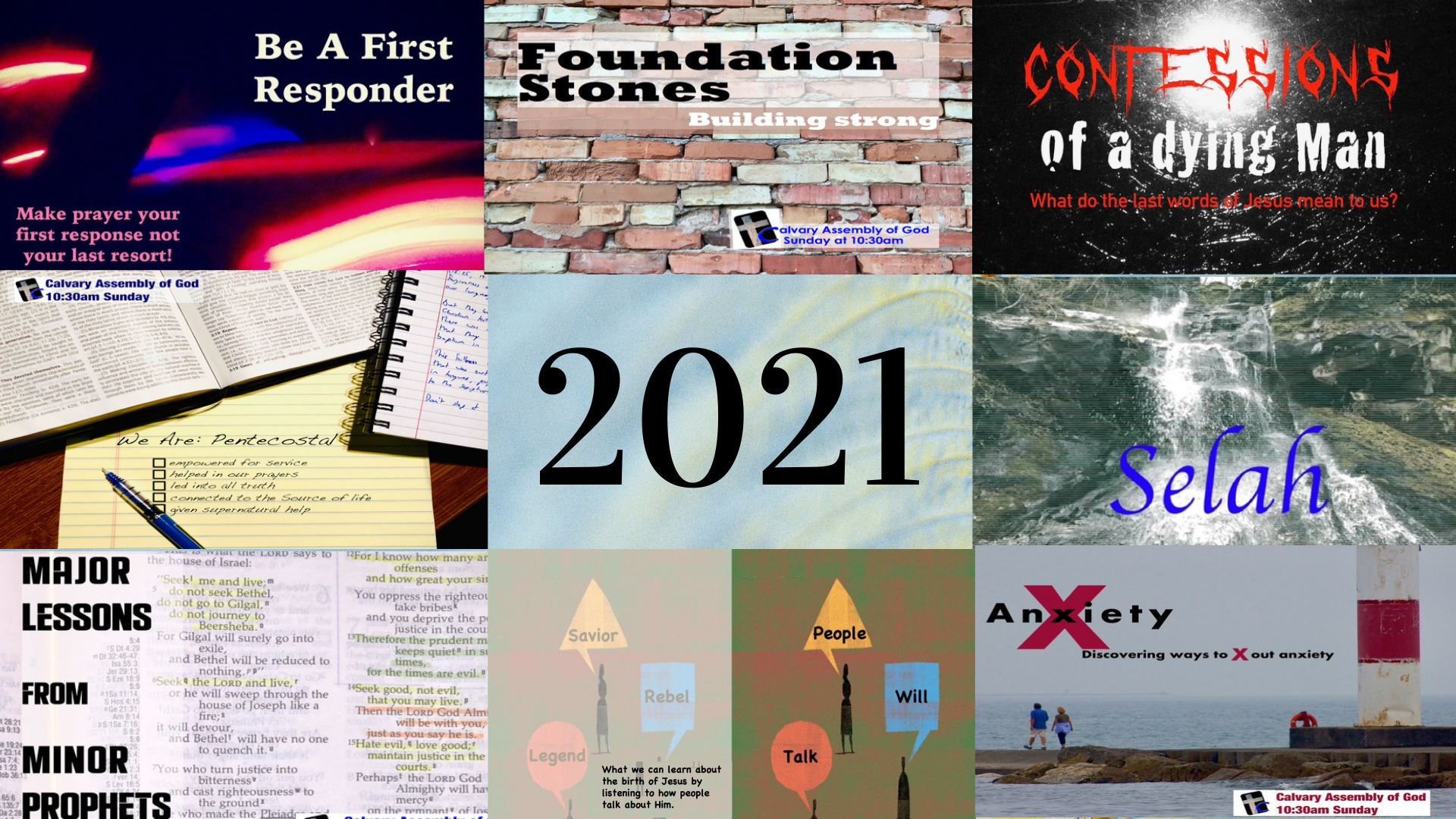
So here are all of the sermon series that I shared in 2021. Clicking on each series title will take you to a list of all of the sermons in that series.
Foundation Stones—Any architect will tell you: You can’t build a great building on a weak foundation. This is just as true in the spiritual realm, which is why John Calvin warned, “Those who are strong only in fervor and sharpness, but are not fortified with solid doctrine, weary themselves in their vigorous efforts, make a great noise…[and] make no headway because they build without foundation.” We have had on the Calvary website since Day 1 a link to “What we believe,” but more than just having them listed there, it is important to discuss them.
Be A First Responder—There is a line in an old hymn that convicts me every time I sing it: “Oh, what peace we often forfeit; Oh, what needless pain we bear all because we do not carry everything to God in prayer.” Why are we so slow to drop to our knees in prayer when trouble strikes? It seems we fool ourselves into thinking the problem is small enough to handle on our own, or we think God isn’t concerned with something that may seem trivial, or we’ve been-here-done-this before and know the way to go. But this isn’t what our Heavenly Father desires; instead, He wants us to come to Him before we try anything else. Instead of making prayer our last resort, why don’t we strive to make it our first response!
Confessions Of A Dying Man—In our justice system, rarely will a judge allow hearsay testimony to be introduced in court. But there is one notable exception: a dying declaration. A dying declaration is the statement of a mortally injured person who is aware he or she is about to die. This statement is admissible testimony in court on the theory that a dying person has no reason not to tell the truth. Jesus was nailed to a Cross. Mortally injured, unable to escape, He had no reason to lie. In His dying moments, struggling to get enough air in His lungs to be able to speak, Jesus choked out seven statements that still have a profound impact on us today.
We Are: Pentecostal—Pentecost for over 1500 years was a celebration in Jerusalem that brought in Jews from all over the world. But on the Day of Pentecost that came just ten days after Jesus ascended back into heaven, the meaning of Pentecost was forever changed! Followers of Jesus—now empowered by an infilling of the Holy Spirit—began to take the good news of Jesus all over the world. These Spirit-filled Christians preached the Gospel and won converts to Christ even among hostile crowds, performed miracles and wonders, stood up to pagan priests and persecuting governmental leaders, and established a whole new way of living as Christ-followers. We, too, can be Pentecostal followers of Jesus Christ today.
Selah—The word Selah appears nearly 70 times in the Bible, almost exclusively in the Psalms. Although it is primarily a musical term, it applies beautifully to our summer series. It means a pause. Throughout the Psalms, Selah appears at the end of a verse, at the end of the psalm, or sometimes even mid-sentence. But each one of them is perfectly placed by the Spirit-inspired authors to get us to take a breath and deeply contemplate what we just read or sang.
Major Lessons From Minor Prophets—Sometimes the naming of things gives us an inaccurate picture of the thing being named. For instance, many people think the “old” in Old Testament means outdated or perhaps updated by the “new” in the New Testament. When in fact, both Testaments are needed to give us the full picture of God’s love and glory. A similar thing happens with the headings “major prophets” and “minor prophets.” It makes it sound like the major prophets have something major to say to us, while we could take or leave the minor messages of the minor prophets. In reality, they were given these headings simply because of the volume of writing—the five major prophets consist of 182 chapters, whereas the 12 minor prophets only have 67 chapters. The volume of their writing may be minor, but their content carries major messages of meteoric power!
X-ing Out Anxiety—Two brothers—one a doctor and one a pastor—addressed the prevalence of anxiety in our culture. They wrote, “A recent survey of primary care physicians in the United States revealed that at least one-third of office visits were prompted by some form of anxiety.” Anxiety can negatively impact our relationships, our ability to think creatively, our physical health, and even our relationship with God. Thankfully, one of the titles given to Jesus is The Prince of Peace. Join us for this freeing series called X-ing Out Anxiety, where we will be learning what God’s Word says about getting free from the anxiety that is robbing us of life, and replacing that anxiety with His peace.
People Will Talk—Sometimes celebrities and other people in the public spotlight will hire a publicist to help promote their cause, build their brand, or present them in the best possible light. If you wanted to stretch the terms, you could say that some of the Old Testament prophets and the New Testament disciples could have been viewed as the “publicists” for Jesus. At least, that’s what critics might point to. But despite the best efforts and high salaries of publicists—both ancient and modern—they cannot control the “word on the street.” What people are actually saying about the one in the spotlight is usually the best evidence of who that person truly is. As we celebrate this Advent season, we are going to look at what the people on the street were saying about Jesus at the time of His birth. Before He ever performed a miracle or presented a parable—before any of His “publicists” could try to make Him look good—people were already talking. And what they said about Him is truly enlightening.
We will be returning to a couple of these series in 2022, and we’ll be launching some brand new ones as well. In either case, if you don’t have a home church in the northern Kent County area, I would love to have you join us!
Listen to the podcast of this post by clicking on the player below, and you can also subscribe on Apple, Spotify, or Audible.
…They have turned their backs to Me and not their faces; yet when they are in trouble, they say, “Come and save us!” (God in Jeremiah 2:27)
In so many ways the USA today resembles ancient Israel. Abortion, prostitution, idolatry, envy, greed, atheism, dirty politics, self-serving church leaders. Our culture calls itself “Christian” but we live anything but.
God is not allowed to be mentioned in our schools, but the moment there is a school shooting, people cry, “Where was God?! Why didn’t He stop this?!”
God is banished from the town square, but as soon as a tornado or hurricane or flood levels the town, the people yell, “How could God let this happen?!”
This was exactly the same lifestyle and same response in Jeremiah’s day.
When these painfully tragic things happen, there should be a different response: “Consider then and realize how evil and bitter it is for you when you have forsaken the Lord your God and have no awe of Me” (v. 19).
Typically, this considering takes place post-tragedy. But it really should be considered before disasters strike. Four times in this chapter God calls us to consider “the word of the Lord” (vv. 1, 4, 5, 31). In order for that considering to take place, loving pastor-shepherds need to hold up the mirror of God’s Word to the ungodly lifestyles people are living.
To all of my fellow pastors, I appeal to you to boldly and lovingly proclaim the full counsel of God’s Word. Not just the “pleasant” parts that speak of God’s blessings, but also the calls to repentance that will allow your people to avoid God’s righteous judgment. And don’t wait to only speak about these topics post-tragedy, but make this message a consistent part of your teaching.
Pastor, if you don’t speak these truths to your flock, how will they know how to live in the way that pleases God? I am praying that God will help you in this.



 Isaiah 49 has an interesting phrase that appears twice: “But I said…” (vv. 4, 14).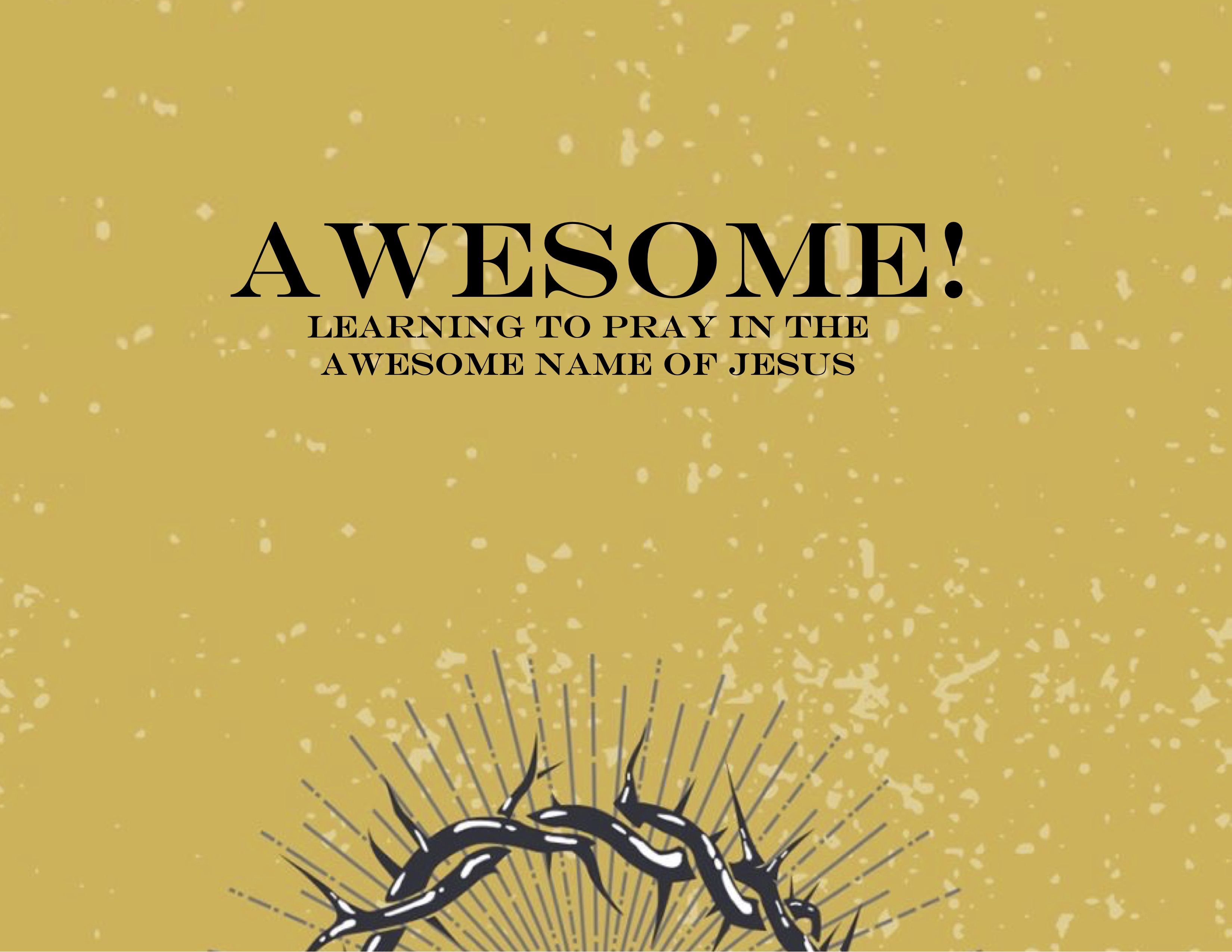





 Craig T. Owens