Think On This…

Here’s the seed thought for this episode of Think On This

In the fifteenth year of Amaziah son of Joash king of Judah, Jeroboam son of Jehoash king of Israel became king in Samaria, and he reigned forty-one years. He did evil in the eyes of the Lord and did not turn away from any of the sins of Jeroboam son of Nebat, which he had caused Israel to commit. He was the one who restored the boundaries of Israel from Lebo Hamath to the Dead Sea, in accordance with the word of the Lord, the God of Israel, spoken through His servant Jonah son of Amittai, the prophet from Gath Hepher. The Lord had seen how bitterly everyone in Israel, whether slave or free, was suffering; there was no one to help them. And since the Lord had not said He would blot out the name of Israel from under heaven, He saved them by the hand of Jeroboam son of Jehoash. (2 Kings 14:23-27) 

Think on this: Just because God has used me to do something amazing doesn’t necessarily mean that I am free of sin. 

Reacting To Injustice

When Shechem…saw Dinah, he took her and he raped her (Genesis 34). 

There is no doubt that what Shechem did to Diana was abhorrent. The text is full of reminders:

  • an outrageous thing
  • a thing that should not be done 
  • Dinah had been defiled
  • their sister had been defiled 
  • he treated our sister like a prostitute 

Shechem never admits to his wrongdoing. We don’t even know if he told his father Hamor what he had done. Dinah was being kept in the city away from her family, so she didn’t tell her father Jacob. Somehow, however, Jacob found out and his response is curious: he did nothing about it (v. 5). Even as Shechem and Hamor address Jacob’s family, it’s Diana’s brothers who reply deceitfully, so either Jacob has left the meeting or he is still sitting there silently. 

Levi and Simeon have the same mother as Dinah. Their reaction to their sister’s defilement is extreme—they kill every male in Shechem’s hometown! 

Since Shechem hadn’t even mentioned his crime to his father, it’s possible that the rape of Dinah has been kept a secret from the rest of the citizens of his city. Perhaps if the other city leaders had found out, Shechem alone would have been punished, instead of the whole city being wiped out. 

Jacob’s silence and inaction to this injustice prompted an overreaction by his sons. 

When a leader’s response is inappropriate to injustice, the followers’ response is likely to become even more so. Injustices must be dealt with in a God-honoring way: quickly and appropriately. 

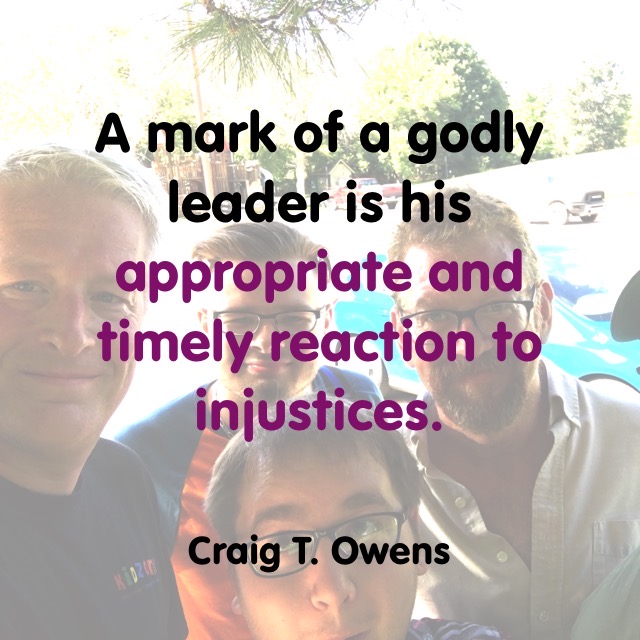
A mark of a godly leader is his appropriate and timely reaction to injustices.

This is part 50 in my series on godly leadership. You can check out all of my posts in this series by clicking here. 

He Who Laughs Last

Traced back to a play in the early 1600s, it still rings true: “He who laughs last, laughs best. 

The distraught father named Jairus hurriedly left his home. He was looking for this Man named Jesus. People said Jesus could perform miracles, and Jairus needed one. 

He found Jesus and quickly explained that his 12-year-old daughter was dying. They had tried everything they knew to do, but she kept inching closer and closer to death’s door. Jesus readily agreed to go with Jairus to his home. 

Along the way, Jesus was interrupted by another woman in desperate need, and He stopped to heal her. As Jairus was (im)patiently waiting for Jesus to continue on the journey, one of his servants ran up to Jairus with the sad news, “Your daughter is dead.” 

Jesus looked at this heartbroken father and simply said, “Don’t be afraid. Just believe, and your daughter will be well.” 

Jairus took Jesus at His word and continued walking with Jesus to his home. 

While Jairus was gone, family members and friends had shown up to mourn the death of this sweet girl. They were wailing loudly, but the clear voice of Jesus could be heard even over their woeful cries: “Stop crying. She is not dead, only asleep.” 

There was a pause, and then there was a totally unexpected and out-of-place response: laughter. 

Not joy-filled laughter, but mocking, derisive laughter at the utter foolishness of the words of Jesus. 

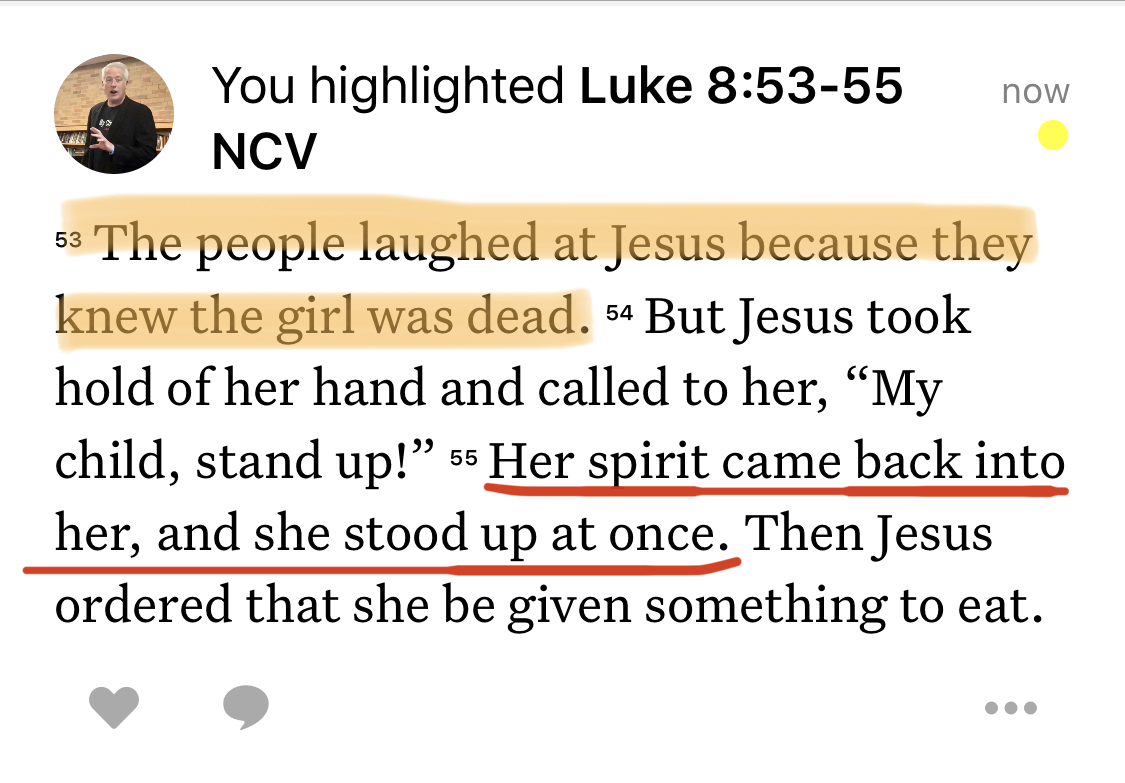
“What do you mean, ‘She isn’t dead’” they yelled. “We’ve been in her room. We’ve seen the cold, lifeless body! She is absolutely, undeniably dead!” And they continued to laugh at the sheer ridiculousness of what Jesus had pronounced. Many of the laughs probably turned to jeers as they began to mock His foolish, insensitive statement. The historian Luke wrote, “They knew the girl was dead.” 

Jesus took the grieving yet believing parents into the girl’s room, He took her lifeless hand in His hand, and simply said, “Little girl, get up.” 

And she did. Fully alive! 

Let me ask you something: Who was laughing now?! 

I’m sure the uncontainable joy of these parents burst out into laughter. And I think Jesus shared in the joyful laughter as well. 

“He who laughs last, laughs best.” 

Friend, what do you “know” right now? What’s gone wrong that cannot be fixed? What terminal diagnosis have the doctors given? What is approaching death’s door? What has already died? 

Listen again to the words of Jesus: “Don’t be afraid. Just believe.” 

Jesus gets the final word. Jesus gets the final laugh. Jesus will make all things new! 

The Sovereign Lord will wipe away the tears from all faces; He will remove His people’s disgrace from all the earth. (Isaiah 25:8) 

He will wipe every tear from their eyes. There will be no more death or mourning or crying or pain, for the old order of things has passed away. He who was seated on the throne said, “I am making everything new!” (Revelation 21:4-5) 

Don’t be afraid. Just believe. 

Jesus has secured the last—and best—laugh for both you and Himself! A laughter that will reverberate through all of eternity! 

The EGO That God Blesses

Have you ever noticed that it seems a lot easier to say, “God bless you” than it does to say, “God bless me”? Why is that? 

Do I feel unworthy of His blessing? If I am a Christian, I need to remind myself that I am in Christ, and He is in me, and He has brought me into the Father. This means that I am as blessed as the Father blesses the Son (John 14:20; Ephesians 1:3-6). God is blessed by our being blessed! 

Or perhaps I feel that “God bless me” is an arrogant prayer, while saying “God bless you” is a humble prayer. There is an EGO that God always blesses, and He delights to show us what that is!   

In Hebrew literature, the key point is found in the middle of a poem or story. In Psalm 67, that would make the middle verse: May the nations be glad and sing for joy, for You rule the peoples justly and guide the nations of the earth. Selah. (v. 4)

The nations rejoice because God judges fairly and God guides the nations. Selah—pause and take that in. The natural attitude is actually a God-negative attitude—“I prefer to be in charge … I don’t like anyone telling me what to do!” But the unnatural attitude is a God-positive attitude—“I trust God more than I trust me, so I’m glad He is in charge … I trust God to judge justly more than I trust world institutions, so I’m glad He is the final Judge!” 

This is very good news: Only God can rule and judge correctly! Men have biases and agendas; men are selfish and self-seeking; men seek their own glory and their own advancement. So the psalmist wants us to Selah/pause to remember that only God can lead and judge in a way that brings Him glory and brings us blessing. God is blessed by our being blessed! 

Working outward from verse 4, we see verses 3 and 5 are identical, teaching us that our God-honoring desire should be for all peoples in all nations to experience the blessing of an intimate relationship with God. 

A similar theme is sounded in the “bookend” verses of 1-2 and 6-7: We are asking God to bless us so that “all the ends of the earth will fear Him.” Once again we Selah/pause to consider this: Do I have the right EGO to request this blessing? Remember: There is an EGO that God always blesses.  

In his book Lead Like Jesus, Ken Blanchard identifies two types of E.G.O.s in our relationship with God:

  • Negative E.G.O.—Edging God Out 
  • Positive E.G.O.—Exalting God Only

The negative EGO says things like, “Bless me” and “Shine on me.” The positive EGO says, “Bless me so that I can be a blessing to others” and “Shine Your light on me so that others will see You.” 

Jesus told us to not let the light of our life be hidden. We are blessed by God so that we can be a blessing to all of the peoples in all of the nations. We desire that all may know the joy of serving a Righteous King. We want everyone to know the praise that comes from Exalting God Only. 

Oh God, be merciful to me. Cause Your face to shine on me. Bless me indeed so that I may teach others to fear You, so that they may come to know You as their All-Righteous, Good, and Loving King! 

If you have missed any of the messages in this series exploring the Selahs in the Psalms, you can find the full list of messages by clicking here. 

Poetry Saturday—Let All Things Now Living

Let all things now living, a song of thanksgiving,
To God the Creator triumphantly raise,
Who fashioned and made us, protected and stayed us,
Who still guides us on to the end of our days.
God’s banners are o’er us, His light goes before us,
A pillar of fire shining forth in the night;
Till shadows have vanished, and darkness is banished,
As forward we travel from light into light.

His law He enforces, the stars in their courses
And sun in its orbit obediently shine,
The hills and the mountains, the rivers and fountains,
The deeps of the ocean proclaim Him divine.
We too should be voicing our love and rejoicing
With glad adoration a song let us raise,
Till all things now living unite in thanksgiving
To God in the highest, hosanna and praise. —Katherine Davis

Thursdays With Spurgeon—Seeing God In Jesus

This is a weekly series with things I’m reading and pondering from Charles Spurgeon. You can read the original seed thought here, or type “Thursdays With Spurgeon” in the search box to read more entries.

Seeing God In Jesus 

For it is the God who commanded light to shine out of darkness, who has shone in our hearts to give the light of the knowledge of the glory of God in the face of Jesus Christ. (2 Corinthians 4:6) 

     Paul knew not merely God, but God in Christ Jesus! Not merely ‘the glory of God,’ but ‘the glory of God in the face of Jesus Christ’ (2 Corinthians 4:6). The knowledge dealt with God, but it was Christward knowledge! He pined not for a Christless theism but for God in Christ! This, beloved, is the one thing that you and I should aim to know. …  

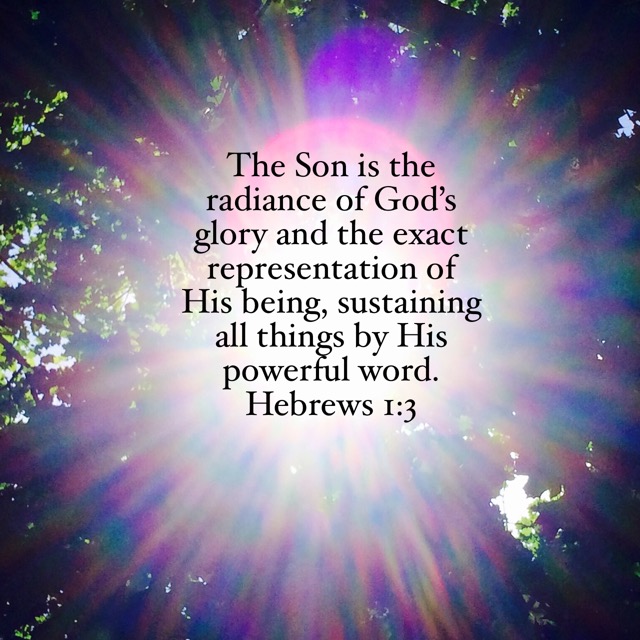
     Even when your thought sweeps round the stars and circumnavigates space, you feel that heaven, even the heaven of heavens, cannot contain Him. Everything conceivable falls short of the inconceivable glory of God! When you come, however, to gaze upon the face of Christ Jesus, how different is the feeling! Now you have a mirror equal to the reflection of the eternal Face, ‘in Him dwells in the fullness of the Godhead bodily’ (Colossians 2:9). His name is ‘Wonderful, Counselor, Mighty God’ (Isaiah 9:6). He is the image of God, ‘the brightness of His glory and the express image of His person’ (Hebrews 1:3). If your conception of Christ is truthful, it will coincide with the true idea of God and you will exclaim, ‘This is the true God and eternal life’ (1 John 5:20). Like Thomas, you will salute the wounded Savior with the cry, ‘My Lord and my God!’ (John 20:28). …  

     How softly breaks the divine glory through the human life of Jesus; a babe in grace may gaze upon this brightness without fear! When Moses’ face shone, the people could not look at him, but when Jesus came from His transfiguration, the people ran to Him and saluted Him! Everything is attractive in God in Christ Jesus! In Him we see God to the fullest, but the Deity so mildly beams through the medium of human flesh that mortal man may draw near and look and live. 

From The Glory Of God In The Face Of Jesus Christ

If you would like to know God more intimately, look more closely at Jesus. 

Read through the Gospels slowly, focusing on what Jesus was saying and doing. Let the Holy Spirit transport you to those dusty Israelite roads, where you can walk with Jesus and get a new glimpse of the majestic glory of God.

How Big?

…your servant has nothing there at all…except a small jar of olive oil (2 Kings 4:2). 

This widow made the right move in going to Elisha for help. The situation seemed impossible, so she had nowhere else to go but to God.

Instead of giving her immediate relief, God asks this widow to extend her faith. The steps she takes next will determine how big of a blessing she will receive. God frequently does this:

  • how many ditches am I willing to dig (3:16)? 
  • how many doors am I willing to knock on to ask for empty jars (4:3)?
  • how many times am I willing to strike the ground with my arrows (13:18-19)?

The ditches were filled with water until they could hold no more.

The jars were filled with oil until they could hold no more.

Joash only struck the ground three times, so he only received three victories.

Jesus told us…

…ask, and keep on asking 

…seek, and keep on looking 

…knock, and keep on knocking 

God IS going to answer. The question is: HOW BIG do I want Him to answer? 

Now all glory to God, who is able, through His mighty power at work within us, to accomplish INFINITELY MORE than we might ask or think. (Ephesians 3:20) 

Five Presidents (book review)

Some of my favorite books to read are in the categories of history and leadership. Five Presidents by Clint Hill is a treasure-trove of both history and leadership, giving us a front-row seat to the leadership styles of five United States presidents. 

Mr. Hill was on the presidential protection detail for Presidents Dwight Eisenhower, John Kennedy, Lyndon Johnson, Richard Nixon, and Gerald Ford. During his time, America experienced several “firsts” and Mr. Hill was right there to see them firsthand. During this time in our country’s history, only one of these presidents was elected, reelected, and finished both of his terms as president: Dwight Eisenhower. President Kennedy was assassinated, President Johnson finished JFK’s term but withdrew from running for reelection, President Nixon resigned during his second term, and President Ford became the only president to serve as both president and vice president without being elected to either office and then was defeated in his reelection bid. 

Five Presidents is not only an eye-opening, behind-the-scenes look at key historical events during the 1960s and ’70s, but it is also an informative study on the different leadership styles of these five unique men. Eisenhower ran the executive branch like a general, Kennedy was an idealist, Johnson used brute force, Nixon started off well and allowed his own insecurities to derail him, and Ford served as the “ordinary man” trying to clean up the mess left by his predecessor. 

Mr. Hill also documents the changes in the operations of the Secret Service. When he began his assignment, there were no bullet-proof presidential vehicles, no protection for presidential candidates (only elected officials), no permanent residence for the vice president, and no Air Force Two. By the time he retired, all of these things—and many more—had been implemented. 

Whether you enjoy history, leadership, or presidential biographies, Five Presidents will be a highly enjoyable and informative book for you. 

Not Shaken

“Anyone have a nice, neat, organized life that never gets rocked by anything unexpected?” he asked, not expecting anyone to answer. Let’s be honest: There’s a whole lot of shaking going on!  Not just now, but it’s always been this way. Even in 1000 BC when David wrote Psalm 62. 

Let me walk you through this psalm and offer a couple of observations. 

In the first two verses, David’s declaration sounds very religious. It sounds like what he’s supposed to say in difficult times. Yet some doubt is obviously creeping in because David refers to himself as a leaning wall and a tottering fence. It’s here that David has his first Selah pause. 

Selah—pause and calmly consider what’s happening. “If God is really such a strong rock and fortress, could bad guys really slip by Him? Is it likely that they could be trying to knock me over without God knowing about it?” Of course not! God knows exactly what is happening to me, and He’s allowed it to happen for a reason.  

After pausing to consider this, David makes a statement that sounds like he’s repeating the first verse. But notice that this time David is talking to himself: “I don’t believe God is my refuge just because my parents believed it, or just because it sounds religious. I declare it because it is true!” It’s good to preach the Word of God to our shaking souls! 

Verse 6 is a word-for-word repeat of verse 2 with one minor exception. Look at it in the NKJV: “I shall not be greatly moved” (v. 2). This means that in David’s mind there is still a possibility of getting knocked over. But then in verse 6: “I shall not be moved” has no qualifiers. Or as Matthew Henry commented, “I may be shocked, but I shall not be sunk.” 

After making the declarations of verses 1-2 his own in verses 5-6, David can no longer be called a hypocrite when he now encourages others to declare God’s salvation for themselves (vv. 7, 8). Then he invites everyone to Selah again, this time to weigh the Rock of God with the ways of men. He declares that mankind and his plans are only a breath, not even close to the weightiness of God! 

The word alone” dominates the first eight verses of this psalm. David is emphasizing that God alone is our refuge. As Augustine wrote, “God, You arouse us so that praising You may bring us joy, for You have made us for Yourself, and our hearts are restless until they find rest in You.” And C.S. Lewis added, “So few of us will really rest all on Him if He leaves us any other support.” 

Sometimes God allows unrest or disquiet SO THAT we will rediscover our rest and quiet in Him alone. 

During times of shaking, David calls us twice to Selah pause to reach the same conclusion he has reached—

  • Nothing is stronger than our God
  • No one is more loving than our God

You can stand firm on a God that is powerful enough to help, and loving enough to want to help. HE ALONE is our security! Let times of shaking reveal to you the flimsy supports of this world that you may have come to rely on, and then run to THE strongest, most loving place possible: God’s presence! 

If you’ve missed any of the other posts in our Selah series, you can find the complete list of them by clicking here. 

Poetry Saturday—Hope

“Hope” is the thing with feathers
That perches in the soul
And sings the tune without the words
And never stops—at all

And sweetest—in the Gale—is heard
And sore must be the storm
That could abash the little Bird
That kept so many warm

I’ve heard it in the chillest land
And on the strangest Sea
Yet—never—in Extremity,
It asked a crumb of me. —Emily Dickinson