


 “God’s promises and His provision do not lift us from the world of common sense and everyday trials, for it is through these very things that our faith is perfected.” —Lettie Cowman, in Streams In The Desert
How Our Faith Is Perfected
July 20, 2017 — Craig T. OwensThursdays With Oswald—Where Are Your Feet?
July 20, 2017 — Craig T. OwensThis is a weekly series with things I’m reading and pondering from Oswald Chambers. You can read the original seed thought here, or type “Thursdays With Oswald” in the search box to read more entries.
 Where Are Your Feet?
“Where did Jesus placed His feet? He placed them by the sick and the sorrowful, by the dead, by the bad, by the twisted and by the good. He placed His feet exactly where we have to place ours…, in the ordinary rough and tumble of human life as it is. ‘I will make the place of My feet glorious [Isaiah 60:13].’”
From Run Today’s Race
Run Today’s Race contains short statements from Oswald Chambers intended to stimulate Christians to ponder things like:
- All of Isaiah 60 is about God’s glory being revealed on earth through Jesus Christ. Am I letting Christ’s glory shine through my life?
- Do I only look for “super-spiritual” moments, or am I aware that God can make wherever I place my feet a glorious place?
- Am I willing to go wherever God needs me to go?
11 Quotes From “Man—The Dwelling Place Of God” by A.W. Tozer
July 19, 2017 — Craig T. Owens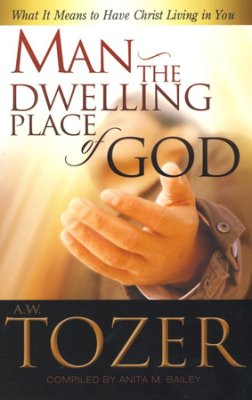 A.W. Tozer’s 50-year-old publication Man—The Dwelling Place Of God still rings with timely truth for today. You can check out my full book review by clicking here.
“I long ago decided that I would rather know the truth than be happy in ignorance. If I cannot have both truth and happiness, give me truth. We’ll have a long time to be happy in heaven.”
“Shakespeare may be enjoyed without penitence; we may understand Plato without believing a word he says; but penitence and humility along with faith and obedience are necessary to a right understanding of the Scriptures.”
“Faith and morals are two sides of the same coin. Indeed the very essence of faith is moral. Any professed faith in Christ as personal Savior that does not bring the life under plenary obedience to Christ as Lord is inadequate and must betray its victim at the last. The man that believes will obey; failure to obey is convincing proof that there is not true faith present.”
“There are two kinds of love: the love of feeling and the love of willing. The one lies in the emotions, the other in the will. Over the one we may have little control. It comes and goes, rises and falls, flares up and disappears as it chooses, and changes from hot to warm to cool and back to warm again very much as does the weather. Such love was not in the mind of Christ when He told His people to love God and each other. … The love the Bible enjoins is not the love of feeling; it is the love of willing, the willed tendency of the heart.”
“Let no one interpret the Scriptures for you in such a way as to rule out the Father’s gift of the Spirit. Every man is as full of the Spirit as he wants to be. Make your heart a vacuum and the Spirit will rush in to fill it.”
“I am among those who believe that our Western civilization is on its way to perishing. It has many commendable qualities, most of which it has borrowed from the Christian ethic, but it lacks the element of moral wisdom that would give it permanence. Future historians will record that we of the twentieth century had intelligence enough to create a great civilization but not the moral wisdom to preserve it.”
“The church today is suffering from the secularization of the sacred. By accepting the world’s values, thinking its thoughts and adopting its ways we have dimmed the glory that shines overhead. We have not been able to bring earth to the judgment of heaven so we have brought heaven to the judgment of the earth. Pity us, Lord, for we know not what we do!”
“David Brainerd once compared a man without the power of the Spirit trying to do spiritual work to a workman without fingers attempting to do manual labor. The figure is striking but it does not overstate the facts. The Holy Spirit is not a luxury meant to make deluxe Christians, as an illuminated frontispiece and a leather binding make a deluxe book. The Spirit is an imperative necessity.”
“I do not believe that it is the will of God that we should seek to be happy, but rather that we should seek to be holy and useful. The holy man will be the useful man and he’s likely to be a happy man too; but if he seeks happiness and forgets holiness and usefulness, he’s a carnal man.”
“That religion may be very precious to some persons is admitted, but never important enough to cause division or risk hurting anyone’s feelings. In all our discussions there must never be any trace of intolerance; but we obviously forget that the most fervent devotees of tolerance are invariably intolerant of everyone who speaks about God with certainty. And there must be no bigotry, which is the name given to spiritual assurance by those who do not enjoy it.”
“The truly spiritual man is indeed something of an oddity. He lives not for himself but to promote the interests of Another. He seeks to persuade people to give all to his Lord and asks no portion or share for himself. He delights not to be honored but to see his Savior glorified in the eyes of men. His joy is to see his Lord promoted and himself neglected.”
A Godly Leader’s “We”
July 18, 2017 — Craig T. Owens When Nehemiah heard about the devastation in Jerusalem, the first thing he did was a very good thing: “I sat down and wept, and mourned for many days; I was fasting and praying before the God of heaven” (Nehemiah 1:4).
An important mark of a godly leader is one who exchanges “you” and “me” for “we.”
Godly leaders identify themselves with their people; they don’t think of themselves more highly nor look down on others.
Nehemiah said in his prayer, “BOTH my father’s house and I have sinned. WE have acted corruptly against You” (vv. 6, 7). Given the fact that this is 70 years after Judah went into captivity, it is doubtful that Nehemiah was captured in Jerusalem, but he was probably born in exile. Yet he said WE sinned against God.
He also asks God to “be attentive to the prayer of Your servant, AND to the prayer of Your servantS” (v. 11). Once again Nehemiah identifies himself with all the people by not claiming that his prayer carries any more weight than anyone else’s prayer. Every prayer, in Nehemiah’s mind, was equally as pleasant to God’s ears.
My prayer—Help me to be a “we” leader.
This is Part 23 in my series on godly leadership. To read my other posts, please click here.
Man—The Dwelling Place Of God (book review)
July 18, 2017 — Craig T. OwensIt’s an awesome thing to ponder that Almighty God wants to live and commune with you and me! I can think of no better person to illuminate this amazing thought than the prophetic voice of A.W. Tozer in his book Man—The Dwelling Place Of God.
Although this book is 50 years old, the message still rings true for this generation. Tozer points out that God wants to dwell with man, to reveal Himself to us in powerful and personal ways, but this comes at a price. That price is not trying to control God, but letting Him be in charge.
The book is made up of 39 chapters, the majority of which are fairly short and can be read in just a few minutes. But the application of the truths in these short chapters will be something that you will need to ponder for quite awhile. God is Lord and Master; He is not a genie in a bottle that grants us our wishes if we rub the bottle the right way. God has laid out for us how He will bless us in His Word and, Tozer says, it’s time for us to take God’s Word more seriously.
Tozer makes it clear that we cannot live however we want to live and then ask God to bless our life with His presence. Instead, God has already shown us in His Word, in the life of His Son Jesus, and in the ongoing witness of the Holy Spirit the kind of life He longs to bless. It’s now up to us to place our lives in that place where God’s blessings and presence will flow.
A.W. Tozer speaks with the authority of a prophet of God, and for those who are willing to listen and apply his words, God’s presence and blessing can be expected.
Now More Than Ever Christians Must Exalt The Cross
July 17, 2017 — Craig T. Owens “Think for a moment what the power of the gospel accomplished in the early centuries. With no political base in the Roman government, without any majority in the culture, the gospel changed the spiritual and moral climate of the Roman Empire. Christianity competed with paganism and, for the most part, won the hearts and minds of the populace. Christians were radicals in the best sense of the word—radically committed to community in worship, radically committed to serving their pagan neighbors, and radically committed to living out the implications of their redemption.
“Without freedom of religion, without a media presence, and without the ability to redress the wrongs against them, the Christians discovered that the gospel had the power to change individuals, families, and the culture.” —Dr. Erwin Lutzer, in When A Nation Forgets God (emphasis added)
Please check out my review of When A Nation Forgets God by clicking here, and then get a copy for yourself. You can also read other quotes I have shared from this book by clicking here and here.
Poetry Saturday—Thine Forever
July 15, 2017 — Craig T. Owens What Thou, my Lord, hast suffered
 Was all for sinners’ gain;
Mine, mine was the transgression,
But Thine the deadly pain …
Oh, make me Thine forever;
And should I fainting be,
Lord, let me never, never
Outlive my love to Thee! —Bernard of Clairvaux
The Value Of Gospel Truths
July 13, 2017 — Craig T. Owens “The fundamental truths of the Gospel are landmarks to keep us safely within the boundaries set by God. Suppose your grandfather owned some property which at one time had been carefully surveyed. He was there when they set the stakes and could have paced it off blindfolded. But he never took the time to show anyone else the markings.
“Over the years, the markers rotted, were rooted up, or washed away. Now your grandfather has died and left the land to you. But a dishonest neighbor claims it is his, and as proof of ownership points to the burgeoning crop of corn he has planted. You discover the deed and land description have been lost. Since you do not really know the proper boundary lines yourself, how will you defend your case in court? You will probably end up losing your property because no one ever told you where it ends and your neighbor’s begins.
“The spiritual parallel is this: Every fundamental truth has some evil neighbor (i.e., heresy) butting up against it, eager to plant a crop of lies upon the sacred ground of God’s Holy Word and thus fool the saints. And the very reason that a spirit of error has encroached so far upon the truth in the last few years is because ministers have not walked the boundaries of the Gospel with their people and acquainted them with these primary truths.” —William Gurnall, The Christian In Complete Armor (emphasis added)
I have shared other quotes from The Christian In Complete Armor here, here, and here.
Thursdays With Oswald—Winning The Spiritual Fights
July 13, 2017 — Craig T. OwensThis is a weekly series with things I’m reading and pondering from Oswald Chambers. You can read the original seed thought here, or type “Thursdays With Oswald” in the search box to read more entries.
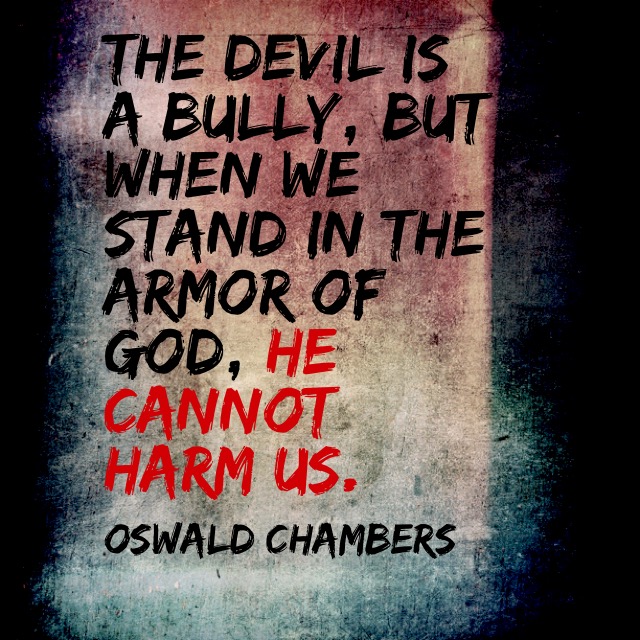 Winning The Spiritual Fights
“The love of God in Christ Jesus is such that He can take the most unfit man—unfit to survive, unfit to fight, unfit to face moral issues—and make him not only fit to survive and to fight, but fit to face the biggest moral issues and the strongest power of satan, and come off more than conqueror.”
“The devil is a bully, but when we stand in the armor of God, he cannot harm us; if we tackle him in our own strength we are soon done for.”
“It is never wise to under-estimate an enemy. We look upon the enemy of our souls as a conquered foe; so he is, but only to God, not to us.”
From Run Today’s Race
Run Today’s Race contains short statements from Oswald Chambers intended to stimulate Christians to ponder things like:
- Have I disqualified myself from the fight because I view myself as “unfit”?
- Do I know how deeply God really loves me?
- Am I daily putting on God’s armor?
- Am I trying to fight satan in my own strength, or in God’s strength?
6 Quotes From “The Dawn Of Christianity”
July 12, 2017 — Craig T. Owens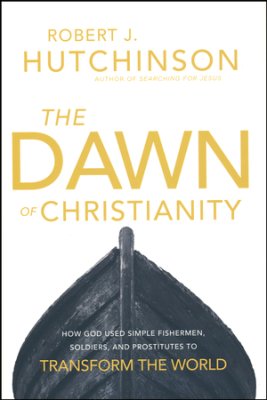 Robert J. Hutchinson makes the history around the birth, life, death, and resurrection of Jesus, as well as the history of Christ’s followers after His resurrection, come to life in The Dawn Of Christianity. Check out my full review by clicking here.
“Skeptics make much of the fact that historians have no independent corroboration from outside sources of most of the events described in the Gospels, but this is common with ancient history and hardly unique to Christianity. For example, virtually everything historians know about the Three Hundred, the Spartan warriors who held off a Persian invasion at the mountain pass of Thermopylae in 480 BC, comes from the writings of a single Greek author, Herodotus. What’s more, the earliest copy historians have of Herodotus’s chronicle of this event, The Histories, dates to the tenth century AD—or more than 1,350 years after it was written! In comparison, historians have a cornucopia of historical sources and archaeological evidence about Jesus of Nazareth and the early Christian community. For example, more than fifty papyrus manuscripts of New Testament texts exist that date before AD 300. The earliest of these manuscripts, a papyrus fragment from the Gospel of John known as P52, dates to around AD 125 or just thirty years after the original was likely written.”
“Around 20 BC, the half-Jewish King Herod the Great set himself the task of renovating and expanding the temple and surrounding area. There had been a small natural plateau there before, fixed atop the ridge in the northeastern corner of Jerusalem; but Herod wanted something far more spectacular. He therefore enclosed this natural plateau on all sides with four immense retaining walls, some more than one hundred feet high, made up of massive rectangular ashlars, or cut stones, that weighed as much as 415 tons each. These stones are so large that even modern cranes and bulldozers would have some difficulty moving them. Herod then filled in this entire quadrangle with stones and dirt, creating an artificial hilltop plaza—roughly 1,500 feet long by 1,000 feet wide—of more than thirty-five acres. In modern terms, Herod’s Temple Mount is so large that about twenty-six American football fields could fit in the space available. This massive engineering marvel has endured for two thousand years and still stands today, almost wholly intact.”
“Simon the Rock continued to loudly protest that he was willing to die, if need be, but would never deny Jesus. The other disciples said the same. This is one of those incidents that even many skeptics believe must be historical under the ‘criterion of embarrassment,’ which means that the Christian community was unlikely to invent a story that cast such a bad light on its leaders; therefore, it must have actually happened.”
“Recent archaeological discoveries are showing that the New Testament in general, and the Gospels in particular, are far more reliable historical sources than previous generations of New Testament experts realized.”
“All four Gospels report that this board, what the Romans called the titulus, held the inscription ‘The King of the Jews.’ John’s Gospel alone reports that Jesus’ name was also on the titulus, ‘Jesus of Nazareth, the King of the Jews,’ and that it was written in Hebrew, Latin, and Greek (19:19-20). In Latin the charge read Iesus Nazarenus Rex Iudaeorum, which is why, to this day, the letters INRI appear at the top of crucifixes.”
“In 1968, archaeologists uncovered a first-century tomb at Giv’at ha-Mivtar, northeast of Jerusalem. Inside the tomb they found in ossuary containing the skeleton of a crucified man—the first and only relic of a crucified man found in Israel. Inscribed on the ossuary was his name in Hebrew: Yehochanan. On top of the bone of his right heel was a wooden board, and through the board, and his heel, was a 4.5-inch iron nail.”
My most-viewed posts


 Craig T. Owens