Links & Quotes

The sooner we start praying, the sooner we can see God move. Let’s make sure that prayer is not our last resort, but our first response!

I have a lot of new video content on my YouTube channel every week. Please check it out and subscribe so you don’t miss anything.

T.M. Moore has a challenging word for those who are called to preach the Gospel. He writes, “Jesus, like Ezekiel set His face like flint to fulfill His appointed mission. And so must we, for whom the Word is both sweet and bitter (cf. Revelation 10:8-11). We must live and proclaim its sweet and bitter message to an impudent and hard-hearted age, beginning in our churches. It is time for judgment to begin from the house of God (1 Peter 4:17). We must speak to our brethren in the Lord, the household of faith, to teach, warn, direct, and to summon them to revival, renewal, and awakening, for a greater knowledge of the Lord and His love, and a fuller realization of His Kingdom presence, promise, and power.”

Then John Piper shares 10 reasons why Christian preaching is a privilege.

“An essential aspect of creativity is not being afraid to fail.” —Edwin H. Land 

I have written before how significant it is that the New Testament uses the phrase “one another” so many times. T.M. Moore writes about this as well, noting, “The more we love Jesus, the more loving our neighbors will come (super)naturally to us as the Spirit of God works in us to will and do of His good pleasure. So, as in everything we do to take up Jesus’ work of building His Church, loving one another begins with loving Jesus.”

After listing a truckload of verses describing Who the Holy Spirit is, Sinclair Ferguson concludes, “Think about all of that! This Spirit—this one and the same Spirit, and no other—‘dwells within thee.’ He is the very Spirit who dwelled in the Lord Jesus. … There are not multiple Holy Spirits—One in Whose grace and power the Lord Jesus lived, One Who indwells you, One Who indwells me, and a multiplicity of other Holy Spirits indwelling an innumerable company of believers. No! There is only One Holy Spirit; and He who thus indwells me as the Spirit of Christ also indwells every believer I shall ever meet.”

The Craig And Greg Show: Cultivate Your Garden

Listen to the podcast of this post by clicking on the player below, and you can also subscribe on AppleSpotify, or Audible.

Here in West Michigan, the city of Holland has a yearly festival that has just begun called Tulip Time where attendees will see millions of the most beautiful flowers growing everywhere. It is a stunning display, but perhaps even more impressive is the hard work and care that goes into the cultivation of these flowers. In today’s episode, Greg and I want to encourage you to bring the mindset of a gardener to your leadership. With hard work, patience, and just the right amount of careful pruning, your team will grow from small seeds in the ground to a dazzling beauty that rivals any horticultural display. 

  • [0:40] I’m not sure I’m qualified to talk about today’s topic… 
  • [1:32] A seed has almost everything it needs to grow, and so do our teammates.
  • [3:13] What do people need most from a gardener-leader?
  • [5:25] Leaders will need to exhibit confidence in a teammate’s competency.
  • [8:04] We need to be careful of not rushing the process.
  • [10:16] I share how the apostle Paul demonstrated belief in his people.
  • [12:04] How do we make sure our teammates know we have genuine belief in them?
  • [14:33] I reference a great passage from Greg’s forthcoming book about how leaders stand up for their team.
  • [19:13] A healthy habit for gardener-leaders.
  • [21:36] Gardening isn’t an assembly line—the growth plan for every person must be individualized.
  • [23:44] Greg shares an insightful quote about obstacles.
  • [25:11] Coaching can help you help your teammates grow.

Check out this episode and subscribe on YouTube so you can watch all of the upcoming episodes. You can also listen to our podcast on Spotify and Apple.

Is It Time To Move On?

isten to the podcast of this post by clicking on the player below, and you can also subscribe on AppleSpotify, or Audible. 

No one wants to over-stay their welcome, but it seems that frequently pastors are a little too quick to want to move on to a different pasture. 

This was a question that John Opalewski, Jim Wiegand, and I discussed on the Leading From Alignment podcast. 

The New Testament stories I reference are found in Acts 8:4-8, 26-40; 16:6-10. I blogged about both of these experience in more depth: 

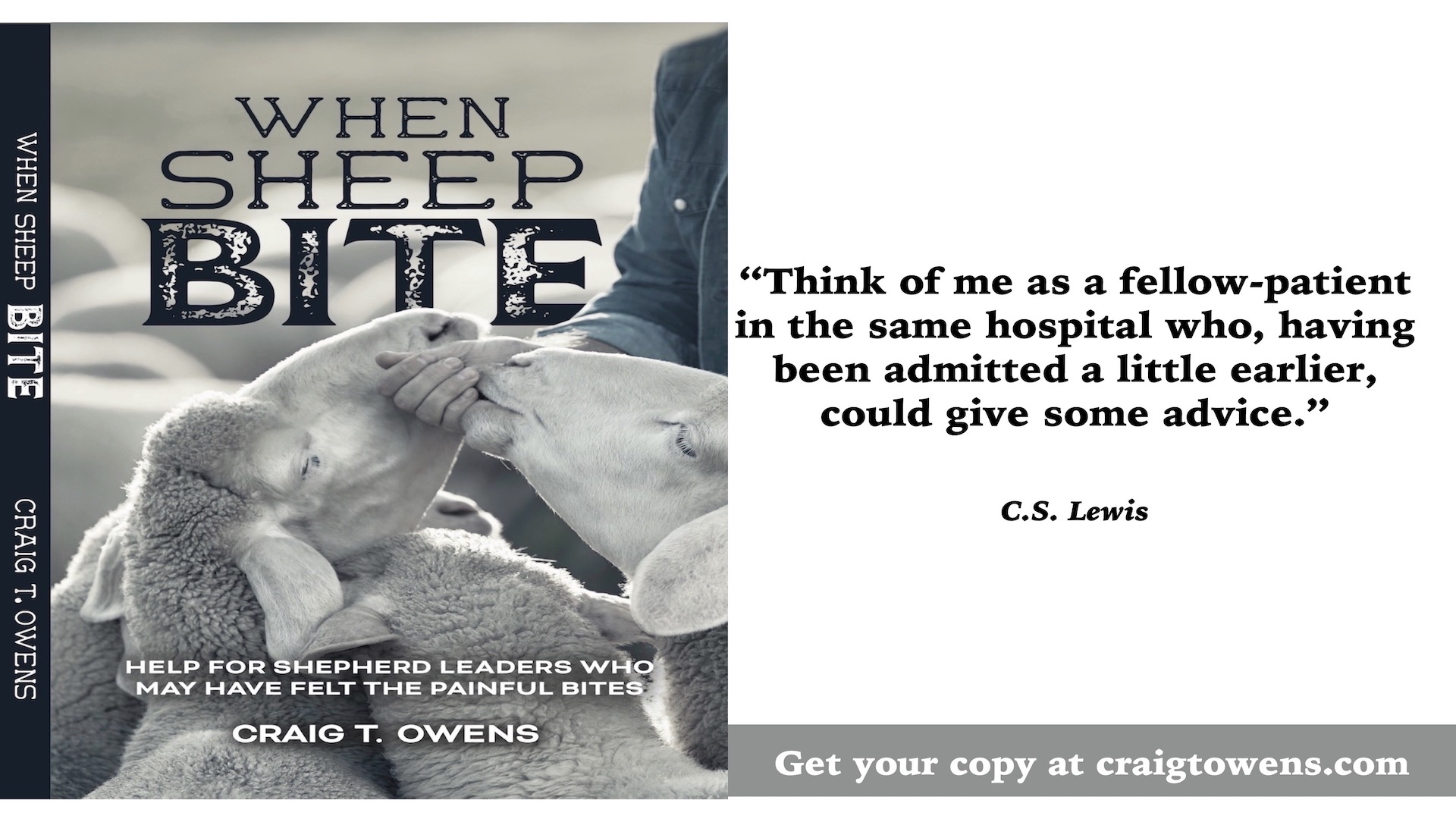
The closing chapter of my book When Sheep Bite is entitled ‘Faithfulness > Fight or Flight.’ In that chapter I wrote—

     Remember that we are all striving to not succumb to the natural fight-or-flight response, but to attain the supernatural response of faithfulness. In this, we have a perfect example in our Good Shepherd. 

     In the Book of Revelation, Jesus is called the One who is “Faithful” (Revelation 19:11), and Paul says that the Faithful One who has called us will empower us to remain steadfast: “He who calls you is faithful, who also will do it” (1 Thessalonians 5:24 NKJV).   

   Yes, fight-or-flight is our natural response, but with the empowerment of the Holy Spirit, we can respond in supernatural faithfulness. We don’t have to sit unmoving and unfeeling, but we can continue to serve even biting sheep until God removes us or them. 

   We glorify God by faithfully serving the sheep He has placed under our care, giving our very best, even if our words and actions are unappreciated or ignored by those we are serving.

If you are in a difficult place in your leadership assignment, I encourage you to check out When Sheep Bite. 

►► Would you please prayerfully consider supporting this ministry? My Patreon supporters get behind-the-scenes access to exclusive materials. ◀︎◀︎

Good Grief From A Friend

Listen to the podcast of this post by clicking on the player below, and you can also subscribe on AppleSpotify, or Audible. 

After God created Adam, He said, “It’s not good for you to be alone.” That’s just as true today: God didn’t intend for us to journey on our own, but He gives us companions along the way. 

Last week we saw that God has to sometimes cause us grief to get our attention when we are straying from His path. He sometimes puts people in our lives to do the same thing. 

There’s a reason God puts the people in our lives that He does. We are called to speak the truth in love (Ephesians 4:15). But that sometimes means people will get upset with us (Galatians 4:16). “Real friends hurt each other. … Truth is the primary way faithful friends should wound each other—it is the help that hurts.” —Dick Brogden 

(Check out all of the verses in this post by clicking here.) 

The Corinthians thought they were super-spiritual, but Paul had to call them out on their foolishness (1 Corinthians 3:3; 5:1-2). Before Pauls’ letter, the Corinthians seemed happy. His letter caused them grief, but it was good grief that led to repentance and true joy (2 Corinthians 7:8-10). 

To keep silent when a brother or sister is straying is not God-honoring. We are not to be the sin police, but we are to address sinful issues (James 5:19-20). 

As King David flirted with the idea of how he could get something that he thought would make him happy, an anonymous attendant tried to get his attention. David ignored this and then tried to sweep it under the rug. In fact, he thought he got away with his sin (2 Samuel 11:1–12:7). 

But God sent Nathan to speak a hard word to David. We don’t know when Psalm 141 was written, but we know that David did write it. Perhaps it was penned at the time of Nathan’s loving confrontation. He said, “Let a righteous man strike me—that is a kindness; let him rebuke me—that is oil on my head” (Psalm 141:5). 

We do know that David wrote Psalm 51 after Nathan’s loving hard word, and in this prayer we see David’s confession, repentance, and a request for God’s joy to replace David’s grief. 

So how do New Testament-era Christians use good grief to help fellow saints? 

  1. Examine yourself first (Matthew 7:1-5). Make sure you aren’t plagued by the same sin you have noticed in a brother or sister. 
  2. Cry before you confront, just as the prophet Samuel did before he had to deliver a hard word to King Saul (1 Samuel 15:10-11). 
  3. Confront in love with the goal of restoration, but make sure you are confronting someone who know you love them and who will receive your loving word  (Proverbs 27:5; 9:8). 
  4. Pray that their grief will be turned to joy (Luke 22:31-32; Galatians 6:1; Psalm 51:12). 

Friendships with fellow saints are precious and they are vital. We need iron to sharpen iron (Proverbs 27:17) so that we will all stand before the throne together for eternity. 

This is the final message in our series Grief Into Joy. If you missed any of the messages, you can check them all out by clicking here. 

►► Would you please prayerfully consider supporting this ministry? My Patreon supporters get behind-the-scenes access to exclusive materials. ◀︎◀︎

Links & Quotes

I’ve found that in helping my teammates receive feedback about areas that need to be addressed, asking questions is the best way to do this. Check out the full conversation Greg and I had about blind spots.

I have a lot of new video content on my YouTube channel every week. Please check it out and subscribe so you don’t miss anything.

William Shakespeare was a master at a well-timed insult when one of his characters zinged another! Reader’s Digest has a list of 53 Shakespearian insults that are still good today!

What happens when you hold your breath? Among other things “your blood is delivering the last of oxygenated blood cells to your tissues while carbon dioxide is rapidly building up (hypercapnia). At the same time, there is a steady decrease of blood oxygen (hypoxia). The pH of your blood is getting slightly lower (acidic), and your heart starts to beat faster. God designed your brain to sense the increased carbon dioxide levels and initiates the effort for you to breathe. This will last for about a minute before there will be an involuntary intake of air via the contraction of your diaphragm.” And yet God designed aquatic mammals in a way uniquely suited to thrive in water. Amazing! 

When the Bible says that God’s hand was against His people, that is actually a very loving thing! Consider this example of a parent with a small child. Please watch this full sermon.

I have been sharing a series of messages with my church about how God turns our grief into joy. As a tie-in with this series, John Piper has Fifteen Tactics for Joy.

Confronting To Restore

Listen to the podcast of this post by clicking on the player below, and you can also subscribe on AppleSpotify, or Audible. 

If an organization is going to grow in a healthy way, leaders must learn how to correctly address wrong attitudes and behaviors. They do this best when they use confrontation only as a means to restoration. 

You can watch or listen to the full conversation Greg and I had on this topic on this episode of The Craig and Greg Show. 

You may also be interested in a couple of previous posts I have shared: 

And to really go deep on this topic, please check out my book When Sheep Bite. 

►► Would you please prayerfully consider supporting this ministry? My Patreon supporters get behind-the-scenes access to exclusive materials. ◀︎◀︎

A Different Response To Attacks

Listen to the podcast of this post by clicking on the player below, and you can also subscribe on AppleSpotify, or Audible. 

Sir Isaac Newton may have said for every action there was an equal and opposite reaction, but that’s not true for God-fearing leaders. 

Check out this episode of The Podcast. 

The story of Paul and Barnabas that I reference in this video is found in Acts 14:1-21. 

My book When Sheep Bite is divided into three section. In the first section I talk about a shepherd leader’s heart and section two diagnosis the sheep bites leaders endure. The final section is all about the faithfulness to finish well—not giving in to the natural responses of fight or flight. 

I open that final section of the book like this—

     Psychologists and medical doctors have all described what happens to our minds and bodies when we are under attack. They are universal responses that our loving Creator has implanted in all of us to be able to respond to threats that come at us. When confronted with a biting sheep, without consciously thinking about it our minds and bodies prepare for fight or flight. 

     But let’s consider those responses in the context of a shepherd pasturing his sheep. Is it an effective strategy for the shepherd to fight his sheep? No, of course not. Paul told Timothy that a shepherd is “not quarrelsome but forbearing and peaceable” (1 Timothy 3:3 AMPC). 

     Is it allowable for the shepherd to run away from the threat, leaving the flock without a shepherd? Again, no, as Jesus told us that one who resorts to flight isn’t worthy to be called a shepherd but is considered a mere “hired hand [who] cares nothing for the sheep” (John 10:12-13). 

     So if godly shepherds cannot give in to the natural responses of fight or flight, what are we to do? Since we serve an all-power, all-loving Chief Shepherd we must look to Him for the supernatural response of faithfulness. 

     Not fight. Not flight. But faithfulness. 

Check out some of my other posts about godly leadership too. 

►► Would you please prayerfully consider supporting this ministry? My Patreon supporters get behind-the-scenes access to exclusive materials. ◀︎◀︎
Links & Quotes

High-capacity leaders may need to tap the brakes a bit for the sake of their teammates. Otherwise, their teams may get discouraged and then completely disengage. Check out the full conversation on The Craig and Greg Show.

I have a lot of new video content on my YouTube channel every week. Please check it out and subscribe so you don’t miss anything.

“The important thing is not to stop questioning. Curiosity has its own reason for existing. One cannot help but be in awe when he contemplates the mysteries of eternity, of life, of the marvelous structure of reality. It is enough if one tries merely to comprehend a little of this mystery every day. Never lose a holy curiosity.” —Albert Einstein 

“A steady and balanced diet of God’s Word provides the spiritual energy disciples need for the work of the Lord. … Preachers and teachers must always bear this in mind. Disciples don’t grow into Christlikeness in leaps and bounds, but incrementally, here a little and there a little. We must teach the glory and majesty and scope of the whole counsel of God, but we must teach the disciples how to discern what that requires for every next step in their lives.” —T.M. Moore 

Some skeptics of Christianity try to push their claim that Easter is really a pagan holiday co-opted by Christians. But reading the historical records shows that this is clearly not the case. Check out this helpful article from Michael A.G. Haykin. 

Caiaphas was a key high priest during the New Testament era. The Bible Archeology Report has a really cool archeological biography of this man.

“One step at a time is all it takes to get you there.” —Emily Dickinson 

Invited To Common Ground

This is an audio portion of a video teaching I recently shared with my Patreon supporters.


My supporters received the full teaching video and audio, along with some supporting resources. 

Would you consider supporting this teaching ministry for just $5 per month? My supporters get exclusive content that no one else receives, as well as early access to content that will eventually be shared publicly. 

The Craig And Greg Show: Blind Spots

Listen to the podcast of this post by clicking on the player below, and you can also subscribe on AppleSpotify, or Audible.

In our last episode, Greg and I discussed how vital it is to focus on your own internal development. If you’ve been doing that, chances are you have identified a few blind spots in yourself. While it might feel more comfortable to simply hide these away and hope nobody notices, we would like to encourage you to be vulnerable: Drag your blind spots into the light, address them, and watch how your leadership improves as a result.

  • [1:30] Leaders have to get comfortable with being vulnerable if they are going to make any meaningful changes in their life.
  • [2:17] Blind spots have to be brought out into the light.
  • [5:44] Paying attention to the feedback from others requires us to slow down to process what we need to change.
  • [7:35] Leaders need to understand the speed of their team in the area of productivity.
  • [8:34] Greg shares a “blind spot” example from one of his kids.
  • [9:53] Why do leaders avoid their blind spots?
  • [11:45] Peripheral vision isn’t good just for athletes, but for leaders too.
  • [13:11] I share how asking good questions has helped my teammates with their blind spots.
  • [14:50] If leaders assume things about their teammates or work with their favorite teammates, they will never improve the morale of the team.
  • [18:17] Greg talks about the movie “Blindside” as a learning point about having the right people watching out for us.
  • [20:10] We need to be thinking about the kind of people we need around us.
  • [25:42] The one word most people are afraid to say.
  • [26:59] Sometimes a fresh set of eyes is necessary to see a blind spot. Maximize coaching would love to be a resource for you in this area.

Check out this episode and subscribe on YouTube so you can watch all of the upcoming episodes. You can also listen to our podcast on Spotify and Apple.