Links & Quotes

link quote

“God has done astonishing and costly things to draw us near. He has sent His Son to suffer and to die so that through Him we might draw near. It’s all so that we might draw near. And all of this is for our joy and for His glory.” —John Piper

“The hardness of God is kinder than the softness of men, and His compulsion is our liberation.” —C.S. Lewis

Detroit Tiger fans know that Alan Trammell should be in the MLB Hall of Fame.

Chilly Chilton has a deathwish, and you should read about it.

“Your business is to go and ‘tell to sinners round what a dear Savior you have found’, for that is God’s way of using you to complete the unity of His Church.” —Charles Spurgeon

“The most important thing a church can have going for it is strong, biblical preaching.  It can do with or without an app, a Facebook page, a glitzy web site, streaming sermons, online giving, a fancy building, free wi-fi, or a clearly defined brand.  But it cannot fulfill God’s purpose without power in the pulpit.” —Mark Atteberry

“Nothing fosters courage like a clear grasp of grace. And nothing fosters fear like an ignorance of mercy.” —Max Lucado

A Legacy Of Faith (book review)

Legacy Of FaithIt sometimes distresses me to see great men and women who stumble later in life. But one man who has lived a life full of integrity is Billy Graham. If anyone can speak about “legacy” with the full support of his life’s message, it is Rev. Graham!

In the same format as Zig Ziglar’s Inspire To Be Great, and John Wooden’s Winning With Principle, A Legacy Of Faith is a collect of noteworthy quotes from Billy Graham. Time and time again I was impressed with Dr. Graham’s words, but more impressed that he lived them out so publicly for all to see.

If you haven’t read any of Billy Graham’s sermons or books, this book is a good place to start. Even if you are familiar with his works, this is still an excellent resource for his wise quotes.

What a great read!

Pray Like Jesus

Private prayerThere’s a really interesting story recorded in the gospels of Matthew, Mark and Luke. It’s the one where a father brings his demon-possessed boy to nine of Jesus’ disciples to ask for their help. But the father sadly reports back to Jesus, “But they could not help.”

Jesus calls His disciples out. He says that their faith is lacking. Even the boy’s father is short on faith. He says to Jesus, “If you can do anything, please help us.” To which Jesus says, “‘If you can’? Anything is possible if you believe.” Jesus rebukes the demon, which immediately comes out of the boy.

Now here’s the interesting part: His disciples asked Him, “Why couldn’t we do that?” Jesus says, “This kind comes out only by prayer.” Let’s review all the words Jesus said to the father and his boy:

  • “How long has he been like this?”
  • “‘If you can’? Anything is possible if you believe.”
  • “Demon, come out of him and never enter again.”

So here’s my question―Jesus said the demon was cast out by prayer. So when did Jesus pray? Look at those words He said again … which of those was His prayer?

Actually, if you look through all four gospels you won’t find Jesus laying His hands on people and saying, “Heavenly Father, will You please heal this leprosy?” Or, “Please bring life back into this little girl.” Instead He says, “Be clean” or “Little girl, get up.

So I ask again: When did Jesus pray? The answer is―He prayed all the time.

  • Very early in the morning, while it was still dark, Jesus got up, left the house and went off to a solitary place, where He prayed. (Mark 1:35)
  • After He had dismissed them, He went up on a mountainside by Himself to pray. When evening came, He was there alone. (Matthew 14:23)
  • But Jesus often withdrew to lonely places and prayed. (Luke 5:16)

Do you want to pray like Jesus? He prayed all the time. He had times of prayer with His Heavenly Father, but He was in unbroken communication with Him.

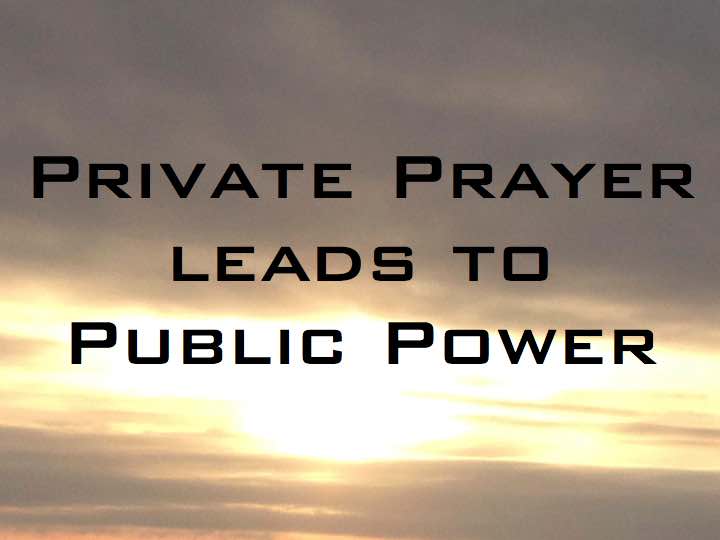
Private prayer leads to public power! 

That’s how we can pray like Jesus!

We will be learning more about prayer in our series The Prayers Of Elisha next Sunday. Please join us!

The Prayers Of Elisha

The Prayers Of ElishaElisha was a prophet whose name means “God is salvation.” And God did show His saving, healing, sustaining power through Elisha in 28 separate miracles.

But here’s the cool thing to me: Elisha is a regular guy. He comes from an average family, from one of the lesser known tribes of Israel. Elisha was a farmer, and had a few guys working for him. Other than that, we don’t know much about his background. Elisha truly was an Average Joe.

Elisha is a perfect guy for us Average Joes to learn more about the power of prayer. What God did through Elisha, He wants to do through all of us too. Please join me this Sunday as we kick-off a new series called The Prayers Of Elisha, and get ready to see your prayer life grow.

Is Jesus Immanuel?

Immanuel & sinI’ve read these two passages of Scripture so many times during the telling of the Advent story, but I never saw this apparent mistake. I’ve highlighted the troubling phrases below—

Therefore the Lord Himself will give you a sign: The virgin will be with Child and will give birth to a Son, and will call Him Immanuel. (Isaiah 7:14)

But after he had considered this, an angel of the Lord appeared to him in a dream and said, “Joseph, son of David, do not be afraid to take Mary home as your wife, because what is conceived in her is from the Holy Spirit. She will give birth to a Son, and you are you to give Him the name Jesus, because He will save His people from their sins.” (Matthew 1:20-21)

Did the angel make a mistake? Was he supposed to tell Joseph “give Him the name Immanuel”? Or maybe Immanuel and Jesus mean the same thing?

The answer to all three of those questions is NO. There wasn’t a mistake; His name should be Jesus; and Immanuel and Jesus don’t mean the same thing.

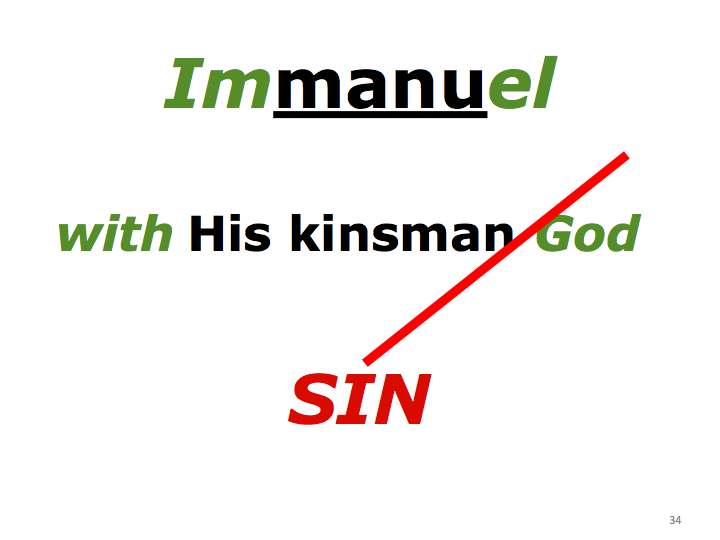
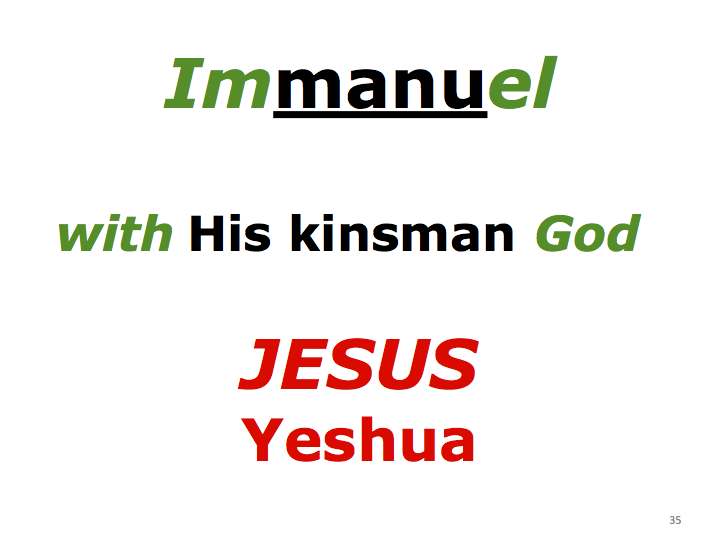
Immanuel & JesusImmanuel is a cool name, appearing only three times in the Bible. The prefix “im” means with, and the suffix “el” means God. The root word in its broadest sense means people, but when we’re talking about God saving “HIS people from their sins,” the best translation would be His kinsman. Thus Immanuel = with His kinsman God.

Just before giving us the prophesy about Immanuel, Isaiah experienced the horror of being with God. When Isaiah was in God’s presence he said, “Woe is me! I am ruined! For I am a sinful man and I have seen God Almighty” (Isaiah 6:5-6). Here’s the simple fact: Our sin separates us from God’s presence. Jesus (in the Hebrew Yeshua = God saves) is the only One Who could remove the penalty of our sin!

Only Jesus could atone for our sin and remove our guilt (see Isaiah 6:7), so that God could stay with us (Immanuel)! 

Jesus (our salvation) makes Immanuel (with His kinsman God) possible. So as the Christmas carol O Come, O Come, Emmanuel implores us: Rejoice! Rejoice! Immanuel shall come to thee!

May you live in the forgiveness of Jesus and the joy of His Immanuel presence this Christmas season!

If you’ve missed any of the messages in this series, you may check them out by clicking here.

Links & Quotes

link quote

“The Lord has many lovers of His crown but few lovers of His Cross.” —Thomas á Kempis

Charles Spurgeon on the power of unity: No Bigotry In Unity.

David Witt asks: Is It Time To Rethink Maslow’s Hierarchy Of Needs?

“The degree of blessing enjoyed by any man will correspond exactly with the completeness of God’s victory over him.” —A.W. Tozer

Dr. Benjamin Mast has a lot of initials after his name (which means he’s really smart!). Check out this interview with him: Alzheimer’s, The Brain and The Soul.

Here is an amazing admission from scientists regarding stem cell formation: “No one, not even the dozen or so groups of scientists who intensively study reprogramming, knows how it happens. They understand that differentiated cells go in, and pluripotent cells come out the other end, but what happens in between is one of biology’s impenetrable black boxes.” Read more in this article about stem cells, but I am glad I can trust the Creator to reveal to us what may be in “the black box”!

I love ReverendFun cartoons! Here is one of my favorites—

Eternal Life

Come, Thou Long-Expected Jesus

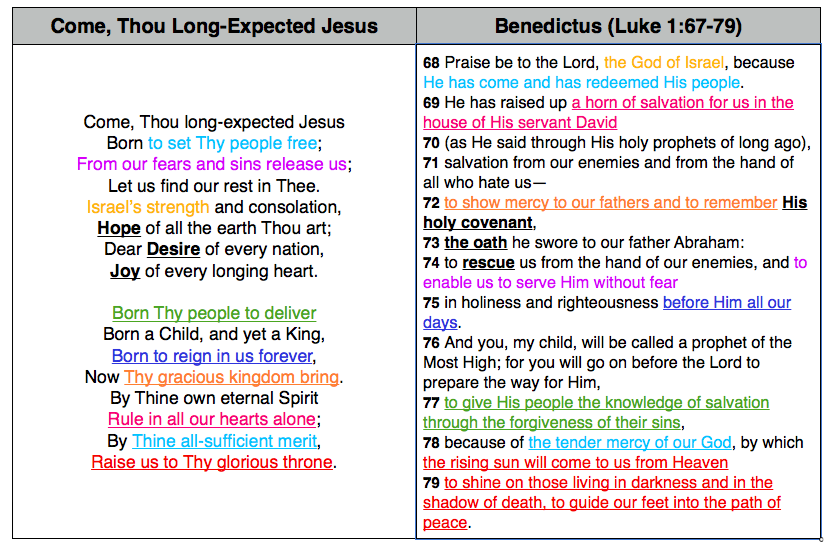
AdventWe began our series on The Carols Of Christmas by looking at the poem written by Charles Wesley in 1744: Come, Thou Long-Expected Jesus. As far as I can find, Wesley never shared where he got his inspiration for this prose, but I have a hunch that it might be from a song in the Bible called The Benedictus.

Zechariah had been unable to speak for nearly a year because of his doubt over the message God sent him through the angel (see Luke 1:5-20). When his son was born and Zechariah named him John, his tongue was loosed and he “was filled with the Holy Spirit” and burst into song (Luke 1:67-79). The first word of his song in Latin is benedictus, from which the name is derived.

Here’s what I love about both Zechariah’s and Wesley’s songs—they both look forward to Christ’s First Advent and His Second Advent. Mary was still pregnant with Jesus when Zechariah sang his song, but his lyrics reflect the Redemption story that Jesus would fulfill as Emmanuel, God with us. Charles Wesley picks up this same theme, rejoicing over Christ’s birth and His imminent return.

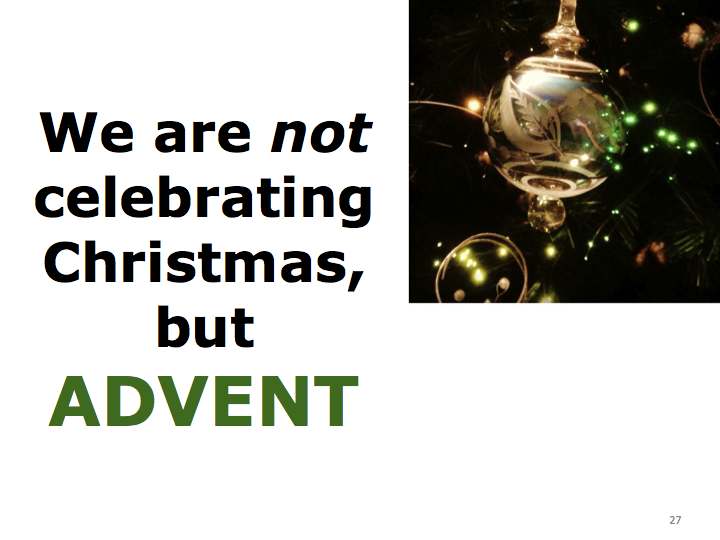
In fact, that’s exactly the point! We aren’t celebrating Christmas as much as we are celebrating Advent. Jesus was born “when the time had fully come” for His First Advent (Galatians 4:4-5), and “this same Jesus, Who has been taken from you into Heaven, will come back in the same way you have seen Him go into Heaven” (Acts 1:11). That’s the message that should encourage us (see 1 Thessalonians 4:13-18).

Check out the remarkable parallels between the Benedictus and Wesley’s hymn—

Come Thou Long-Expected Jesus & Benedictus

If you’d like to download a PDF of this side-by-side comparison, here it is → Come Thou Long-Expected Jesus & Benedictus ←

If you’ve missed any of the messages in this series, you may check them out by clicking here.

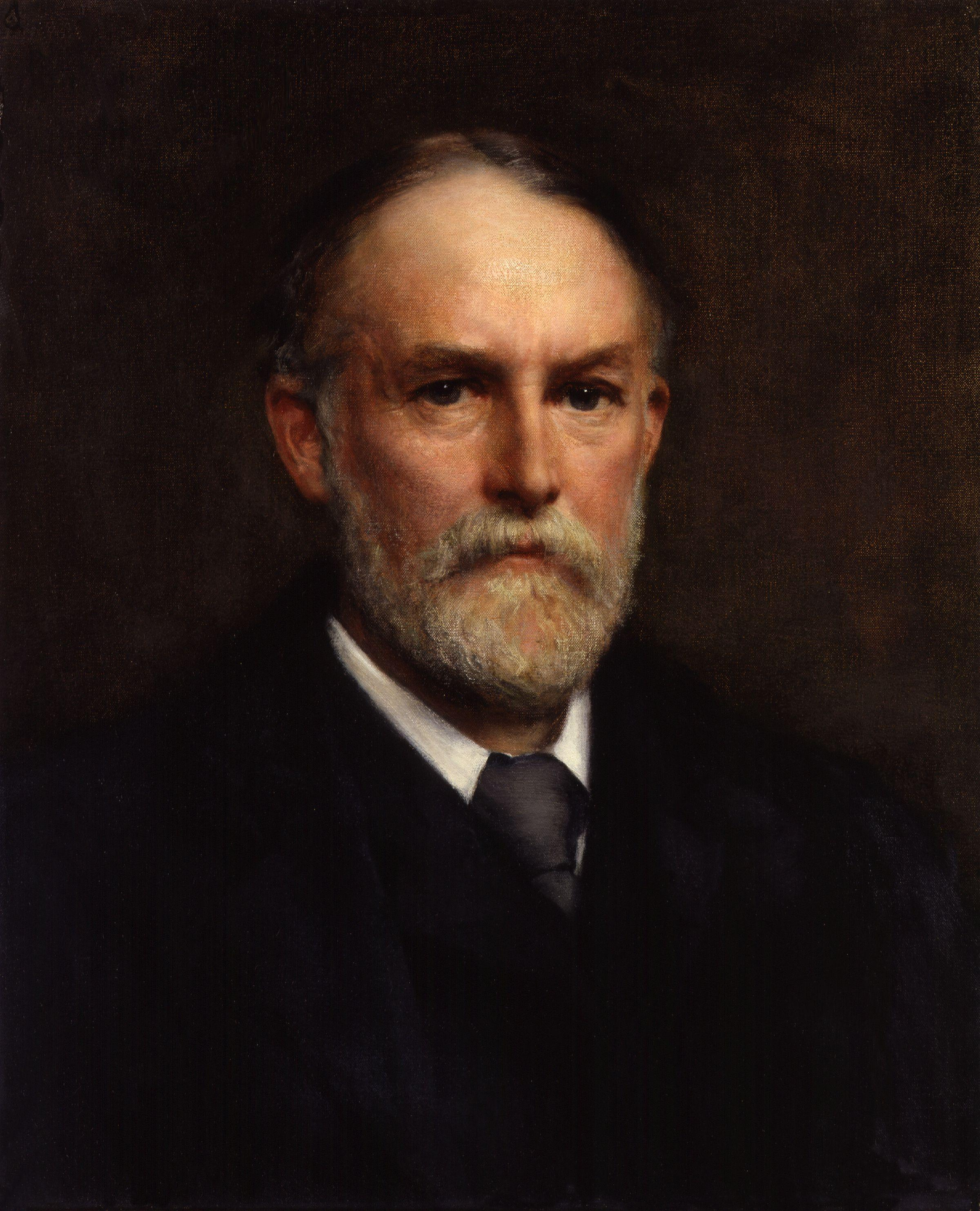
Poetry Saturday—Saint Paul

F.W.H. MyersOh, could I tell, ye surely would believe it!
   Oh, could I only say what I have seen!
How should I tell, or how can ye receive it,
   How, till He bringeth you where I have been?

Therefore, O Lord, I will not fail nor falter;
   Nay but I ask it, nay but I desire,
Lay on my lips thine embers of the altar,
   Seal with the ring, and furnish with the fire.

Give me a voice, a cry, and a complaining,—
   Oh, let my sound be stormy in their ears!
Throat that would shout, but cannot stay for straining,
   Eyes that would weep, but cannot wait for tears.

Quick, in a moment, infinite forever,
   Send an arousal better than I pray;
Give me a grace upon the faint endeavor,
   Souls for my hire, and Pentecost today!

Scarcely I catch the words of His revealing,
   Hardly I hear Him, dimly understand;
Only the Power that is within me pealing
   Lives on my lips, and beckons with my hand.

Whoso has felt the Spirit of the Highest,
   Cannot confound, nor doubt Him, nor deny;
Yea, with one voice, O world, though thou deniest,
   Stand thou on that side, for on this am I. —F.W.H. Myers


The Carols Of Christmas

Carols Of ChristmasI heard the bells on Christmas Day
Their old familiar carols play,
And wild and sweet the words repeat
Of peace on earth, goodwill to men. (Henry Wadsworth Longfellow)

How many “old familiar carols” have you heard Christmas after Christmas, until the words have almost lost their meaning? If we’re not careful, any song repeated too often can lose the richness of its original intent.

There are some amazing messages in many of our old familiar Christmas carols, because many of those messages are saturated with the old familiar story of Redemption that the Bible tells over and over again.

Please join me this Sunday as we take a new look at the old familiar messages in our Christmas carols. These messages will bring a new appreciation of God’s love that was sung at Christ’s Advent, and reawaken the sweetness of meaning for this Christmas Day.

If you’ve missed any messages in this series, check them out here:

From The Cutting Room Floor: The Love In The Law

Love In The LawWhenever I am working on a series of messages, I always end up with way more material than I could possibly share. But it’s still really good stuff! I remember a movie director once remarking that some of his best and favorite scenes ended up on the cutting room floor during the movie’s editing process. So here are some of the quotes and thoughts I really liked, recovered from “the cutting room floor” as I prepared our Love In The Law series.

“True obedience to God (not just to lists of laws) means more than outward performances which can be tallied in percentages (like 80 percent obeyed). Rather, true obedience is to be so transformed that we delight to do God’s will at multiple levels. We delight in His will as the excellent expression of His wisdom and justice and love. We delight in personal, close communion with Him as our guide, which we would lose, at least for a season, if we acted against His counsel. We delight in His gift of a clean conscience. We delight in the smile of His approval. We delight in God Himself whom we see and know more clearly when we walk in unbroken fellowship and obedience. We delight in the prospect of ongoing assurance and hope, which is jeopardized and weakened if we gradually slip away from Him in callous disobedience.” —John Piper

I delight to do Your will, O my God; yes, Your law is with in my heart. —Psalm 40:8

“To detect ourselves thus balancing a transgression here, against many observances there, ought at once to startle us into the conviction that the whole principle of our lives must be faulty. Our aim is, not to love God, or to obey Him, but to get to heaven, or at least escape hell, on the cheapest terms.” —Alfred Plummer

“Our will is morally and spiritually flawed. Nevertheless we are responsible to do the commandments of God. The moral corruption that cripples us does not relieve us of our responsibility to do what is right and good to do.” —John Piper

“I call the love to God the motion of the soul toward the enjoyment of God for His own sake, and the enjoyment of one’s self and of one’s neighbor for the sake of God.” —Augustine

“If thou neglect thy love to thy neighbor, in vain thou professest thy love to God; for by thy love to God, the love to thy neighbor is begotten, and by thy love to thy neighbor, thy love to God is nourished.” —Francis Quarles

“A pennyweight o’ love is worth a pound o’ law.” —Scottish Proverb

It pleased the Lord for the sake of His righteousness to make His law great and glorious. —Isaiah 42:21