Listen to the podcast of this post by clicking on the player below, and you can also subscribe on Apple, Spotify, or Audible.
The first Church in the Book of Acts could have easily become the first two churches right from the beginning. Why? Because of a deep disagreement that pitted two camps against each other.
Unity was ultimately maintained because they all agreed to only listen to the counsel that agreed with Scripture.
Listen to the podcast of this post by clicking on the player below, and you can also subscribe on Apple, Spotify, or Audible.
As we learned last week, we are not the judge, nor the jury, nor the prosecution, nor even the sin police in deciding appropriate retribution. With that in mind, let’s consider Statement #15 in our series—Do not judge. Is that in the Bible?
Yes, those three words are there, spoken by Jesus, in Matthew 7:1. But then again, we need to say, no, because these words don’t mean we are not to make determination about the rightness or wrongness of something.
Let’s zoom-out a bit get the context of the words Jesus spoke. Who was His audience for these words? This is a part of the Sermon on the Mount (Matthew 5–7). Notice in the opening words, “His disciples came to Him, and He began to teach them” (5:1-2). So Jesus isn’t speaking to the world at-large, but He is talking with His disciples.
Jesus was very specific in His wording. In talking about the world, He uses words like people (5:11) or men (5:16; 6:1, 5). When talking about His disciples, He uses one word quite frequently: brother (3x in 5:22-24).
Matthew 7:1 is still in this sermon, and the word brother appears 3x in vv. 3-5. So these are instructions primarily for Christians to use with other Christian brothers and sisters.
The words judge here in the Greek means, “Those who judge severely (unfairly), finding fault with this or that in others.” To me, “this or that” sounds like a deliberate searching for something wrong, but Jesus assures us that this will boomerang on the judgmental person (v. 2; Luke 6:37).
In modern psychology, we find terms like:
mirroring = a psychological term the means quickly seeing what’s in others because it’s in me
projection = taking the negative things in me and projecting them onto others
Paul addresses both of these thoughts in Romans 2:1-3, where the word for judging here is the same Greek word Jesus uses in Matthew 7.
Paul concludes his remarks by reminding us that God treats us kindly (Romans 2:4). David echos this same thought in Psalm 103:8-10, 13-14.
When you read the whole passage in Matthew 7:1-5, please notice the words “brother,”“first,” and “then.”
Jesus does not mean that I am not to point out to my brothers and sisters any areas of concern. Jesus did this, as well as nearly every epistle writer. What it does mean is that correction needs to be gentle and never condemning. In other words, I want to lovingly help someone before they have to stand before The Judge.
That’s why I need to first humbly recognize that what I see in others may be apparent to me because I am afflicted with the same thing. That’s why Jesus says first deal with my own plank. Examine myselfbefore I try to correct a brother or sister (1 Corinthians 11:28; 2 Corinthians 13:5).
After I have allowed the Holy Spirit to deal with my plank, I will then have the empathy to help my brother or sister (2 Corinthians 1:3-4). Trying to get someone else to repent of something that still exists in my life is hypocritical.
If I see something wrong in someone else:
First ask the Holy Spirit to search me.
If necessary, confess it, repent from it, ask forgiveness, make things right.
Then lovingly and humbly share with your brother or sister (Ephesians 4:15).
If someone else sees something wrong in me, I should follow the exact same steps!
This is not easy, but it is vital for the Body of Christ to grow in a healthy way.
If you’ve missed any of the other messages in this installment of our series Is That In The Bible?, you can find them all here.
Listen to the podcast of this post by clicking on the player below, and you can also subscribe on Apple, Spotify, or Audible.
We have to be very attentive when we hear anyone say something that they claim is a word from God. The first question we need to ask is, “Is that in the Bible?” If it is, then the next question is, “Is that statement being used in its proper context—does it conform with the whole counsel of God’s Word?”
So here is statement #14 in our series—An eye for an eye, and a tooth for a tooth. Is that in the Bible? Yes.
This first shows up in Exodus 21:24, and it is a part of the legal code God gave through Moses (Exodus 21:1). This code was entrusted to capable men (i.e. judges) in Exodus 18:19-22, 25.
This has been referred to as “the law of exact retribution.” Later on the Romans would name it lex talionis—the law of the tooth. This was to prevent one-upmanship or escalating retaliation, and it also applied to false witnesses who were trying to get someone else in trouble (Deuteronomy 19:15-21).
By the time of Jesus, this legal maxim was so well known that when Jesus quoted it to His audience, everyone knew what it meant (Matthew 5:38).
One of the most innate responses that we humans have to threats or to an attack is fight-or-flight.
In this case, flight would be sweeping it under the run or pretending it didn’t happen. But it did happen, and there is a sense of justice in us that wants to see retribution. If this offense isn’t acknowledged and dealt with appropriately, the desire for retribution will allow unforgiveness to fester. This shows up in all sort of negative ways—physically and emotionally—and often there is a breaking point where the injured party lashes out.
Fight would be taking the law into our own hands. I want everyone to know that I was wronged by you, and I want you to suffer more than you made me suffer. But the first time this law is given, God calls for precise compensation (Exodus 21:22-25).
God’s means for carrying our the lex talionis today is exactly the same—a legal code administered by trained judges (Romans 13:1-4).
This is the law of the land—the natural law—but Jesus calls on us to respond supernaturally. Not to be the judge or jury, but to remember that God perfectly judges and vindicates (Luke 8:17; Deuteronomy 32:35).
Jesus continually calls us forego the natural reaction for the supernatural response. Notice the repeated pattern of, “You have heard that it was said” and then, “But I tell you…” in Matthew 5:21-22, 27-28, 31-32, 33-37, 43-44 and specifically vv. 38-42.
If our eyes are on the one who injured us, our eyes are off of the only One who can vindicate and heal us (Romans 12:17-21).
Natural people merely react out of innate instinct. Supernatural people are able to respond with Christlike love.
Don’t give in to the merely natural reaction, but submit to the Holy Spirit who can help you respond supernaturally.
Listen to the podcast of this post by clicking on the player below, and you can also subscribe on Apple, Spotify, or Audible.
I am a big fan of Alcoholics Anonymous (AA). They are founded on biblical principles. I would paraphrase two of the most important ones as: (1) We need a Savior to set us free and (2) We need friends to lean on. James 5:16 says this as succinctly as any verse: “Therefore confess your sins to each other and pray for each other so that you may be healed. The prayer of a righteous person is powerful and effective.”
AA says: “Often times, a person with substance use disorder may have a need for control that can prevent them from achieving peace of mind. They may feel frustrated that they cannot control the actions of other people and turn to substances like alcohol to control their feelings, even though the control that alcohol provides is a farce. The Serenity Prayer is a gentle reminder that letting go and accepting a loss of control can help put an end to the substance abuse cycle.”
In light of our series called Is That in the Bible? let’s ask, is the serenity prayer in the Bible.
No, it’s not, but still there are some very important principles we shouldn’t miss from this prayer.
The full prayer is—
God grant me the serenity to accept the things I cannot change; courage to change the things I can; and wisdom to know the difference.
Living one day at a time; enjoying one moment at a time; accepting hardships as the pathway to peace;
Taking, as He did, this sinful world as it is, not as I would have it; trusting that He will make all things right if I surrender to His will;
That I may be reasonably happy in this life and supremely happy with Him forever and ever in the next. Amen.
Should Christians pray a prayer like this? Biblically, there is nothing wrong with Christians praying prayers that have been written by men or women, provided that they don’t contradict the words God has spoken to us.
Remember James 5:16 that we looked at earlier? The Personalized Promise Bible has a prayer for that verse:
If I have stumbled in any way, I do not need to fret over it—I can rest in full confidence that the Lord loves me and forgives all of my shortcomings. I also know that sin is a hindrance to my healing. Therefore, if there is any sin in my life I repent of it. I confess my sins to trusted brothers and sisters in Christ, gaining strength and praying in agreement with them so that I will be healed.
In a similar fashion, I see several passages of Scripture that are woven into the serenity prayer.
“God grant me the serenity to accept the things I cannot change; courage to change the things I can; and wisdom to know the difference.” Proverbs 1:2-3 describes the help God’s wisdom gives us for daily living.
“Living one day at a time; enjoying one moment at a time.” Jesus taught us to pray each day for our daily bread (Matthew 6:8, 11).
“Accepting hardships as the pathway to peace.” Jesus also taught us to pray, “Your will be done on earth as it is in Heaven” (Matthew 6:10), and He also prayed a very similar prayer Himself when He was in the Garden of Gethsemane, “Yet not as I will, but as You will” (Matthew 26:39).
“Taking, as He did, this sinful world as it is, not as I would have it; trusting that He will make all things right if I surrender to His will.” Jesus promised us both trouble in this world and His overcoming power to stand strong in that trouble (John 16:33).
“That I may be reasonably happy in this life and supremely happy with Him forever and ever in the next. Amen.” Jesus promises eternal rewards that vastly outweigh the trouble we may face in this life (Luke 12:32; Matthew 25:21, 34).
The bottom line: The Bible is not just a Book to read through but a Book to pray through. ALL Scripture is for ALL servants of God. ALL Scripture is applicable to ALL the circumstances we will ever face in life.
If something like the serenity prayer—or any other man-made prayer—is based on Scripture and helps give voice to your prayers, use them! But use them as guides to help you begin to form your own prayers from biblical passages you are reading for yourself.
Listen to the podcast of this post by clicking on the player below, and you can also subscribe on Apple, Spotify, or Audible.
We’ve made it to the top step after a long climb. We’ve arrived! But arrived for what? Not for taking it easy, but for serving.
Jesus was at the top, and consider what He did with that position:
He laid aside His prerogatives as God to serve us—Philippians 2:6-8
He demonstrated this by becoming a servant of the servants—John 13:3-5
He said, “For who is greater, the one who is at the table or the one who serves? Is it not the one who is at the table? But I am among you as One who serves.” (Luke 22:27)
We strive for the top not to be served, but to serve. This is why the final Song of Ascent addresses those at the top as “servants of the Lord” (Psalm 134:1).
The first duty of the servants is to praise (2x in vv. 1, 2). The KJV actually renders this word “bless,” which I believe is a good way for us to think about this. The word means:
praise God with a reverential mind and
celebrate God on bended knee
In other words, both our heart and our body need to be in a posture of a praising servant. In the Septuagint, the word used for praise / bless is eulogeo, which means to say good words. In putting the two parts of the definition together, it mean we aren’t grumbling about our service (like “I have to do this”), but we are thankfully and worshipfully serving (as in “I get to do this!”).
These servants are called to “minister…in the house of the Lord [and] in the sanctuary” (134:1-2), just as the priests in the tabernacle (1 Chronicles 9:33; Leviticus 6:13; 24:2, 4).
This blessing and serving is itself a blessing which unlocks even more blessing. The final words of the final Song of Ascent is a prayer request (notice the word “may” in v. 3).
The word bless in this final is the same word translated praise in vv. 1-2, except here the form of the verb means “to be shown divine favor”!
We don’t get blessed by God because we have blessed God, but we bless God because He has already blessed us. I don’t command His blessing, but I bless Him in recognition of the blessing that continually flows from Him to me.
To word minister as in v. 1 means to:
endure all hardships
continue until the task is done
cause or help others to stand too
God loves to bless people who love to bless people!
As long as we’re here, keep blessing and serving others as your act of worship to God. Say good words to people about God and say good words to God about people. Lift up your hands, fall on your knees, sing out loud, or worship quietly in your heart. But keep on serving like Jesus. All of this blesses God.
Your final and eternal reward in the Heavenly Zion is coming and it is beyond compare—
It will be good for those servants whose Master finds them watching when He comes. Truly I tell you, He will dress Himself to serve, will have them recline at the table and will come and wait on them. It will be good for those servants whose Master finds them ready, even if He comes in the middle of the night or toward daybreak. (Luke 12:37-38)
In blessing others, we are blessing the God who has already blessed us and who longs to bless us for all of eternity!
If you’ve missed any of the messages looking at the fifteen Songs of Ascent, you can find them all here.
Listen to the podcast of this post by clicking on the player below, and you can also subscribe on Apple, Spotify, or Audible.
The 12th Song of Ascent (Psalm 131) was written by David to remind us to rely on God’s help even more as we progress on the journey (or mature in our faith). In the 13th Song (Psalm 132), the psalmist says, “Remember David” and his passion for God’s people to experience God’s righteousness and joy. In order for us to know that, we have to remember Jesus.
Those who put this collection of Songs of Ascent together now include David’s fourth song (Psalm 133) in this collection which expresses his desire for unity among God’s people.
Can you imagine the pilgrims starting out from their individual villages? Maybe there’s not very many of them to begin with and traveling is pretty easy, but they do have to be vigilant against dangers on the road.
As they progress, they begin to join with pilgrims from other villages. Maybe these are from the same tribe, perhaps even distant relatives. The journey may go a bit slower now that there are more people to keep track of, and some complications of personality may start to arise. But the level of safety and assistance also increases.
Soon the group is getting larger as they now join with pilgrims from other tribes. These aren’t near relatives at this point, so there may be more complications, but there is even greater encouragement, safety, and potential.
Aha! Potential.
We’ve gone singing with a small ensemble to singing in a choir. And David is anticipating us singing in an even larger, majestic choir! There will undoubtedly be more problems, but there is also assuredly so much more potential, beauty, and strength in their combined worship.
My friend Dan Chastain has over 20 years of experience in the United States Army. He points out that the Army did the same things in his day as we read in the Old Testament.
The unity of a fighting force, Dan said, is a blessing. David was a professional soldier. Many people today join the military because of this professional, unity, and camaraderie. Maintaining this unity is the responsibility of everyone, because disunity leads to mistrust, chaos, and defeat.
David says this choir paints a picture—“it is like” (v. 2) and “it is as if” (v. 3). He is saying that God desires overflowing blessings on His people (v. 2), and that God desires saturating blessings on His people (v. 3). Why? Because God wants to give us more than enough for our needs so that there is plenty left for those who aren’t brothers and sisters yet. He longs for our choir to include people from every tribe, race, and nation.
Just as we said last week that a Christian’s joy is a testimony, a choir of Christians is an even more compelling testimony!
David calls this unity “good” which really means so much better than the alternative. And he calls this unity “pleasant.” The Hebrew word literally means singing a sweet sound!
The Hebrew word for “unity” here is also instructive. It means to be together in the same place—not just in spirit and desire—but in physical proximity. This is exactly the picture we see in the first Church (Acts 2:44, 46-47), as well as the picture of the choir from every nation, tribe, people, and language singing around God’s throne in Heaven (Revelation 7:9-10).
In order to navigate all of the differences of personality that could keep us from this unity, we have to work at. We need the attitude of Jesus (Philippians 2:1-5). This requires a daily transformation of our minds (Romans 12:1-3), and this transformed mind is what helps us move from a small ensemble to a majestic choir (Romans 12:4-5, 16-18).
Listen to the podcast of this post by clicking on the player below, and you can also subscribe on Apple, Spotify, or Audible.
A recent movie set box office records. Many Hollywood commentators are surmising that it is because the unlikely duo in the movie does something so noble at the end of the movie. Throughout the movie one of the main characters takes to calling himself “Jesus.” At the end of this movie, this character and his friend take the full brunt of the evil on them in the hopes of saving the universe.
Of course, this storyline isn’t new to Hollywood or even in ancient literature. This epic quest is longed for in the human heart, looking for a hero to selflessly sacrifice himself to save everyone else around them.
The only problem is that these heroes aren’t sure if their sacrifice is actually going to work.
This, of course, isn’t the case with Jesus. Angels announce before His incarnation that He will save His people. Jesus Himself says, “I will lay down My life for My friends and I will take it up again.” And in the very last book of the Bible we read that before Time even began, Jesus was already seen as the sacrificial Lamb slain for the deliverance of His people.
This story doesn’t start in Bethlehem, but when John 1:1 says, “In the beginning,” the language there is really saying, “From before there was a beginning, Jesus our Hero already knew the outcome of His selfless sacrifice.”
We see hints and foreshadowing of this Most Epic Story all throughout history and throughout Scripture. Like in Psalm 132—the longest of the Songs of Ascent (at 18 verses, the next longest song is only half its length).
The key verse (v. 10) is in the middle: it connects David and Jesus. The words “Anointed One” is one word in Hebrew: Masiah which is Messiah. In the New Testament,the word Christ also means Anointed One.
What do we learn in the first half of this song. It opens with the words, “O LORD, remember David…” (v. 1).
Because this psalmist mentions the same incident that we discussed in Psalm 131, this is another reason why I think David had the incident of moving the ark of the covenant to Jerusalem in mind when he wrote the previous song (see Psalm 132:2-5; 2 Samuel 6:17). The people continued to rejoices as David made arrangements and provided building materials for his son Solomon to build the temple (vv. 6-9).
Look at how verse 10 connects David to Jesus the Messiah. In verse 2, David swore an oath to the Lord, but he was physically unable to fulfill his promise. In verse 11 (also see 2 Samuel 7:11-16), “The Lord swore an oath to David.”
God was able to fulfill His promise, which we see in the life, death, resurrection, andascension of Jesus, and then in the promised outpouring of the Holy Spirit. On the Day of Pentecost, Peter declares this in his sermon—connecting the work of Jesus to the prophesy of King David (Acts 2:22-36).
We can sum up the first half of Psalm 132 with the words “Remember David.” And we can sum up the second half of this song of ascent with the words “Remember Jesus.”
Remember Jesus [the] Christ, raised from the dead, descended from David (2 Timothy 2:8).
I like this verse from the Amplified Bible: Constantly keep in mind Jesus Christ (the Messiah) as risen from the dead, as the prophesied King descended from David, according to the good news (the Gospel) that I preach.
David swears an oath (v. 2) but has no power to fulfill it. God swears an oath (v. 11-12) and fulfills it (Luke 1:33; Revelation 11:15).
David longs for blessings for the priests and saints (v. 10) but has no power to make it happen. God says, “I will” bless the priests and saints (vv. 13-18; 1 Peter 2:5-9; Revelation 1:6).
All of our longings for a Hero—for salvation, for purpose, for meaning—are fulfilled in Jesus. All of God’s promises for these things are fulfilled in Jesus. All of our life should be lived in this joyful assurance (Hebrews 10:35-39; Revelation 3:11)!
Not only should we not stumble in the homestretch, but we should live in such joyful assurance of God’s promises that we soar across the finish line!
If you cannot remember anything else, remember David and remember Jesus.
Listen to the podcast of this post by clicking on the player below, and you can also subscribe on Apple, Spotify, or Audible.
We’re up to Psalm 131. After this step, only three more steps to go until we reach the top! We’re almost there. We started in a dark valley surrounded by enemies that wanted to keep us in the valley, but we persevered, we matured, and now the end it almost in sight!
Notice that David wrote this Song of Ascent, and I think he may have had a particular instance from his history in mind when he did.
At the height of David’s success, the Bible says that, “David knew that the LORD had established him as king over Israel and that his kingdom had been highly exalted for the sake of His people Israel” (1 Chronicles 14:2). So David used his position to do something very noble: return the ark of the covenant of the Lord to Jerusalem. This was a popular decision that “seemed right to all the people” (13:3).
But it turned out disastrously!
One of the priests overseeing the transportation of the ark of the covenant was killed, and as a result David became angry at God and fearful of Him.
After a cooling off time, David humbled himself. He admitted that he hadn’t “inquired of the Lord” before undertaking this task and then he looked to the Scriptures to find out how to move the ark the correct way (15:12-15).
It’s quite possible David had this incident in mind when he wrote the Song of Ascent for people coming to worship God in the temple where the ark of the covenant of the Lord would be housed.
The opening words sound the tone of humility—“my heart is not proud” and “my eyes are not haughty.” I think in the context of this opening verse of Psalm 131, pride can be defined as:
trying to handle things on my own
concerning myself with things outside my control
That means that humility is trusting that God is in total control.
Verse 2 starts with an important word: But. Instead of the fretting of pride, David chooses the trusting of childlike humility. David says that he has “stilled and quieted my soul.” He has chosen childlike humility.
This is exactly what Jesus told us: “Truly I tell you, unless you change and become like little children, you will never enter the kingdom of heaven.Therefore, whoever takes the lowly position of this child is the greatest in the kingdom of heaven” (Matthew 18:3-4).
The consistent message throughout Scripture—from Creation in Genesis 1 until the realization of our eternal reward in Heaven in Revelation 22—is childlike trust in our Heavenly Father.
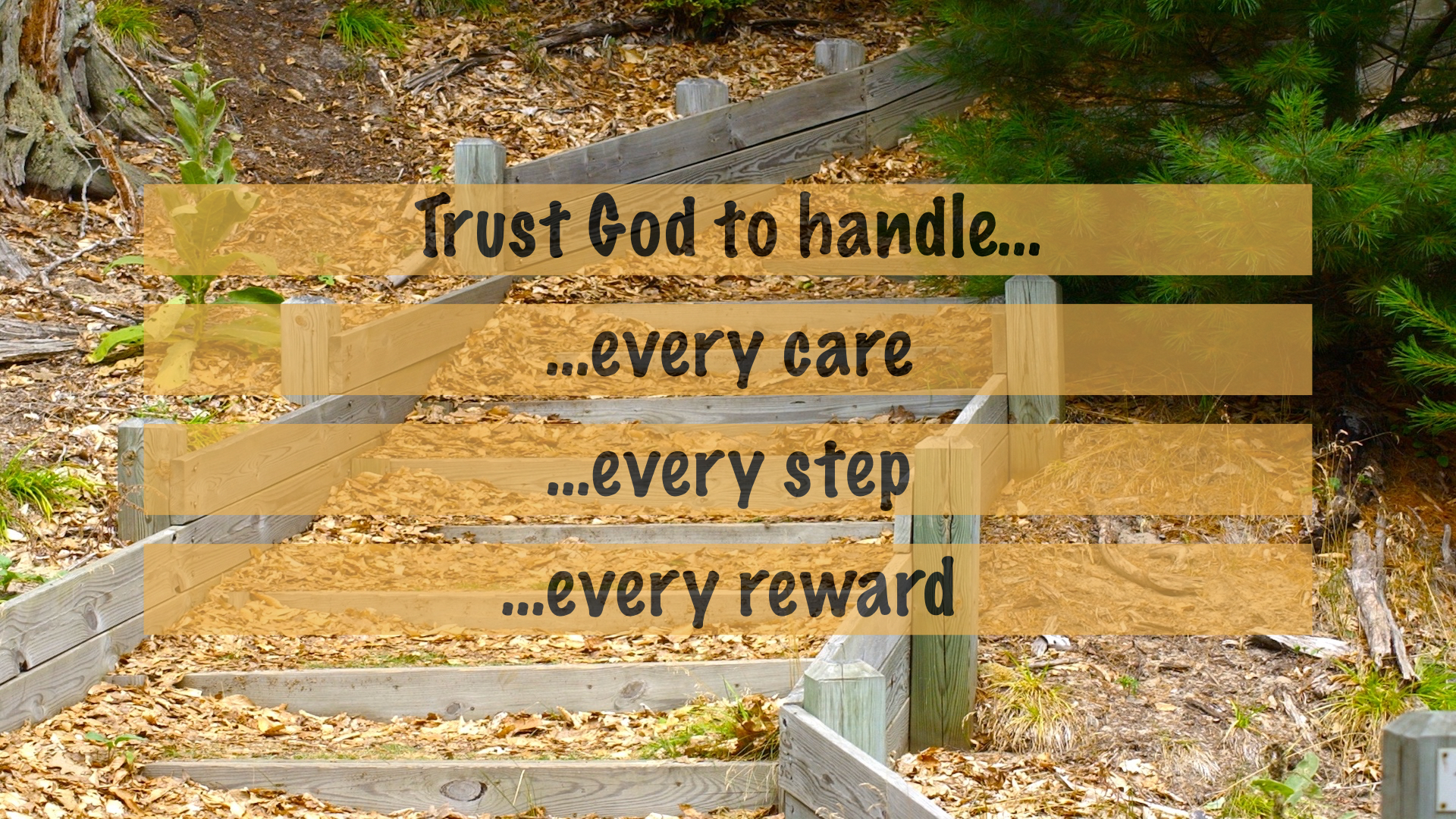
We can trust God to handle…
…every care—1 Peter 5:7
…every step—Proverbs 3:5-6
…every reward—Luke 12:32
Don’t let pride cause you to stumble in the homestretch. The closer we get to the end of the journey, the more childlike we should become.
Even the well-known hymn The Solid Rock has the line that says, “When all around my soul gives way.”
Isaiah 40:27-30 gives us a helpful example from the eagle of how we can handle life’s storms.
Eagles have huge wingspans and can travel up to 125 miles in a single flight. When they see storms coming, they lock their wings in place and stop flapping on their own. Instead, they sense the warm currents of air and rides those up and over the storm.
So Tom gave us these steps:
Disengage from our own efforts—don’t try to handle the storm on our own.
Perceive the warmth of God’s promises.
Trust the everlasting God (Isaiah 40:28). “Everlasting” means that God is infinite, vigorous, strong, faithful, and capable.
Ride up and over the storm in God. When God says we mount up on wings like eagles (Isaiah 40:31), it means we are braided together with God.
Live in the renewed strength that only God can give us.
Jesus went through the most unimaginable life storm that any human has ever had to endure, and He said, “Father, into Your hands I commit My spirit” (Luke 23:46). We need to trust our Heavenly Father just like Jesus did when we face storms!



 The first Church in the Book of Acts could have easily become the first two churches right from the beginning. Why? Because of a deep disagreement that pitted two camps against each other.









 Craig T. Owens