11 Quotes From “The Duty Of Pastors”

The Duty Of PastorsJohn Owen has some fascinating insights on pastors and ministers (hint: they’re not the same thing) in his book The Duty Of Pastors. Here are some of the quotes I liked from this book. Remember this book was written in the 17th-century, so don’t let the Old English keep you from discovering the rich truths in these passages.

“Why should any speak where the Holy Ghost is silent? … Where things are obscured, it is a safer way to prove the practice of men by God’s precept, charitably supposing them to have been obedient, than to wrest the divine rule to their observation, knowing how prone men are to deify themselves by mixing their inventions with the worship of God.”

“The lights which God maketh are sufficient to rule the seasons for which they are ordained. As, in creating of the world, God ‘made two great lights, the greater light to rule the day, and the lesser light to rule the night;’ so, in the erection of the new world of His church, He set up two great lights, the lesser light of the Old Testament to guide the night, the dark space of time under the law, and the greater light of the New Testament to rule the glorious day of the gospel. And these two lights do sufficiently enlighten every man that cometh into this new world. There is no need of the false fire of tradition where God sets up such glorious lights.”

“All faithful ministers of the gospel, inasmuch as they are ingrafted into Christ and are true believers, may, as all other true Christians, be called priests; but this inasmuch as they are members of Christ, not ministers of the gospel. It respecteth their persons, not their function, or not them as such.”

“Thus, this metaphorical appellation of priests is, in the first place an intimation of that transcendent privilege of grace and favour which Jesus Christ hath purchased for everyone that is sanctified with the blood of the covenant.”

“Not to lose myself and reader in this digression, the sum is, the unspeakable blessings which the priesthood of Christ hath obtained for us are a strong obligation for the duty of praise and thanksgiving; of which that in some measure we may discharge ourselves, He hath furnished us with sacrifices of that kind to be offered unto God.” 

“That the name of priests is nowhere in the Scripture attributed peculiarly and distinctively to the ministers of the gospel as such. … And yet, when Christ ascended on high, He gave some to be prophets, for the edification of His body, Eph. iv. 11; none, as we find, to be priests. Priests, then (like prelates), are a sort of church-officers whom Christ never appointed.”

“Never fear the equity of what God sets thee upon. No excuses of disability or any other impediment ought to take place; the Lord can and will supply all such defects.”

“God never sendeth any but whom He doth so extraordinarily and immediately call and ordain for that purpose; and that this may be manifested unto others, He always accompanieth them with His own almighty power, in the working of such miracles as may make them be believed, for the very works’ sake which God by them doth effect.”

“We do not read of any such miracles wrought by the prophet Amos, and yet he stands upon his extraordinary immediate vocation, ‘I was no prophet, neither was I a prophet’s son, but the Lord took me,’ etc. It sufficeth, then, that they be furnished with a supernatural power, either in, 1. Discerning; 2. Speaking; or 3. Working. … The sum is, that seeing such men pretend that their revelations and miracles are from heaven, let us search whether the doctrine they seek to confirm by them be from heaven or no.”

“There is a general obligation on all Christians to promote the conversion and instruction of sinners, and men erring from the right way.”

“For a public, formal, ministerial teaching, two things are required in the teacher: first, Gifts from God; secondly, Authority from the church (I speak now of ordinary cases). He that wants either is no true pastor.”

Be sure to check out my review of The Duty Of Pastors by clicking here.
The Duty Of Pastors (book review)

The Duty Of PastorsJohn Owen is one of the influential and powerful voices of the Puritans from the mid-17th century. One of the things that makes him influential is the source of his wisdom: Everything he writes is thoroughly grounded in Scripture. This is especially true for his book The Duty Of Pastors.

Originally this book was entitled The Duty Of Pastors and People Distinguished. As you might be able to tell from this original title, Owen lays out from Scripture the roles of ministers and pastors. These two titles and roles are distinct, although many people want to lump them together. Owen points out that any one who is a Christian can minister to people (and thus be called a “minister”), but there are special God-appointed roles for those called “pastors.”

Owen writes, “The first and principal duty of a pastor is to feed the flock by diligent preaching of the Word.” Indeed, this is one of the main thing which distinguishes pastors from ministers.

Owen also takes to task those in religious circles who would put artificial (in other words, things not commanded in Scripture) barriers for people to answer God’s call to the pastorate.

This is not a very long book, but given that fact that it is older, it is a bit of a challenging read. But for anyone who is interested in the roles of pastors and ministers, or for anyone who wants to know how to support their pastors, The Duty Of Pastors is well worth your time and effort.

How To Get Along With Others

How To Get Along With OthersJohn Maxwell famously said, “The entire world—with one minor exception—is made up of other people.” That “one minor exception”? It’s the person staring at you in the mirror every morning! Obviously learning how to get along with all the “others” in the world is hugely important.

It’s even more important for those who call themselves Christians.

The Bible makes it quite clear that people watch how Christians treat one another to see if the message they preach is one worth living. And Jesus told one of His most well-known stories to make the point that all of the Bible is fulfilled in just two things: (1) Loving God and (2) Loving others.


To live above with the God that we love,
Oh, wouldn’t that be glory!
But to live below with the saints that we know,
Well, that’s a different story!

The Bible says a lot about “one another.” In fact, that phrase is used nearly 60 times in the New Testament! Not only is there much that the Scripture has to say to us about getting along with one another, but most of what was written has been confirmed by modern psychology.

Join me this Sunday at Calvary Assembly of God as we begin a new series called How To Get Along With Others. We’ll be learning some practical training along with biblical insights to help us excel at this vitally important life skill.

You can find directions to our church here, and if you can’t join us in person, be sure to tune in to our Periscope broadcast (follow me @craigtowens to be notified when the broadcast starts).

How Do We Read Bible Stories?

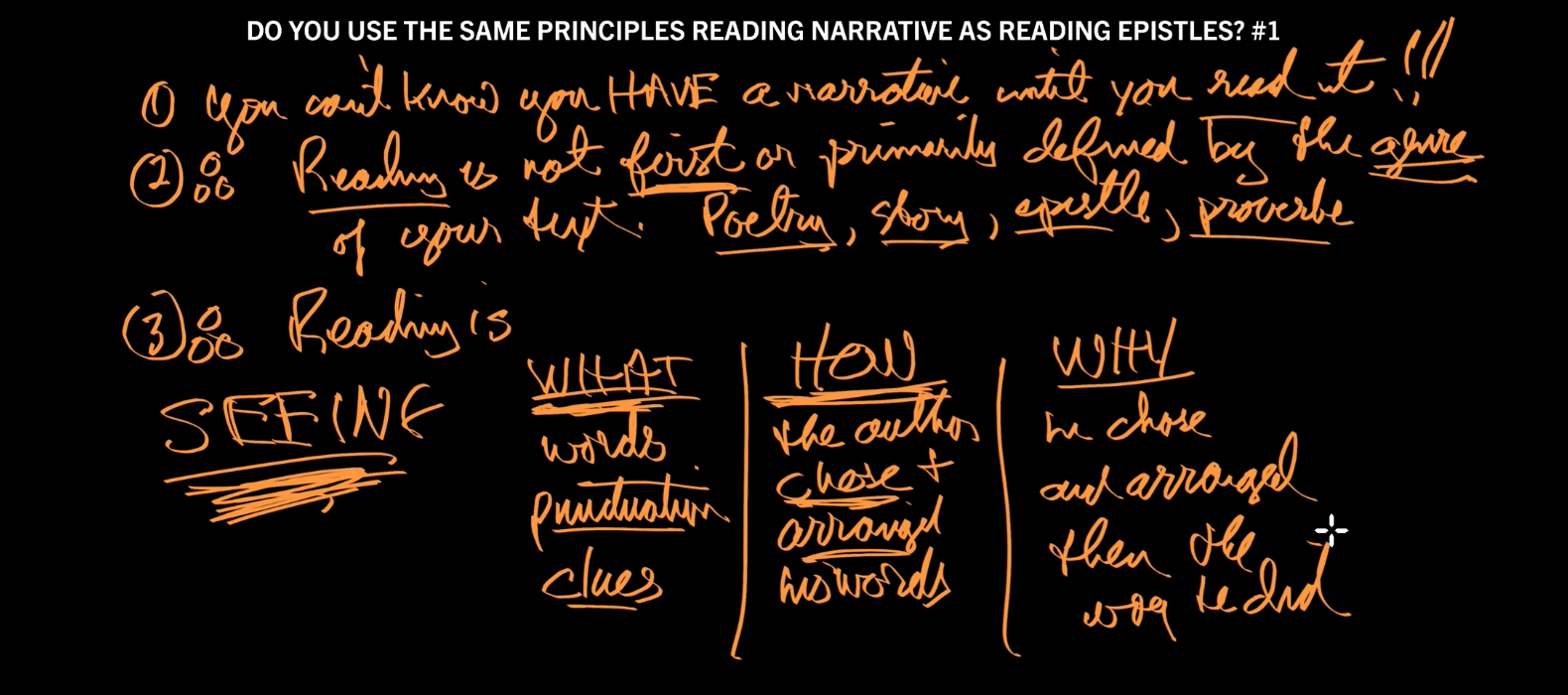
How do we read Bible storiesAt Calvary Assembly of God, we have been going through a series on how to study our Bibles. I love this insight from John Piper on how to read Bible stories—

Pastor Bobby Conway from the One Minute Apologist has a great series of videos that give us an oversight of each book of the Bible. In this video, he talks about the different genres of Scripture (much like Piper did in the above video)—

3 Bible Studies For You To Try

Book by book studyLast week I spoke and wrote about some tools you might use to study your Bible. Now I’d like to share some Bible study projects you might try with those new tools. As always, I recommend that beginning Bible studies go verse by verse through the Bible. I believe you will lay a strong foundation for your faith when you systematically put God’s Word into your heart.

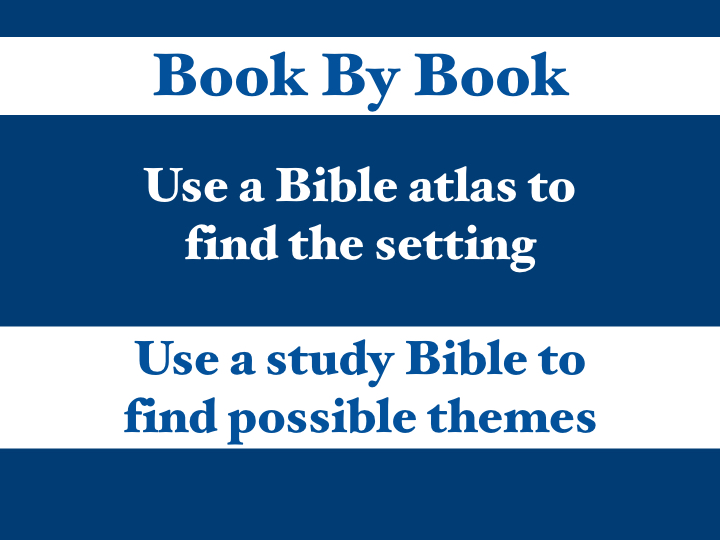
Book By Book

I’ll use the book of Ephesians as an example. Using my Bible atlas I find that the city of Ephesus is located along an important trade route, and it is the Roman capital of the province of Asia. My Full Life Study Bible tells me that because so much trade passed through this city, this letter was probably intended to be a circular letter for all of the communities near Ephesus. As a result, Paul is not addressing any specific problems in this church, but writes theological ideas for a broad spectrum of people.

As I begin reading, I paused in the first verse when I came to the phrase “the faithful in Christ.” I asked myself, “What does it mean to be faithful IN Christ? Can I be faithful outside of Him?” By the time I got to verse 3, I saw a similar phrase: “every spiritual blessing in Christ.” Now I went back and used a blue highlighter (there’s nothing special about blue, it just happened to be the first highlighter I grabbed), and marked those two “in Christ” phrases. I see two more in verse 4: “He chose us in Him” and “holy and blameless in His sight.” Going through the whole book I discovered 36 times the phrases “in Christ” or “in Him.” This is helpful to me to know the kind of security I have in Jesus.

Another thing that stood out to me were Paul’s prayers for the church. I see His very moving prayers in passages like 1:15-19 and in 3:14-21. I also see in 6:18 that he tells us to pray all kinds of prayers for ourselves and for others. And I see in 6:19 that Paul asked the church to pray for him too.

And always look for “therefore” phrases. For example in 4:24-25 or 4:32-5:1. The “therefore” phrases tell us how to live or think in light of the ideas that were just shared.

Chapter By Chapter

A good place to do this is in the Psalms or Proverbs. These are usually stand-alone chapters. When reading the chapters in these two books, I love reading them in parallel with other translations. For example, check out this from Psalm 1.

In Psalm 59, notice the superscript (or introduction). This gives us some background information to the psalm. Using my concordance, I found that this psalm was written this time in David’s life.

There is usually a theme to each chapter of the Proverbs, so try to discover that. In Proverbs 2, I noticed the “if … then” statements. In the first four verses I see things like “IF you will seek wisdom like this,” and then in verses 5-22 I see a whole bunch of blessings that follow the “then” that starts verse 5.

Word By Word

Sometimes I like to go really deep in a passage, so I slow down and look at it word by word. Here you need to use a Strong’s Concordance of the Bible. I like the one available on Blue Letter Bible. For example, next to 2 Peter 1:5, you can hover over the word “Tools” and select “Interlinear.” Clicking on “Interlinear” you will see all of the Greek words that make up this verse. By clicking on the Strong’s number, you can see the definition of that Greek word. Scrolling down a bit, you can see all of the other verses where that Greek word is used in the New Testament.

None of these tools are meant to take the place of the Holy Spirit. He is called the Spirit of Truth, and since He is the One who inspired all of the Scripture, ask His help before you begin any Bible study.

Here are two more Bible studies for you to try.

In this video I go into more detail on how I undertake all of these Bible studies. And be sure to join us next week as we take another look at different types of Bible studies.

3 Quotes About Bible Studies

New Bible study toolsYesterday I shared 7 must-have Bible study tools. Here are three powerful quotes on how and why we should make studying our Bibles an ongoing, lifelong pursuit.

“Search the Scriptures. Do not merely read them—search them; look up the parallel passages; collate them; try to get the meaning of the Spirit upon any one truth by looking to all the texts which refer to it. Read the Bible consecutively: do not merely read a verse here and there—that is not fair.” —Charles Spurgeon

“One cannot simply read the Bible, like other books. One must be prepared really to enquire of it. Only thus will it reveal itself. Only if we expect from it the ultimate answer, shall we receive it.” —Dietrich Bonhoeffer

“Let us resolve to read the Bible more and more every year we live. Let us try to get it rooted in our memories, and engraved into our hearts. … Let us resolve to be more watchful over our Bible reading every year that we live. Let us be jealously careful about the time we give to it, and the manner that time is spent. Let us be aware of omitting our daily reading without sufficient cause. Let us not be gaping, and yawning and dozing over our book, while we read. … Let us be very careful that we never exalt any minister, or sermon, or book, or tract, or friend above the Word. Cursed be that book, or tract, or human counsel, which creeps in between us and the Bible, and hides the Bible from our eyes! … Let us resolve to talk more to believers about the Bible when we meet them. Sorry to say, the conversation of Christians, when they do meet, is often sadly unprofitable! How many frivolous, and trifling, and uncharitable things are said! Let us bring out the Bible more, and it will help to drive the devil away, and keep our hearts in tune.” —J.C. Ryle

4 Terrible Ways & 4 Great Ways To Study Your Bible

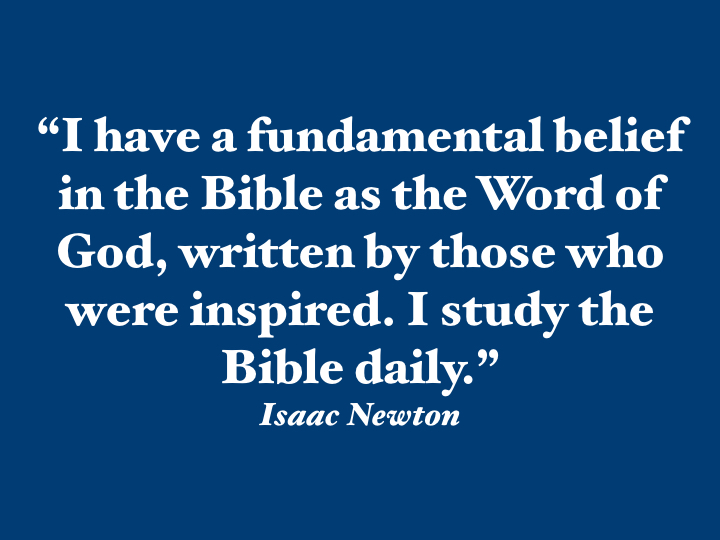
Isaac Newton Bible study.001There are two Greek words in the New Testament that have to do with trying to figure things out. One of them leads to less knowledge, and one opens the way for greater learning. Not surprisingly, Jesus never used the first way, but He confronts people who try to.

The first Greek word is defined as learning through self-calculation. In other words, I try to get at the right answer by either teaching myself, or by talking with people who don’t know any more than I do. This way leaves me in the dark.

For example, notice the phrase “discussed among themselves” in Matthew 16:7 and Mark 11:31. These are people who wanted to try to get answers without going to someone who could teach them. So that leads to four terrible ways to study your Bible—

  1. Approach your Bible with a know-it-all attitude.
  2. Try to figure out what the Bible is saying all on your own.
  3. Try to be your own Bible teacher.
  4. Grade your own tests as to your answers being right or wrong.

These are not only terrible ways to learn, but they are the exact opposite of what God desires. God says things like, “Come, let us reason together” (Isaiah 1:18), and “Call to Me and I will tell you things you do not know” (Jeremiah 33:3).

There is another Greek word which means to learn by having a conversation with someone more knowledgable than myself. So that means four great ways to study your Bible are—

  1. Ask the Holy Spirit to illuminate Scripture to you (John 16:13).
  2. Study the Bible in a daily systematic way (Acts 19:9).
  3. Don’t take anyone else’s word for what the Word says (Acts 17:11).
  4. If you’re confused, ask God to make it clear to you (Jeremiah 33:3).

Luke records an important story for us that took place on the day Jesus was raised from the dead. Two men were walking along “discussing these things with each other,” but not consulting the Scriptures. The result: they were sad and confused. Jesus join them on their journey (although they didn’t recognize Him at first), and took them to the Scriptures that showed them the answers for which they were yearning. They even said, “When He talked to us from the Scriptures, that’s when our hearts burned within us!” (see Luke 24:13-32).

You can try to figure life out on your own, and you will probably end up stymied like the religious leaders in Mark 11, or downcast like the disciples in Luke 24. Or you can ask the Holy Spirit to show you truths from the Scriptures, and have your eyes opened, like the two disciples after Jesus met with them. I think the choice is obvious!

Join me next week as we continue our series How To Study Your Bible.

4 Reasons To Study Your Bible

Commitment to readYou probably hear Christians say quite frequently, “You should read your Bible.” But one thing you may not hear as often is why you should read your Bible. There are probably many more reasons, but here are four reasons why I believe reading your Bible should be a daily part of your life.

(1) To help spot errors.

When the devil tempted Jesus, it is noteworthy that Jesus didn’t try to use logic, or persuasion, or even willpower. Every temptation was blocked by Jesus saying, “It is written” as He quoted Scripture.

In the second temptation, the devil tried the same tactic. He, too, quoted a couple of verses from the Psalms, but he took them out of their context. So notice Christ’s reply, “It is also written” (Matthew 4:7). The best way to spot error is to know the full counsel of God’s Word. This tactic the devil tried with Jesus wasn’t something new, but it was something he used on the very first humans: “Did God really say…” (Genesis 3:1), and he will try it again on you!

(2) To clarify your emotions.

Most of us allow our emotions to control our actions. Or sometimes we wrestle with, “My heart says one thing, but my head says something else!” In this tug-of-war, we allow our emotions to determine our beliefs, and then our beliefs determine our actions. This is not only dangerous, but it is contrary to what the Bible teaches.

The healthy way to respond is by fully knowing what we believe, and then acting according to our beliefs. Our proper emotional response will then follow those actions.

Look at the example of Jesus in John 2:13-16. He was ticked off at how people were misusing His Father’s house, and He did some serious house cleaning! Just reading those four verses, you may get the idea that Christ’s emotions carried Him away. But check out verse 17, in which we see He was acting in accordance to His beliefs, which were fully grounded in Scripture.

(3) To know prophesy.

All of the Scriptures point to Jesus, so all of the Scriptures are illuminated by Christ (Luke 24:27, 45). If you want to know what is happening in our world, turn to the pages of Scripture and see how Jesus is revealed. This will help you put even current events into perspective.

(4) To give sound answers.

When people need help, I want to be able to give them real answers. Not my opinion, but truth that they can apply. The Apostle Peter told us to always be prepared to give people an answer that is based on our knowledge of Jesus (1 Peter 3:15).

“Beware of saying, ‘I haven’t time to read the Bible, or to pray’; say rather, ‘I haven’t disciplined myself to do these things.’” —Oswald Chambers

Can I challenge you to do something I challenged my whole church to do … Make a commitment to read the Bible every day for the next seven days. See what happens as God meets with you, and reveals Himself and His wisdom to you, every day.

We’ll be learning some Bible study strategies next Sunday, and I invite you to join us.

How To Study Your Bible

How To Study Your BibleMaybe first we should ask, “Why should we study the Bible?” Many people loudly proclaim, “All that is needed for salvation is faith in Jesus.” This is correct, but remember this—Faith [for salvation] comes from hearing the message, and the message is heard through the Word of Christ (Romans 10:17).

Then after our faith in Jesus brings us the forgiveness for our sins, there is an ongoing process of walking out our faith, something the Bible calls sanctification. Here again the Bible plays a vital role. Jesus prayed for His followers this way: Sanctify them by the truth; Your Word is truth (John 17:17).

The bottom line … Our Christian walk is nearly impossible to maintain without the resources found in the Scriptures! 

But the Bible is a large book, and many people don’t know where or how to begin to study it. That’s why we are taking the time to learn together some practical ideas for studying God’s Word.

Please join us at Calvary Assembly of God over the next few weeks as we learn the practices which will help us make the most of our time studying the Bible. If you cannot join us in person, we will be broadcasting all of our messages live on Periscope (follow @craigtowens to be notified when the broadcasts begin).

If you are ready to take your Bible study to a new level, please join us beginning this Sunday!

Light & Truth—Acts And the Larger Epistles (book review)

Light & Truth [Acts]Horatius Bonar has given us a fantastic companion for our Bible reading time. This is my second review of his Light And Truth series (the first review on the Gospels may be read here). This installment covers the biblical books of Acts, Romans, and 1 & 2 Corinthians.

Bonar grew up in a pastoral home, with plenty of other pastors and evangelists in his family tree. You might say that he was weaned on Scripture and its application to our lives. This Bible-based heritage comes through in all he writes. By no means, though, does Bonar simply ride the coattails of his esteemed family, but he is quite brilliant in his own Holy Spirit-inspired insights.

Bonar’s commentaries are not a verse-by-verse exposition of the Scripture. Instead, he may just take one or two verses and “go deep” with them. A short passage may be taken apart word by word, and many rich applications are thus brought forth.

As I am reading through the New Testament, I am finding Horatius Bonar to be a helpful “tour guide” on my journey.