The Qur’an And The Bible

Answering JihadIn his outstanding book Answering Jihad, Nabeel Qureshi gives us an understanding of the beliefs which support the Islamic faith. One thing that is key for Muslims is their reliance on multiple sources for definitive answers to their faith. Nabeel explains it this way…

“The Qur’an that was the first Arabic book ever put into writing, and the Arabic script of the seventh century remained too deficient to capture the richness and complexities of its text. … Muslim biographers begin to write about Muhammad’s life around 770 A.D.” 

“By the middle of the ninth century, there were more than 500,000 traditions of Muhammad’s life in written and oral circulation, and Muslim scholars decided to undertake the effort of sifting through them and distilling the most authentic accounts.” 

“Since there are thousands of verses in the Qur’an and hundreds of thousands of hadith, it is expected that only trained Muslim jurists can engage in determining what sharia teachers. The jurist must give primacy to the Qur’an, then consider the actions (sunnah) and sayings (hadith) of Muhammad, followed by reviewing the consensus of Islamic scholars, or ijma, before using his own reasoning (qiyas). By following these four steps, a Muslim jurist can make a decision, or fatwa, about what sharia teaches on a given matter. The ultimate goal is to apply the teachings of sharia to Muslim life, and that is called fiqh.” 

“As is probably clear by now, at no point was the average Muslim expected to read the Qur’an to decide upon correct Islamic practices by himself or herself. Not only is Islam not a faith that upholds the sufficiency of scripture alone, the complexity of its foundations virtually necessitates a reliance on jurists and scholars for proper practice.” 

I prefer to pattern my life after the Bible, a book which I am free to read on my own. It’s authenticity has been well-established, and it doesn’t require me to find an “expert” in the texts and traditions to explain to me how to live my life.

I would highly recommend you read two books by Nabeel Qureshi: Seeking Allah, Finding Jesus and Answering Jihad. If you are curious about the claims of the Bible, you can check out God-Breathed and Questions Christians Hope No One Will Ask. And if you want to dig any deeper, search this website for the quotes I have posted from all four of these books.

Archeological Study Bible (book review—part 2)

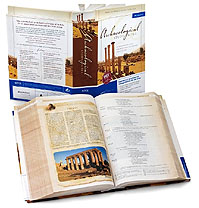
Archeological Study BibleI wrote a review on the Archeological Study Bible when I was roughly halfway through the Bible, but as I have now finished, I thought another review was in order.

Zondervan did an amazing job on this project! I love reading the Bible, and I love studying history, and this study Bible helped me to do both of those things without getting lost on too many “rabbit trails.” Some study Bibles I have read require a lot of page flipping to follow a thought or do a little research. But the ABS kept the historical articles, maps, and graphics close at hand to the biblical text I was reading, so page flipping was kept to a minimum.

At over 2300 pages, there is so much history that came alive as I read through the Bible. I also read through the Bible in chronological order, so I really felt like the ABS was helping me move seamlessly along the timeline of history.

Purchasing this Bible gives you access to an online gallery of many of the photos and other study materials. I also purchased the Kindle version of this Bible, to make searching for content much easier.

If you are looking for a fresh way to study the history surrounding the Scripture, I highly recommend the Archeological Study Bible to you.

Thursdays With Oswald—The Harmony Of Health

Oswald ChambersThis is a weekly series with things I’m reading and pondering from Oswald Chambers. You can read the original seed thought here, or type “Thursdays With Oswald” in the search box to read more entries.

The Harmony Of Health

     Health, or physical harmony, is a perfect balance between our organism and the outer world. … The great error of the healthy-minded cult is that it ignores a man’s moral and spiritual life. … The attitude to sickness in the Bible is totally different from the attitude of people who believe in faith-healing. The Bible attitude is not that God sends sickness or that sickness is of the devil, but that sickness is a fact usable by both God and the devil. 

   Happiness or moral harmony is a perfect balance between our inclination and our environment. … The Bible reveals that a man can have physical health at the cost of his moral welfare, and happiness at the cost of spiritual welfare. 

   Holiness, or spiritual harmony, is a perfect balance between our disposition and the law of God. … 

   The devil tries to make us think that when we have entered into the sanctified life, all is done; it is only begun. We have entered into Jesus Christ’s finished work, but remember, says Paul, you have attained to nothing yet; everything is perfectly adjusted, now began to attain and to “grow up into him in all things. These three things develop slowly together: first, the basis of spiritual holiness; second, the building of moral happiness; and third, the decoration of physical health. A full-grown man in Christ Jesus is one who has become exactly like Christ Jesus. “Till we all come…unto the measure of the stature of the fullness of Christ” (Ephesians 4:13). 

From The Philosophy Of Sin

Quite simply Oswald Chambers identifies health as a perfect balance:

  • Physical health balances outside germs against inside defenses.
  • Emotional health balances outside circumstances with inside coping mechanisms.
  • Spiritual health balances God’s law (outside) with our obedience to that law (inside).

Furthermore, Chambers says that Jesus Christ is our measuring stick. We must study God’s Word, and watch Jesus closely to see how He lived out the perfect balance of the Scriptural principles so that we can attain “unto the measure of the stature of the fullness of Christ.”

Thursdays With Oswald—Stay True To The Word

Oswald ChambersThis is a weekly series with things I’m reading and pondering from Oswald Chambers. You can read the original seed thought here, or type “Thursdays With Oswald” in the search box to read more entries.

Stay True To The Word

     We must disabuse our minds of the idea that God sits like a Judge on a throne and batters humanity into shape. …

     We have to remember that an enthusiasm for humanity which ignores the Bible is sure to end in disaster. … 

     It is quite possible for the human mind to blot God out of its thinking entirely, and to work along the line of the elements which are the same in every man, and to band the whole of the human race into a solid atheistic community. … 

     When men depart from the Bible they call humanity “God” in differing terms; the use of the term “God” means nothing to them, God is simply the name given to the general tendencies which further men’s interests. This spirit is honeycombing everything, we find it coming into the way we talk of Christian experience; there is creeping in the idea that God and Jesus Christ and the Holy Ghost are simply meant to bless us, to further our interests. … 

     Watch the tendency abroad today; people want to get rid of Jesus Christ, they cannot prove that He did not live, or that He was not a remarkable Man; but they set to work to dissolve Him by analysis, to say He was not really God Incarnate. Jesus Christ always upsets the calculations of humanity; that is what made Voltaire say “Crucify the wretch, stamp Him and His crazy tale out,” because He was the stumbling block to all the reasonings of men. You cannot work Jesus Christ into any system of thinking. If you could keep Him out, everything could be explained. The world could be explained by evolution, but you cannot fit Jesus Christ into the theory of evolution. Jesus Christ is an annoyance to satan, a thorn in the side of the world at large, an absolute distress to sin in the individual.

From The Philosophy Of Sin

Oswald Chambers always penned wise words, but what makes his words so wise is that they are solidly rooted in Scripture.

In the above passages, Chambers warns us what happens when we forget the word of God as given to us in the Bible:

  • We see God as harsh and unloving
  • We make short-sighted decisions
  • We build a community in our image
  • We all have a different idea of who God is
  • We make “God” fit into our own molds
  • We water down who Jesus is
  • We create new worldviews not consistent with God’s design

Bottom line: Stay in the Word. Make Bible reading a regular part of your life, so that you don’t get caught up in the churning waves of “popular” culture.

8 Quotes From “Culture”

cultureIn Culture, you will find a collection of chapters from various A.W. Tozer books all addressing the theme of how a Christian should behave in worldly culture. If you are concerned about influencing the culture for Christ (instead of being influenced by it), I urge you to read my review of this book, and then pick up a copy for yourself. Below are a few quotes from Culture that caught my attention.

“The sacred-secular antithesis has no foundation in the New Testament. … The Lord Jesus Christ Himself is our perfect example, and He knew no divided life. In the presence of His Father He lived on earth without strain from babyhood to His death on the Cross. God accepted the offering of His total life, and made no distinction between act and act. ‘I do always those things that please Him,’ was His brief summary of His own life as it related to the Father (John 8:29). As He moved among men, He was poised and restful.”

“A Christian is now living according to the will of God as he understands it from the written Word. Of such a one it may be said that every act of his life is or can be as truly sacred as prayer or baptism or the Lord’s Supper. To say this is not to bring all acts down to one dead level; it is rather to lift every act up into a living kingdom and turn the whole life into a sacrament.”

“Keep reminding God in our times of private prayer that we mean every act for His glory; then supplement those times by a thousand thought-prayers as we go about the job of living. Let us practice the fine art of making every work a priestly ministration. Let us believe that God is in all our simple deeds and learn to find Him there.”

“You cannot get miracles as you would get a chemical reaction. You cannot get a miracle as you get a wonderful act on stage by a magician. God does not sell Himself into the hands of religious magicians. I do not believe in that kind of miracles. I believe in the kind of miracles that God gives to His people who live so close to Him that answers to prayer are common and these miracles are not uncommon.”

“Our trouble is not that we refuse to believe right doctrine, but we refuse to practice it. We have the peculiar contradiction of believing the right thing and living the wrong way.”

“It seems that the average person spends more time and intellectual labor each year filling out income tax forms then he or she spends in a lifetime trying to learn from the Scriptures and from the light of the Spirit what the church is and what he or she ought to do about it.”

“I would also have in our body the power of the Spirit of Christ. I have said that the average gospel church could get along without the Holy Spirit—and many do. We are praying for revival. What is revival? It is when the Holy Spirit takes over the work that is His, instead of being pushed aside into the benediction. He now becomes the Chief Executive of the church, running it. ‘But ye shall receive power, after that the Holy Ghost is come upon you’ (Acts 1:8). That means that the Spirit of Heaven should come to a company on earth with His all-prevailing gifts, power, and grace, with His life, His illumination, and His discernment. This is not fanaticism; this is not any weird religion. This is just what the Bible teaches.”

“Did you read the Bible or watch TV more this week? Think of the time you have spent. How many half-hour periods did you spend with your Bible, and how many did you spend with amusements? We do not take our faith seriously enough.”

I will be sharing other quotes from Culture soon. If you will enter your email address in the “Subscribe” box to on the right side of the page, you will be notified as soon as new quotes are posted. You can also read Tozer’s quotes from this book, as well as other empowering quotes that I share daily in Twitter and Tumblr.

9 Quotes From “Of Antichrist And His Ruin”

Of Antichrist And His RuinJohn Bunyan’s works are steeped in Scripture. His thoughts about the Antichrist and other end times events are either directly taken from biblical passages, or else his line of reasoning fits perfectly with the intent of the Scriptures. You can read my full book review by clicking here. Below are some quotes I found enlightening.

“Coercion, in anything connected with religion, whether it imposes creeds, liturgies, or modes of worship, is Antichrist: whom to obey, is spiritual desolation, and if knowingly persevered in, leads to death.” —George Offor, editor

“As God therefore did put it into the hearts of the wicked kings of Babylon, to distress in His church and people for their sins; so He put it into the hearts of the kings of the Medes and Persians, who were to be, in a sense, their saviors; to ease them of those distresses, to take off the yoke, and let them go free.”

“This twenty years we have been degenerating, both as to principles, and as to practice; and have grown at last into an amazing likeness to the world, both as to religion and civil demeanor.” 

“Take heed in laying the cause of your troubles in the badness of the temper of governors. … God is the chief, and has the hearts of all, even of the worst of men, in His hand. Good tempered men have sometimes brought trouble; and bad tempered man have sometimes brought enlargement to the churches of God: Saul brought enlargement (1 Samuel 14:28). David brought trouble (2 Samuel 12:10).) Ahab brought enlargement (1 Kings 21:29). Jehoshaphat and Hezekiah did both sometimes bring trouble (2 Chronicles 19:2; 20:35; 32:25). Therefore, the good or bad tempers of men sway nothing with God in this matter; they are the sins or repentances of His people, that make the church either happy or miserable upon earth.”

“Antichrist is the adversary of Christ; an adversary really, a friend pretendedly. So then, Antichrist is one that is against Christ; one that is for Christ, and one that is contrary to Him (and this is that mystery of iniquity [2 Thessalonians 2:7]). Against Him in deed; for Him in word, and contrary to Him in practice. … Christ prefereth His Father’s will above heaven and earth: Antichrist prefereth himself and his traditions above all that is written, or that is called God, or worshiped.”

“Nor can all the fallen angels, with all the members and limbs of Antichrist, cause that their brat should abide so much as one day longer than our God’s prefixed time.”

“Now, by ordinances of Antichrist, I do not intend things that only respect matters of worship in Antichrist’s kingdom, but those civil laws that impose and enforce them also; yea, that enforce that worship with pains and penalties, as in the Spanish Inquisition. … What could the king of Babylon’s golden image have done, had it not been for the burning fiery furnace that stood within view of the worshipers (Daniel 3)? Yea, what could that horrible command, to pray for thirty days to neither God nor man, but to the king, have done, had it not been for the dark den and the roaring lions therein ready to devour those that disobeyed it (Daniel 6)? … For as the furnace would have been next to nothing, if void of fire; and the den as little frightful, if destitute of lions; so these laws will be as insignificant, when Christ has slain that spirit that is in them; that spirit that causes that as many as will not worship the image of the beast, should be killed.”

“What say ye now, ye sons of God! Will you learn to make a judgment of things according to the mystery of the wisdom of God, or will ye longer conclude according to sense and reason?”

“Cold blasts in November are not received with that gentleness as are colder in March and April; for that these last cold ones are but the farewell notes of a piercing winter; they also bring with them the signs and tokens of a comfortable summer. Why, the church is now at the rising of the year; let then the blasts at present, or to come, be what they will, Antichrist is assuredly drawing towards his downfall.”

Of Antichrist And His Ruin (book review)

Of Antichrist And His RuinAs I was finishing up reading through the Bible this time, I especially noticed in the last couple of books quite a few mentions of the Antichrist. Wanting to dig a little deeper on this subject, I turned to a man who so throughly knew Scripture: John Bunyan and his book Of Antichrist And His Ruin.

The Antichrist is not something we can just brush off and say, “Well, that’s end-times stuff and doesn’t really concern Christians. After all, won’t we already be in Heaven when the Antichrist appears on earth?” But John, in his first epistle warns us—

This is the spirit of the Antichrist, which you have heard is coming and even now is already in the world. (1 John 4:3, emphasis added)

Wow, even in the first century, John already saw the spirit of the Antichrist at work. How much more so should Christians today prepare themselves for this onslaught of evil!

I didn’t want any “pop theology” or well-intentioned ideas about the Antichrist, I wanted to know what the Bible said about it. Speaking of John Bunyan, Charles Spurgeon said, “Prick him anywhere—his blood is Bibline, the very essence of the Bible flows from him. He cannot speak without quoting a text, for his very soul is full of the Word of God.”

Indeed, Bunyan’s work in Of Antichrist is a compilation of all the biblical texts, put together in a way that makes sense. Of course, the English is sometimes a bit challenging to follow, since Bunyan wrote over 400 years ago. But if you are interested in the biblical facts about the Antichrist described in the Bible, this must be your go-to source!

4 Quotes On Persecution From “The Blessing Of Humility”

The Blessing Of HumilityAs I stated in my review of Jerry Bridges’ book The Blessing Of Humility, reading through these thoughts slowly—Beatitude by Beatitude—would bring about the most life-changing impact. In that spirit, I will be sharing some noteworthy quotes one Beatitude at a time. Here are some quotes on blessed are those who are persecuted because of righteousness (Matthew 5:10-12)

“There is no doubt that the culture is becoming more and more antagonistic toward biblical values. For some years I have thought our American culture to be ungodly; that is, to believe and act as if God is irrelevant. Now I believe we have become not just ungodly but actually anti-God. An increasing number of those who most influence our culture—such as academia, the media, and the entertainment industry—are openly hostile to the whole idea of God or of biblical values.”

“I suspect that our own court system will eventually fail us, as more and more judges are appointed who have been trained in law schools that at best are indifferent to biblical righteousness and at worst are openly hostile to it. Even our Supreme Court seems to be rendering decisions based on the mores of popular culture rather than on a principled application of the Constitution.”

“There is a sense in which this eighth Beatitude is the climax of several preceding ones dealing with our response to the way others treat us. … In this eighth Beatitude Jesus has in mind persecution rooted in the hostility of the anti-God culture we live in.”

“Keep in mind these words from Jesus [Luke 6:27-28] are precepts—authoritative commands of God. Furthermore, they address more than our attitude toward those who persecute us. They are action steps: we are to love our enemies, do good to them, bless them, and pray for them.”

 I have previously shared quotes on:

6 Quotes On Peacemakers From “The Blessing Of Humility”

The Blessing Of HumilityAs I stated in my review of Jerry Bridges’ book The Blessing Of Humility, reading through these thoughts slowly—Beatitude by Beatitude—would bring about the most life-changing impact. In that spirit, I will be sharing some noteworthy quotes one Beatitude at a time. Here are some quotes on blessed are the peacemakers (Matthew 5:9)…

“Jesus was speaking of making peace when we ourselves are involved in conflict with others.”

“It is often the sinful use of our tongues that cause conflict. But the tongue is only an instrument. The real problem is the heart. … To become peacemakers, then, we must begin with ourselves. We must ask ourselves, ‘Why do I make cutting remarks to another person? Why do I make demeaning remarks about them?’ We must also ask us ourselves, ‘What causes my resentment toward that person?’ or ‘Why do I continue to nurse hurts by that person instead of forgiving them? What is it that causes me to be envious or jealous of that person?’ In order to even ask those questions, we have to admit that we have those attitudes. But because we know they are sinful, we tend to live in denial that we have them.”

“Peacemaking where there is conflict with someone else is not an option for us. It is God’s commandment. We are to strive for peace with everyone (Hebrews 12:14). The word strive is a translation of the Greek word dioko. It is a very intense word and is most often used for the word pursue. (See also Philippians 3:12, 14; 2 Timothy 2:22; 1 Peter 3:11.)”

“Jesus tells us, ‘Love your enemies and pray for those who persecute you’ (Matthew 5:44). Are we willing to pray for those who have hurt us, that God will bless them? To be a peacemaker, then, means we absorb the hurtful words or actions of others without becoming resentful, retaliating, or even cutting off a relationship with the person.”

“To be a peacemaker means taking the initiative to restore such broken or damaged relationships, even when the major cause of the rupture lies with the other person.”

“To be a peacemaker means we must seek to be delivered from self-interest and not look at everything in terms of how it affects us. Instead we must be concerned about the glory of God and how we can best promote that glory in situations of conflict.”

 I have previously shared quotes on:

Quotes on the final Beatitude will be posted soon. Stay tuned…

Thursdays With Oswald—What “Religious” Things Perplex You?

Oswald ChambersThis is a weekly series with things I’m reading and pondering from Oswald Chambers. You can read the original seed thought here, or type “Thursdays With Oswald” in the search box to read more entries.

What “Religious” Things Perplex You? 

     If we are perplexed over the question of sanctification, or about the baptism of the Holy Ghost, we ourselves are the reason why we are bothered. God has written a Book, and the phrases “sanctification” and the “baptism of the Holy Ghost” are His, not man’s; why do we not go to Him about it? 

     We are the reason why we do not go; we dare not go. If we honestly ask God to baptize us with the Holy Ghost and fire, anything that happens is His answer, and some appalling things happen. If we accept the revelation that our body is the temple of the Holy Ghost, are we prepared to ask God to fulfill the purpose of the Holy Ghost in our body? If we are, watch the consequences—that friendship must go, that book, that association, everyone of them must decay off like a lightning flash. 

     If anyone has a difficulty in getting through to God, it is never God who is to blame. We can get through to Him as soon we want to, there is nothing simpler.

From The Psychology Of Redemption

I believe Chambers’ line of reasoning goes like this:

  • God has revealed His full will in the inspired words of Scripture.
  • The same Holy Spirit Who inspired the Bible can illuminate our hearts.
  • We don’t have insight because we either don’t ask for it [James 1:5], or we don’t really want to hear the truth [James 4:3].
  • Asking for help while posturing ourselves to obey will quickly bring clarity—“Jesus Christ’s life must work through our flesh, and that is where we have to obey. So many go into raptures over God’s supernatural salvation, over the wonderful fact that God saves us by His sovereign grace (and we cannot do that too much), but they forget that now He expects us to get ourselves into trim to obey Him” (Oswald Chambers).