17 Final Quotes From “Not Knowing Where”

Not Knowing WhereI’ve been sharing some of the amazing quotes from Oswald Chambers’ book Not Knowing Where. Here is the last set of quotes from this book.

“The natural life is not spiritual, it can only be made spiritual by deliberately casting it out and making it the slave instead of the ruler. … Jesus Christ cannot give me a meek and quiet spirit, I have to take His yoke upon me; that is, I have to deliberately discipline myself. … If we do not resolutely cast out the natural, the supernatural can never become natural in us.”

“Remember, Abraham had to offer up Ishmael before he offered up Isaac. Some of us are trying to offer spiritual sacrifices before we have sacrificed the natural. The only way we can offer a spiritual sacrifice to God is to do what He tells us to do, discipline what He tells us to discipline.”

“Common sense is not faith and faith is not common sense; they stand in the relation of Ishmael and Isaac, of the natural and spiritual, of individuality and personality, of impulse and inspiration. Faith in antagonism to common sense is fanaticism, and common sense in antagonism to faith is rationalism. The life of faith brings the two into right relationship.”

“We have the idea that the body, individuality, and the natural life are altogether of the devil; they are not, they are all of God, designed by God, and it is in the human body and in the natural order of things that we have to exhibit our worship of God. The danger is to mistake the natural for the spiritual, and instead of worshiping God in my natural life to make my natural life God.”

“How am I going to find out what the will of God is? In one way only, by not trying to find out. If you are born again of the Spirit of God, you are the will of God, and your ordinary common sense decisions are God’s will for you unless He gives an inner check. When He does, call a halt immediately and wait on Him. Be renewed in the spirit of your mind that you may make out His will, not in your mind, but in practical living. God’s will in my common sense life is not for me to accept conditions and say—‘Oh well, it is the will of God,’ but to apprehend them for Him, and that means conflict, and it is of God that we conflict. Doing the will of God is an active thing in my common sense life.”

“As Abimelech rebuked Abraham when he was in the wrong (see Genesis 20), and Abraham in his turn rebuked Abimelech, so in the same way the children of men from time to time rebuke the children of God, and the children of God rebuke the politics of natural men. Compromise with each other or unity between them is immoral. Arbitration until He comes Whose right it is to reign is the God-ordained program.”

“The very nature of faith is that it must be tried; faith untried is only ideally real, not actually real. Faith is not rational, therefore it cannot be worked out on the basis of logical reason; it can only be worked out on the implicit line of living obedience.”

“God does not further our spiritual life in spite of our circumstances, but in and by our circumstances.”

“To say ‘Here I am’ when God speaks, is only possible if we are in His presence, in the place where we can obey.” 

“God never fits His Word to suit me; He fits me to suit His Word.”

“True faith does not so much take God at His Word as take the Word of God as it is, in the face of all difficulties, and act upon it, with no attempt to explain or expounded.”

“The path to God is never the same as the path of God. When I am going on with God in His path, I do not understand, but God does; therefore I understand God, not His path.”

“Christ died in the stead of me. I, a guilty sinner, can never get right with God, it is impossible. I can only be brought into union with God by identification with the One Who died in my stead. No sinner can get right with God on any other ground than the ground that Christ died in his stead, not instead of him.” 

“The maturity of character before God is the personal channel through which He can bless others. If it takes all our lifetime before God can put us right, then others are going to be impoverished.”

“The genius of the Spirit of God is to make us pilgrims, consequently there is the continual un-at-home-ness in this world (cf. Philippians 3:20).”

“It is impossible for a saint, no matter what his experience, to keep right with God if he will not take the trouble to spend time with God. In order to keep the mind and heart awake to God’s high ideals you have to keep coming back again and again to the primal source.”

“Bitterness and cynicism are born of broken gods; bitterness is an indication that somewhere in my life I have belittled the true God and made a god of human perfection.”

You can read other quotes I’ve shared from Not Knowing Where by clicking here, here, and here.

And my book review of Not Knowing Where is here.

14 More Quotes From “Not Knowing Where”

Not Knowing WhereWhen I’m reading an Oswald Chambers book, I could practically highlight every line! Even when I restrain myself, I still find so much good material. I’ve already shared some quotes from Not Knowing Where, but I wanted to share a few more with you.

“In seeking the best we soon find that our enemy is our good things, not our bad. The things that keep us back from God’s best are not sin and imperfection, but the things that are right and good and noble from the natural standpoint.”

“Fanaticism is sticking true to my interpretation of my destiny instead of waiting for God to make it clear.”

“God will never have more power than He has now; if He could have, He would cease to be God.”

“Whenever God gives a vision to a saint, he puts the saint, as it were, in the shadow of His hand, and the saint’s duty is to be still and listen. Genesis 16 is an illustration of the danger of listening to good advice when it is dark instead of waiting for God to send the light (cf. Galatians 1:15-16). When God gives a vision and darkness follows, wait; God will bring you into accordance with the vision He has given if you will wait His time.”

“All God’s commands are enablings. Therefore it is a crime to be weak in His strength.” 

“God never hastens and He never tarries. He works His plans out in His own way, and we either lie like clogs on His hands or we assist Him by being as clay in the hands of the Potter.”

“Faith is not a bargain with God—I will trust You if you give me money, but not if You don’t. We have to trust in God whether He sends us money or not, whether He gives us health or not. We must have faith in God, not in His gifts.”

“The relation is to be that of a child; fling yourself clean over on to God and wash your hands of the consequences, and John 14:27―‘My peace I give unto you’―becomes true at once. The profound realization of God makes you too unspeakably peaceful to be capable of any self-interest.”

“Faith is not the means whereby we take God to ourselves for our select coterie; faith is the gift of God whereby He expresses His purposes through us.”

“Beware of insulting God by being a pious prude instead of a pure person.”

“It is the attitude of a spiritual prig to go about with a countenance that is a rebuke to others because you have the idea that they are shallower than you.”

“Friendship with God is faith in action in relation to God and to our fellow men.”

“The most amazing evidence of a man’s nature being changed is the way in which he sees God, to say ‘God led me here’; ‘God spoke to me’; is an everyday occurrence to him.”

“It is not that we prepare a palace for God, but that He comes into our mortal flesh and we do our ordinary work, in an ordinary setting, amongst ordinary people, as for Him.”

You can read my review of Not Knowing Where by clicking here.

You can read other quotes from this book by clicking here.

Links & Quotes

link quote

Margaret Sanger, the founder of Planned Parenthood, had some messed up values! Check out this video where she is interviewed by Mike Wallace of 60 Minutes. If you cannot watch the whole thing, fast forward to the 19:50 mark where she answers a question about sin. She says one of the greatest sins is to bring unfit children into the world(!). Disgusting.

“I freed a thousand slaves. I could have freed a thousand more if only they knew they were slaves.” ―Harriet Tubman

“We do our Lord an injustice when we suppose He wrought all His mighty acts in days of old, and showed Himself strong for those in the early time, but does not perform wonders or lay bare His arm for the saints that are now upon the earth. … Surely, beloved, the goodness of God of old has been repeated unto us.” —Charles Spurgeon

“Not one life spent in the cause of world evangelization is spent in vain. Not one prayer or one dollar or one sermon or one letter of encouragement mailed or one little light shining in some dark place—nothing in the cause of the advancing kingdom is in vain. The triumph is sure.” —John Piper

“Perfect humility dispenses with modesty. If God is satisfied with the work, the work may be satisfied with itself.” —C.S. Lewis

“Christ lived the life we could not live, and took the punishment we could not take, to offer the hope we cannot resist. Why? Jesus was angry enough to purge the temple, distraught enough to weep in public, winsome enough to attract kids, poor enough to sleep on dirt, responsible enough to care for His mother, tempted enough to know the smell of satan. Why? Why would heaven’s finest Son endure earth’s toughest pain? So you would know that He is able. . .able to to run to the cry of those who are being tempted, tested and tried.” —Max Lucado

Comedian Tim Hawkins shares what songs may be sung at an “atheist church”―

What God Is Building

Relativity by M.C. EscherI love the drawings of M.C. Escher. But some of his sketches are clearly optical illusions we all know couldn’t work in the real world. We don’t have to be architects or engineers or builders to know that for a building to be functional it has to have (1) a solid foundation, (2) it must be built with quality materials, and (3) it must be constructed by someone who knows what he/she is doing.

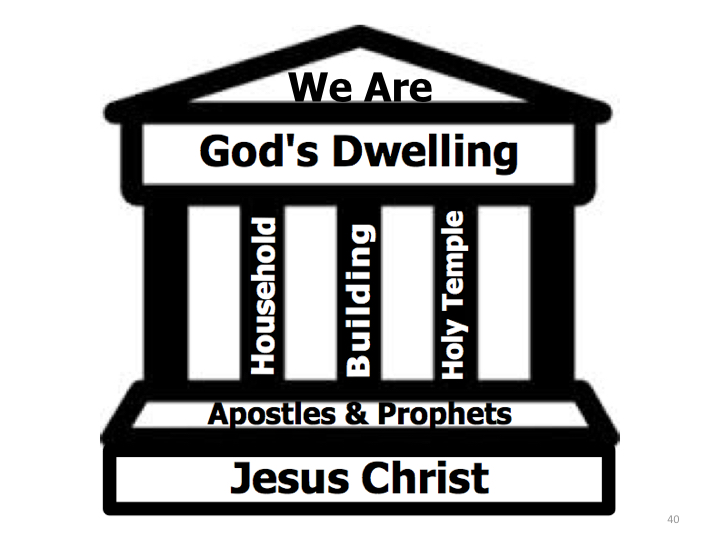
The Apostle Paul tells us that (1) Jesus Christ is the cornerstone of the sure foundation, (2) you and I—God’s saints—are the quality building materials that are being used, and (3) the Holy Spirit knows exactly what He is doing as He joins us together.

A cornerstone is the first stone set in the construction, the reference point for all other stone, which determines the position of the entire structure. Christ Jesus Himself is the cornerstone of His Church (Ephesians 2:20b). Orientated to that cornerstone we have the foundation of the apostles and prophets (2:20a).

This foundation is the Word of God (2 Peter 1:19-2:3 and 2 Timothy 3:14-4:5). We dare not try to replace, nullify, update, or change His Word. Not would this cause the foundation to crumble, but there are dire consequences for the one who tries to do so (Revelation 22:18-19).

Our foundationOn this foundation, God is constructing three things, each one growing in its level of intimacy with Him and with the surrounding saints:

  • God’s household (Ephesians 2:19)—this Greek word means a family home.
  • the whole building (Ephesians 2:21a)—this is a specific part of the family home used for prayer and fellowship.
  • a holy temple (Ephesians 2:21b)—this is the same word used for the Holy Place and Holy of Holies in the tabernacle.

God’s Presence dwells in us individually, but collectively we make a more powerful statement (1 Corinthians 3:16). There is a far greater testimony to the world when individuals willingly and actively allow themselves to be built together; when Christians give up their personal agendas to say, “I want to be a part of something bigger than me—I want to be a part of we.”

We must study God’s Word to make sure we are building on the same foundation. We must allow our lives to be quality building materials. We must allow the Holy Spirit to build us together through prayer and fellowship! This becomes the fulfillment of the prayer Jesus Himself prayed for us (John 17:20-23).

This was the last message (for this time) in our series on the Book of Ephesians. I hope to be able to continue this study next year.

10 Quotes From “Notes On Ezekiel”

The Complete Works Of Oswald ChambersI loved reading Oswald Chambers’ insights on the book of Ezekiel as I read that book of the Bible side-by-side. Seeing what Chambers saw is astounding! You can read by book review of Notes On Ezekiel by clicking here. Below are a few quotes I especially appreciated.

“If you imagine you are called on to be isolated and aloof…you will be as free from sanity as from the Spirit of God.”

“We have to beware lest our impatience makes us infidel; impatience means unbelief in God’s providence, and is due to lack of right relationship of the personal life to God.”

“What is called practical work is the greatest hindrance in God’s dealing with souls. We rush through life and call ourselves practical, we mistake bustle for busyness, activity for real life, and when the activities stop we go out like vapor, our work is not based on the fundamental energy of God.” 

“We are not here to serve God, but for God; the self-consciousness of being a saint never enters in.”

“There is no call of God to be prosperous, but there is a call to be a proclaimer of God’s truth to the gates of death. It is the winsome note that men want today—‘I don’t mind listening as long as you talk about the kindness of God, but don’t tell me God damns sin, don’t tell me He allows no quarter for lying or for lust.’ The Gospel awakens an intense craving and an equally intense resentment. The snare of the devil, through God’s own servants, comes when they say ‘Now remember the people.’ Never water-down God’s Word to suit men’s experience. … Be possessed with unflinching courage in preaching the truth of God, but when you deal with sinners, remember who you are.”

“God must make His prophets vitally one with His voice—holy man and holy message, one.”

“Fanaticism comes in when we say, ‘I won’t appropriate the words of God, I don’t want to be limited to what Jesus Christ says, I must get other messages.’”

“Ezekiel had to receive what he heard before he repeated it; this is imperative in all spiritual development. Reception of God’s Word implies personal devotion to the One who speaks it. … Ezekiel, in common with all the Old Testament prophets, had not to generate his message out of his own individuality, he had simply to obey God.”

“Whenever in the prophets or in the New Testament we come to statements of the justice of God at work it is always the same—inescapably terrible and full of doom. Viewed apart from the interpretation of the Spirit of God, God’s dealings with men and with nations are perplexing. … The terrible side of God’s character is only realized by us when the truth dawns on us individually that God is no respecter of persons. Beware of tying God up in His own laws and saying He can’t do what He says He is going to do. The greatest ingredient in the sovereignty of God is the measure of free will He has given man; but be careful you don’t make the sovereignty of God the binding of Almighty God by human logic.”

William Law On Prayer

William LawSome quotes from William Law on prayer …

“There is nothing that makes us love a man so much as praying for him.” —William Law

“He who has learned to pray has learned the greatest secret of a holy and happy life.” —William Law

“The greatest saint in the world is not he who prays most or fasts most; it is not he who gives alms, or is more eminent for temperance, chastity, or justice. It is he who is most thankful to God.” —William Law

Poetry Saturday—Light Shining Out Of Darkness

William CowperGod moves in a mysterious way,
His wonders to perform;
He plants His footsteps in the sea,
And rides upon the storm.

Deep in unfathomable mines
Of never failing skill,
He treasures up His bright designs,
And works His Sovereign will.

Ye fearful saints, fresh courage take,
The clouds ye so much dread
Are big with mercy, and shall break
In blessings on your head.

Judge not the Lord by feeble sense,
But trust Him for His grace;
Behind a frowning Providence,
He hides a smiling face.

His purposes will ripen fast,
Unfolding every hour;
The bud may have a bitter taste,
But sweet will be the flower.

Blind unbelief is sure to err,
And scan His work in vain;
God is His own interpreter,
And He will make it plain. —William Cowper, Light Shining Out Of Darkness

Poetry Saturday—There Is A Safe & Secret Place

Henry Francis LyteThere is a safe and secret place,
Beneath the wings Divine,
Reserved for all the heirs of grace;
O be that refuge mine!

The least and feeblest there may bide,
Uninjured and unawed;
While thousands fall on every side
He rests secure in God.

He feeds in pastures, large and fair,
Of love and truth Divine;
O child of God, O glory’s heir,
How rich a lot is thine.

A hand almighty to defend,
An ear for every call,
An honored life, a peaceful end,
And heaven to crown it all! —Henry Francis Lyte


Faithful, Christian & Talkative From “Pilgrim’s Progress”

Pilgrim's ProgressThe dialogue in Pilgrim’s Progress is all so rich and meaningful, that it’s hard to pull out “favorite” passages from this book. You can read my full book review by clicking here. Over the next few days I would like to share some of the passages which especially stood out to me this time reading through this classic.

This is part of a dialogue between Faithful, Christian and Talkative—

Faithful: “Well, I see that saying and doing are two things, and hereafter I shall better observe this distinction.”

Christian: “They are two things indeed, and are as diverse as are the soul and the body; for as the body without the soul is but a dead carcass, so saying, if it be alone, is but a dead carcass also. The soul of religion is the practical part. Pure religion and undefiled before God and the Father is this, to visit the fatherless and widows in their affliction, and to keep himself unspotted from the world. This Talkative is not aware of; he thinks that hearing and saying will make a good Christian; and thus he deceiveth his own soul.” …

Talkative: “Why, what difference is there between crying out against, and abhorring of sin?”

Faithful: “Oh! a great deal. A man may cry out against sin, of policy; but he cannot abhor it but by virtue of a godly antipathy against it. I have heard many cry out against sin in the pulpit, who can yet abide it well enough in the heart, house, and conversation.” …

Talkative: “You lie at the catch, I perceive.”

Faithful: “No, not I; am only for setting things right. But what is the second thing whereby you would prove a discovery of a work of grace in the heart?”

Talkative: “Great knowledge of gospel mysteries.”

Faithful: “This sign should have been first; but first or last, it is also false; for knowledge, great knowledge, may be obtained in the mysteries of the gospel, and yet no work of grace in the soul. Yea, if a man have all knowledge, he may yet be nothing, and so, consequently, be no child of God. When Christ said, Do you know all these things? and the disciples had answered, Yes, He added, Blessed are ye if ye do them.” …

Christian: “You did well to talk so plainly to him [Talkative] as you did. There is but little of this faithful dealing with men now-a-days, and that makes religion to stink so in the nostrils of many as it doth: for they are these talkative fools, whose religion is only in word, and are debauched and vain in their conversation, that (being so much admitted into the fellowship of the godly) do puzzle the world, blemish Christianity, and grieve the sincere. I wish that all men would deal with such as you have done; then should they either be made more conformable to religion, or the company of saints would be too hot for them.”

Poetry Saturday—The Lay Of The Last Minstrel


NGS68272In peace, Love tunes the shepherd’s reed; 
In war, he mounts the warrior’s steed; 
In halls, in gay attire is seen; 
In hamlets, dances on the green. 
Love rules the court, the camp, the grove, 
And men below, and saints above; 
For love is heaven, and heaven is love. … 

But earthly spirit could not tell 
The heart of them that loved so well; 
True love’s the gift which God has given 
To man alone beneath the heaven. 
It is not Fantasy’s hot fire, 
Whose wishes, soon as granted, fly; 
It liveth not in fierce desire, 
With dead desire it doth not die: 
It is the secret sympathy, 
The silver link, the silken tie, 
Which heart to heart, and mind to mind, 
In body and in soul can bind.

—Sir Walter Scott