A Godly Man’s Superpower

Listen to the podcast of this post by clicking on the player below, and you can also subscribe on AppleSpotify, or Audible. 

On Mother’s Day, I mentioned that Proverbs 31 might be an intimidating description for Moms, but it doesn’t need to be that way. This chapter lists what is possible when a woman is fully committed to God, her husband, and her children.  

Her faithfulness is her superpower which unleashes so many good things for those around her. Or as we said it: Her nobility helps her be a king maker. 

I concluded by saying that men have an important role to play in order to honor the king-making power which the godly women in his life have unlocked. This is a man’s superpower! Together, God-fearing men and women can create a legacy of king makers. But separated or self-focused men and women can create a legacy of king breakers. 

(Check out all of the Scriptures I mention in this post here.) 

The Hebrew word for noble is used five times in Proverbs: three times for the godly superwoman (Proverbs 12:4, 31:10, 31:29), and twice for the godly superman (13:22, 31:3). 

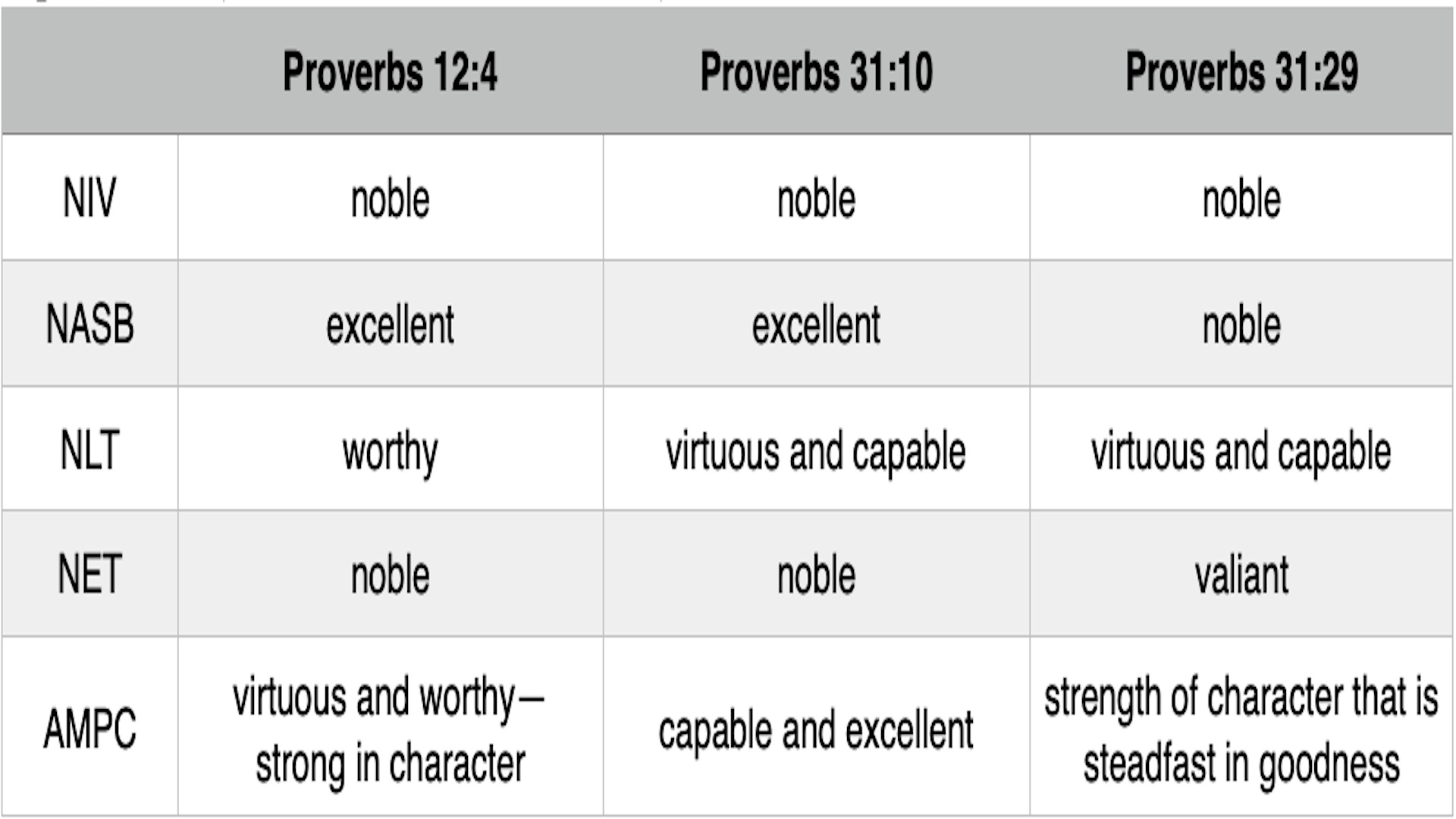
Remember that this word is also translated in different versions of the Bible as excellent, virtuous, and strong in character. 

In Proverbs 31:3 the word vigor for men is attached to that same Hebrew word. In this context, the word can be defined as strength, efficiency, ability, or wealth. 

On Mother’s Day, we said that Eve is the “help meet” (as the old King James Version says), which means that she is the key that unlocks Adam’s potential. The teaching throughout Proverbs says that men can squander this unlocked potential by…

  • …forgetting God’s laws—Proverbs 31:4-5 
  • …not stewarding the unlocked leadership opportunities in our marriage, parenting, work, or community involvement (Proverbs 5:15-20; 2:1-5, 12-17; 22:29; 31:23). 

In essence, we cancel the definition of vigor that we saw above, changing strength to weakness, efficiency to inefficiency, ability to inability, and wealth to poverty. 

On Mother’s Day we looked at virtuous Ruth who used her godly superpower to unlock the potential for Boaz, the man who would become her husband. Let’s look at his example: 

  • he was called a man of standing because his righteousness was well known in Bethlehem—Ruth 2:1 
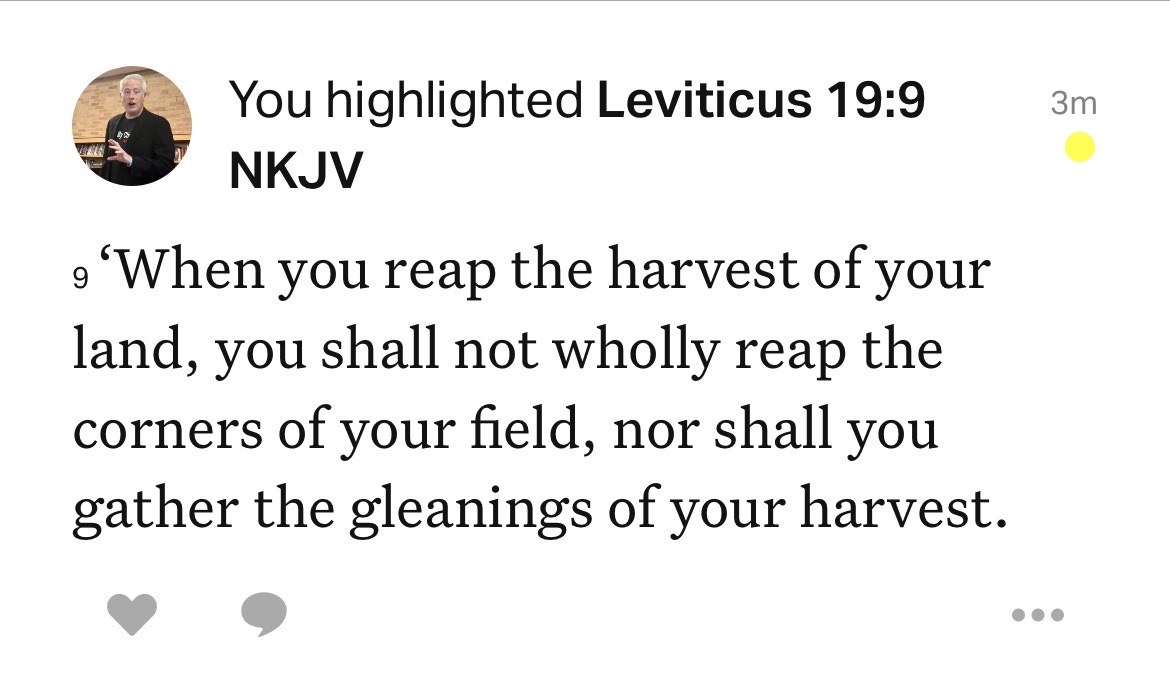
  • he was obedient to the smallest details of the law—Ruth 2:3; Leviticus 19:9-10  
  • he honored his father by following his example—Matthew 1:5; Joshua 2:1-24, 6:23 
  • he was an honored employer—Ruth 2:4 
  • he was also (just like Ruth) called a man of noble character—Ruth 3:7-11, 14 

A Dad’s superpower looks very similar to a Mom’s superpower. The godly woman unlocks the potential, and when the godly man carefully stewards that potential, he is also using his godly superpower (Luke 12:42-43, 48)! 

Guys, when we use our God-given superpower, we honor Him and the godly women in our lives who have made this possible for us. We do this by…

  • …faithfully loving God with all our heart, soul, mind, and strength—Proverbs 31:4-5; Mark 12:28-31 
  • …caring for our bride like Jesus cares for His bride—Ephesians 5:25 
  • …honoring the legacy of our parents—Ephesians 6:2-3 
  • …passing on a godly heritage to our children—Ruth 4:21-22 

This is God’s design. And it is God’s delight when we live this way. So we must make the choice to either carry on the godly heritage that was handed down to us, or reverse the ungodly heritage that we may have inherited. 

Godly men and women unlock and perpetuate their God-given superpower by giving their heart, soul, mind, and strength to God. And then God will continue to empower us as the spouses, parents, and leaders in our community that He desires for us to be! 

►► Would you please prayerfully consider supporting this ministry? My Patreon supporters get behind-the-scenes access to exclusive materials. ◀︎◀︎
A Godly Woman’s Superpower

Listen to the podcast of this post by clicking on the player below, and you can also subscribe on AppleSpotify, or Audible.

Mother’s Day messages seem to set a lofty expectation for women. When a pastor flips to Proverbs 31 and begins to read the description of the noble wife, I’m afraid many women—both moms and not-yet-moms—wonder how they could measure up to this list! The proverb itself really starts out with a question, “Who could find such a woman?!” (Proverbs 31:10).  

The Hebrew word for noble is used five times in Proverbs. Three of those are for this kind of superwoman (Proverbs 12:4, 31:10, 31:29).

This same word is also used twice for men in Proverbs—A good man leaves an inheritance to his children’s children (13:22); do not spend your strength on women, your vigor on those who ruin kings (31:3). 

(You can read all of the verses I’ve mentioned in this post by clicking here.)

A woman’s nobility and virtue either unleashes strength OR her vices deplete strength and bring ruin. In the language of Proverbs 31:3, she is either a king-maker or a king-breaker. 

This picture of empowerment is seen in the very first couple (Genesis 2:18-24). In the King James Version language, the word for helper is help meet. This means that Eve is the key that unlocks Adam’s potential. The godly woman makes possible what the godly man cannot do on his own. 

For a negative example of this, look at how Delilah sapped Samson of his strength and potential (Judges 16:6, 16, 19). On the flip side, we see a positive example in Ruth who unleashed the king-making power of her husband Boaz (Ruth 3:11, 4:11). 

As a kid, I always suspected my Mom had superpowers. I remember digging through the hair on the back of her head to find “the eyes” she said she had in the back of her head! She could kiss my boo-boo and instantly I was better, and she could help me understand the things that perplexed me the most. 

As I got older, I realized that my Mom actually did have superpowers:

  • She faithfully loved her God—Proverbs 31:30  
  • She diligently served her husband—31:11-12, 23 
  • She consistently cared for her children—31:27-28 

Ladies, that is the superpower that you have—you complete us, you elevate us, you unlock our potential! This brings both elevation for your family and honor for yourself (see Proverbs 31:29-31, and notice the phrase “city gate” in vv. 23 & 31 which symbolizes a leadership position). 

Women who ignore their God-given superpower of nobility unleash the vicious cycle of king-breakers. 

Women who use their God-given superpower of nobility unlock a virtuous cycle of king-makers. 

Ladies, be encouraged today that all that is required for this Proverbs 31 list to be an accurate description of you is faithfully loving your God and faithfully serving your family in the consistent, little things day after day after day. God sees this, He is pleased by it, and He is rewarding it! 

Guys, you have a part to play in this too. What you do with the potential that your mother and your wife have unlocked for you also plays a vital role in your family and in your community. I talked about this on Father’s Day, which you can check out here.

►► Would you please prayerfully consider supporting this ministry? My Patreon supporters get behind-the-scenes access to exclusive materials. ◀︎◀︎
Links & Quotes

Our anxiety is usually tied to our insecurity about our needs being met. Philippians 4:6-7 counsels us to turn those anxieties into prayer. It’s not what we can provide for ourselves, but trusting what our Heavenly Father has already provided for us. Check out this amazing series on prayer. I have lots of new content every week, which you can check out on my YouTube channel.

A recent post at the Institute for Creation Research says, “despite popular perception, the impact theory of dinosaur extinction has problems and is still a source of contention among even conventional scientists.” In fact, “Despite uniformitarian claims to the contrary, these rocks and fossils are best explained by the Genesis Flood that covered the earth about 4,500 years ago. All the air-breathing, land-dwelling creatures outside the Ark perished. However, the representatives of these animals that God brought on board the Ark, including dinosaurs, survived, reproduced, and spread across the Earth after the Flood. Many ancient peoples wrote about and described what appear to be dinosaurs, even though they called them by other names, e.g., dragons. In the creation Flood model, impacts may have hit the earth during the Flood, but none of them caused the dinosaurs to go extinct.” This article is a good overview of the geological and paleontological evidence that supports the biblical account of the Flood.

“Scripture teaches us that there are two points of view from which we may regard Christ’s death upon the Cross. The one is the redemption of the Cross: Christ dying for us as our complete deliverance from the curse of sin. The other, the fellowship of the Cross: Christ taking us up to die with Him and making us partakers of the fellowship of His death in our own experience. … O Christian, when the world crucified Christ, it crucified you with Him, when Christ overcame the world on the Cross, He made you an overcomer too. He calls you now, at whatever cost of self-denial, to regard the world, in its hostility to God and His kingdom, as a crucified enemy over whom the Cross can ever keep you conqueror. What a different relationship to the pleasures and attractions of the world the Christian has who by the Holy Spirit has learned to say: ‘I have been crucified with Christ;…[the crucified] Christ lives in me!’ (Galatians 2:20).” —Andrew Murray

Sullivan and Addie Chainey were both deaf, but that didn’t stop them from becoming premier missionaries in the Assembly of God fellowship. Their work with other deaf people was amazing! I love this concluding thought in this short biography of their ministry work: “The Chaineys’ story testifies that God can empower those who are marginalized in society to do redemptive work in their own communities and beyond.”

“Earth, I think, will not be found by anyone to be in the end a very distinct place. I think earth, if chosen instead of Heaven, will turn out to have been, all along, only a region in Hell: and earth, if put second to Heaven, to have been from the beginning a part of Heaven itself.” —C.S. Lewis, in The Great Divorce

Years later, Boaz was obeying this commandment in Leviticus 19:9. That allowed Ruth to be in his field, which led to a marriage that began the family line of King David, which traces all the way to Jesus! Obedience matters. Just imagine if Boaz had been disobedient in this. The Messiah still would have come, but Boaz and Ruth (and their children and grandchildren) would have missed out on this blessing.

Obedience Helps Obedience

Listen to the podcast of this post by clicking on the player below, and you can also subscribe on AppleSpotify, or Audible. 

The book of Judges in the Bible records a dark time in Israel’s history. There is a phrase that is repeated multiple times in that book, “In those days Israel had no king; everyone did as they saw fit” (Judges 17:6, 18:1, 19:1, 21:25). The absence of godly leaders setting a God-honoring example for the people led to some ugly behaviors! 

The Book of Ruth (which is set during this same time period) opens with the words, “In the days when the judges ruled, there was a famine in the land” (Ruth 1:1). This famine of both godly leadership and good harvests led Elimelech to leave Israel and allow his sons to marry women they shouldn’t have married. It also prompted opportunity seekers to seize Elimelech’s land, so that when his widow Naomi returned with her daughter-in-law Ruth, there was no source of income for them. 

One godly leader, a prophetess named Deborah, held firmly to God’s word. Her unwavering devotion to God was an encouragement to Barak to lead his armies to victory over their oppressors. In her song after the victory was secured, Deborah sang—

When leaders lead in Israel, when the people willingly offer themselves, bless the Lord! … My heart is with the rulers of Israel who offered themselves willingly with the people. Bless the Lord! (Judges 5:2, 9 NKJV)

Notice this vital principle: 

A mark of a godly leader is one whose obedience toward God helps others obey God.

Deborah’s obedience helped Barak obey God. 

We see this again in the Book of Ruth when Boaz obeys God’s command to fulfill his responsibility as Naomi and Ruth’s kinsman-redeemer. His obedience helped Ruth also obey God. 

Even in the New Testament, Joseph is a phenomenal example of this principle. Every single time the angel of God speaks to him about what he should do, Joseph’s immediate response is obedience. And then Matthew records that Joseph’s obedience is directly tied to prophecies about Jesus being fulfilled (Matthew 1:20-24; 2:13-15, 19-23). 

Godly leaders must go first! When we are the first in obedience—no matter how difficult it may seem in the moment—we make it possible for others to obey God themselves. 

This is part 75 in my series on godly leadership. You can check out all of my posts in this series by clicking here.

►► Would you please prayerfully consider supporting this ministry? My Patreon supporters get behind-the-scenes access to exclusive materials. Like this video where I talk about the logic in Psalm 119. ◀︎◀︎

The Promise Of The King

Listen to the podcast of this post by clicking on the player below, and you can also subscribe on AppleSpotify, or Audible.

My podcast partner Greg and I just recorded an episode of our leadership podcast about Christmas traditions. I think there more traditions associated with this time of year than with any other event on our calendars. Traditions keep us connected to our roots, but they also help us feel like we can be in control of things. 

There has been a tradition in countries with monarchies that whenever a king died, the people would say something like, “The king is dead. Long live the king!” They would say this because the next king ascended to the throne immediately after his predecessor died. Except when a nation had been defeated, the traditional cry of, “The king is dead” was unanswered by, “Long live the king!” 

It appears at this moment that a new tradition has to be started—one where we take leadership over our own fates. 

The apostle Peter noted that people awaiting the Second Coming of Jesus would question if that event was ever going to happen. And the prophet Malachi closed the Old Testament with people saying much the same thing: “There doesn’t seem to be any advantage to following God’s laws, so maybe we should just do things our own way” (2 Peter 3:3-4; Malachi 3:13-15).

But then we turn the page to the dawn of the New Testament, and Matthew writes his Gospel about the First Advent of Jesus. He wants to show us that although the line of earthly kings in Israel may have been broken, the promised King of kings had now come to earth. 

I’m intrigued by the exceptions Matthew lists in his opening genealogy to illustrate this truth. First, as you might expect, the phrase “the father of” appears 39 times. This tells us a biological fact of life. These men didn’t know if they had fathered a son or a daughter, what their child’s contribution to the world might be, or even if their child would live faithfully to God. 

Matthew opens his genealogy by saying “the son of” twice. First, Matthew lists Jesus as the son of David—the king to whom God gave a very special promise of an eternal King coming from David’s family line. Then Matthew traces the genealogy back further to say “the son of Abraham”—the one through whom God said He would bless all nations (2 Samuel 7:11-16; Genesis 12:1-3). 

And what about the exceptional women Matthew records in this male-dominated genealogy? We have Tamar, Judah’s daughter-in-law, who tricked him into fathering a child by her; Rahab, a Canaanite prostitute who put her faith in God; Ruth, a Moabitess who left her homeland because she trusted God; Bathsheba, an adulteress who became David’s wife; and then Mary, the mother of Jesus, who was called “highly favored” of God (Luke 1:28). 

The phrase “son of” appears one more time when the angel calls Joseph by this title (Matthew 1:20). Jospeh is also called “the husband of Mary” (Matthew 1:16). 

Whereas Abraham and David were rewarded for their faithfulness to God and were told of future blessings, Joseph’s act was different. Joseph had a choice. He was told that the Child in Mary’s womb would be the Messiah. Now Jospeh had to decide: Would he choose to believe this? Would he choose to bear the shame and reproach to accept his role as father? 

We have the a similar choice today: Will we choose to believe that God has announced His plan and that He is fulfilling His plan? 

Here’s the simple truth. It appears as two statements, but it is really the same thought—

The Advent of Jesus has come. The Advent of Jesus will come. 

The First Advent of Jesus should build our anticipation for the Second Advent. His First Advent should be proof that God keeps His promise. 

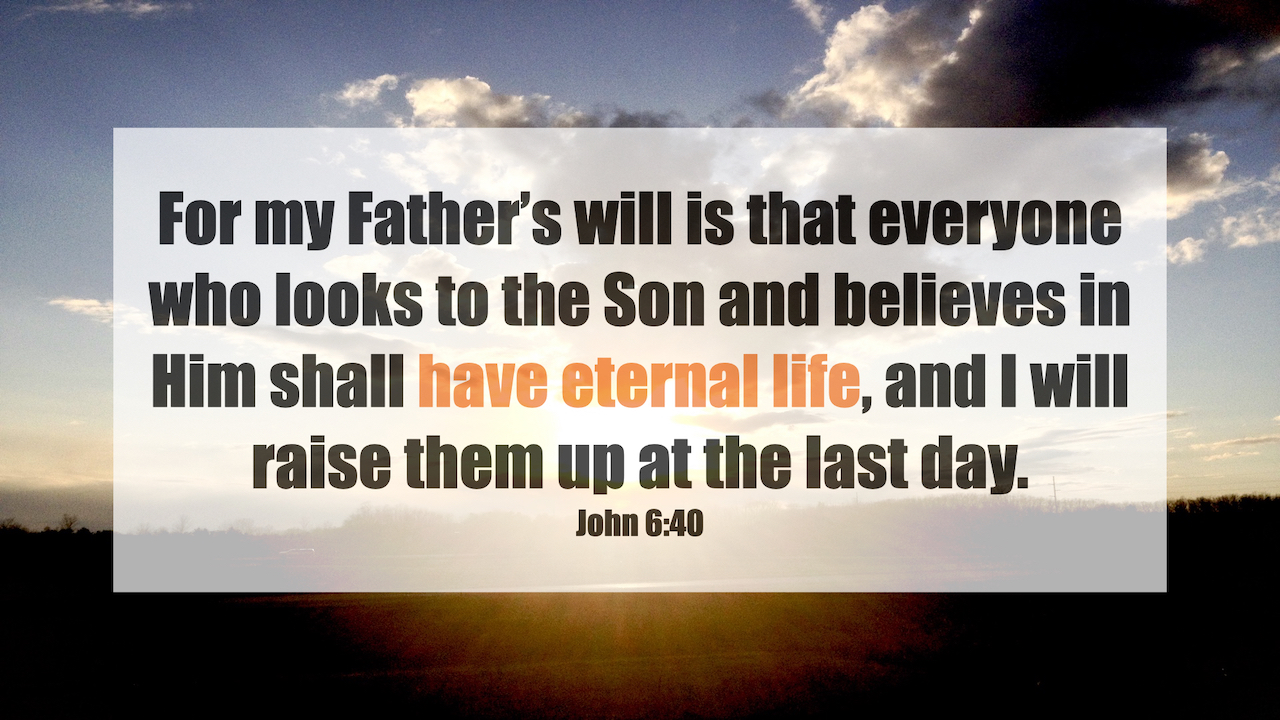
Jesus told us that believing God’s promise would bring us into God’s family. Jesus said, “For My Father’s will is that everyone who looks to the Son and believes in Him shall have eternal life, and I will raise them up at the last day” (John 6:40). 

The apostle Paul also assures us, “So in Christ Jesus you are all children of God through faith” (Galatians 3:26). 

Let’s not blindly follow the traditions of previous generations, but let us chose for ourselves to believe in God’s promised Messiah, to trust that He alone can give us eternal life, and then let us live in both celebration of His First Advent and expectation of His Second Advent. 

If you’ve missed any of the messages in our Christmas series called Long Live The King Of Kings, you can find them all by clicking here. 

►► Would you please prayerfully consider supporting this ministry? My Patreon supporters get behind-the-scenes access to exclusive materials. ◀︎◀︎

Ruth + Boaz—The Father’s Day Version

Listen to the podcast of this post by clicking on the player below, and you can also subscribe on Apple or Spotify.

On Mother’s Day that we saw how Ruth’s obedience allowed her to realize God’s favor, part of that favor is being included in the genealogy of Jesus Christ. Of course, Ruth can’t give birth to her son Obed without there being a father, which makes Boaz’s part in this story just as important. 

[This whole story of Ruth + Boaz is just four short chapters, so I’d encourage you to take a couple of minutes to read it.] 

When we first meet Boaz, he is described as “a man of standing.” Some Bible translations say “a man of wealth,” which is an acceptable definition. In fact, the word can mean strength, wealth, valor, or prominence, but the root word means something brought forth out of travail and pain. That tells us that Boaz wasn’t born a man of standing, he became a man of standing by going through difficult times, not giving in to the downward slide of culture, and remaining true to God. 

Boaz had a steel-forged integrity! 

Believe me, it would have been easy for Boaz to compromise! This was a dark time of selfishness in Israel’s history. A time where just doing the bare minimum was acceptable because most of the Israelites were selfishly doing whatever would benefit them (Judges 21:25). 

The other description we read about Boaz is that he is a “kinsman-redeemer.” This same word is used in this verse: “Plead my cause and redeem me; revive me and give me life according to Your word” (Psalm 119:154). A redeemer is one who is close by to help, has the strength or resources to help, and is willing to help. Of course, the perfect example of a Kinsman-Redeemer is Jesus, who became our human kinsman so that He could rescue us (see Hebrews 2:14; Philippians 2:7-8). 

Boaz was given the opportunity to do this for Naomi and Ruth, and he seized the opportunity with gusto. Far from being a “bare minimum” man, Boaz always went the second mile to bless Ruth and Naomi:

  • he practiced the “hospitality clause” plus he protected Ruth and gave her more than was required 
  • he provided food for his workers plus he provided food for Ruth and Naomi 
  • he blessed his workers plus he blessed Ruth in the name of the Lord 

Ultimately, Boaz did indeed become the kinsman-redeemer for Naomi (by paying off all the debts of her deceased husband) and for Ruth (by marrying this non-Israelite woman and bringing her into the family line of Jesus). 

Boaz was King Solomon’s great-great-grandfather. When Solomon was completing the temple in Jerusalem, he erected two pillars at the entrance: one was named Boaz, and the other was Jakim (with means “God will establish”). Taken together these pillars proclaim the message: By His integrity and faithfulness, God establishes and makes firm. 

Boaz exhibited integrity at every opportunity, which is what forged his character and made him “a man of standing.” Boaz demonstrated that integrity is really faith in God plus faith-filled, second-mile, others-focused actions.

“Faith without works is just wishful dreaming.
Works without faith is just religious posturing.
Works with faith is God-glorifying!” —Craig T. Owens

Men of God, please remember this: 

  • Every Word of God that you read or hear is a test—will you obey Him or will you compromise? 
  • Every setback you go through is a test—will you learn and grow or will you sulk and shrink back? 
  • Every success you experience is a test—will you bless others or will you hoard your blessings? 
  • Every decision you make in a dark culture is a test—will you just have faith, just have bare-minimum works, or will you exhibit the steel-forged integrity that comes from putting your faith to work? 

God’s blessing on your life of integrity will show others a picture of Jesus. God’s blessing on your life of going the second mile will show others that it is God who establishes and makes firm. 

Don’t rob your family, don’t rob us, don’t rob future generations of the outpouring of God’s blessing because you are selfish or compromising. Stand strong, trust God, go the second mile, be the kinsman-redeemer for those in need, and then watch for God’s blessings! 

If you missed Ruth’s vital part in this story, please check that out by clicking here.

►► Would you please prayerfully consider supporting this ministry? ◀︎◀︎

Ruth + Boaz

This is one of my all-time favorite stories in the Bible! It’s a story of disappointment, death, heartache, hope, redemption, and legacy. 

But mostly it’s a story of unexpected love. It’s a perfect portrayal of God’s redemption, and it’s beautifully lived out by an unlikely heroine and hero: It’s the eternal love story of Ruth + Boaz. 

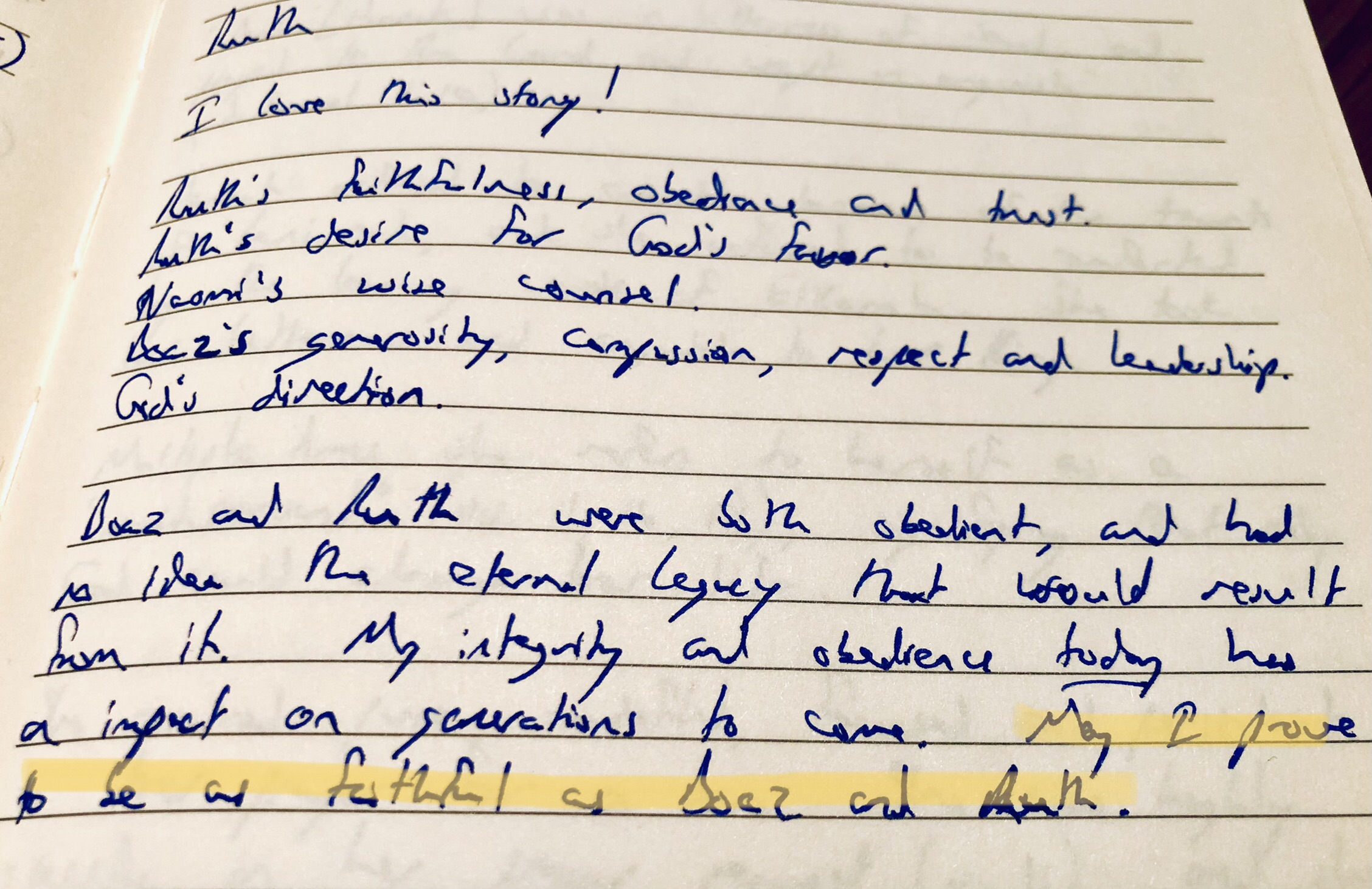
While thinking about this story, I wrote in my journal nearly four years ago, “May I prove to be as faithful as Boaz and Ruth.” Indeed, it’s hard to find better examples! 

This story is still teaching lessons to us today. On Mother’s Day, we looked at this love story through the eyes of Ruth, and on Father’s Day, we saw the lessons Boaz lived out for us. 

  • You can check out the Mother’s Day message about Ruth by clicking here.
  • And the Father’s Day look at Boaz is here.

Ruth + Boaz—The Mother’s Day Version

Listen to the podcast of this post by clicking on the player below, and you can also subscribe on Apple or Spotify.

John Maxwell said, “We overestimate what we can do in a day; we underestimate what we can do in a year.” In the case of parents, I think we do the same thing: we lose sight of the big picture when we get bogged down in the details and the pressures of each day. As a result, many times we are unaware of the long-lasting rewards that come from our daily obedience and God’s eternal faithfulness. This was never more true than in the fantastic love story of Ruth + Boaz. 

Last week we looked at the history of Pentecost and what took place 50 days after the Passover, we saw a picture in the Old Testament that was fulfilled in the New Testament. The Jews saw this too. In the Hagiographa (Holy Writings), they picked one of the books of the Old Testament to read at each of the annual Jewish feasts, and the Book of Ruth was selected for Pentecost. I think this was because Ruth herself is in essence a “harvest” of God’s blessing. She is the firstfruits of the non-Jewish people whom God has engrafted into His holy family. 

The story of Ruth’s coming into God’s family is birthed out of heartache. Elimelech and Naomi live in Bethlehem, which means “house of bread,” but it was a time of famine; Elimelech’s name means “God is King,” but Israel had no king and everyone lived for themselves; Naomi’s name means “pleasant,” but her days were bitter (see Judges 21:25; Ruth 1:1-5). 

After Elimelech and his two sons die, Naomi changes her name to Mara (which means bitterness), and yet she hears “that the LORD had come to the aid of His people by providing food for them” (1:6) and she decides to return to Bethlehem. She counsels her daughters-in-law to remain with their families in Moab, but Ruth decides to cling to Naomi. 

In the face of utter hopelessness, Ruth could have chosen what was familiar—her family, her homeland, her gods—but instead she chose to cling to Jehovah. 

Perhaps when she heard that Jehovah had come to the aid of His people she realized, “I’ve never heard of Chemosh coming to the aid of his people. We sacrifice to him but he doesn’t do anything for us. This Jehovah cares for His people. I will put my faith in Him.” 

Ruth’s first step of obedience triggers a whole series of events, starting with one that the writer of this story introduces by saying, “As it turned out, Ruth found herself working in a field belonging to Boaz.” 

But this is no accident—God oversees and directs all of the details. All of history is His story. God is in charge of the tiniest of details: even down to directing Ruth to the right barley field. Ruth’s trust in Jehovah, her obedience in following Him, set things in motion that God had planned, just as Paul explained in Romans 8:28. 

Moms, at the end of the story of your life, you will look back and see so many as-it-turned-out moments. But that means you are living in an as-it-turned-out moment right now. If you believe God is overseeing the details of your life, then every moment is divinely orchestrated by Jehovah, every moment is strategic, every moment is God-directed. You must remain daily obedient to God. 

Don’t underestimate the legacy of God’s provision that is being established every single day that you remain obedient in following Him. Look at the amazing way God used Ruth and Boaz in the family tree of Jesus Christ (Ruth 4:16-22; Matthew 1:1-6).

Moms, your obedience today is preparing your children—and their future generations—for them to experience God’s provision in a coming famine (see Amos 8:11; Psalm 91).

Of course, Ruth can’t give birth to Obed without there being a father, which is why the story is called Ruth + Boaz. On Father’s Day we’ll look at the integrity of Boaz that made this possible too, so please make plans to join me then.

►► Would you please prayerfully consider supporting this ministry? ◀︎◀︎

Keeping In Step

But He needed to go through Samaria (John 4:4). 

Jesus was never late, never early, never out of position, never scrambling to catch up. 

He kept in step with the Holy Spirit so that He was exactly where He needed to be when He needed to be there. Whether it was battling satan, helping a soon-to-be-embarrassed wedding party, talking with a lonely Samaritan woman, raising a widow’s dead son to life, or walking toward Jerusalem (see Luke 4:1, 7:11, 19:1; John 2:1, 4:4). 

Others have experienced this too. Like when Ruth “happened” to be in the right farmer’s field at the right time, or when Philip was on the right road at the right time (see Ruth 2:3; Acts 8:27).

A mark of a godly leader is one who keeps in step with the Holy Spirit. 

If we live by the Holy Spirit, let us also walk by the Spirit. If by the Holy Spirit we have our life in God, let us go forward walking in line, our conduct controlled by the Spirit. (Galatians 5:25 AMP)

Holy Spirit, You know where I need to be today. Let me not grumble at what I may call “detours” or “delays,” but help me to submit to Your direction and Your timing. I want to keep in step with You. 

This is part 35 in my series on godly leadership. You can check out all of my posts in this series by clicking here.

Five Women; One Amazing Story!

For some of you, it’s hard to put the word “happy” in front of Mother’s Day.

One definition of happy is “favored by fortune; lucky.” In other words, we’re happy IF things happen to be going our way. But we don’t know how things are going to turn out?

In the last Super Bowl, the New England Patriots were down by 25 points early in the 3rd quarter. It didn’t appear that things were going the Patriots’ way … except they won!

So don’t judge “happy” or “not happy” by how things are going in the middle of the story! 

To God, all of History is His Story. He knows every move, every hurt, every fumble, every betrayal, every noble deed, every evil deed … nothing escapes His notice. And it all fits into His Story—We are assured and know that God being a partner in their labor ALL THINGS work together and are fitting into a plan for good… (Romans 8:28).

Check out the stories of these five women—

Tamar had to pretend to be a prostitute in order to get her father-in-law to followthrough on his commitment. As a result, she became pregnant by him and was almost burned at the stake.

Rahab didn’t pretend to be a prostitute; she was a prostitute. She lived in an important city that was about to be defeated by the Israelites. Instead of trying to make things easier on herself, she trusted God and put herself in a very dangerous position.

Ruth was a non-Israelite married to an Israelite man. But when her husband, her brother-in-law, and her father-in-law all died, she took a huge risk in staying with her mother-in-law. She could have moved in with her family in a country she knew, but she went where she was an alien, a widow, and dirt poor.

Bathsheba was married to Uriah, who was a member of the king’s inner circle. But the king took advantage of her when Uriah was away at war, impregnated her, killed her husband, and then married her. Their son from that union died shortly after being born, but Bathsheba trusted God to make something good of her tragedy.

Mary was engaged to be married when she was found to be pregnant. Society could have shunned her, her fiancé could have had her killed for her unfaithfulness, but she trusted God to keep His word.

These five mothers are the ONLY women mentioned in the genealogy of Jesus (Matthew 1:1-6, 16)

God used all of these women. Despite the way they were treated or mistreated; despite their own mistakes; despite the injustices committed against them. God used all of them as irreplaceable parts of His Story.

To God, all of History is His Story! He’s doing things through your life that you can’t possibly imagine. Trust Him—if you do, your name will also be recorded in the best “His Story” ever recorded! 

Whenever you don’t know what’s going on, lean into Him, cry out to Him. But then say with Mary, “I am the Lord’s servant. May it be to me as you have said.” And what does God say? “I am working ALL THINGS together to tell My Story through your life!”