8 More Powerful Relationship Quotes

Keep Your Love OnI have shared a couple of sets of quotes from Danny Silk’s book Keep Your Love On! (which you can read here and here). I have also posted a review on this book here.

This book is a must-read for pastors or counselors who do marriage or family counseling. This is also an excellent book to read if you have a relationship in your life that you would like to see healed or strengthened. Check out a few more quotes below.

“If you cannot communicate your needs to another person clearly, it is obviously going to be very difficult for that person to meet them. That’s why one of the primary tasks of reaching maturity is learning how to express thoughts, feelings, and needs. Those who never learn this skill, however, expect relationships to function without it. They say things like, ‘Well, if you love me, then you will just know what I need. Didn’t you notice that that bothered me? Haven’t you been paying attention? I can’t believe you don’t know that about me.’ Where does this desire or expectation that loved ones have a telepathic ability to know our feelings and needs come from? It comes from powerlessness and fear. It comes from dreaming that everything will turn out magically without actually having to communicate. Powerless people want to win the lottery, get their dream girl/guy with minimal effort, lose weight without exercise, and get their needs met without ever having to say a word.”

“The reason we can’t get our needs met without expressing them is that we were designed to have our needs met through a relational exchange. God made us this way. … Think about it. God, the one Person in the universe Who knows all things, and knows us incomparably better than we know ourselves, never says, ‘Well, obviously I know your needs, so you don’t need to tell Me about them.’ Instead, He repeatedly tells us to ask Him for what we need, and gives us some of the most profound, beautiful, and honest language for doing so—like the Lord’s Prayer, and most of the Psalms. He won’t meet our needs outside of a connection where we have to show up and crack our hearts open to Him, because that very connection is what we need to have our needs met in the first place.”

“If you want to protect your connection and build trust by always communicating respectfully, then your guiding rule must be, ‘It’s my job to tell you about me, and your job to tell me about you.’ The best tool for telling another person about you is an ‘I message.’ The basic structure of the ‘I message’ is: ‘I feel [emotion] when [described experience] and I need to feel [emotion].’” 

“As you construct an ‘I message,’ make sure that you are really expressing a feeling, not an opinion. … If you start to say, ‘I feel like…’ you should stop and check yourself—because what is most likely going to follow is not a feeling, but a judgment. And a judgment statement is actually an expression of mistrust, not trust.”

“Intimacy—‘into-me-see’—is created between two people who can say, ‘We can be ourselves together because you can see into me and I can see into you.’ The experience of intimacy—of being completely known and accepted, and completely knowing and accepting in return—is the most satisfying experience we can have as humans. Intimacy in a safe place brings euphoria. Remember the Garden of Eden? Paradise was the place where a man and a woman were unafraid to be vulnerable and intimate with each other in every way. The problem is that most of us are scared to death to be vulnerable in relationships. The reason is simple: In being vulnerable, we reach for our greatest need while risking our greatest pain.”

“Fear of rejection and shame sets us up to fall for the enemy’s counterfeits. Ever since sin entered the world and humanity became disconnected from God, we have been looking for ways to get our needs met outside of relationship or any scenario where we are required to be vulnerable and risk our hearts. We have always desperately sought the benefits of intimacy without wanting to pay the price. And the enemy continues to offer us the euphoric experiences we think we can control—things like alcohol, drugs, sex, Internet pornography, shopping, carbohydrates, adrenaline, or cash. We use these things to give ourselves a euphoric release and take care of our needs. But the counterfeits always have ugly repercussions, like drunk drivers killing innocent people, young kids destroying their brains, men ignoring the beautiful real women beside them in favor of the images, serious debt, morbid obesity and the host of diseases that accompany it, thrill seekers slowly becoming numb to reality, and selfish jerks not caring who they step on to get what they want. Counterfeits never come through.”

“Every respectful conversation needs one speaker and one listener at all times. … The listening role is the true servant role in a respectful conversation. The listener affirms, ‘Right now, this conversation is about you and your needs. I am here to help you figure them out and find a way to help you get them met.’ But in the end, the listener is really the winner. If I listen well, I will have two vital pieces of information—what you need and what I need to do. With these two pieces of information, I start to identify and take ownership of the problem and create an effective solution.”

“A skilled listener with a servant’s heart is the deadliest weapon against the fear-bombs that threaten connection.”

Links & Quotes

link quote

Now that the Spring weather is here, get outside for some fresh air … listen to the birds, smell the flowers, look at the beauty around you! “A study of rodents, published in Science in 2013, indicated that the brain’s place cells are much less active when animals make their way through computer-generated landscapes than when they navigate the real world.” —Nicholas Carr

“We have men of science, too few men of God. We have grasped the mystery of the atom and rejected the Sermon on the Mount. The world has achieved brilliance without conscience. Ours is a world of nuclear giants and ethical infants. We know more about war than we know about peace, more about killing than we know about living. If we continue to develop our technology without wisdom or prudence, our servant may prove to be our executioner.” —Omar Bradley

“No man who enters upon the office to which I have succeeded can fail to recognize how every president of the United States has placed special reliance upon his faith in God. Every president has taken comfort and courage when told…that the Lord ‘will be with thee. He will not fail thee nor forsake thee. Fear not—neither be thou dismayed.’ … Each of our presidents in his own way has placed a special trust in God. Those who were strongest intellectually were also strongest spiritually.” —John F. Kennedy

Frank Turek has a fascinating post on why the Supreme Court of the United States shouldn’t allow homosexual “marriages” because of our 14th Amendment.

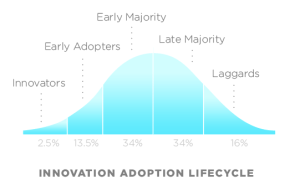
Innovation Adoption Lifecycle“If you want a population to adopt your innovation, you have to create a problem that is solved by adoption. And that problem is almost always related to, ’what about the others?’” Check out this insight from Seth Godin on product adoption.

 

[VIDEO] Greg Koukl addresses on Christians can demonstrate Christ-like tolerance and Christ-like tolerance—

[VIDEO] Dr. Bobby Conway and Nel Brace discuss a great tool for helping Christians defend their faith—

Links & Quotes

link quote

Some good reading from this weekend…

“I do not agree with a big way of doing things. What matters is the individual. If we wait till we get numbers, then we will be lost in the numbers and we will never be able to show that love and respect for the person.” —Mother Teresa

For anyone struggling with an addiction to pornography, this sounds like a helpful book: 10 Lies Men Believe About Pornography.

According to Cosmopolitan magazine, if you are pro-life political candidate you are automatically disqualified from getting support from any “enlightened” woman.

Obama & ISIS[INFOGRAPHIC] This is scary … do you know how much money ISIS makes every day from selling the oil they have captured?

“It is right to pour out our whole soul before Him that careth for us. But it is good, likewise, to unbosom ourselves to a friend, in whom we can confide.” —John Wesley

“That is always the way with a truly healthy Christian; God’s grace is externally manifested. There is the inner life within, it is active, and by and by when it is in a right state, it saturates everything. You talk with the gracious man, he cannot help talking about Christ; you go into his house, you will soon see that a Christian lives there; you notice his actions and you will soon see he has been with Jesus. He is so full of sap [Psalm 104:16] that the sap must come out. He has so much of the divine life within, that the holy oil and divine balsam must flow from him.” —Charles Spurgeon

“O God, of Thy goodness give me Thyself, for Thou art enough for me, and I may ask nothing that is less and find any full honors to Thee. God give me Thyself!” —Lady Julian

“Yes—at first one is sort of concussed and ‘life has no taste and no direction.’ One soon discovers, however, that grief is not a state but a process—like a walk in a winding valley with a new prospect at every bend.” —C.S. Lewis

A great post from Dave Barringer for married couples: Faking Your Death.

“Christianity is the only world religion whose primary source documents are in a language other than the founder of the religion. In other words, the New Testament texts are not in Aramaic, but in Koine Greek. … This makes a vitally important theological statement which so dramatically contrasts, for example, with Muslims who maintain that the Qur’an is untranslatable and that the Word of Allah can be conveyed truly and fully only in Arabic. For, at the very outset of the Christian message, the translatability of the gospel is enshrined in our primary source documents.” —Dr. Timothy C. Tennent, President of Asbury Theological Seminary, The Translatability Of The Gospel

Links & Quotes

link quote

Some good reading from today…

“We were made not primarily that we may love God (though we were made for that too) but that God may love us, that we may become objects in which the Divine love may rest ‘well pleased.’ To ask that God’s love should be content with us as we are is to ask that God should cease to be God: because He is what He is, His love must, in the nature of things, be impeded and repelled, by certain stains in our present character, and because He already loves us He must labour to make us lovable.” —C.S. Lewis

“Our old history ends with the Cross; our new history begins with the resurrection.” —Watchman Nee

Chick-Fil-A closed for a very honorable reason.

A bit scary: Muslims’ attitude toward non-Muslims.

“It’s easy, and perhaps comforting, to think of all the things the church is doing to try to change the world. But the real question is, what are you doing? Sure, you go to church and try to live a good life. But how intentional are you when it comes to actually impacting the lives of the lost people you rub shoulders with every day?” —Mark Atteberry

“Whatever the currents of public opinion and governmental action, God’s message is constant and glorious. Whether it is a crime to defy Scripture or to defend it, the Church must preach it—both in season and out of season. This is her calling.” —Kairos Journal

Favor

FavorThere’s a really cool comment in parentheses in the book of Exodus: “(The Lord made the Egyptians favorably disposed toward the people, and Moses himself was highly regarded in Egypt by Pharaoh’s officials and by the people)” (Exodus 11:3; see also 12:36).

At Moses’ word bad things have happened in Egypt; in fact, nine bad things have happened so far. Blood, frogs, gnats, hail, locusts, and other nasty things have plagued the Egyptians, and still the general population—and even the inner court of Pharaoh—hold Moses and the Israelites in high regard!

The King James Version says it this way: “The Lord gave the people favor.”

Favor with people doesn’t come when I try to please people. Favor with people comes when I try to please God. 

People didn’t respect Moses because he cowered before Pharaoh, but because he feared God.

Ironic, isn’t it? We fear the opinion of people, which excludes us from the favor of God, which robs us of favor with people! 

To grow in favor with people, to earn their respect, I must be sold-out to God. I must not care about the opinion of people in order to be highly favored by people.

How To Earn R-E-S-P-E-C-T

Here’s how the apostle Paul said it…

Make it your goal to live a quiet life, minding your own business and working with your hands, just as we instructed you before. Then people who are not Christians will respect the way you live, and you will not need to depend on others. (1 Thessalonians 4:11-12)

Pretty straightforward, isn’t it? To live a life that those who are not Christians will respect:

  • Live with the right ambition. The Greek word for ambition means hard work that brings honor.
  • Mind your own business.
  • Do your own work to provide for yourself.
  • Repeat it again tomorrow.

I want to live a life that glorifies God and earns the respect of others. This seems like a pretty doable list.

Respecting Elected Officials

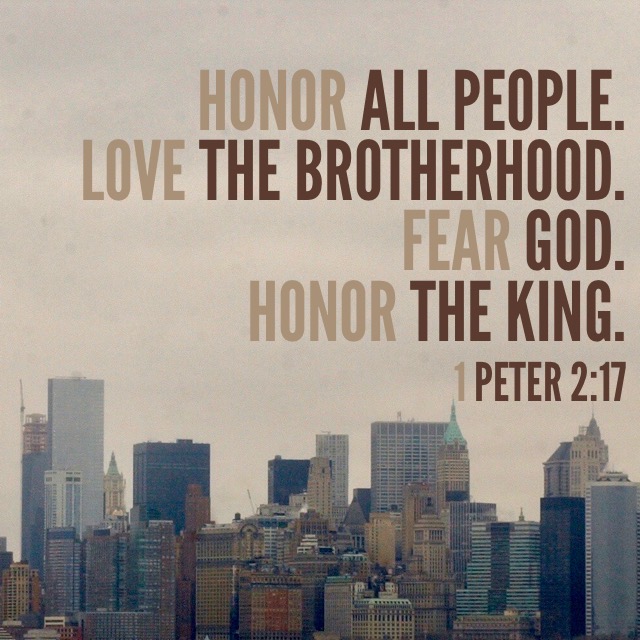
During our prayer time yesterday, I was contemplating the Apostle Peter’s instruction to, “Fear God, and respect the king” (1 Peter 2:17).

  • How do I respect the king (or the other elected officials in my city, state, and country)?
  • Does respect mean saying “yes” to every law that’s passed?
  • Can I be respectful and still disagree with those in elected office? How?

During our hour of prayer at the church last night, I was really wrestling with how I as a Christian should show respect to those in authority in our governments. Here are the nine things the Holy Spirit showed me.

I can show respect to those in authority by:

  1. Not forgetting that God placed them in their office (Daniel 4:25).
  2. Praying for them regularly (1 Timothy 2:1-2).
  3. Obeying all laws that aren’t immoral (Luke 20:25; Acts 5:29).
  4. Disobeying laws that are immoral (Esther 4:16; Acts 4:19).
  5. Holding them to biblical standards (Proverbs 8:15).
  6. Insisting they uphold the United States Constitution (Ecclesiastes 8:2).
  7. Reminding them that God’s wisdom is the ultimate standard (Proverbs 8:22-23).
  8. Requiring them to honor their promises, unless those promises conflict with God’s Word or the Constitution (Esther 1:13; 8:8).
  9. Speak to and about them without complaining or arguing (Philippians 2:14-15).

(Check out all of the above passages by clicking here.)

I’m working on living these out. What do you think?

They’re Both Dissin’

Check out these opening paragraphs from an article on WebMD (if you wish, you can read the full article here):

     People over 50 get a self-esteem boost when they read negative news about young adults, a study shows.

     Researchers also say young people, when given the choice, would rather read about people their own age and aren’t very interested in stories about their elders, whether the articles are positive or negative.

     “Our results reflect that the younger readers did not perceive older people as all that relevant,” study researcher Silvia Knobloch-Westerwick, PhD, of Ohio State University, tells WebMD by email. “They’re more concerned with figuring out who they are and where they stand, and those in the same age group appear to provide the relevant comparisons for that.”

Okay, this disturbs me on several areas. Basically, each age group is dissin’ the other age group.

The senior citizens are projecting a snickering, see-I-told-you, father-knows-best, condescending attitude on youth. Why would anyone who is willing to learn and grow want to be around that kind of person?!

Then our youth have an I’ve-got-it-all-figured-out, I-don’t-need-you, you’re-out-of-touch attitude toward the senior citizens. Why would anyone who is willing to mentor someone ever want to be that kind of person?!

I think both of these generational groups could learn from this wise advice:

Children, do what your parents tell you. This is only right. “Honor your father and mother” is the first commandment that has a promise attached to it, namely, “so you will live well and have a long life.” Fathers, don’t exasperate your children by coming down hard on them. Take them by the hand and lead them in the way of the Master.

Lead Like David

I’ve always been fascinated by the leadership of Israel’s second king: David. There are so many leadership lessons to be learned from his life. A few things I’ve noted about his leadership that I am always trying to implement in my life as well.

Respect—David treated everyone (even his enemies) with respect.

Shrewdness—David used his wits exceptionally well. He knew how to shower gifts on the right people, show recognition to those who needed their ego stroked, be gracious to those who were uncertain, and even flex his muscles with show-offs who got out of line.

Prayer—David was a man of prayer. He prayed for direction, he asked God for strategies, he prayed for deliverance. He prayed for everything.

Confident humility—I know it sounds like an oxymoron (how can someone be both confident and humble?), but David really got this. Check out this commentary:

And David became more and more powerful, because the Lord God Almighty was with him. … And David knew that the Lord had established him as king over Israel and had exalted his kingdom for the sake of His people Israel.

Man of the people—David didn’t closet himself away; he lived and led in full sight of everyone.

All the people took note and were pleased; indeed, everything the king did pleased them.

I want to lead like David led!

What about you? Are there other areas of David’s leadership that you admire or want to imitate?

Be Careful

In the final instructions before the Israelites were going to enter the Promised Land, the book of Deuteronomy uses the phrase be careful fifteen (15) times:

  • Be careful not to forget
  • Be careful to obey
  • Be careful to avoid making idols
  • Be careful to honor your leadership
  • Be careful of your thoughts

In the dictionary careful is defined as being attentive to potential danger, error, or harm. It implies paying special attention to accuracy and being discerning.

God doesn’t ask this of me to cramp my style but to put me in a place where He can bless me. And not just me: being careful leads to generational blessings. Here’s my favorite be careful verse:

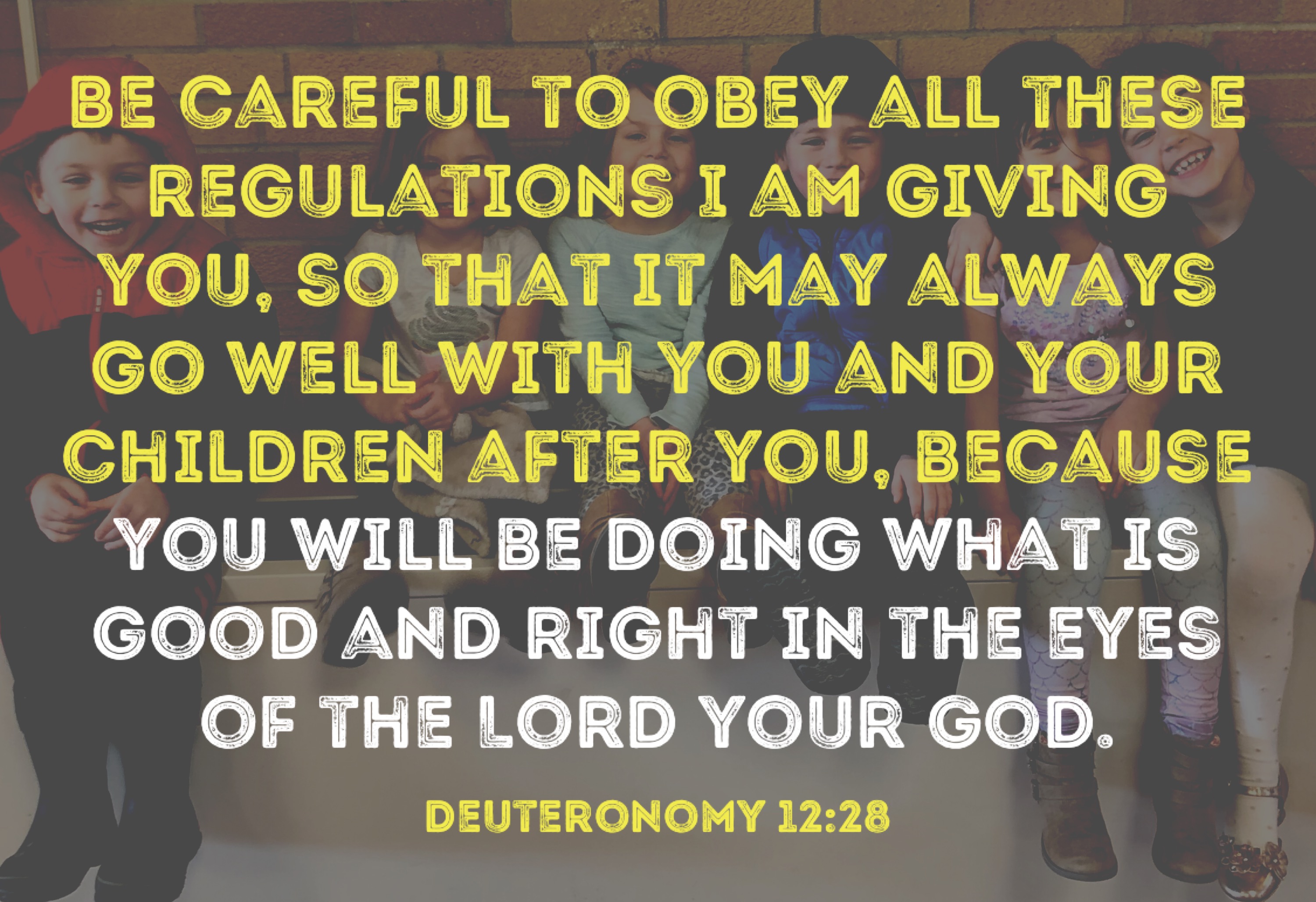
Be careful to obey all these regulations I am giving you today, so that it may always go well with you and your children after you, because you will be doing what is good and right in the eyes of the Lord your God.

Sometimes to be careful we have to slow down. We seem to want everything quickly and with as little effort as possible. Remember the cliché “Haste makes waste”?

What if you slowed down a bit today?

What if you took just a little time to be attentive to potential danger?

What if you paused long enough to discern if you were giving your best to God?

What if you took a moment to simply ask God to give you the wisdom needed to make a godly decision?

Being careful so that it may ALWAYS go well with you and your children after you….

Isn’t that worth it?