4 Quotes On Selfless Sacrifice From “The Seven Laws Of Love”

The Seven Laws Of LoveIn The Seven Laws Of Love, Dave Willis gives us some highly practical, biblically-based counsel for investing in all of our relationships. Normally when I share quotes from books, I share all of them at once, but for this book I felt like it would be good to share these quotes a bit more slowly, to give you time to read them and apply them.

The seven laws Dave identifies are:

  1. Love requires commitment (read the quotes here)
  2. Love selflessly sacrifices
  3. Love speaks truth
  4. Love conquers fear
  5. Love offers grace
  6. Love brings healing
  7. Love lives forever

From law #2, here are some quotes on selfless sacrifice—

“That’s the beautiful irony of love. The only way we can truly keep it is to give it away.”

“First Lieutenant Alonzo Cushing was a twenty-two-year-old officer in the Union Army during the Civil War when he made the ultimate sacrifice. The young West Point graduate was in charge of six cannons and more than one hundred men during the Battle of Gettysburg. His small force found itself trapped in the middle of the battlefield during the Confederate Army’s infamous assault known as Pickett’s Charge. The full force of the rebels was closing in on Cushing and his men. The young officer had already been shot twice and was critically wounded. He had every right to retreat to safety, but he recognized the magnitude of the moment. Instead, he ordered the cannons moved to the front lines, and he limped forward to lead a counterattack. His courage and tenacity inspired the men around him, and they fought back valiantly before Cushing was shot again. The final shot proved to be fatal. The sacrifice of one young man turned the tide of a battle, which turned the tide of war, which ultimately held a nation together.”

“We don’t make our sacrifices for recognition; we make our sacrifices for love. When love moves you to sacrifice, you can rest assured that lives will be changed and eternity will be impacted.”

“Many people believe they have put their faith in Jesus, but they also believe they have to earn what He did for them on the Cross. Here’s the good news: when Jesus was hanging on that Cross, dying to save you, He did not use His dying words to say, ‘Earn this.’ Do you know what He said instead? He said, ‘It is finished!’ Did you catch that? It is finished. That means done, complete, sealed, finished! That’s God’s gift of grace. Jesus has done all the work already. You couldn’t possibly earn it even if you tried with everything you had, and God never expected you to.”

Check out my review of The Seven Laws Of Love by clicking here.

Watch for more quotes from the other laws of love explained in this book throughout the next few days.
6 Quotes On Commitment From “The Seven Laws Of Love”

The Seven Laws Of LoveIn The Seven Laws Of Love, Dave Willis gives us some highly practical, biblically-based counsel for investing in all of our relationships. Normally when I share quotes from books, I share all of them at once, but I felt like it would be good to share these quotes a bit more slowly, to give you time to read them and apply them.

The seven laws Dave identifies are:

  1. Love requires commitment
  2. Love selflessly sacrifices
  3. Love speaks truth
  4. Love conquers fear
  5. Love offers grace
  6. Love brings healing
  7. Love lives forever

Dave writes in the introduction to his book, “God wants love to flow through our lives like a mighty river. The laws of love are the invisible banks God has placed around love for our prosperity and protection. When our relationships live with in those boundaries, everyone involved is enriched. When we dismiss or disregard the boundaries, our relationships can quickly become unhealthy and unsustainable.”

From law #1, here are some quotes on commitment—

“God created love to be a transformative force in every aspect of our lives. … Before that can happen, though, there must be commitment. Without a real commitment, there can be no real love.”

“The strength of your commitment will always determine the strength of your relationship.”

“God brought His own Son through the lineage of a poor young woman named Ruth who understood the power of commitment in the meaning of love. God wants to create a generational impact through your life as well. The level at which you’ll make an eternal impact is defined by your level of commitment to the people God has placed in your life.” 

“Our commitment to others is evident in the consistency with which we serve them. Grand, one-time gestures can be nice, it’s what we do with consistency that will ultimately shape our relationships.”

“We’ve traded true intimacy for porn. We’ve traded committed marriages for commitment-free cohabitation. We’ve traded having children for having pets. We’ve traded meaningful conversations for text messages. We’ve traded ‘till death do us part’ for divorce. We’ve traded the pursuit of holiness for the pursuit of happiness. We’ve traded love for lust. We’ve attempted to exploit all the benefits and pleasures of love without investing the commitment and self-sacrifice that love requires.” 

“Your life and your relationships will be defined by the commitments you make and how well you keep them.”

Check out my review of The Seven Laws Of Love by clicking here.

Watch for more quotes from the other laws of love explained in this book throughout the next few days.
The Seven Laws Of Love (book review)

The Seven Laws Of Love“Love is an unconditional commitment to selflessly serve, truthfully communicate, fearlessly protect, gracefully forgive, compassionately heal, and enduringly remain in relationship with and for the sake of another.” What a great definition of love from Dave Willis in his book The Seven Laws Of Love!

This quote is only the introduction to seven laws of love which Dave unpacks from the Scripture to fill-out that hefty definition. You’ll discover the principles which make loving relationships so rich, fulfilling, and God-honoring. Principles like commitment, sacrifice, truth and grace.

The first part of the book gives us the seven laws, and the second part of the book gives us practical ways to put these laws into action. In action loving your spouse, your friends and enemies, God, and even loving yourself.

Dave does a masterful job of weaving together biblical examples, personal stories, and down-to-earth applications to make this a very readable book. You will discover ways to improve or strengthen all of your relationships almost immediately. I could hardly put this book down! I think you’ll love it too.

I am a Thomas Nelson book reviewer.

Improve Performance At Work, Home & School

How To Get Along With OthersA huge component of poor performance is poor communication. You might think you are communicating your expectations well, but if you are only speaking in your primary communication style, you are probably only fully connecting with 1-out-of-3 people in your life.

I previously shared some thoughts for Christians to share their faith in Jesus in a communication style that will connect with all other communication styles. Here are some thoughts for improving communication effectiveness at work, home and school, which will lead to improved performance as well.

HOW TO TALK THEIR TALK AT WORK

Doer

  • Communicate in bullet points
  • Training: give them the quick-start guide
  • Strength: implementation
  • Position: service calls on products
  • Focus: bottom line

Planner

  • Communicate with detailed instructions
  • Training: give them the full training manual
  • Strength: logistics
  • Position: back office work (accounting, billing, HR records)
  • Focus: milestones with due dates

People

  • Encourage teamwork
  • Training: take them to a seminar
  • Strength: people resources
  • Position: sales / customer service
  • Focus: milestones with due dates

Vision

  • Show them the big picture
  • Training: verbally explain to the procedures
  • Strength: brainstorming
  • Position: customer service / R&D
  • Focus: boundaries

HOW TO TALK THEIR TALK AT HOME

Doer

  • Chores: assign small chunks with a deadline
  • Tell them the bottom line

Planner

  • Chores: work with an organized schedule
  • Let them come up with the plan

People

  • Chores: Work together
  • Show them what to do, don’t tell them what to do

Vision

  • Chores: start with the end in mind
  • Give them boundaries

I shared some other ways to connect with people of different communication styles in an earlier post. You can read that here.

Love = Patience

PatienceLast week I wrote about how we can be empowered to get along with everyone, everywhere. But something I didn’t mention (which might be obvious) is this: Connecting with everybody, everywhere is hard work!

We have to remember that relationship is the goal. We’re not trying to make converts to Christianity and rack up some sort of high score. We’re building relationships with people because we love people; and that love for them should motivate us to:

  1. Want what’s best for them
  2. Be willing to serve them

The Bible says this: And we urge you, brothers, warn those who are idle, encourage the timid, help the weak, be patient with everyone.

Everyone?! There’s that word again!

This word patient has five parts to its definition. I’m struck by how these aspects of patience also echo the definition of love in 1 Corinthians 13

  • Patience doesn’t lose heartLove is patient (1 Corinthians 13:4a)
  • Patience endures misfortuneLove is not self-seeking (13:5a)
  • Patience is slow to angerLove is not easily angered (13:5b)
  • Patience bears with the offenses of othersLove keeps no record of wrongs (13:5c)
  • Patience perseveres bravelyLove always protects, always trusts, always hopes, always perseveres. Love never fails (13:7-8)

How are you doing in your relationships? Are you losing heart? becoming angry? about ready to throw in the towel on a difficult relationship? Ask God to renew your love, and your patience level will increase as well. 

Let’s all strive to love others—even the difficult “others”—the way God loves us!

4 Ways To Share The Good News With Everyone

Everybody EveryoneJesus told His followers that their ministry assignment was to take His message of salvation throughout the entire world. One requirement to do this, is to be able to communicate with lots of people. Actually to be able to communicate with everyone.

Be careful to do what is right in the eyes of everybody. If it is possible, as far as it depends on you, live at peace with everyone. (Romans 12:17-18)

Really? Everybody and everyone?!

Yes!

Jesus said our Helper would be the Holy Spirit. He would come to empower us to be witnesses to everyone, everybody, everywhere (Acts 1:8).

We have been learning how to communicate with others better, but noticing their communication style “accent.” Check out this post to get some more insight into this. In a nutshell…

  • Doers are action-oriented
  • Planners like to work out all the details
  • People want to make sure everyone is connected
  • Visions are imagining a better future

So if you are a Doer, and you’re trying to share the Good News about Jesus with a Planner, you can probably see a potential problem. The Doer is speaking in bullet points, but the Planner is wanting a lot more facts and figures.

This is where the Holy Spirit can help us. He has the insight that we don’t, and He can direct our words, just as He directed Christ’s words (see John 12:49-50).

Here’s how to talk their talk when you’re sharing the Good News:

(1) Doer

  • Keep it brief
  • Share more facts than stories
  • Stress now/today
  • Rely on the Gospel of Mark (action oriented)

(2) Planner

  • Tell them the who, what, where, when, why, and how
  • Be ready for lots of questions
  • Give them time to process your information
  • Rely on the Gospel of Matthew (lots of background, lots of Old Testament references to answer the who, what, where, when, why and how)

(3) People

  • Develop a friendship first
  • Share more stories than facts
  • Don’t tell them, show them your personal life
  • Rely on the Gospel of Luke (lots of personal stories about changed lives)

(4) Vision

  • Share both the facts and the stories
  • Encourage them to “Imagine what would happen …”
  • Give them time to ask questions
  • Rely on the Gospel of John (very poetic and image-rich)

You can connect with everyone, everybody, everywhere and share the Gospel with them in an effective way. Allow the Holy Spirit to give you the insight you need.

Check out how I describe this in more detail here…

The Rewards For Getting Along With Difficult People

How To Get Along With OthersHere’s a shocking statement—Difficult people are difficult to get along with. I know, I probably just blew your mind with that one, but sometimes it’s important to state the obvious.

Christians should be the best at getting along with others. First of all, because they have the Holy Spirit to help them, and, second, because the world is watching to see if having a relationship with Jesus really does make a difference.

We’ve already learned that in order to change our behavior toward difficult people, we can’t change our behavior (check out my post on that topic here). Instead, we need to change our thoughts first. One thought to change is about ourselves, and another thought to change is the fact that Jesus promised rewards for those who loved difficult people—

If you love those who love you, what credit is that to you? Even sinners love those who love them. And if you do good to those who are good to you, what credit is that to you? Even sinners do that. And if you lend to those from whom you expect repayment, what credit is that to you? Even sinners lend to sinners, expecting to be repaid in full. But love your enemies, do good to them, and lend to them without expecting to get anything back. Then your reward will be great, and you will be children of the Most High, because he is kind to the ungrateful and wicked. (Luke 6:32-35)

One way to love others is by learning to “speak their language.” Most of us communicate with four different accents: Doer, People, Planner, Vision.

You can watch the video where I explain these styles in more detail, but you can learn their accent by listening for…

(1) How they handle stressful situations:

  • Doer—get hyper-focused
  • Planner—withdraw to plan
  • People—call a meeting
  • Vision—take time to daydream

(2) How they listen to others:

  • Doer—take short bullet points and then quick action
  • Planner—take detailed notes, and ask lots of detailed questions
  • People—make good eye contact, take very little notes, and then reiterate what was said
  • Vision—doodle, and express “ping pong ball” thoughts

(3) How they speak about folks with other “accents”:

  • Doer—this is taking too long; nothing ever gets done; they’re daydreamers
  • Planner—they jump the gun; they’re swayed by emotions; they’re unpredictable
  • People—why don’t they want to meet; they’re too aggressive; they’re too robotic
  • Vision—they don’t see the big picture; they’re too rigid; they’re too emotional

You CAN get along better with everyone. Romans 12:18 tells us that peaceful living with others depends on you and me. Let’s do this well so that Jesus is glorified!

How To Make New Communications Habits

Making new habitsPreviously I wrote about NOT trying to change our bad behaviors. That’s because our behavior is a natural outcome of several other factors (read more about that by clicking here). The important progression goes like this: Thoughts → Values → Attitudes → Behaviors.

The two areas we can address are our thoughts and attitudes. When it comes to interacting with other people, notice carefully the words Jesus said: “Love your neighbor as yourself” (Mark 12:31).

Jesus says that our thoughts about ourselves can limit our thoughts about others. If your thoughts are limited, your value on people and healthy relationships will slide. If those values drop, your attitude about others will begin to sour. And with those thoughts, values and attitude dropping, isn’t it natural to expect that you will struggle getting along with others?

So you must get this clear—

  • God had a plan for you from before the beginning of time (Ephesians 2:10)
  • God knit you together in your mother’s womb (Psalm 139:13-18)
  • God put just the right gifts and talents in you to change the world (Romans 12:3-6; 1 Corinthians 12:4-7).
  • God made you unique (you-nique!).
  • You are a one-of-a-kind masterpiece!

Because you are you-nique, you hear and see the world uniquely, and you respond uniquely. You and I respond mostly by habit.

Habits are good when they are healthy. But unhealthy habits create assumptions and blind spots that can hinder our relationships.

To make new relationship habits requires three things:

  1. Knowledge (what do I need to do)
  2. Skill (how do I need to do it)
  3. Desire (I really want to make this change)

If you want to make some new communication habits, get knowledge from people who love you and from reading the Bible. Then read some books or attend some seminars that will give you new skills. Then combine those with your sincere desire to want to improve your relationship habits, and watch for great things to happen!

I am leading our church through a training on our communication styles. Please join us on Sunday as we learn how to better get along with others. I’d love for you to join us either in person or on our Periscope broadcast.

You Are An Empowered Peacemaker

My new attitude“The whole world—with one minor exception—is made up of others,” says John Maxwell. The ‘one minor exception’ is that person who’s looking back at you from the mirror every morning, so if you want to be successful in life, you better learn to get along with ‘the others.’

I believe this is especially important for those who call themselves Christians. Here are three reasons why—

  1. Our interaction with other Christians is a testimony to outsiders—John 13:34-35.
  2. Our positive interaction with outsiders can draw others to Christ—Colossians 4:5.
  3. Our negative interaction with outsiders can repel others from Christ—1 Peter 2:12.

So although it can be very (sometimes very, very!) challenging, we are called to find ways to get along with others. The Apostle Paul said:

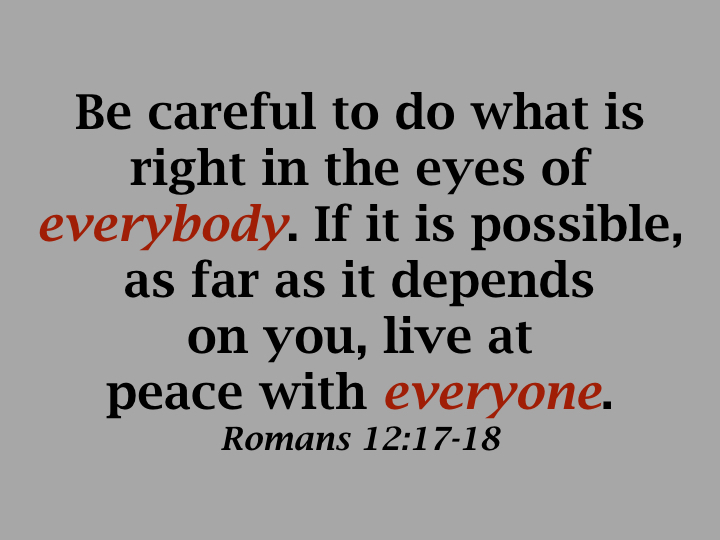
Be careful to do what is right in the eyes of everybody. If it is possible, as far as it depends on you, live at peace with everyone (Romans 12:17-18, emphasis added).

When you see the phrase “if it is possible” you may think that Paul has given us an “out.” We could say, “I tried really hard to get along with that guy, but it just hasn’t worked, so I’m off the hook!”

But consider how another translation of the Bible states this phrase: Do all that you can to live in peace with everyone.

Jesus was asked to do something that had never been done before: heal two men born blind. Jesus asked these men, “Do you believe I am able to do this?” (Matthew 9:28). The men answered an emphatic, “Yes!” On another occasion a father asked Jesus to heal his son by saying, “If You can, please help us.” Jesus said, “‘If I can? All things are possible to those who believe.” The father immediately replied, “I do believe; please help my unbelief” (Mark 9:22-24).

If you are Christian, the Spirit of Jesus lives in you. So the question Jesus asks us about our difficult relationships is, “Do you believe I am able to help you?” Or perhaps more accurately He asks us, “Will you let Me help you?”

So the part of the verse which says, “if it is possible, as far at it depends on you” is really saying, “If you really believe Jesus is stronger than this strained relationship, will you let Him do something in you to bring about peace?”

We aren’t asking Jesus to change the other person; we’re asking Him to change us. We aren’t asking someone else to get on our page, or to see the world from our perspective; we’re asking the Holy Spirit to help us get on their page, to help us see the world they way they see it.

We need to have a new attitude. And I believe that attitude comes from a prayer like this—

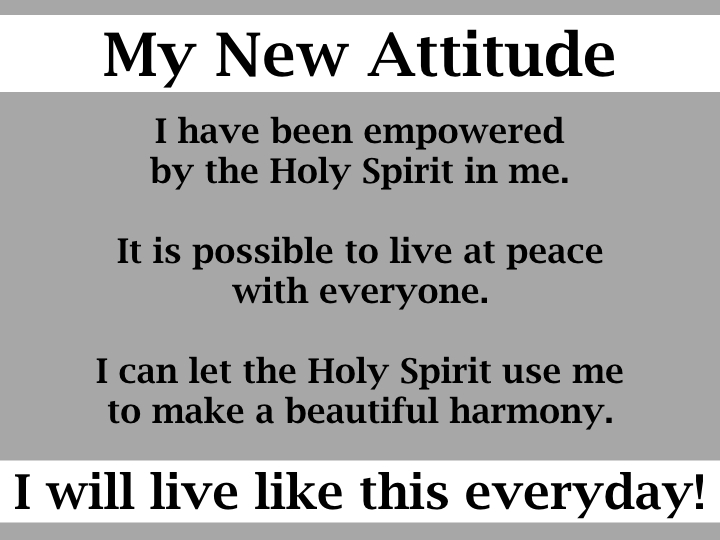
I have been empowered by the Spirit of Christ in me. 
It is now possible for me to live at peace with everyone. 
I can let the Holy Spirit use to me make a beautiful harmony. 
I will keep on living like this every day.

Next Sunday we will be looking at some practical techniques and more biblical insights to help us excel in getting along with all ‘the others’ that make up the world. Please join us in person or on Periscope.

How To Get Along With Others

How To Get Along With OthersJohn Maxwell famously said, “The entire world—with one minor exception—is made up of other people.” That “one minor exception”? It’s the person staring at you in the mirror every morning! Obviously learning how to get along with all the “others” in the world is hugely important.

It’s even more important for those who call themselves Christians.

The Bible makes it quite clear that people watch how Christians treat one another to see if the message they preach is one worth living. And Jesus told one of His most well-known stories to make the point that all of the Bible is fulfilled in just two things: (1) Loving God and (2) Loving others.


To live above with the God that we love,
Oh, wouldn’t that be glory!
But to live below with the saints that we know,
Well, that’s a different story!

The Bible says a lot about “one another.” In fact, that phrase is used nearly 60 times in the New Testament! Not only is there much that the Scripture has to say to us about getting along with one another, but most of what was written has been confirmed by modern psychology.

Join me this Sunday at Calvary Assembly of God as we begin a new series called How To Get Along With Others. We’ll be learning some practical training along with biblical insights to help us excel at this vitally important life skill.

You can find directions to our church here, and if you can’t join us in person, be sure to tune in to our Periscope broadcast (follow me @craigtowens to be notified when the broadcast starts).