


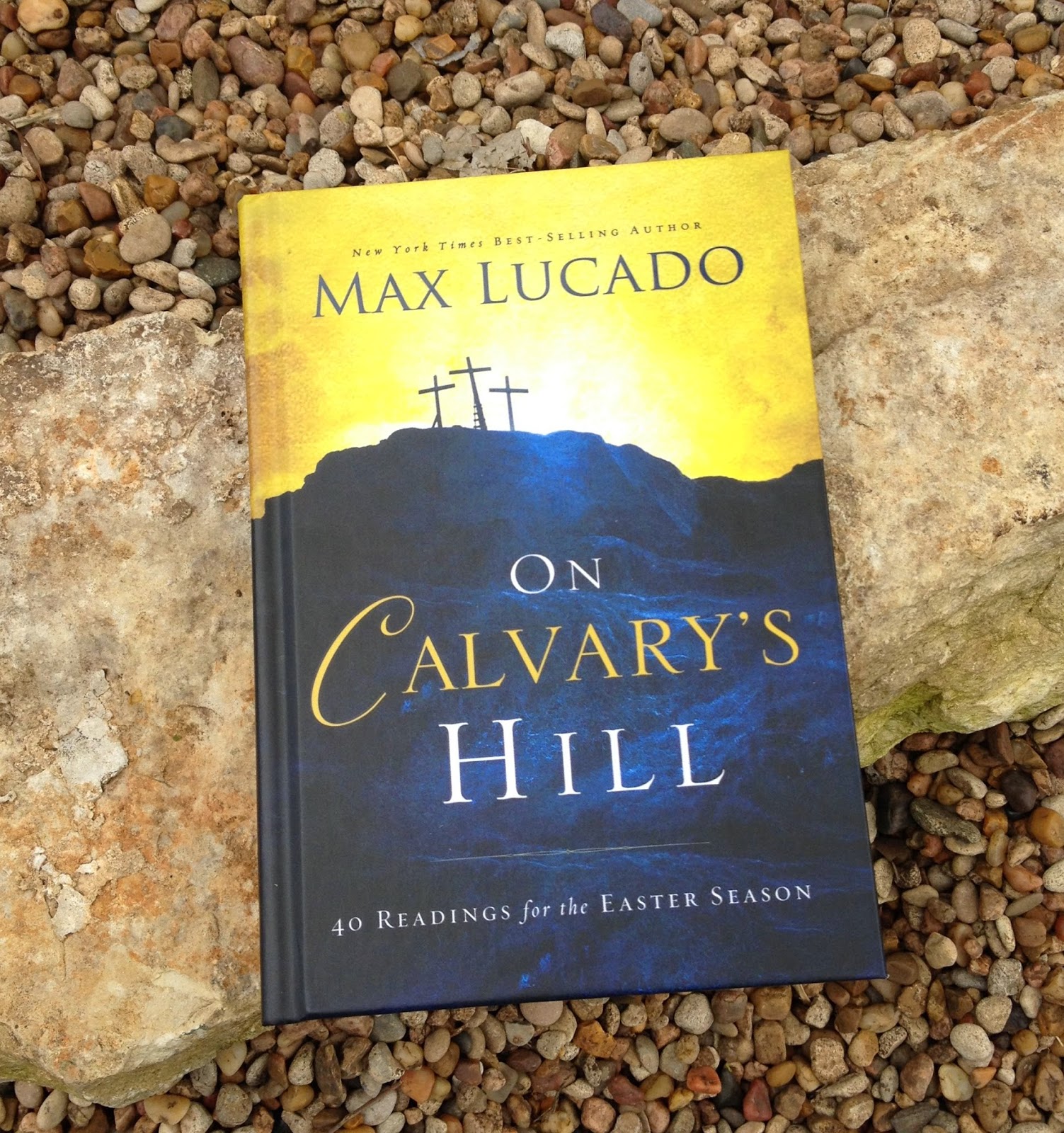
 “Six hours, one Friday. To the casual observer the six hours are mundane. A shepherd with his sheep, a housewife with her thoughts, a doctor with his patients. But to the handful of awestruck witnesses, the most maddening of miracles is occurring. God is on a Cross. The Creator of the universe is being executed. Spit and blood are caked to His cheeks, and His lips are cracked and swollen. Thorns rip His scalp. His lungs scream with pain. His legs knot with cramps. Taut nerves threaten to snap as pain twangs her morbid melody. Yet, death is not ready. And there is no one to save Him, for He is sacrificing Himself. It is no normal six hours . . . it is no normal Friday. For worse than the breaking of His body is the shredding of His heart. His own countrymen clamor for His death. His own disciple planted the kiss of betrayal. His own friends ran for cover. And now His own Father is beginning to turn His back on Him, leaving Him alone. Let me ask you a question: What do you do with that day in history? What do you do with its claims? If it really happened . . . if God did commandeer His own crucifixion . . . if He did turn His back on His own Son . . . and if He did storm satan’s gate, then those six hours that Friday were packed with tragic triumph. If that was God on that Cross, then the hill called Skull is granite studded with stakes to which you can anchor your soul forever.” —Max Lucado, On Calvary’s Hill
Six Hours, One Friday
April 19, 2019 — Craig T. OwensNo Polite Conversations Here, Please
April 18, 2019 — Craig T. Owens “Most of us would never commit murder, but how often have we taken a neighbor into some dark alley of our thoughts and there torn him limb from limb with a desire for revenge over some petty quarrel?
“Christian, this is imperative for you to realize: When wicked or unclean thoughts first force their way into your mind, you have not yet sinned. This is the work of the devil! But if you so much as offer them a chair and begin polite conversation with them, you have become his accomplice. In only a short time you will give these thoughts sanctuary in your heart.” —William Gurnall, in The Christian In Complete Armor
Sovereign Love
April 15, 2019 — Craig T. OwensListen to the podcast of this post by clicking on the player below, and you can also subscribe on Apple, Spotify, or Audible.
 Jesus is on His passionate journey toward the Cross. Every step on this journey is a step of love.
After Jesus finished His last supper with His disciples, they all went to one of their favorite places to pray—the Garden of Gethsemane. It was a place they all knew well. Including Judas, who had been looking for an opportunity to turn Jesus over to the religious authorities when He was out of the public eye.
Jesus knew this time was coming (Matthew 10:33-34; John 13:1, 3; 18:4), and His knowing prompted His serving. So we can say that His foot-washing service was as much a reminder to Himself as it was to His followers.
After they entered the garden to pray, events began to unfold at a fast pace, ultimately culminating in Jesus being crucified.
But let us never forget that through all of this horrific, inhumane mistreatment and torture, Jesus remains the King of kings, the Son of God. In fact, very God Himself.
The Jewish religious leaders knew this too (John 8:54-59; 10:31-33). And without “knowing it” the soldiers that came to arrest Jesus knew it as well.
Just look at the absolute authority of the King of kings. Grown men—religious leaders and hardened soldiers—fall to their knees at just three words: “I am He.”
Christ’s kingdom has overruling authority. It collects no taxes, it has no standing army, it requires no checks-and-balances because its Sovereign IS Truth and Love. This unequaled, unrivaled power was contained in Jesus—“You would have no authority over Me unless it was given you from above.”
Which makes His submission to Pilate and others even more amazing! One word from Him could have crushed legions and toppled governments—yet for love’s sake, He submitted. Let that sink in—Sovereignty submitted.
What appeared to be the cruelty of man was the sovereignty of God.
No one can take My life from me. I sacrifice it voluntarily. For I have the authority to lay it down when I want to and also to take it up again. For this is what My Father has commanded. (John 10:18)
“Christ’s death was not the death of a martyr, who sinks at last overwhelmed by enemies, but the death of a triumphant conqueror, who knows that even in dying He wins for Himself and His people a kingdom and a crown of glory.” —J.C. Ryle
Christ has bought us out from under the doom of that impossible system by taking the curse for our wrongdoing upon Himself. For it is written in the Scripture, “Anyone who is hanged on a tree is cursed” (as Jesus was hung upon a wooden Cross). (Galatians 3:13 TLB)
Sovereign love submitted to the cruelty of man SO THAT you and I could be saved from the inescapable doom that will inevitably crash down on us. Jesus loved us so much that He allowed the Cross to happen to Him.
The question now remains—what are you doing with this sovereign love?
Do you know Jesus as your Savior? Have you received this gift He willingly, lovingly purchased for you on the Cross?
If you have, let me ask you another question: Christian, are you living in a way that leads others to this sovereign love too (John 13:34-35)?
Anytime you see the Cross, remember what sovereign love did there for you.
►► Would you please prayerfully consider supporting this ministry? My Patreon supporters get behind-the-scenes access to exclusive materials. ◀︎◀︎
The Fire Of Greatness
April 11, 2019 — Craig T. Owens “It is not wrong to aspire to greatness. The warning here is to be careful to never confuse fame with greatness. Otherwise, you may be aspiring to what is not really greatness at all. Fame is what you do for yourself; greatness is what you do for others. Jesus has unveiled to us how greatness is achieved in His kingdom. To be great, you must serve. So don’t give up on your ambition to be great; instead, change your definition of what it means to be great and how greatness is achieved. …
“The words samurai and deacon have the same core meaning. They both mean ‘servant.’ … Too often we have confused humility with powerlessness. Humility cannot be achieved from a posture of powerlessness. As long as we see ourselves as victims, humility does not come from a position of strength. True humility can be experienced only when we have come to know our power and use it for the good of others and not for ourselves. …
“Greatness is never found; it is gained. Greatness never comes easy; it’s always the outcome of great discipline and hard work. If you’re comfortable with where you are, if you’re complacent, you will never discover the greatness that lies within. Complacency is like pouring water on coals. It is so important not to misunderstand the words of Jesus. Remember, He never said, ‘Don’t be great.’ In fact, His invitation was for only those who aspire to greatness: ‘Whoever wants to become great among you must be your servant.’ You will never know the power of servanthood until you know the fire of greatness. …
“Whatever God has placed within you that could ever be described as great was never meant for you, anyway. It’s a stewardship that has been given to you. Greatness never belongs to the one who carries it; it belongs to the world that needs it.” —Erwin McManus, The Way Of The Warrior (emphasis mine)
You can read other quotes from The Way Of The Warrior here and here.
Your Incense…
April 9, 2019 — Craig T. Owens …to God and the world.
Let’s follow this thread from the Old Testament into the New Testament—
“When Aaron trims the lamps at twilight, he shall burn incense. There shall be perpetual incense before the LORD throughout your generations.” (Exodus 30:8)
“Therefore I urge you, brethren, by the mercies of God, to present your bodies a living and holy sacrifice, acceptable to God, which is your spiritual service of worship.” (Romans 12:1)
“For we are a fragrance of Christ to God among those who are being saved and among those who are perishing.” (2 Corinthians 2:15)
“The incense which you shall make, you shall not make in the same proportions for yourselves; it shall be holy to you for the LORD.” (Exodus 30:37)
“Our lives are not to be about us, lived out in private and for self-glory. Our lives are to be about God, lived out in full view of the nations and for His name’s sake.” —Dick Brogden
What incense is your life—your witness, your testimony—sharing with those around you?
Weeping And Rejoicing
April 6, 2019 — Craig T. Owens “First, I would bid you stand and see the place where the Lord lay with emotions of deep sorrow. O come, my beloved brother, thy Jesus once lay there. He was a murdered man, my soul, and thou the murderer.
His chief tormentors were,
Each of my crimes became a nail,
And unbelief the spear.’
And did my Sov’reign die?’
“I slew Him—this right hand struck the dagger to His heart. My deeds slew Christ. Alas! I slew my best beloved: I killed Him who loved me with an everlasting love. Ye eyes, why do ye refuse to weep when ye see Jesus’ body mangled and torn? Oh! give vent to your sorrow, Christians, for ye have good reason to do so…. My soul was drowning. From heaven’s high portals He saw me sinking in the depths of hell. He plunged in.
‘He SANK beneath His heavy woes,
To raise me to a crown;
There’s ne’er a gift His hand bestows.
But cost His heart a groan.’
“Ah! we may indeed regret our sin, since it slew Jesus.
“Now, Christian, change thy note a moment. ‘Come, see the place where the Lord lay,’ with joy and gladness. He does not lie there now. Weep, when ye see the tomb of Christ, but rejoice because it is empty. Thy sin slew Him, but His divinity raised Him up. Thy guilt hath murdered Him, but His righteousness hath restored Him. Oh! He hath burst the bonds of death; He hath ungirt the cerements of the tomb, and hath come out more than conqueror, crushing death beneath His feet. Rejoice, O Christian, for He is not there—He is risen.” —Charles Spurgeon
Escaping The Devil’s Deception
March 20, 2019 — Craig T. Owens“Not only does he choose when he will tempt, satan also chooses the best methods for displaying his temptations. One strategy is to hang out false colors. He comes up to the Christian disguised as a friend, so that the gates are open to him before his true identity is discovered. Paul says we should not be shocked to find false teachers masquerading as apostles of Christ, ‘…satan himself is transformed into an angel of light’ (2 Corinthians 11:13-14). Of all his plots, this is perhaps the most dangerous to the saints; when he appears in the mantle of a prophet and silver-plates his corroded tongue with fair-sounding language. In this manner he corrupts some in their judgment by interpreting gospel truth in such a way that God appears to condone questionable behavior. These Christians get caught up in the world’s morality under the guise of Christian liberty. … How we need to study the Scriptures, our hearts, and satan’s wiles, that we may not bid this enemy welcome and all the while think it is Christ who is our guest!” —William Gurnall, in The Christian In Complete Armor (emphasis mine)
What Christians Often Miss About Zeal
March 18, 2019 — Craig T. Owens On what we now refer to as Palm Sunday, Jesus arrived in Jerusalem with the crowd shouting, “Hosanna” because they thought Jesus was going to set things right. In this, they were disappointed. Jesus knew that His time for reigning in Jerusalem hadn’t come yet, and Christ’s passionate journey meant He would not cut any corners!
Before Jesus left Jerusalem that Sunday evening, Mark noted that “He looked around at everything.” He didn’t respond right away to what He saw. This is very important to note because we shouldn’t think that His response on Monday was something spontaneous. No, it was planned out in specific detail.
On Monday morning, Jesus prepared to make the 2-mile trip from Bethany to Jerusalem. The Gospels note quite frequently the amount of time Jesus spent in prayer, including beginning His day in conversation with His Father (see Mark 1:35). On this morning, He must have talked with His Father about everything He had seen in Jerusalem the day before.
En route to Jerusalem, Jesus encounters a fig tree that gives every appearance of life and vitality. It looks like it’s ready to serve people, but upon closer inspection, Jesus discovers that there is no fruit on it. He curses the tree for its deceptive outward appearance. This is definite foreshadowing for what’s about to happen!
Jesus enters the temple and begins to drive out merchants, and moneychangers, and dove sellers. He roars at them, “God says this is to be a place of prayer for all nations, but you have turned it into a den of robbers!” (see Matthew 21:12-17; Mark 11:15-19; and Luke 19:45-48).
The phrases house of prayer and den of robbers are direct quotations from Isaiah and Jeremiah, respectively (Isaiah 56:3-7; Jeremiah 7:1-11), but what do they mean?
 The temple had specific courts available—
- The Court of the Gentiles was open to all people, foreigners included.
- The Women’s Court was open to all Jews and, their “uncontaminated” wives.
- The Court of Israel was limited to male Jews who were clean and purified.
- The fourth court was the Holy Place limited to priests robed in their priestly vestments.
This buying and selling was undoubtedly happening in the Court of the Gentiles. As the Passover was approaching, people from all over the world were here—some purchasing animals to use as sacrifices, and some exchanging their foreign money for Israelite money for the temple tax.
There was a lot of hustle and bustle, but very little worship. This is what angered Jesus. The activity in the temple was like the fig tree He cursed—it looked like it was fruitful, but that was merely outward deception.
Were the merchants exploiting people? Perhaps. But they were certainly occupying the only space where non-Jews could worship. They were certainly becoming a distraction to any true worship activities. They were clearly becoming the main attraction.
There are two important lessons in this outburst that Jesus gives to all His disciples:
- As our Christlikeness increases, our intolerance of religious showmanship should increase.
- As our Christlikeness increases, our intolerance of unrighteousness should increase—both a greater hate for sin and a greater love for sinners!
“Let the zeal of the house of the Lord ever eat you up. For example: do you see a brother running [toward sin]? Stop him, warn him, be grieved for him, if the zeal of God’s house has now eaten you up. Do you see others running and wanting to drink themselves drunk? Stop whom you can, hold whom you can, frighten whom you can; win in gentleness whom you can: do not in any way sit still and do nothing.” —Augustine
Christ’s passionate journey was out of love for us. Which means He hates anything that keeps us from His Father.
If you know God’s love, be zealous about those things that keep others from coming in to know God’s love for themselves. Not angry at people, but angry at practices and “religious shows” that hinder people from knowing God’s love like you know God’s love.
Make A Big To-Do Out Of God
March 14, 2019 — Craig T. Owens “God endows us with gifts so we can make Him known. Period. God endues the Olympian with speed, the salesman with savvy, the surgeon with skill. Why? For gold medals, closed sales, or healed bodies? Only partially.
“The big answer is to make a big to-do out of God. Brandish Him. Herald Him. ‘God has given gifts to each of you from His great variety of spiritual gifts. Manage them well. … Then God will be given glory’ (1 Peter 4:10-11 NLT).
“Live so that ‘He’ll get all the credit as the One mighty in everything—encores to the end of time. Oh, yes!’ (1 Peter 4:11 MSG). Exhibit God with your uniqueness. When you magnify your Maker with your strengths, when your contribution enriches God’s reputation, your days grow suddenly sweet.” —Max Lucado, in You!
No Spiritual Gains Without Pains
March 5, 2019 — Craig T. Owens “Sanctification, again, is a thing which depends greatly on a diligent use of scriptural means. When I speak of ‘means,’ I have in view Bible-reading, private prayer, regular attendance on public worship, regular hearing of God’s Word, and regular reception of the Lord’s Supper. I lay it down as a simple matter of fact, that no one who is careless about such things must ever expect to make much progress in sanctification. I can find no record of any eminent saint who ever neglected them. They are appointed channels through which the Holy Spirit conveys fresh supplies of grace to the soul, and strengthens the work which He has begun in the inward man. Let men call this legal doctrine if they please, but I will never shrink from declaring my belief that there are no spiritual gains without pains. I should as soon expect a farmer to prosper in business who contented himself with sowing his fields and never looking at them till harvest, as expect a believer to attain much holiness who was not diligent about his Bible-reading, his prayers, and the use of his Sundays. Our God is a God who works by means, and He will never bless the soul of that man who pretends to be so high and spiritual that he can get on without them.” —J.C. Ryle
My most-viewed posts


 Craig T. Owens