Protected To Be Fruitful 

Listen to the podcast of this post by clicking on the player below, and you can also subscribe on AppleSpotify, or Audible. 

We just finished a 2-week look at Psalm 88 & Psalm 89 which reminded us of the reality of temporary darkness and the certainty of eternal light. We said our dark days are meant to get our attention to rely on God’s covenant promise. 

Something else we should be aware of: Whenever we run to or return to Jesus, the enemy of our souls prepares an attack (1 Samuel 7:3-10; 1 Peter 5:8). 

The next psalm with a Selah is David’s prayer in Psalm 140. Selah appears 3 times in this short, 13-verse psalm. 

We’ve said that Selah can mean a pause to carefully consider, a pause to observe the contrasts, or a pause to prepare for a crescendo. The Selahs after verses 3 and 5 don’t appear to fit the second or third definitions, but why would David ask us to pause to consider what wicked men are doing? I believe it is because we need to pause to contemplate two vital things, which I’ll share with you in a moment. 

But first, notice the wicked men and evil times that David is confronting. He speaks of evildoers, violent people, wicked men, arrogant people, and slanderers (vv. 1, 4-5, 8, 11). 

Surrounding the first two Selahs, check out David’s prayer for God to…

  • …rescue me (v. 1a)—get me out of here, or take the evil away from me  
  • protect me (v. 1b, 5b)—don’t let me be defeated or even diminished  
  • keep me (v. 4a)—we might say David is asking God to “watch my six” or guard the places I cannot see (notice the words net and traps in v. 5b) 

The first Selah lesson we should take away is: There, but for the grace of God, go I. 

If I hadn’t accepted Jesus as my Savior and had a new nature imparted to me, I would be doing exactly what these wicked people are doing. Paul tells Timothy what evil people will do, and he tells the Corinthian Christians that they used to be those same kinds of people (2 Timothy 3:1-5; 1 Corinthians 6:11). 

When I see evil men, men of violence, and wicked people who are proud and slandering, I need to Selah to pray that the light and love of Jesus will be revealed to them. 

The second Selah lesson we should take away is: God is doing something in my life through wicked men and evil times. 

The words the Holy Spirit prompted David to pen have a richer definition than what I previously shared with you. Check this out…

  • rescue me (v. 1a) also means make me strong and well-armed for battle  
  • …protect me (v. 1b, 5b) envisions a gardener carefully watching over his vineyard to bring the plants to fruitful maturity (like in John 15:1-2)  
  • keep me (v. 4a) can mean “fight for me”  

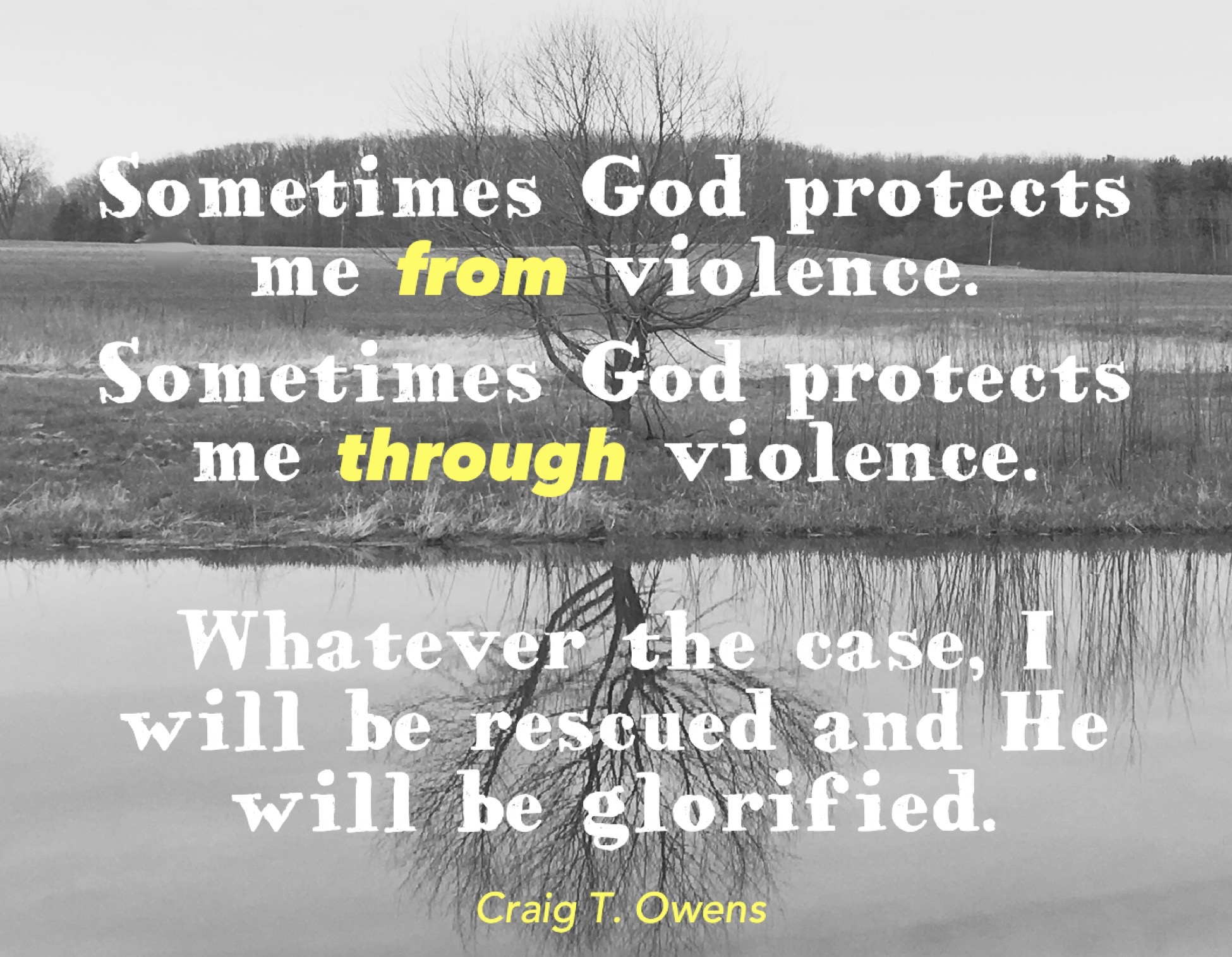
Sometimes God protects me from violence. Sometimes God protects me through violence. Whatever the case, I can be assured that I will be rescued and He will be glorified. This prayer in Psalm 140 is a prayer for protection so that we can be fruitful for God’s kingdom.

We need to Selah during the evil times we live in and whenever we have to endure wicked attacks. 

  1. Selah to thank God that you have been redeemed from that evil lifestyle by your faith in Jesus, and then pray for your attackers (Matthew 5:44). 
  2. Selah to thank God that He is using even evil people to make you more fruitful, to arm you for battle, and to glorify His name (Mark 13:9). 

If you’ve missed any of the messages in our Selah series, you can check them all out by clicking here. 

►► Would you please prayerfully consider supporting this ministry? My Patreon supporters get behind-the-scenes access to exclusive materials. ◀︎◀︎

Thursdays With Spurgeon—Proof Of God’s Love

This is a weekly series with things I’m reading and pondering from Charles Spurgeon. You can read the original seed thought here, or type “Thursdays With Spurgeon” in the search box to read more entries.

Listen to the podcast of this post by clicking on the player below, and you can also subscribe on AppleSpotify, or Audible. 

Proof Of God’s Love

I have written for him the great things of My law, but they were considered a strange thing. (Hosea 8:12) 

     It is no mean proof of His goodness, that He stoops to, rebuke His erring creatures. It is a great argument of His gracious disposition, that He bows His head to notice terrestrial affairs. … He might dwell alone, far, far above this world, up in the seventh heaven, and look down with calm and silent indifference upon all the doings of His creatures. He might do as the heathens supposed their Jove did, sit in perpetual silence, sometimes nodding his awful head to make the Fates move as he pleased. But Jove never thought of the little things of earth, disposing of them as beneath his notice, engrossed within his own being, swallowed up within himself, living alone and retired. … 

     We see from our text that God looks upon man, for He says of Ephraim, ‘I have written for him the great things of My law, but they were considered a strange thing.’ But see how when He observes the sin of man He does not dash him away and spurn him with His foot? He does not shake him by the neck over the gulf of hell until his brain does reel and then drop him forever. But rather, He comes down from heaven to plead with His creatures. He argues with them, He puts Himself, as it were, upon a level with the sinner, states His grievances, and pleads His claim.

From The Bible

In my sermon this last Sunday I was leading my congregation through Psalm 89. I noted that there were two important blessings that Ethan the Ezrahite tells us of: 

  1. The blessing of God’s favor on our obedience 
  2. The blessing of God’s discipline on our disobedience

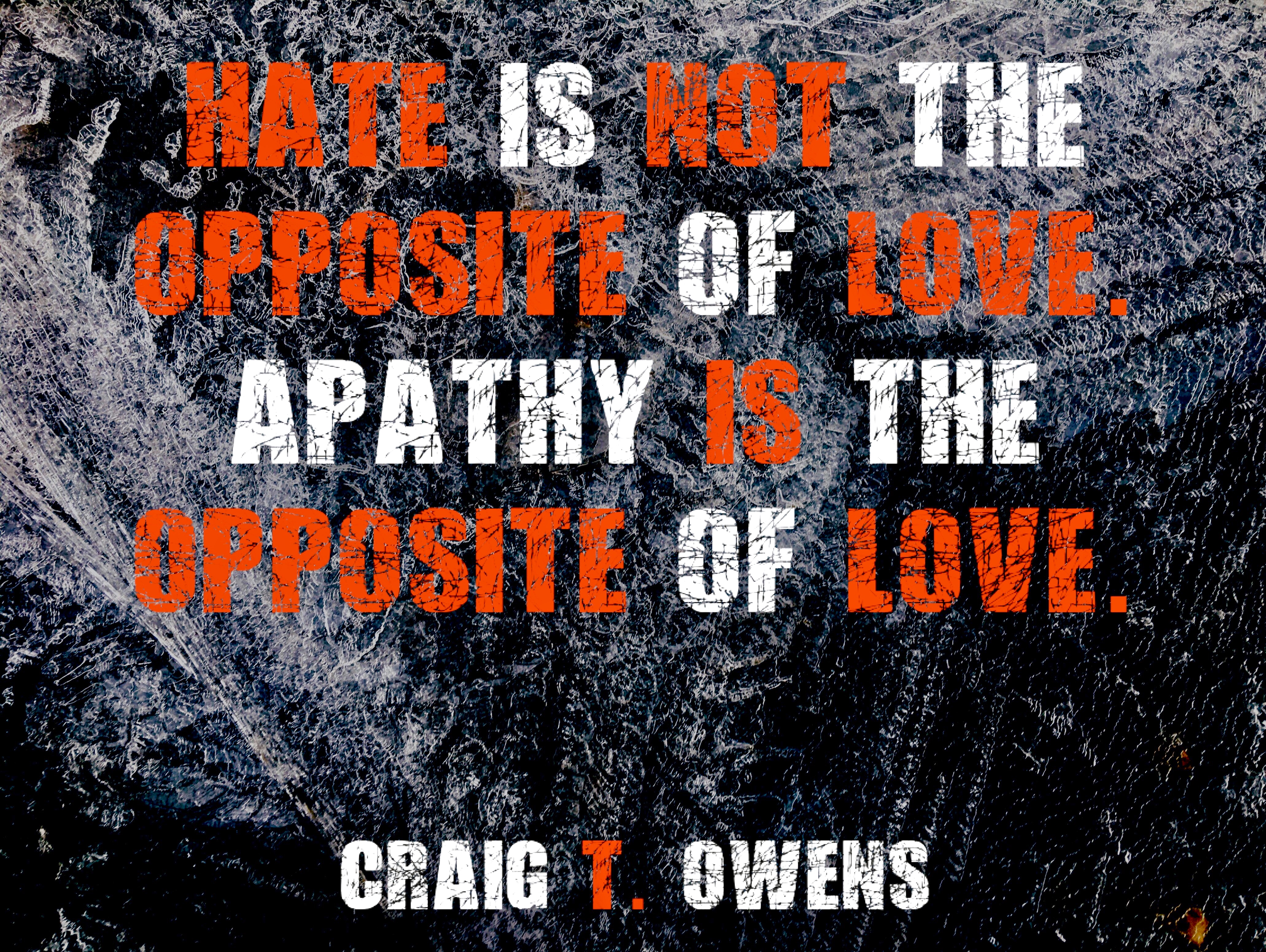
Yes, the fact that God disciplines us—that He “stoops to rebuke His erring creatures”—is positive proof of His immense, unending love for us. The opposite of love is not hate but apathy. If God didn’t love us, He wouldn’t personally involve Himself in our lives because neither our obedience or disobedience would mean a thing to Him. 

Consider this passage—

In all their affliction He was afflicted,
and the Angel of His Presence saved them;
in His love and in His pity He redeemed them;
and He bore them and carried them
all the days of old.
But they rebelled and grieved His Holy Spirit;
so He turned Himself against them as an enemy,
and He fought against them
. (Isaiah 63:9-10)

In His love, God both carries us in our adversity AND turns to confront us in our waywardness. BOTH of these actions are proof of His love. My friend, wherever you are and whatever you may be facing, be assured of God’s unquenchable love for you!

►► Would you please prayerfully consider supporting this ministry? My Patreon supporters get behind-the-scenes access to exclusive materials. ◀︎◀︎
…The Certainty Of Eternal Light

Listen to the podcast of this post by clicking on the player below, and you can also subscribe on AppleSpotify, or Audible.

Even though Jesus explicitly told His followers about His crucifixion, it was clear on that Friday on Golgotha that they didn’t fully grasp what was going on. 

We see the same thing in Heman’s maskil of Psalm 88: The faint hope that his Savior would rescue him from death, but still not fully grasping what was happening. Just as Jesus cried out, “It is finished” and His disciples thought the darkness had fallen, Heman ends his psalm with, “You have taken my companions and loved ones from me; the darkness is my closest friend” (Psalm 88:18). 

There is the reality of darkness in this world—but it is only temporary darkness. This is why I entitled our look at Psalm 88 as “The reality of temporary darkness” because, in the second part of this couplet of maskil psalms, Ethan moves right into the light of Resurrection Sunday: “I will sing of the Lord’s great love forever” (Psalm 89:1). 

Consider this Good Friday-to-Resurrection Sunday thought from Jesus: “…In the world you will have tribulation; BUT be of good cheer, I have overcome the world” (John 16:33). This tells us of both the temporary darkness and the conquering Light. But also notice that Jesus said our peace would come from knowing that both darkness and light are realities: “These things I have spoken to you, that in Me you may have peace.” Whether we are in temporary darkness or looking forward to the eternal light, our peace is only found in Jesus. 

When the followers of Jesus came to His tomb on Sunday morning, the angels asked them a penetrating question, “Why are you looking for a living Person in a place where there are dead people?” Then they began to stimulate their memory to get them to recall Christ’s words. Finally, we read, “THEN they remembered” (Luke 24:5-8). Then they had to choose to obey the word of God. 

Ethan recalls God’s words and uses his “will” three in the opening two verses. 

The disciples also could bank on Christ’s words, just as Ethan chose to bank on Jehovah’s words. The central part of Psalm 89 is God speaking: Check out His assurance in the “I will” statements within the quotation marks in verses 19-37. Then we are called to Selah to let that soak in. 

Notice what radiates out from this foundational assurance:

  • Ethan uses the pronouns You/Your 20 times in reference to God to assure us that God is in sovereign control (vv. 8b-14). Then he tells us of the blessings of God’s favor on our obedience to His word (vv. 15-18). 
  • On the other side of the central quotation from God, Ethan again uses the pronouns You/Your 13 times in vv. 38-45, but then he tells us of the blessing of God’s discipline on our disobedience.
  • Radiating out further, Ethan asks seven questions—much like his brother Heman did in Psalm 88—in verses 5-8 and 46-48. 
  • Finally, we see the psalm both opening and closing with praising God as we remember His covenant word (vv. 1-4, 49-52). 

Remember we said the darkness cannot prevail. The darkness is temporary (Romans 8:18) but Ethan repeatedly reminds us of God’s foreverness (vv. 1, 2, 4, 29, 52). 

  • The Selah after v. 4 is to pause in wonder at God’s words and break into rejoicing!
  • The Selah after v. 37 is again to pause after remembering God’s covenant, and to reflect on our own obedience or disobedience. 
  • The Selah after v. 45 is a pause to mourn and repent from our disobedience. 
  • The Selah after v. 48 is to pause to reflect on the forgiveness purchased on Calvary and the eternal light and life that bought. 
  • Finally, v. 52 harkens back to v. 1 as the praise is restored and the cycle begins all over again. In fact, the praise of God’s light continues forever! 

Heman and Ethan both remind us of this important truth—

My dark days are meant to get my attention. Are they dark because I live in an evil world, or because I have sinned? In either case, my only remedy is to rely on God’s covenant promise fulfilled in the death and resurrection of Jesus. 

If you’ve missed any of the other messages in our Selah series, you can find a complete list by clicking here.

►► Would you please prayerfully consider supporting this ministry? My Patreon supporters get behind-the-scenes access to exclusive materials. ◀︎◀︎
The Reality Of Temporary Darkness…

Listen to the podcast of this post by clicking on the player below, and you can also subscribe on AppleSpotify, or Audible.

A father came home from work and noticed a note addressed to him taped to his teenage son’s door:

Dear Dad, 

Jason and I borrowed Mom’s car to go to Taco Bell. I know I didn’t have permission, but I thought we’d be back before you and Mom got home. Unfortunately, I hit a pothole and blew out the front right tire. 

We jacked up the car to put on a spare tire, but the jack slipped and the car rolled backward into the ditch. 

Bill came with his pickup to pull us out, but the tow strap pulled off the front bumper and the car rolled further down the hill and sunk in the pond. 

I bought a bus ticket to get out of town and go enlist in the Army. Give Mom a hug and I’ll see you both in about 2 years. 

Love, your son

P.S. None of the above is true. Mom took her car to Aunt Jan’s house and I rode my bike to Jason’s house. However, I hope the fact that none of these bad things actually happened will help you put in perspective the D+ on my report card. 

We like to manage expectations, don’t we? We frequently deliver bad news with the good news close by. 

Psalms 88 and 89 are written by brothers: both of them are called Ezrahite, and both of them were worship leaders in the tabernacle. And until Solomon, these guys were considered the wisest in the land (1 Chronicles 2:6; 15:19; 1 Kings 4:29-34). 

I believe these two psalms form a couplet. They make up the last two psalms of Book III in the Psalter, with Psalm 89 ending with, “Amen and Amen.” Both of them label their psalms a maskil which means “a poem of contemplation” (NKJV). And look how Psalm 88 leaves us in the dark, while Psalm 89 shines a light in the dark.

In Psalm 88, Heman soberly prepares us for his two-Selah psalm in his introductory remarks. He uses a phase mahalath leannoth which means someone who is so physically weak from emotional grief that they are now battling depression. The NLT calls it “the suffering of affliction.”  

Heman is describing a reality: We will all experience pain in this life. Maybe even for our entire earthly life—from my youth I have been afflicted and close to death (v. 15). Heman’s reality is seen in his words in the first five verses of this psalm. 

His first Selah is breathtaking because he wants us to pause to realize that God has allowed all of this (notice the pronoun You in vv. 6-8, 16-18). But still, Heman knows God saves because he has made a decision to continue to praise Him even in the dark times (vv. 1-2, 9, 13).  

Heman’s second Selah comes in the middle of a series of five questions (vv. 10-14) that sound a lot like both questions Jesus asked in Gethsemane and from the Cross, and the reality of the temporary darkness He was facing (Psalm 22:1-2; Luke 22:53; John 19:11). 

Even the way Heman closes his psalm foreshadows the darkness surrounding the death of Jesus: “My God, My God, why have You forsaken Me? 

Jesus tasted all of this darkness for us so that He could be our perfect and empathetic High Priest (Hebrews 5:7, 4:15-16). 

Psalm 88 shows us the reality of temporary darkness (like Good Friday), but Psalm 89 points us to the certainty of eternal light (like Resurrection Sunday)! 

So when you are battling your dark times, let me give you these assurances: 

  1. This darkness is only temporary (Romans 8:18) 
  2. Jesus walks with us in our dark times (Romans 8:26-39)
  3. The darkness cannot prevail—Jesus tasted all of this temporary darkness for us so that He could be our eternal High Priest!

If you’ve missed any of the messages in our Selah series, you can check them out by clicking here. Please join me on Sunday when we will look at Ethan’s words in Psalm 89 about the certainty of the eternal light. 

►► Would you please prayerfully consider supporting this ministry? My Patreon supporters get behind-the-scenes access to exclusive materials. ◀︎◀︎
Thursdays With Spurgeon—God Means What He Says

This is a weekly series with things I’m reading and pondering from Charles Spurgeon. You can read the original seed thought here, or type “Thursdays With Spurgeon” in the search box to read more entries.

Listen to the podcast of this post by clicking on the player below, and you can also subscribe on AppleSpotify, or Audible. 

God Means What He Says

…For the mouth of the Lord has spoken (Isaiah 1:20).

     You talk about God as being ‘love,’ and if you mean by this that He is not severe in the punishment of sin, I ask you what you make of the destruction of Jerusalem? Remember that the Jews were His chosen nation and that the city of Jerusalem was the place where His temple had been glorified with His presence. Brethren, if you roam from Edom to Zion and from Zion to Sidon and from Sidon to Moab, you will find, amid ruined cities, the tokens that God’s words of judgment are sure. Depend on it, then, when Jesus says, ‘These will go away into everlasting punishment’ (Matthew 25:46), it will be so. When He says, ‘If you do not believe that I am He, you will die in your sins’ (John 8:24), it will be so. … 

     It is of no avail to sit down and draw inferences from the nature of God and to argue, ‘God is love, and therefore He will not execute the sentence upon the impenitent.’ He knows what He will do better than you can infer. He has not left us to inferences, for He has spoken pointedly and plainly. He says, ‘He that believes not shall be damned’ (Mark 16:16), and it will be so, ‘for the mouth of the Lord has spoken.’ Infer what you like from His nature. But if you draw an inference contrary to what He has spoken, you have inferred a lie and you will find it so. …

     I know why you do not believe in the terrible threats. It is because you want to be easy in your sins. … Yet if you do not believe its loving warnings nor regard its just sentences, they are true all the same. If you dare its thunders, if you trample on its promises, and even if you burn it in your rage, the Holy Book still stands unaltered and unalterable. ‘The mouth of the Lord has spoken.’ Therefore, I pray you, treat the sacred Scriptures with respect and remember that ‘these are written that you may believe that Jesus is the Christ, the Son of God, and that believing you might have life through His name’ (John 20:31).

From The Infallibility Of Scripture

Spurgeon delivered this sermon on March 11, 1888. Nearly 2000 years earlier, Asaph delivered a similar message from God—

“Call upon Me in the day of trouble; I will deliver you, and you shall glorify Me.” But to the wicked God says: “What right have you to declare My statutes, or take My covenant in your mouth, seeing you hate instruction and cast My words behind you? When you saw a thief, you consented with him, and have been a partaker with adulterers. You give your mouth to evil, and your tongue frames deceit. You sit and speak against your brother; you slander your own mother’s son. These things you have done, and I kept silent; you thought that I was altogether like you; but I will rebuke you, and set them in order before your eyes. Now consider this, you who forget God, lest I tear you in pieces, and there be none to deliver: Whoever offers praise glorifies Me; and to him who orders his conduct aright I will show the salvation of God.” (Psalm 50:15-23) 

Commenting on this passage from Psalm 50, T.M. Moore wrote, “Surely, this is the most fundamental error of thinking humans ever make: To think of God, spiritual things, worship, human life, the world, and everything else from our vantage point rather than His. … Asaph could see what was happening. And even though the nation was safe, strong, and surfeited with wealth, he knew that, spiritually, things were going awry. The people had persuaded themselves that God was just like them, that He thought like they did, and so was agreeable to their doing things their own way, indulging all their base desires, and pursuing their schemes for success—all the while continuing an outward show of faith.”

Let us take the Bible as what it truly is: Words the mouth of God has spoken. Let us not play games with them, changing the message to words we like. But if the Word of the Lord makes us uncomfortable, let us repent and return to Him. It is those who accept God’s Word as His Word, and obey it, that will see the salvation of God.

►► Would you please prayerfully consider supporting this ministry? My Patreon supporters get behind-the-scenes access to exclusive materials. ◀︎◀︎
God Bless America?

Listen to the podcast of this post by clicking on the player below, and you can also subscribe on AppleSpotify, or Audible. 

On this 4th of July weekend, is it right for us to pray for God’s blessing on America? I have blogged before about being careful with our terms that are biblical, unbiblical, or non-biblical. Clearly, the phrase “God bless America” is non-biblical—that is, this phrase doesn’t explicitly appear in the Scripture. But are there principles in the Bible that can make that phrase biblical? 

Yes, I believe so IF we recognize why we have been blessed by God. 

In God’s perfect timing, the next psalm in our series looking at the Selahs in the Psalms is one that addresses this topic. 

Notice the very first word in Psalm 87 is the personal pronoun “He.” There is an assumption the sons of Korah make that their readers will know that “He” is The Creator and Sustainer of the Universe. In fact, they see God as the Prime Mover in this psalm, putting His words at the very middle of the psalm (v. 4). 

Just before these quotation marks, we are invited to Selah—pause and carefully listen to God. He announces heavenly citizenship for age-old enemies of Israel: Rehab, Babylon, Philistia, Tyre, Cush. Peoples from all of these nations are identified as: “those who acknowledge Me” and three times He says they are “born in Zion” (vv. 4-6). 

God desires that none should perish. He wants people from every nation, tribe, and language to enjoy His presence forever in the eternal Zion. 

The sons of Korah remind us of just how blessed Zion truly is (vv. 1-3) and how God establishes all who have Zion citizenship (v. 5). God does this so that all people will see God’s blessing on those people who acknowledge Him as their Lord and King. 

So let’s return to my earlier question: Is it right and biblical for Christians to pray for God to bless America? 

Let me ask it another way: Has God blessed America? I believe He has and we should be eternally grateful. I believe this nation was founded on biblical principles, and recognized as a place where people could have the freedom to worship God.

Will God continue to bless America? Psalm 87 says the blessing will last only as long as we Americans acknowledge, “All my fountains are in You” (v. 7). This is a call for us to continually recognize God as our Foundation and Source. We also have to remember that the blessing is only to us so that it can flow through us to all peoples, languages, and tribes. 

The blessing stops when we dig our own wells, or we try to hoard the blessing. 

There are two phrases in this psalm that stand out to me as prophetic. 

  1. Selah (listen to this) and then “I will record” (vv. 3-4) 
  2. The Lord will write in the register” (stop to celebrate) Selah (v. 6)

God keeps perfect records of those who are citizens of Zion because they have acknowledged Jesus as the One who paid the price for their sins to be forgiven. So when John gives us a glimpse of the eternal Zion, he tells us about the rejoicing over those who are there “from every tribe and language and people and nation” (Revelation 5:9-10, 7:9-10, 21:22-27). 

Just as Revelation records spontaneous praise to God, the sons of Korah build in those Selah pauses to worship too:

  • Glorious things are said of God—praise Him! 
  • He has blessed us by His presence in our midst—praise Him! 
  • People from all tribes are entering Zion—praise Him! 

May God continue to bless America so that we can use those blessings to tell the world about His love as we invite them into a personal relationship with Jesus! 

If you’ve missed any of the messages in our Selah series, you can find the full list by clicking here.

►► Would you please prayerfully consider supporting this ministry? My Patreon supporters get behind-the-scenes access to exclusive materials. ◀︎◀︎

Poetry Saturday—All People That On Earth Do Dwell

Listen to the podcast of this post by clicking on the player below, and you can also subscribe on AppleSpotify, or Audible.

All people that on earth do dwell,
sing to the Lord with cheerful voice;
Him serve with fear, His praise forth tell,
come ye before Him and rejoice.

The Lord ye know is God indeed;
without our aid He did us make;
we are His folk, He doth us feed,
and for His sheep He doth us take.

O enter then His gates with praise,
approach with joy His courts unto;
praise, laud, and bless His name always,
for it is seemly so to do.

For why? The Lord our God is good,
His mercy is forever sure;
His truth at all times firmly stood,
and shall from age to age endure. —William Kethe

►► Would you please prayerfully consider supporting this ministry? My Patreon supporters get behind-the-scenes access to exclusive materials. ◀︎◀︎
Thursdays With Spurgeon—Accepting It For What It Is

This is a weekly series with things I’m reading and pondering from Charles Spurgeon. You can read the original seed thought here, or type “Thursdays With Spurgeon” in the search box to read more entries.

Listen to the podcast of this post by clicking on the player below, and you can also subscribe on AppleSpotify, or Audible. 

Accepting It For What It Is

…For the mouth of the Lord has spoken (Isaiah 1:20).

     In the Word of God the teaching has unique dignity. This Book is inspired as no other book is inspired, and it is time that all Christians avowed this conviction. …  

     Where are we if our Bibles are gone? Where are we if we are taught to distrust them? If we are left in doubt as to which part is inspired and what is not, we are as badly off as if we had no Bible at all. I hold no theory of inspiration. I accept the inspiration of the Scriptures as a fact.

From The Infallibility Of Scripture

I, too, accept the inspiration of the Scriptures as a fact. Every single word is perfectly inspired by the Holy Spirit. Even the order in which the words are spoken.

During the summer months, I like to lead my congregation through a study of the Book of Psalms. Currently, we are looking at the psalms that contain the word Selah. 

It is distressing to me to see how many “modern” translations of the Bible either relegate the word Selah to a footnote (like the NIV which says, “The Hebrew has Selah [a word of uncertain meaning] here”), or completely disregard this word (e.g. The Message, The Contemporary English Version, and The Living Bible, to name a few). 

Why? Do we think we are so much smarter now that we know which words the Holy Spirit truly inspired, and which ones we can leave out?

Once we start down this path, what is to stop us from modifying any word in the Bible? Many liberal-minded people want to tell us “what God really meant” in some passages, or to water down the inspiration so much to try to make it “culturally relevant” that they end up destroying its very meaning. This is not only a slippery slope, but it is something that God has already warned us against doing: 

I warn everyone who hears the words of the prophecy of this scroll: If anyone adds anything to them, God will add to that person the plagues described in this scroll. And if anyone takes words away from this scroll of prophecy, God will take away from that person any share in the tree of life and in the Holy City, which are described in this scroll. (Revelation 22:18-19)

Let us accept the Word of God for what it is: Words that the mouth of Almighty God has spoken, not words that we think can be modified, improved, or eliminated. 

►► Would you please prayerfully consider supporting this ministry? My Patreon supporters get behind-the-scenes access to exclusive materials. ◀︎◀︎
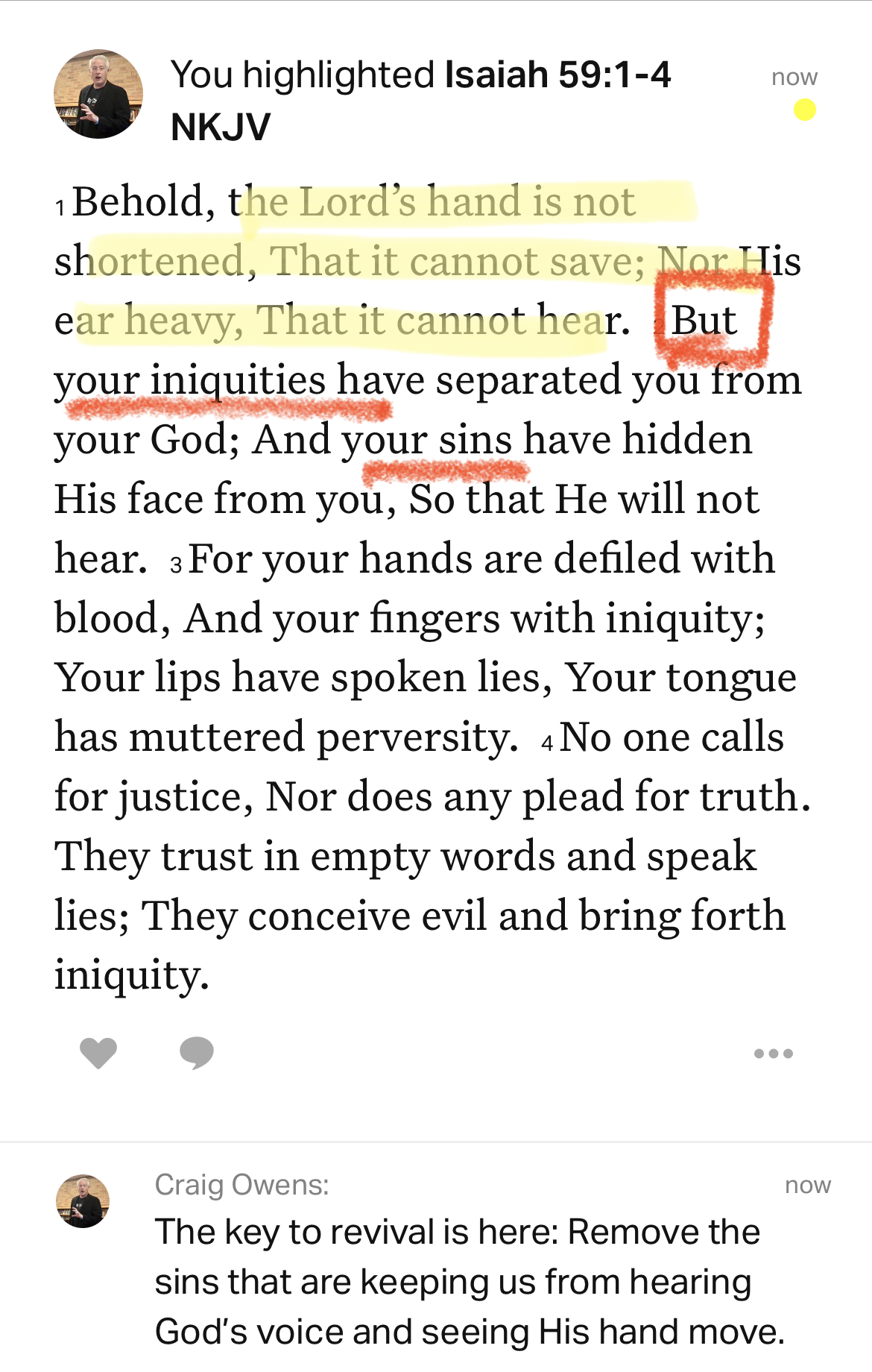
The Path To Revival

Listen to the podcast of this post by clicking on the player below, and you can also subscribe on AppleSpotify, or Audible. 

As we rejoin our series looking at the Selahs in the Psalms, let me remind you of the definition of Selah: (a) a pause to reflect—or “pause, and calmly think of that,” as the Amplified Bible says; (b) notice the contrasts; or (c) get ready for a crescendo. 

Psalm 85 is a longing for revival. Not only longing for it but giving us the path to revival. 

Many Christians say they want revival, but I’m not so certain they have the biblical definition in mind. When most people define revival, they use descriptions about exuberant worship, manifestations of the gifts of the Holy Spirit, the church reenergized for ministry, and non-believers flocking to see what’s happening and then accepting Jesus into their hearts as a result. 

But those are actually the results of revival, not the revival itself. 

Take a look at this overview of Psalm 85: 

  • a look back (vv. 1-3) 
  • a look around (vv. 4-6) 
  • a look ahead (vv. 8-13) 

I am aware that I skipped verse 7 in that overview. That is the middle verse of this psalm, so it is presenting us with the main idea. It’s a longing to see the path forward, the path to revival. It’s not about “getting saved” again because verses 1-3 already thank God for His salvation. 

But let’s notice the Selah. It seems to come mid-thought in the backward look. I think this is both a pause to consider deeply, and also a pause to look at the contrasts. It’s almost as if the sons of Korah, who wrote this psalm, have their breath taken away as they consider the immensity of God’s love that covers our sins! 

That word “cover” means to cover our nakedness, conceal our shame, and hide us from our forgiven sins. The alternative is to live in fear of God’s righteous judgment on our unforgiven sin. 

The sons of Korah long for this again. They long for a crescendo of righteousness, which is why in the “look around” section we see the phrases “restore us again” (v. 4) and “revive us again” (v. 6). 

This Hebrew word for “restore” always means a turning:

  • men turning back from God (apostasy) 
  • men turning away from God (backsliding) 
  • men turning away from evil (repentance) 
  • men turning back to God (revival) 

The ball is in our court. God has remained faithful; we are the ones who have sinned and turned away from Him. God hasn’t gone anywhere; we have! 

So revival begins with the recognition of our sin and profound repentance from that sin. Revival is a recognition that I have turned back from God, and now I need to turn away from evil and turn wholeheartedly back to God. 

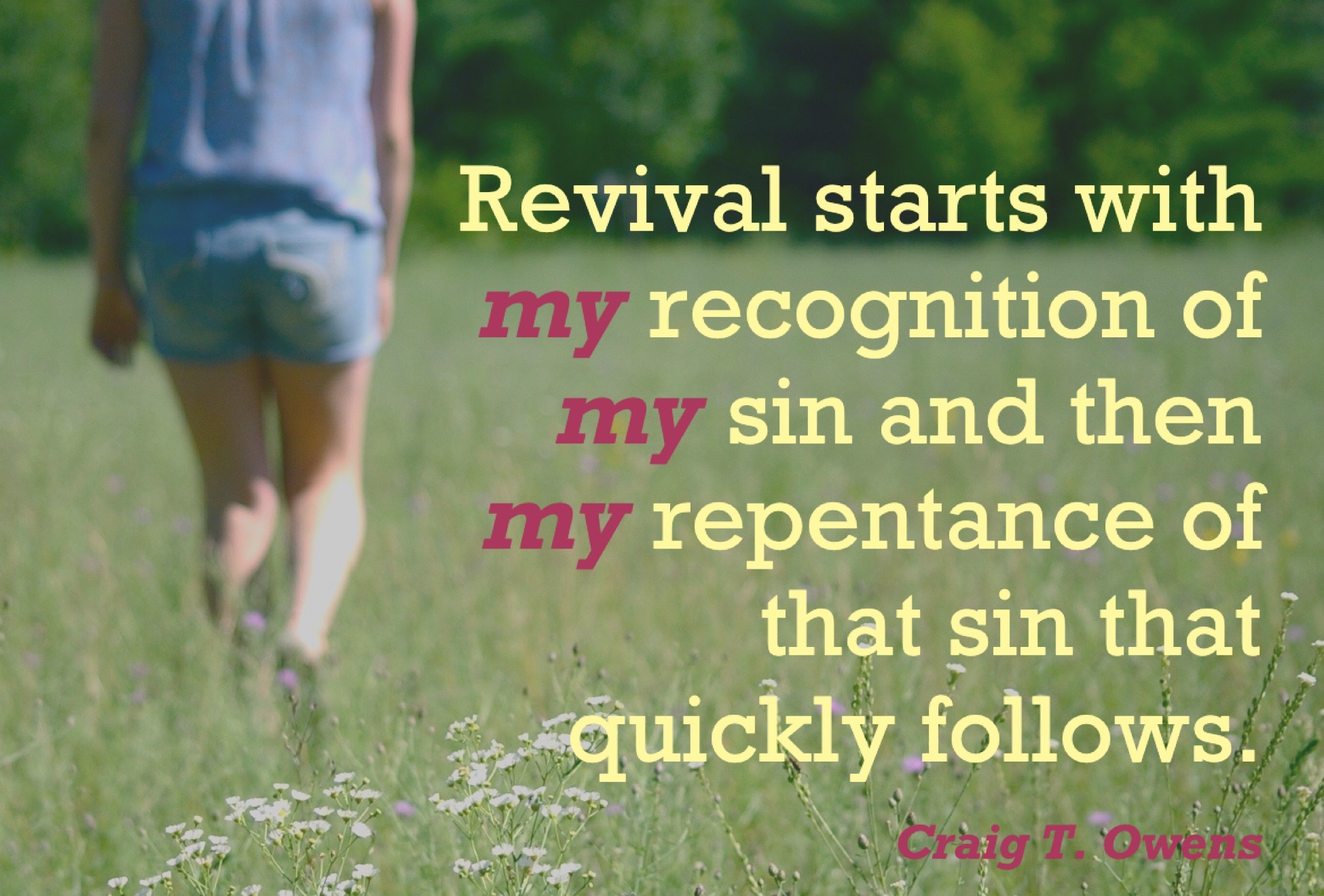
Immediately following that middle verse notice the personal, singular pronoun “I” in verse 8. Revival starts with my recognition of my sin and then my repentance of that sin quickly follows. 

The “show us the way” prayer of verse 7 is answered in verse 13: “Righteousness will go before Him, and shall make His footsteps our pathway” (NKJV). God Himself shows us the way! His footsteps mark the path for us to walk! 

Just as Jesus told us He was the way (John 14:6). 

When we repent from following any other path, revival and restoration happen. The fruit of revival is then a life sustained, quickened, and equipped by God’s presence that will draw others to Him too! 

Let us SELAH—pause and consider the forgiving love of God, the need for my repentance, and then let us enjoy the crescendo of living in daily revival! 

If you have missed any of the other messages in our Selah series, you can find all of those messages by clicking here. 

►► Would you please prayerfully consider supporting this ministry? My Patreon supporters get behind-the-scenes access to exclusive materials. ◀︎◀︎
Medical Science And The Bible

Listen to the podcast of this post by clicking on the player below, and you can also subscribe on AppleSpotify, or Audible. 

I just love it when science catches up with what God has already pronounced in the Bible!

I’ve blogged previously about psychology, archeology, and astronomy uncovering truths that have already been stated in the Bible, but there are also numerous recent medical discoveries that confirm what Scripture has already been telling us. 

Like the fact that there is a healthy way to relieve stress, and that retaining the stress hormone cortisol in our bodies for too long has serious implications. The apostle Paul tells us to not “be anxious about anything” but to enjoy “the peace of God which transcends all understanding” (Philippians 4:4-7). 

Or that getting the right amount of sleep is so beneficial to long-term health. The Bible tells us that God “grants sleep to those He loves” and we can have the assurance that “when you lie down, you will not be afraid; when you lie down, your sleep will be sweet” (Psalm 127:2; Proverbs 3:24).

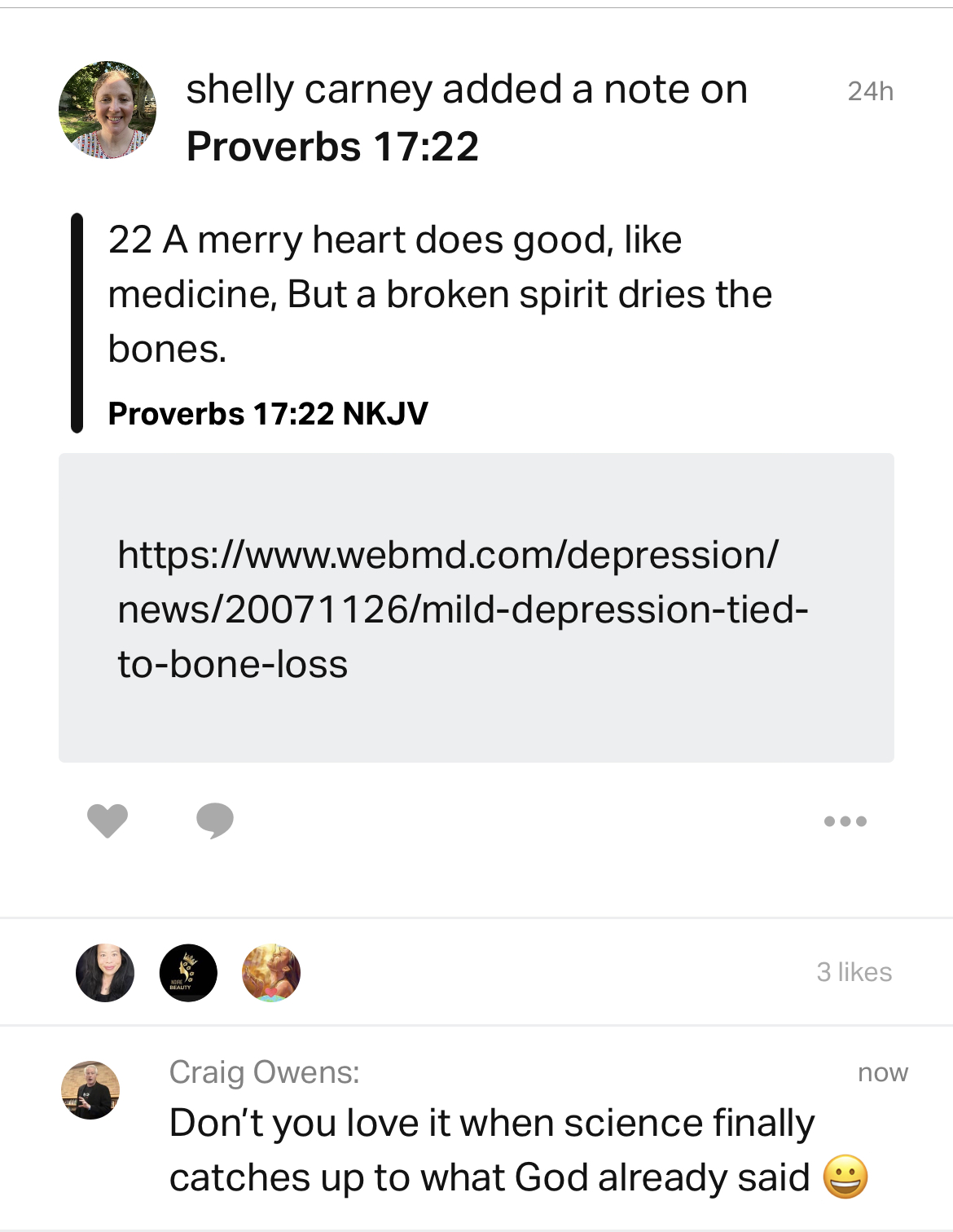
And then there is this finding that my YouVersion friend Shelly pointed out. “A happy heart is good medicine and a cheerful mind works healing, but a broken spirit dries up the bones” (Proverbs 17:22 AMP). 

In a WebMD article, medical science confirms this truth of dried-up bones resulting from depression. They wrote, “Even mild depression may significantly increase a woman’s risk for developing osteoporosis. … The level of bone density loss attributed to depression in the study was similar to that previously associated with other well-known osteoporosis risk factors, including smoking cigarettes and getting little or no exercise. … Bone mineral density testing revealed that 17% of the depressed women showed evidence of bone thinning at a particularly vulnerable area of the thigh bone, compared to 2% of women who were not depressed.” 

The Bible is God’s inspired Word to humankind, which means it is never out of date. The principles God has shared with us stand the test of time and are continually verified by the brightest scientific minds. 

So here is my challenge to you: Take God at His Word, and apply the principles He has given you. I think you will find how much better your life will go when you live God’s way.

►► Would you please prayerfully consider supporting this ministry? My Patreon supporters get behind-the-scenes access to exclusive materials. ◀︎◀︎