Walking Intimately

Listen to the podcast of this post by clicking on the player below, and you can also subscribe on AppleSpotify, or Audible. 

There’s an interesting verb used with both Enoch and Noah that denotes intimate fellowship—the word is “walked.”

Enoch walked with God; and he was not, for God took him. (Genesis 5:24) 

These are the records of the generations of Noah. Noah was a righteous man, blameless in his generation. Noah walked with God. (Genesis 6:9)

David uses this same verb when he prays, “Vindicate me, Lord, for I have walked in my integrity, and I have trusted in the Lord without wavering. Examine me, Lord, and put me to the test; refine my mind and my heart. For Your goodness is before my eyes, and I have walked in Your truth” (Psalm 26:1-3). 

And Solomon uses the same verb to say that anyone who walks in righteous integrity leaves a legacy of righteousness for his family: “A righteous person who walks in his integrity—how blessed are his sons after him” (Proverbs 20:7). 

There is something important that is implied in this walking. God tells us what it is in this question: How can two walk together unless they agree to do so? (Amos 3:3). 

But make no mistake, God doesn’t agree with whatever path I choose to walk, but I must agree to walk God’s path. 

I must agree that God’s path is best, despite what everyone else is doing—“Then the Lord saw that the wickedness of mankind was great on the earth, and that every intent of the thoughts of their hearts was only evil continually” (Genesis 6:5). Yet Noah didn’t walk with the wicked, but he was commended because he walked with God. 

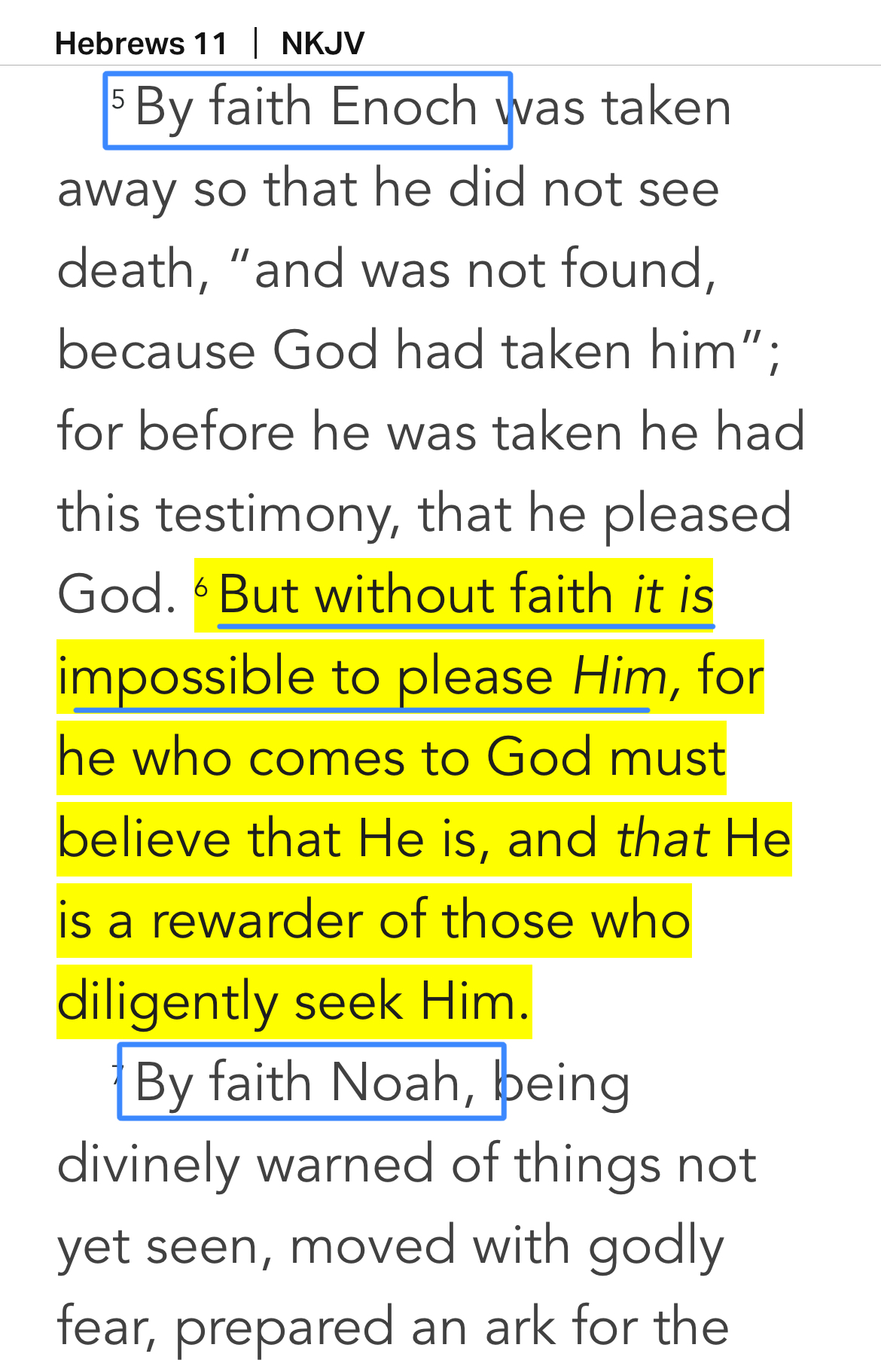
In the New Testament, Enoch and Noah are listed as back-to-back examples of faith (Hebrews 11:5, 7). The verse that connects these two men speaks of the faith-filled integrity that kept them walking with God—

And without faith it is impossible to please Him, for the one who comes to God must believe that He exists, and that He proves to be One who rewards those who seek Him. (Hebrews 11:6) 

That word “seek” means to diligently crave. Enoch and Noah and David show us examples of men who diligently craved walking with God above all else. Their faithful, diligent walking made them stand out from all those around them. 

What about us? Hebrews 11:6 says we can follow their example. We can choose to walk with God by faith. We can diligently crave Him above all else. When we walk righteously with God, He “rewards those” who do—for ever and ever! 

►► Would you please prayerfully consider supporting this ministry? My Patreon supporters get behind-the-scenes access to exclusive materials. Like this exceptional Bible study tool to help with Creation apologetics. ◀︎◀︎

Book Reviews From 2023

I love reading, and I love sharing my love of good books with others! Here is a list of the books I read and reviewed in 2023. Click on a title to be taken to that review.

A Hobbit, A Wardrobe, And A Great War

Opportunity Leadership

Proverbs: Amplified and Applied

Sage Advice

Here are my book reviews for 2011.

Here are my book reviews for 2012.

Here are my book reviews for 2013.

Here are my book reviews for 2014.

Here are my book reviews for 2015.

Here are my book reviews for 2016.

Here are my book reviews for 2017.

Here are my book reviews for 2018.

       Here are my book reviews for 2019.

Here are my book reviews for 2020.

Here are my book reviews for 2021.

Here are my book reviews for 2022.

►► Would you please prayerfully consider supporting this ministry? My Patreon supporters get behind-the-scenes access to exclusive materials. ◀︎◀︎

An Octopus And God’s Word

Listen to the podcast of this post by clicking on the player below, and you can also subscribe on AppleSpotify, or Audible. 

Watching a documentary about an octopus reminded me of something new about God’s Word.

Check out this episode of The Podcast.

Some resources to go along with this video:

►► Would you please prayerfully consider supporting this ministry? My Patreon supporters get behind-the-scenes access to exclusive materials. ◀︎◀︎

The Goals Of Confrontation

Listen to the podcast of this post by clicking on the player below, and you can also subscribe on AppleSpotify, or Audible. 

Say the word “confrontation” and many people cringe. “I try to avoid confrontations with others,” people will quickly say. 

The origin of the word comes from a derivative of the word for “forehead.” The original intent of confrontation was simply putting the facts in front of someone’s face so that they could acknowledge them. 

The problem for most of us (myself included) is two-fold: 

  1. I don’t like to be confronted with things I may be doing incorrectly or incompletely. 
  2. I don’t like making others defensive when I confront them with the things they may be doing incorrectly or incompletely.

As a result, we usually don’t confront others and they usually don’t confront us. Sadly, this can keep us from maturing in areas where we may be able to soar if we could only make some minor changes. 

Christians should be especially open to confrontation from a brother or sister. After all, Solomon told us, “Wounds from a friend can be trusted, but an enemy only multiplies kisses” (Proverbs 27:6). And Jesus warned us, “Woe to you when all men speak well of you, for so did their fathers to the false prophets” (Luke 6:26 NKJV). 

The best confrontation is self-confrontation in the presence of the Holy Spirit. After we have submitted to that loving spotlight, then we can proceed with our loving confrontation with our brothers and sisters. 

Remember this: 

The goals of Christian confrontation are restoration and maturity. 

We want to see wandering saints return to God’s path, and we want those saints who are immature to blossom into Christ-like maturity that brings glory to God. 

I have prepared a flowchart that can help you with a biblical framework for the work of confrontation. Please work through this flowchart slowly and prayerfully. Don’t rush any step, but make sure you can answer an honest “yes” to each question. When you get to the last step, keep in mind these three Ms:

  1. Maturity—self-confrontation and confrontation of others should always be moving us toward maturity. 
  2. Mutual accountability—agree to stay involved in this process, with each of you remaining accountable to each other. 
  3. Mercymercifully restore the one who has strayed so that the entire Christian body of believers can be strengthened.

Here are some resources to help you:

►► Would you please prayerfully consider supporting this ministry? My Patreon supporters get behind-the-scenes access to exclusive materials. ◀︎◀︎
Appointment Vs. Opportunity

Listen to the podcast of this post by clicking on the player below, and you can also subscribe on AppleSpotify, or Audible. 

If we’re not careful, we can get so focused on our own appointments that we will miss out on the amazing opportunities God sends our way to show His love to others.

Check out this episode of The Podcast.

Resources mentioned in this video:

►► Would you please prayerfully consider supporting this ministry? My Patreon supporters get behind-the-scenes access to exclusive materials, like this recent video where I explain how God reveals previously-unknown truths to us. ◀︎◀︎

Links & Quotes

Put the good stuff from the Bible in your heart and mind regularly. When you do, the Holy Spirit can remind you of what you’ve studied and help you apply it to your daily situations. I have lots of new content every week, which you can check out on my YouTube channel.

“It pays to know the enemy—not least because at some time you may have the opportunity to turn him into a friend.” —Margaret Thatcher

John Stonestreet and Dr. Glenn Sunshine shared this, “The despicable and horrendous attacks by Hamas against civilians last week, including beheading children and kidnapping the elderly, seems a throwback to some distant, barbaric past of human history. We may have thought the world had long ago outgrown such barbarity, but it hasn’t. In fact, as shocking as it is, the kinds of atrocities carried out by the Hamas terrorists are the norms of warfare, at least throughout most of human history.” What changed this? Quite simply: a Christian worldview of just warfare.

“It is the quiet, steady appeal that moves the heart of kings. So then, the wise find ways to bring their cause visibly before the authority without being annoying. This is subtle art; it is not manipulation. This silent plea communicates to the leader a determination and resolve that appeals deeply to their conscience. Fools make themselves annoyingly heard; the wise make themselves dignifiedly seen.” —Dick Brogden, in Proverbs: Amplified and Applied

Links & Quotes

God made you uniquely YOU! You have been made on purpose and for a purpose. I have lots of new content every week, which you can check out on my YouTube channel.

This is an exciting archeological discovery: the first Koine Greek rendering of a psalm ever discovered inscribed on stone rather than on parchment or papyrus.

“The wise recognize before the fight that adversity will come and therefore are not surprised by it. The wise recognize in the fight that adversity is a formidable foe and thus steel themselves for a long, hard struggle to the death. The wise recognize after winning a fight that the war is not over and so never let down their guard nor release their weapons.” —Dick Brogden, in Proverbs: Amplified and Applied

Astronomers have discovered planet-sized objects that are puzzling the best minds. In fact, they have had to create a new category for these objects: Jupiter Mass Binary Objects (JuMBOs). What is baffling the brightest minds is that these planets don’t orbit a star but appear to be gravitationally bound to other JuMBOs. My favorite line is this one: “The new phenomenon challenges current frameworks explaining how stars and planets form within nebula, with astrophysicists claiming such objects should not exist.” There is at least one who isn’t baffled: The One who created JuMBOs along with everything else in our universe.

T.M. Moore is in the midst of a series of posts about the Christian and the government. They are excellent! Here is just a short sample—“The Christian understands that government is a servant of God for good, and that God, therefore, must define the terms of goodness by which a government fulfills its appointed task. As Paul reminds us, the Law of God is holy and righteous and good (Romans 7:12). It is important, therefore, that Christians understand the Law of God and consider the best ways of bringing its influence to bear in the arena of public policy. … Public policy is not about what governments can do, but what they should do, that is, if they are to fulfill their callings as God’s servants for good. When it comes to applying the Law of God to public policy, Christians must make this first principle foundational in the logic with which they approach the work of influencing and shaping public policy.”

“The weak can never forgive. Forgiveness is an attribute of the strong.” —Mahatma Gandhi

Leaders are naturally wired to be either confident or humble. Both kinds of leaders need to remain coachable. Greg and I unpacked this idea on this episode of The Craig And Greg Show, and I also discuss it in greater depth in my book Shepherd Leadership.

A Hard Word For A Good Reason

Listen to the podcast of this post by clicking on the player below, and you can also subscribe on AppleSpotify, or Audible. 

Is it okay for a friend to hurt another friend’s feelings? Let’s talk about it.

Check out this episode of The Podcast.

Resources mentioned in this video:

►► Would you please prayerfully consider supporting this ministry? My Patreon supporters get behind-the-scenes access to exclusive materials, like a 10-minute video I just shared on study tips for the poetic books of the Bible. ◀︎◀︎

Probably Not A Straight Path

Listen to the podcast of this post by clicking on the player below, and you can also subscribe on AppleSpotify, or Audible.

Sometimes, as I look back on my life, I wonder how I ended up where I ended up. It certainly hasn’t been a journey that I could have mapped out. 

Nor would I have wanted to try. 

God has so perfectly and lovingly led me to positions and experiences that have taught me invaluable lessons. These are lessons I would have missed out on had I been the one in charge of my path. 

As I was meeting with a group of pastors online, I shared a brief story about one of the unexpected paths God brought me to.

There are two places in the Bible that have really helped me. First is the wise words of King Solomon: “Trust in the Lord with all your heart and lean not on your own understanding; in all your ways submit to Him, and He will make your paths straight” (Proverbs 3:5-6).

I don’t think “straight“ means a clear path. But it does mean that God is leading me straight to His destination for me. 

The other verse is this, “And we know that in all things God works for the good of those who love Him, who have been called according to His purpose” (Romans 8:28). This promise assures me that not one experience in my life—pleasant or unpleasant—has been wasted. God is using all these things for my good and for His glory.

So, the next time you find yourself wondering how you ended up where you ended up, be assured that God has a plan and a purpose for your life and that He is overseeing every step of your journey. 

►► Would you please prayerfully consider supporting this ministry?  My Patreon supporters get behind-the-scenes access to exclusive materials, like a 10-minute video I just shared on study tips for the poetic books of the Bible. ◀︎◀︎

Spotting The Attitude That Derails

Listen to the podcast of this post by clicking on the player below, and you can also subscribe on AppleSpotify, or Audible. 

There is an attitude that can derail almost everything. I’d like to help you spot it ahead of time.

Check out this episode of The Podcast.

Resources mentioned in this video:

►► Would you please prayerfully consider supporting this ministry? My Patreon supporters get behind-the-scenes access to exclusive materials. ◀︎◀︎