Listen to the podcast of this post by clicking on the player below, and you can also subscribe on Apple, Spotify, or Audible.
The Israelites had just been released from the slavery in Egypt when they faced one of the most difficult places they would know. God taught them how to thinking differently in this hard place.
Listen to the podcast of this post by clicking on the player below, and you can also subscribe on Apple, Spotify, or Audible.
The Christians could have used the “great persecution” that broke out against them (Acts 8:1) as a great excuse to hide or to remain quiet. After all, Saul and his hoard were specifically targeting those who were known to be Christians, so keeping quiet or out of sight might have saved their lives.
Instead, these fearless Christians used this great persecution as a messenger from God to keep them on-mission in fulfilling the Great Commission (Matthew 28:18-20; Acts 1:8), taking the Gospel to even the despised Samaritans (Acts 8:4)!
Would they have taken this message to these folks without this “nudge” of persecution? Maybe, but then again, maybe they would have stayed in Jerusalem and delayed too long in sharing with those who lived in the capital city. It’s a really good bet that without this persecution they wouldn’t have come up with the idea of going to Samaria on their own!
I think we can learn some good lessons from this incident. When unexpected difficulties crash into our lives, let’s re-frame our thinking. Instead of using this hardship as an excuse to do less, let’s ask:
Do I need to re-evaluate what I have (or haven’t) been doing? Do I need to repent of anything?
Am I on-mission as a Christian witness? Am I consistently using my God-given gifts in God-glorifying ways to point others to Jesus?
How can I live out and proclaim the Word of God even in this unexpected place?
Let’s be like those Christians who didn’t grumble, who didn’t hide, who didn’t make excuses. But they said, “This is just another opportunity for us to invite people to meet Jesus as their Lord and Savior,” and then they joyfully moved forward.
Christians do a disservice to the Gospel when we’re known more for what we’re against than what we’re for.Check out this full message here. I have lots of new content every week, which you can check out on my YouTube channel.
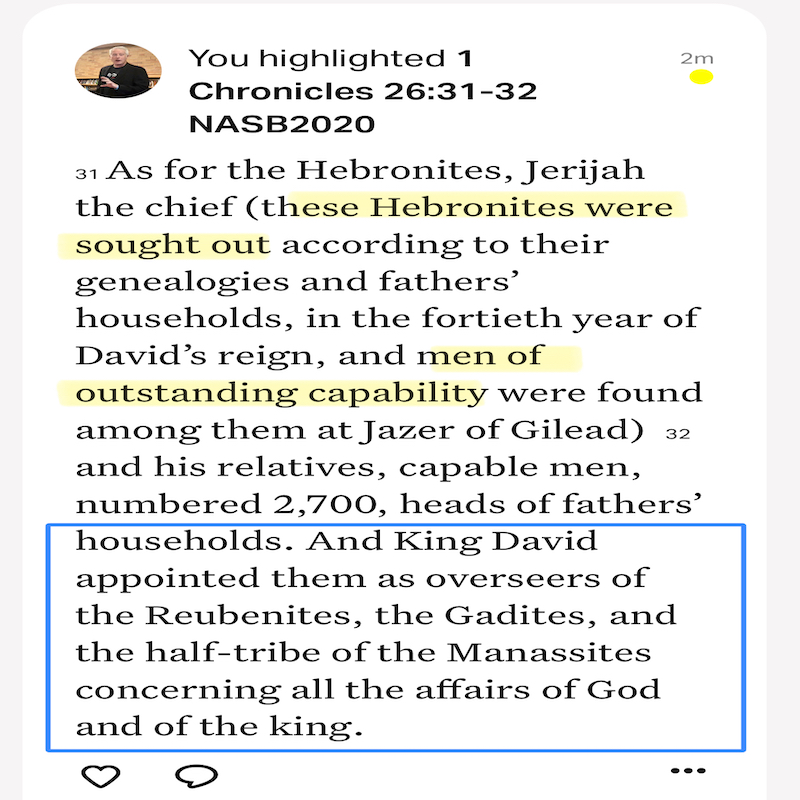
The Hebronites faithfully served God and King David without any fanfare or recognition. God shined His light on these “men of outstanding capability” so that they were finally recognized publicly. Note that they didn’t try to promote themselves. They faithfully served and God promoted these humble men in His timing.
I always appreciate the straightforward leadership insights that Ken Blanchard shares. He wrote, “Leadership is not something you do to people, but something you do with people.” And in this post he discusses some strategies when one of your direct reports is struggling.
“If I find 10,000 ways something won’t work, I haven’t failed.” —Thomas Edison
“We are a Christian people, according to one another the equal right of religious freedom, and acknowledging with reverence the duty of obedience to the will of God.” —1931 Supreme Court ruling
The Holy Spirit reminds us of God’s Word. But in order for Him to remind us, we have to study it first! Check out this full message.
“Your real, new self…will not come as long as you are looking for it. It will come when you are looking for God.” —C.S. Lewis, in Mere Christianity
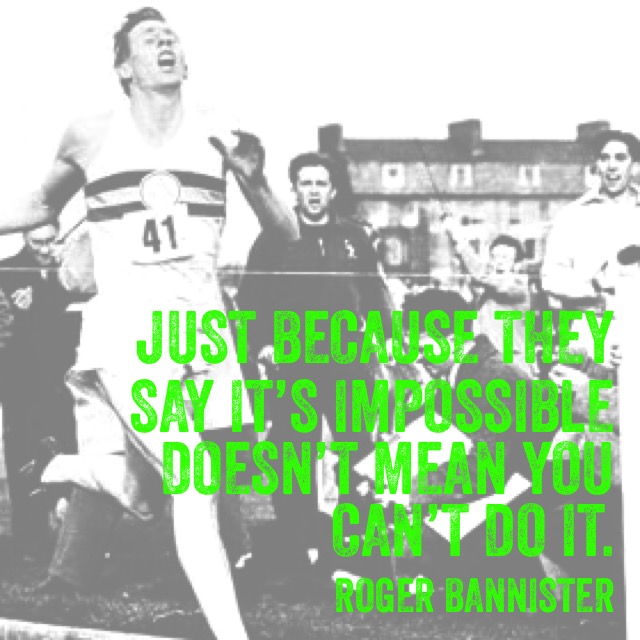
“Just because they say it’s impossible doesn’t mean you can’t do it.” —Roger Bannister, who broke the “impossible” barrier of running less than a 4-minute mile on May 6, 1954
Listen to the podcast of this post by clicking on the player below, and you can also subscribe on Apple, Spotify, or Audible.
Have you ever been going through a difficult time in your life and wondered to yourself, “What in the world is going on here?” I might have a different way for you to think about that!
The Holy Spirit loves to give us those “lightbulb moments” when the Word of God almost leaps off the page! I have lots of new content every week, which you can check out on my YouTube channel.
It has long been believed that some migratory animals use the earth’s magnetic force to help them navigate. Some researchers discovered that moths can see both the magnetic fields and the stars to plot their course. The lead researcher wrote, “If you have this tiny insect with a brain a tenth the volume of a grain of rice and eyes smaller than a pinhead, that they can do this is surprising.” The protein in their eyes that allow them to do this is unevolved—it’s always been there, implant from the beginning by our awesome Creator!
In the God Speaks Science reading plan on YouVersion, John Von Sloten wrote, “Creation is God’s first book. To read it we need science. Science is not the enemy of the Christian faith; it’s an ally! … We need to read biblical creation references with the Author’s omniscience and original intent in mind. To do that, we need science. … What if you try to connect the next scientific truth you encounter to an attribute of our ever-near God? If everything comes from God’s mind, then everything has something to say about God’s nature.”
Competitive leaders need to keep both winning and losing in perspective. Check out the full conversation Greg and I had about competition on The Craig and Greg Show.
Listen to the podcast of this post by clicking on the player below, and you can also subscribe on Apple, Spotify, or Audible.
I read something which is really challenging my leadership paradigm. It’s a challenge to look at successful organizations through the lens of both a servant-hearted leader and a servant-hearted follower.
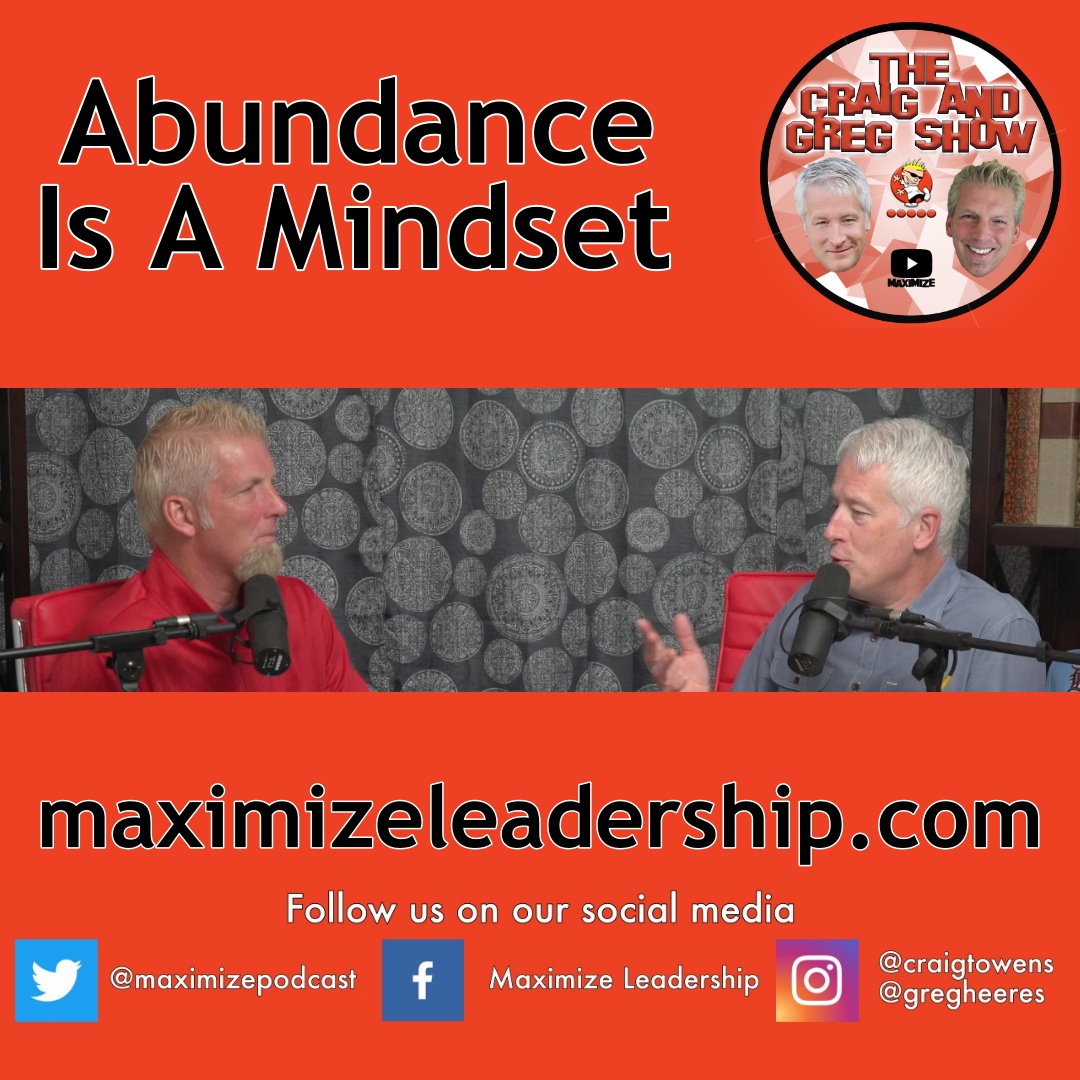
[19:17] You don’t have it all, so don’t act like it!
[19:43] Greg would love to help your organization develop an abundance mindset.
Check out this episode and subscribe on YouTube so you can watch all of the upcoming episodes. You can also listen to our podcast on Spotify and Apple.
Listen to the podcast of this post by clicking on the player below, and you can also subscribe on Apple, Spotify, or Audible.
Why is it that so many people have a worst-case mindset as their guiding factor?
As a leader responsible for programs, and large groups of people, and the financial well-being of organizations, I know that I frequently fell into this trap. When we began making plans for the future, I wanted to keep a “fallback plan” in place. I frequently found myself saying to our leadership team, “Even in the worst case scenario we can….”
But then I realized how much vitality this was sapping from our team.
If we as leaders want to infuse more energy and excitement in our teams it may take some paradigm shifts on our part. Here are three shifts that I have endeavored to implement in my life:
Shift scarcity to abundance.
Shift fear to hope.
Shift worst-case to best-case.
On a recent episode of our leadership podcast, my friend Greg Heeres and I discussed the limitations that come as a result of a leader’s limiting fears.
As a Christian, I believe the greatest Helper in these three paradigm shifts is the Holy Spirit. When I take time to pray about the big decisions for my personal life and for the organizations I lead, I find that His guidance helps me tap into God’s abundance, which gives me hope for the best-case scenarios to be realized. This hope in me quickly translates to hope and expectation in my team.
Leaders, start with prayer and then try these three paradigm shifts. As the Holy Spirit transforms your heart and mind, I believe you will begin to see a greater energy and excitement in the organizations that you lead.
Let’s stop asking, “What’s the worst thing that could happen?” and shift to asking, “What’s the best thing that could happen?”
Listen to the podcast of this post by clicking on the player below, and you can also subscribe on Apple, Spotify, or Audible.
David uses the phrase “no one” three times in verse 4 of the 142nd Psalm. This verse is also the middle verse of the psalm. Since Hebrew literature often puts the central message in the center, we should start with this verse and then see the message that radiates out from the center.
In this middle verse, David realizes that no earthly help can sustain him:
no one is at my right hand with any strength to lend to me
no one is truly concerned for my wellbeing
no one can help my eternal soul
Radiating out from this middle verse we see…
…God, You watch over me, and You are my refuge (vv. 3, 5)
…I pour out my complaint to You, God, and You listen and respond to me (vv. 2, 6)
…God, I cry to You for mercy, and You set me free from my prison (vv. 1, 7)
I find it interesting that David calls it “my prison.” David has learned that God may allow affliction and shaking so that he will see that there is only One who is reliable and stable. Trusting in anything or anyone else becomes, in essence, a prison.
In verse 7, David mentions God’s “goodness to me.” Sometimes this word for goodness is translated “bountiful,” and it comes from a Hebrew word that can mean “to be weaned.” David is sharing with us that our afflictions can wean us from all human help so that we can fully enjoy the bountiful goodness of our loving God!
When it appears that there is no one around to help me, that is actually a good thing.
It’s a good thing because it means that now that everything else has been cleared out of my way, I can clearly see The Only One that truly cares about me both today and forevermore!









 Craig T. Owens