Listen to the podcast of this post by clicking on the player below, and you can also subscribe on Apple, Spotify, or Audible.
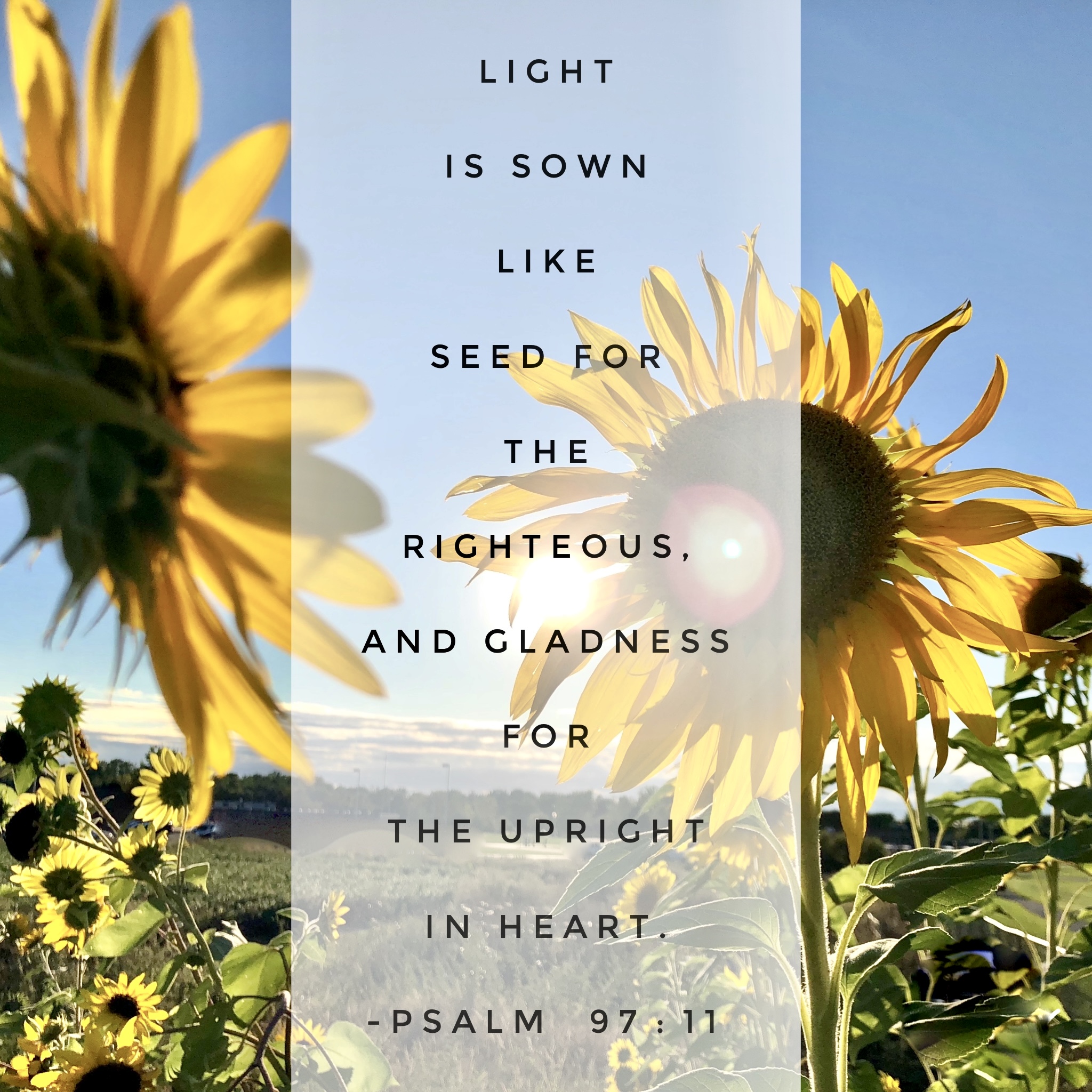
Light is sown like seed for the righteous, and gladness for the upright in heart. (Psalm 97:11)
Jesus used the parable of a farmer sowing seed as a picture of the seed God wants to sow in our hearts. The psalmist says that God’s seeds are light—driving out the shadows of darkness, and producing an abundant harvest of gladness in our hearts.
I like how the Amplified Bible renders this verse in Psalm 97—Light is sown for the uncompromisingly righteous and strewn along their pathway, and joy for the upright in heart—the irrepressible joy which comes from consciousness of His favor and protection.
Let’s live in a such a God-honoring way that His seeds of light bring forth an abundant harvest that gives Him all the glory and points others to Jesus the Savior.
Listen to the podcast of this post by clicking on the player below, and you can also subscribe on Apple, Spotify, or Audible.
“…the Jews there tried to stone You, and yet You are going back?” (John 11:8).
The disciples were sitting around Jesus contemplating the next steps when they heard the news that Jesus’ friend Lazarus was sick and on death’s doorstep.
This statement seems to be a very logical thought. At least it is logical from a human perspective. But God sees wider, farther, and deeper than we ever will, so His logic is both perfect and limitless.
Yes, the Jews had tried to stone Jesus (8:59; 10:31, 39), and for mere men operating and thinking as men, staying away from danger is a logical conclusion.
But Jesus was on-mission from His Father (5:19). He had to go to Bethany because the sickness of Lazarus “will not end in death. No, it is for God’s glory so that God’s Son may be glorified through it” (11:4). Later, at the tomb of Lazarus, Jesus prayed, “This is for the benefit of the people standing here, that they may believe that You sent Me” (v. 42). When the dead Lazarus was returned to life and came out of the grave, God indeed was glorified!
Jesus declares that when we walk with Him, we always walk in the light (v. 9). This is because He IS the light of the world (8:12; 9:5). And as we walk with Him, we too bear the light wherever He calls us to walk (Matthew 5:14).
To walk in our own logic is to stumble in the darkness (John 11:10). We calculate and plan from a place of scarcity and fear. As a result, we stumble right past—or we sit still out of fear—and miss the opportunities for God’s glory to be displayed.
My logic always has a dark edge that I cannot see past. But the logic of God has no dark places because He can see from beginning to end perfectly.
I must daily walk in His light, even into those places where my limited logic would tell me to avoid. It is there that I will be able to witness God’s glory that I wouldn’t have seen had I sat still in my “safe” place.
Listen to the podcast of this post by clicking on the player below, and you can also subscribe on Apple, Spotify, or Audible.
Have you ever wondered why the Roman soldiers treated Jesus so cruelly? After all, these are professional soldiers so why are they acting in such an unsoldierly way (see Mark 15:16-20)?
Perhaps they thought that Jesus was just another criminal that was in cahoots with Barabbas—a murderer and insurrectionist. But where would they get that idea? It must have come from the lies and slander that the Sanhedrin were spewing.
Perhaps the soldiers had a low value of all human life. Where would this come from? First from their leadership: particularly the way history tells us that Pontius Pilate treated the Jews. But we can go a little broader because we also know from history the disregard the Romans had for the weak, the young, the sick, and the aged.
The bottom line is this: Anytime there is a departure in even the slightest degree from the Great Commandment—love God, love yourself, and love your neighbor—the resulting society is dark and ugly, with people mistreating others in the most inhumane of ways.
We stand as a check against the decay in societal values. Our high view of God’s power and love, our proper understanding of each person’s worth in God’s sight, and the way we express genuine love for others—especially the weak and marginalized—is a preservative to the moral decay.
It’s so easy to get caught up with the loud voices around us. Pontius Pilate did, the Roman soldiers did, the Sanhedrin did, and the crowds that listened to these leaders did too.
If you are concerned about the moral decay you see in your neighborhood, the movies and music that are released, or the behavior of our elected officials, we must adhere all the more closely to the Great Commandment: Love God with all your being, maintain a healthy self-image in light of God’s love for you, and then love your neighbor—allof your neighbors—in the same way God loves you.
Listen to the podcast of this post by clicking on the player below, and you can also subscribe on Apple, Spotify, or Audible.
I’ve noticed that when people want to sound super-spiritual that they like to use King James Version phrases. Sometimes I hear people speaking in normal, everyday English until they begin praying and then I hear, “Thy servant … Thou O Most High … we beseech Thee … Thou knowest Thine children….”
Statement #6 in our series “Is that in the Bible” also sounds more powerful when people quote it in King James English—Shun the very appearance of evil or sometimes Wherefore come out from among them, and be ye separate, saith the Lord. Are those in the Bible? Yes, they are!
We don’t use the word “shun” very often today, but in what was probably the first written book of the Bible we read that not only did Job shun evil, but God commended him for shunning evil too. And wise King Solomon advocated for his readers to shun evil (Job 1:1, 8; 2:3; Proverbs 3:7, 14:16).
Yes, those phrases that I quoted earlier come right from the King James Version of the Bible in 1 Thessalonians 5:22 and 2 Corinthians 6:17, but does this mean that we are to stay away from anything that is “unChristian”? Does it mean that we are to shun sinners?
There is a story that is told in the synoptic Gospels, but I especially like it in Matthew’s Gospel for one specific reason (which I’ll share with you in a moment). Jesus has just called Matthew to be His disciple, and several of Matthew’s coworkers appear to be having a going-away dinner for him which Jesus attended.
Then comes the “911” call from the Pharisees (this statement is in Matthew 9:11): “Gasp! Jesus is eating with sinners! He’s not shunning them! Call in the sin police!” The New Living Translation is even more harsh, with the Pharisees asking, “Why does your Teacher eat with such scum?” (v. 13 NLT).
In Luke’s Gospel we read another story where Jesus eating with “such scum” turned another tax collector’s life around. In Luke 19:1-10, we read of Zaccheus experiencing a complete life change because of His encounter with Jesus.
Listen to Christ’s words in both Matthew and Luke: “It is not the healthy who need a doctor, but the sick. … I have not come to call the righteous, but sinners. … The Son of Man came to seek and to save what was lost” (Matthew 9:12-13; Luke 19:10).
This doesn’t sound like Jesus shunned sinners.
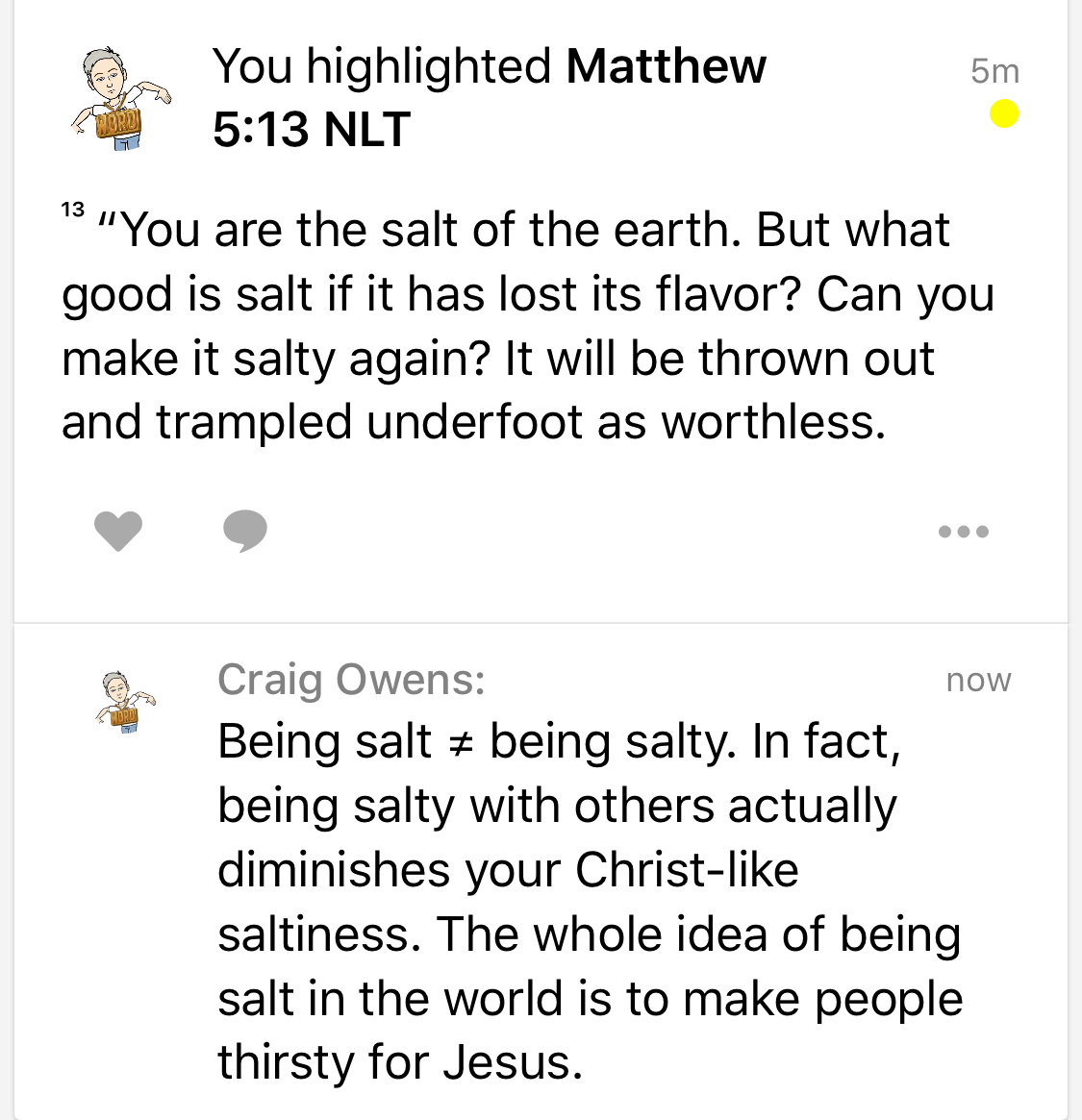
Likewise, Jesus called us to be His salt and light in the world (Matthew 5:13-14). No matter how beneficial the salt of my life is, it doesn’t help anyone if it stays in the saltshaker, shunning the food. No matter how bright the lantern of my life is, it doesn’t help anyone in a closed closet, shunning the darkness.
Notice what Jesus didn’t do. He didn’t go to Matthew’s house or Zaccheus’ house for a good time, or for a good meal, or for a time of entertainment. He was on mission. So too for Christians: We go into dark places not for our pleasure or entertainment, but because we’re on a rescue mission!
In both the Old Testament Hebrew and the New Testament Greek, the words for “shun” point at our own hearts. The words mean: You walk away from things that will pull you down, or you hold yourself back from the places and things that will lead you to sin.
So look at the phrase “Shun the very appearance of evil” in its context: “Do not quench the Spirit. Do not treat prophecies with contempt but test them all; hold on to what is good, reject [or shun] every kind of evil” (1 Thessalonians 5:19-22).
Paul is calling us to shun the things that drown out the voice of the Holy Spirit. Listen to two of those verses in another translation: “But test and prove all things until you can recognize what is good; to that hold fast. Abstain from evil” (vv. 21-22 AMP).
In 2 Corinthians 6 the phrase “Be ye separate” is in the context about being “unequally yoked” with unbelievers. This is what happened to King Solomon when he married women who were idolaters, and they pulled his heart away from God.
“Shun” means to keep away from those things that would pull you down. How do I know if a certain environment or activity or person is pulling me down? I need to check my thoughts, attitudes, and actions. If I find they are becoming un-Christlike, then that is an indication of a place or person that I need to limit my exposure.
As long as my thoughts, attitudes, and actions remain Christlike, I should keep on seasoning and shining in dark places so that I can draw others to Jesus. “Do everything without complaining and arguing, so that no one can criticize you. Live clean, innocent lives as children of God, shining like bright lights in a world full of crooked and perverse people” (Philippians 2:14-15 NLT).
Don’t shun people that Jesus dearly loves, but don’t put yourself in a position where your devotion to God is compromised either. Listen to the voice of the Holy Spirit giving you the wisdom you need to be both on-mission for Jesus and shining a bright, innocent light!
Listen to the podcast of this post by clicking on the player below, and you can also subscribe on Apple or Spotify.
Don’t you wish that you could clean things up and they would stay clean? After you get everything set the way you like it, why can’t it just stay that way? Quite simply, things can’t stay clean and pristine because of the Law of Entropy. Entropy is the measure of disorder in a system, and the Law of Entropy says that unless sufficient energy is applied, an ordered system will always move toward disorder. This is as true spiritually as it is in physics.
God created a perfectly ordered system both physically and spiritually, but man’s sin brought in disorder, disease, and decay. It gets so bad that just three chapters after man’s first sin we read, “The Lord saw how great the wickedness of the human race had become on the earth, and that every inclination of the thoughts of the human heart was only evil all the time” (Genesis 6:5).
Throughout history, there have been revivals, reformations, and awakenings where people see the disorder and decay that sin has brought to their lives and they want to return to God. The pain of entropy causes people to repent, and the Spirit of God moves in with sufficient energy to restore. Sadly, unless the Holy Spirit’s energy is continually applied, entropy will again begin to run its downward course.
Jesus not only came to reverse the entropy of sin (see Isaiah 9:2, 49:9; John 1:5, 8:12), but He sent us out into a sinful world to do the same thing. Jesus told us that we are salt that reverses entropy’s decay and we are light that reverses entropy’s darkness (Matthew 5:13-14). Jesus also told us that there’s no way we can maintain this entropy-reversing energy on our own—we need the Holy Spirit’s empowerment (Luke 24:49; Acts 1:8). [Check out all of these verses by clicking here.]
Paul talked about this same idea in 2 Corinthians 3. He contrasts the ministry of the Old Testament with its fading glory, and the ministry of the New Testament with terms like moreglorious, surpassing glory, and ever-increasing glory.
Do you realize that Spirit-filled Christians never have to long for “the good ol’ days”? Being baptized in the Holy Spirit means, as Paul reminds us, that we are perpetually being transformed into the image of Jesus and we are therefore reflecting more and more of His glory. Every day can be more glorious than the day before. We don’t have to experience any entropy in our spiritual walk.
This isn’t because of our actions. Paul says, “not that we are competent in ourselves…but our competence comes from God. … [We] are being transformed into His likeness with ever-increasing glory, which comes from the Lord, who is the Spirit.”
Spirit-filled Christians are the agents of change in the world IF we are being transformed by the Holy Spirit. In other words, we will tend toward entropy (and uselessness) unless we have the Spirit’s energy continually applied to our lives.
Being transformed is an ongoing, continual process. We have to have the energy of the Holy Spirit continually at work on us personally to keep us from entropy. And then we’ll be able to reflect that entropy-defeating light to a dark world.
I’ve said this before, but I’m going to keep on saying it: Don’t stop at salvation—be baptized in the Holy Spirit. Don’t let entropy decay your salt or dim your light. Let the Holy Spirit help you reflect the light Jesus so that you can reverse the entropy of a dark, sinful world.
This is a weekly series with things I’m reading and pondering from Charles Spurgeon. You can read the original seed thought here, or type “Thursdays With Spurgeon” in the search box to read more entries.
Be A Reflector
For it is the God who commanded light to shine out of darkness, who has shone in our hearts to give the light of the knowledge of the glory of God in the face of Jesus Christ. (2 Corinthians 4:6)
It is by the heart that we know God and Christ, and as our affections are purified, we become sensible of God’s presence in Christ. … Our beholding Him has purified the eyes that have gazed upon His purity. His brightness has helped our eyesight so that we see much already and will yet see more. …
Why did not everybody see the glory of God in Jesus Christ when He was here? It was conspicuous enough. Answer: It matters not how brightly the sun shines among blind men. … What, then, has happened to us? To eternal grace be endless praise! God Himself has shined into our hearts. That same God who said, ‘Light be,’ and light was, has shined into our hearts! … If you can delight in God in Christ Jesus, then remember, no man can say that Jesus is the Christ but by the Holy Spirit, and you have said it [Matthew 16:13-17]! …
You must not hoard up the light within yourself—it will not be light to you if you do. Only think of a person when his room is full of sunlight saying to his servant, ‘Quick, now! Close the shutters and let us keep this precious light to ourselves.’ Your room will be in the dark, my friend! …
A man of God, when he receives the light of Christ, can become so perfect a reflector that to common eyes, at any rate, he is brightness itself! … Scatter your light in all unselfishness. Wish to shine, not that others may say, ‘How great he is,’ but that they, getting the light, may rejoice in the Source from which it came to you and to them.
From The Glory Of God In The Face Of Jesus Christ
As the old hymn reminds us, “’Twas grace that taught my heart to fear, and grace my fears relieved; how precious did that grace appear the hour I first believed.” It is by God’s grace alone that we have been given light to see Jesus and to place our faith in Him!
This is a weekly series with things I’m reading and pondering from Oswald Chambers. You can read the original seed thought here, or type “Thursdays With Oswald” in the search box to read more entries.
No Undercover Christians
The illustrations our Lord uses are all conspicuous—salt, light, and a city set on the hill. There is no possibility of mistaking them. …
“You are the salt of the earth.” Some modern teachers seem to think our Lord said, “You are the sugar of the earth,” meaning that gentleness and winsomeness without curativeness is the ideal of the Christian. Our Lord’s illustration of a Christian is salt, and salt is the most concentrated thing known. Salt preserves wholesomeness and prevents decay. It is a disadvantage to be salt. Think of the action of salt on a wounded, and you will realize this. If you get salt into a wound, it hurts, and when God’s children are amongst those who are “raw” their presence hurts. The man who is wrong with God is like an open wound, and when “salt” gets in it causes annoyance and distress and he is spiteful and bitter. … How are we to maintain the healthy, salty tang of saintliness? By remaining rightly related to God through Jesus Christ. …
“You are the light of the world.” Light cannot be soiled; you may try to grasp a beam of light with the sootiest hand, but you leave no mark on the light. A sunbeam may shine into the filthiest hovel in the slums of the city, but it cannot be soiled. … Thank God for the men and women who are spending their lives in the slums of the earth, not as social reformers to lift their brother men to cleaner sties, but as the light of God, revealing a way back to God.
From Studies In The Sermon On The Mount
God wants you to be His salt and light in the world. Are you willing to do that?
Salt preserves, but it also stings as it does so. Some people will lash out at you for being salt in their presence, but keep on loving them with the love of Jesus.
Light guides, but it also reveals unpleasant things. Some people will lash out at you for revealing sinful things, but keep on loving them with the love of Jesus.
Don’t let the hostile reaction of people send you “underground.” Keep being conspicuously, unmistakably God’s salt and light in a world that is in desperate need of cleansing and illumination!
“Blessed rather are those who hear the Word of God and obey it.” (Luke 11:28)
There are a lot of things we want to call “blessed.” Sometimes we almost use that word as a lucky charm: “I was blessed by…” or “Isn’t a blessing that….”
As Jesus is speaking, someone interrupts Him to say His mother is blessed. Jesus didn’t disagree, but He went back to why Mary was blessed—she heard God speak and she obeyed Him.
All the blessings I could ever need are listed in God’s Word. All I have to do to receive those blessings is obey.
As Jesus goes on, He makes clear that reading and obeying what the Word says will ensure “that the light within you is not darkness” (v. 35). This, then, will make me a better witness for Christ, as the result of this inner light appears outside too: “as when the light of a lamp shines on you” (v. 36).
Does this “lamp that shines on you” look like a halo? Perhaps. But a life that shines with the blessings of God—which come from obedience to His Word—is unmistakable and irresistible! That sounds like a halo to me!



 Light is sown like seed for the righteous, and gladness for the upright in heart. (Psalm 97:11)










 Craig T. Owens