How To Read A Book (book review)

how-to-read-a-bookIt’s amazing with all the books I’ve read that I’ve never before read How To Read A Book by Mortimer J. Adler and Charles Van Doren.

This book was originally published in 1940, but there is a reason it has stood the test of time. You may have been reading before, but this book will show you how to really read a book for all it’s worth. The opening paragraph states it well: “This is a book for readers and for those who wish to become readers. Particularly, it is for readers of books. Even more particularly, it is for those whose main purpose in reading books is to gain increased understanding.”

If you read simply to be entertained or to escape reality, don’t waste your time on this book. However, if you read to learn new things, expand your worldview, or increase your understanding, then the science and insight packed into How To Read A Book will revolutionize your approach to reading.

This is a challenging read, and a couple of times I almost gave up on getting through all of the information. But I’m glad I persevered!

If you’re ready to read better than before, please spend some time with this classic.

12 Quotes From “Think On These Things”

think-on-these-thingsJohn Maxwell’s books always inspire me to think differently. In Think On These Things—the first book Maxwell wrote—we get to see the seed thoughts that would appear in fuller form in his later books. Be sure to check out my review of Think On These Things by clicking here, and then enjoy a dozen John Maxwell quotes.

“Your life today is a result of your thinking yesterday. Your life tomorrow will be determined by what you think today.”

“The truth of a man is known not by how he acts when he is in control but how he reacts when things are beyond his control.”

“Your willingness to learn and adjust positively from mistakes and shortcomings will largely determine how far you will travel the road to success.”

“A thankful heart is one that has had time to count blessings.”

“Our spiritual, physical, and emotional condition will greatly determine how we react to situations. The better we feel, the more capable we will be to evaluate difficult situations and make important decisions.”

“If you haven’t made any mistakes lately, I question if you are trying hard enough. … When you make a mistake, you can resolve never to make another one. But that is impossible. You can decide that mistakes are too costly and become fearful of them, that that fear will keep you from fulfilling your potential. You can constantly think about your mistakes and live with regret, but that is self-torture. Finally, you can learn from your mistakes and become a better person, and that is progress.”

“Success is never instantaneous. It is never an accident. Success is continuous. It takes growth and development. It is achieving one thing and using that as a stepping-stone to rise higher up the mountain of accomplishment.”

“No problem will leave you the same person after it has gone. Problems are the great dividers between success and failure. How you handle them will determine on which side you will live.”

“An experience is not a failure if it prods us to keep on trying. An experience is not a failure if through it we discover how we failed and put that knowledge to good use. An experience is not a failure if through it we discover our own true selves. An experience is not a failure if through it we become better-disciplined individuals.”

“Problems are reminders. They remind us that we need God’s help to handle the upheavals of life.”

“Experience is a hard teacher. She gives the test first and the lesson afterward. Experience is yesterday’s answer to today’s problems.”

“It is vitally important to realize that either the situations around us control our lives or we control them.”

The Gospels Side-By-Side (book review)

Gospels Side By SideI love reading. But hands-down, without a doubt, my favorite book to read is the Bible. So I’m always intrigued by any resource that can help me get more out of my time in the Scriptures. In The Gospels Side-By-Side by Rose Publishing, I found a goldmine.

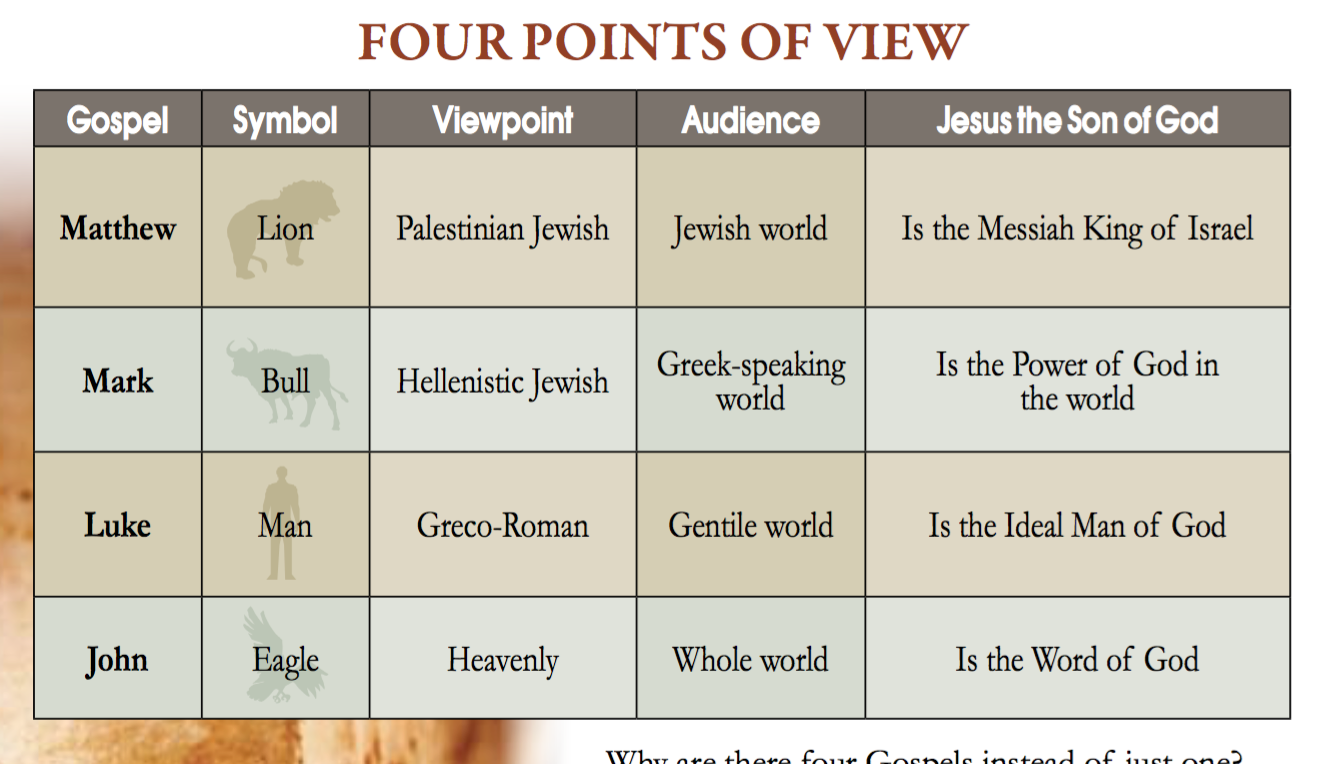
This short pamphlet is chockfull of graphics, charts, maps and historical background information  that helped me see the bigger picture of the story of Jesus that the Gospel writers were conveying to us. It begins with the unique perspective of each Gospel writer, and launches us deeper into the Bible from there.

In this book you will see things like:

  • The events of Christ’s life, and which Gospel tells particular events
  • The miracles of Jesus
  • The parables of Jesus
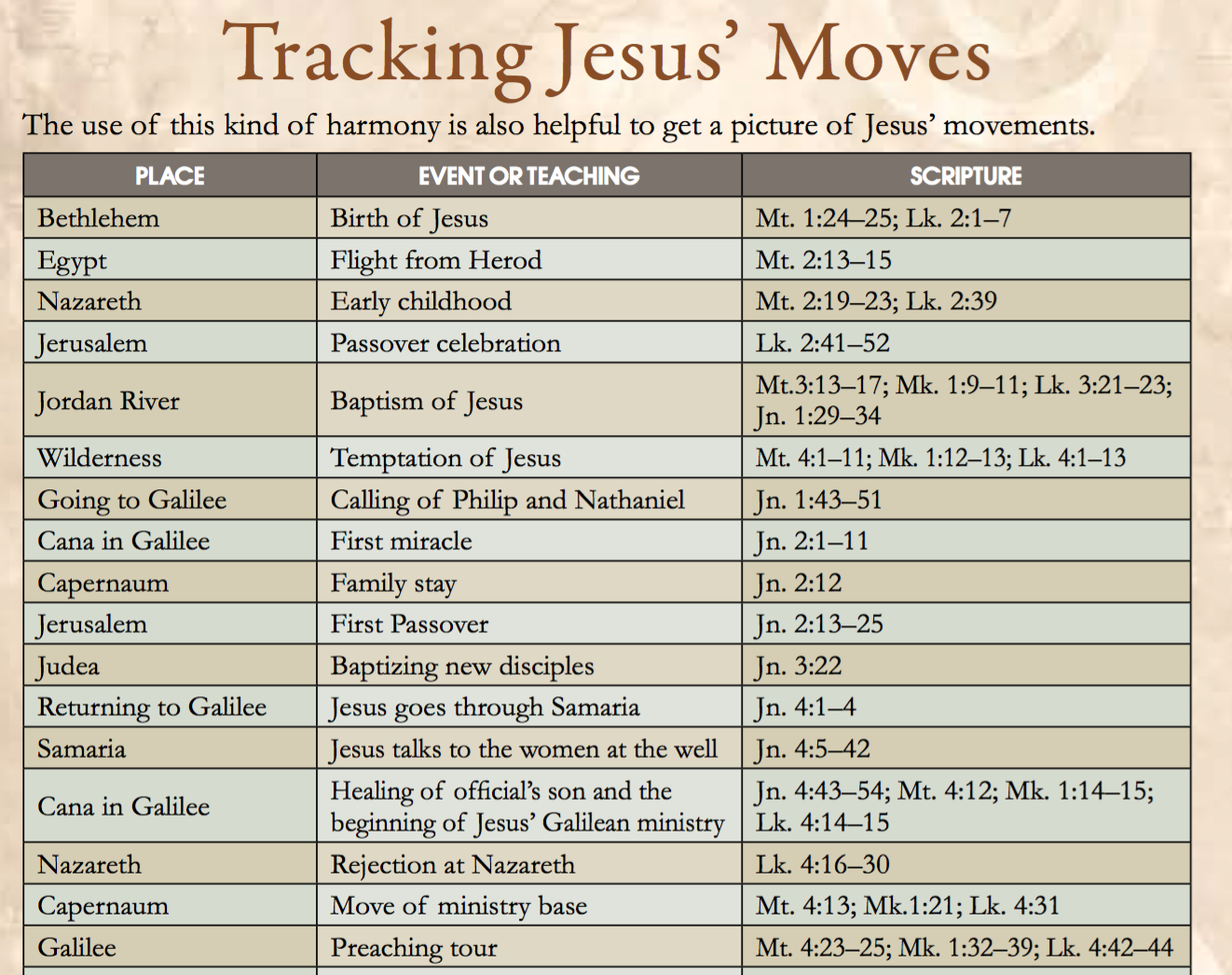
  • The chronological movements of Jesus
  • How Jesus celebrated Passovers during His public ministry
  • How these biblical biographies compare to other biographies of the era
  • Even the historical harmony of the Gospel message in the post-apostolic age

This should bring new life to any Bible student’s reading time! I highly recommend you check out not only this pamphlet, but many of the other resources available at Rose Publishing.

Here are a couple of screenshots from the book…


Screen Shot -Christ's movesScreenshot - gospel writers

Notes From The Global Leadership Summit

I had an amazing time last week at the Willow Creek Global Leadership Summit. Every year I came away with some many thoughts, and a brand new passion for the various leadership roles in which I get to serve.

Below are just a few of my notes that I jotted down during an intense two days.
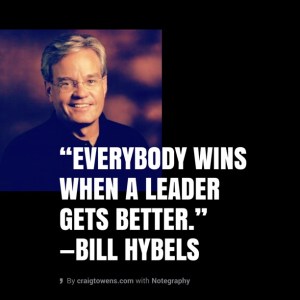
Hybels - everybody winsBill Hybels—The Lens Of Leadership

“Everybody wins when a leader gets better.”

“Armed with enough humility, leaders can learn from anyone.”

Hybels discussed four leadership lenses:

1.   Passionate leader (depicted by vibrant bright red frames)

  • They understand unbridled passion in leadership.
  • “Passion is like protein for the team.”
  • A motivated worked will outperform an unmotivated worker by 40%.
  • People are more motivated by working for a passion-filled leader than they are by compensation or perks.
  • Passion comes from a mountain-top dream, or a valley-deep frustration of current settings.

2.   People leader (cool frames, but cracked lenses)

  • An organization will only be as healthy as the top leader wants it to be.
  • This world needs more pastors of businesses, factories, medical offices, military units, etc.

3.   Performance leader (self-adjusting glasses)

  • Leaders ask: what progress should be made? how do we measure this? what doesn’t need to be measured?
  • Every worker wants to know how they are doing. For the leader, it’s cruel to hire someone and never let them know how they’re doing. Every staff member should get an update at least every six months.

4.   Legacy leader (sunglasses with a rearview mirror [cyclist])

  • Every once in awhile we need to look behind to see what legacy we’re leaving behind.
  • Leaders should reflect on this annually.
  • If my leadership assignment were to end today, what legacy would I leave?
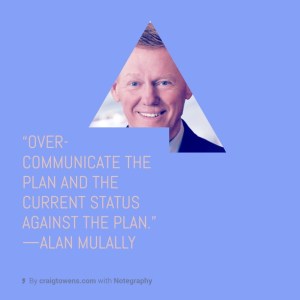
Mulally - overcommunicateAlan Mulally—CEO Boeing and Ford Motor Company

An average commercial airline has 4 million parts!

  • People first
  • Include everyone
  • Create a compelling vision
  • Present a workable strategy
  • Set clear performance goals
  • Relentless implementation
  • Share lots of data
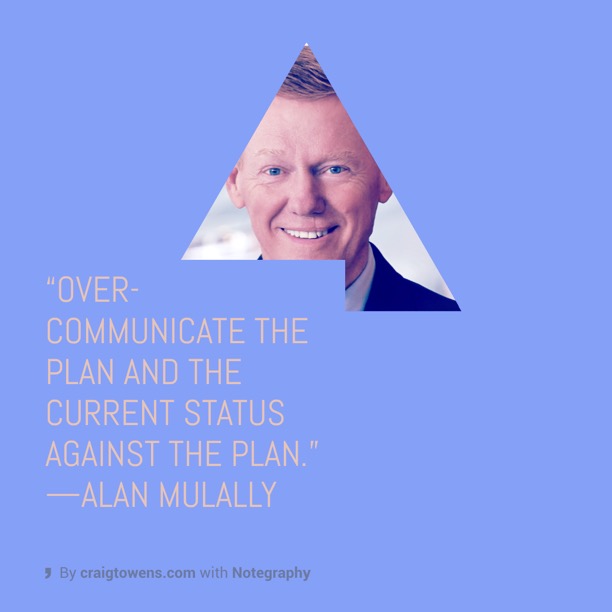
  • “Over-communicate the plan and the current status against the plan.”
  • Instill a positive can-do attitude
  • Keep your emotional resilience
  • Have fun


Melinda Gates - hear the criesMelinda Gates—Gates Foundation

Melinda says of herself, “I am an impatient optimist. We are changing the world, but we need to change it faster.”


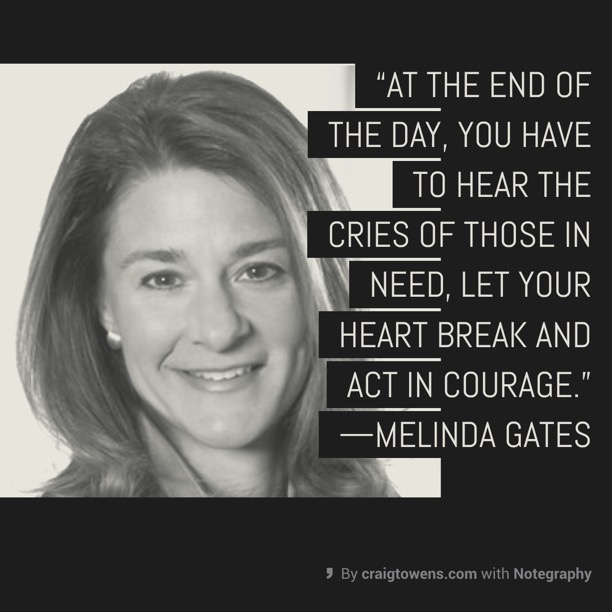
“At the end of the day, you have to hear the cries of those in need, let your heart break and act in courage.”

Jossy Chacko—Empart

“All of us have been entrusted with something. What are we doing to leverage it?”

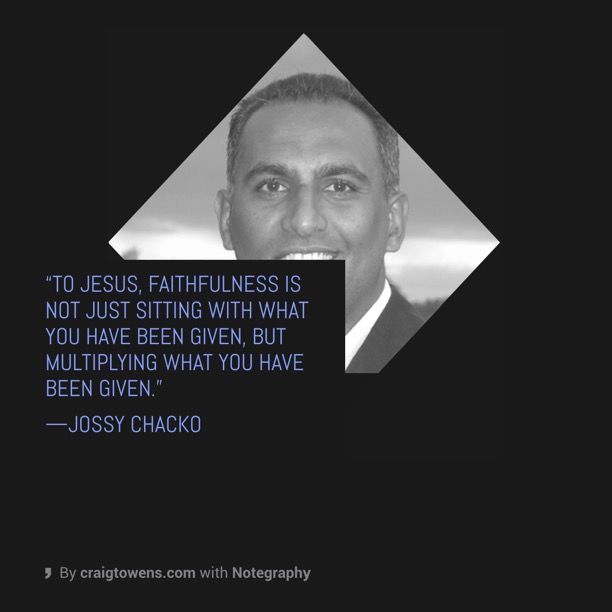
In thinking about the parable of the talents … “To Jesus, faithfulness is not just sitting with what you have been given, but multiplying what you have been given. God’s mission is not maintaining.”

“Playing it safe is not enough for a follower of Jesus Christ.”

Three principles for expanding our leadership reach:
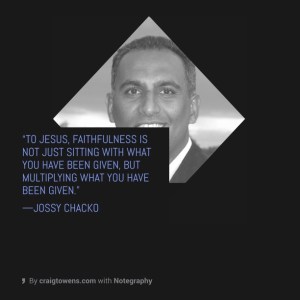
Jossy Chacko - faithfulness1. Enlarge your vision

  • “When people hear my vision, they should know the size of my God.”
  • “An enlarged vision should keep us driven.”
  • “Do not be confused about what people say about your vision; trust what God has said to you.”

2. Empower your people

  • “Leadership is about taking wise chances and giving people opportunities.”
  • “Your leadership reach will be determined by your empowerment choices.”
  • Three things to keep in mind: (1) Focus on building their character before empowering them; (2) Empowerment has to be through relationship; and (3) Make sure we have agreed on the right outcomes, and have the right way to measure them.

3. Embrace risk

  • Faith = risk. Without faith it is impossible to please God = without taking risks it is impossible to please God.
  • Paradigms to be changed: (1) See risk as your friend to love, not as your enemy to be feared; (2) See comfort and safety as your enemies; and (3) Increase your pain threshold.
  • “Your leadership capacity is in direct relationship to your pain threshold.”
  • “Don’t allow the fear of losing what we have to lose what God has in store for you.”
  • “By me not taking risks, who is missing out?”
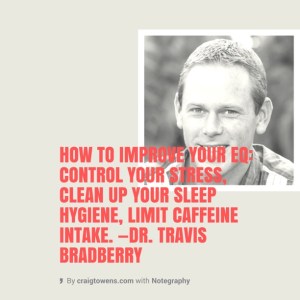
Bradberry - EQDr. Travis Bradberry—TalentSmart

All inputs into the brain travel through the limbic system first (emotional center) before the inputs travel to the frontal cortex. The EI (emotional intelligence) center is in the front of the brain, just above the left eye.

Only 36% of people are able to accurately identify their emotions as they happen.

EQ (the Emotional Quotient that measures emotional intelligence) is not IQ.

EQ can be improved all throughout life.

Four components of emotional intelligence:

 1. Self-awareness: knowing my emotions, and knowing my tendencies. I need to lean into my discomfort if I want to improve.

   2. Self-management: what I do with this increased self-awareness. This is not “stuffing” my feelings. The biggest mistake is only trying to manage negative emotions; positive emotions need to be managed too.

   3. Social awareness: focusing more on others than on myself.

   4. Relationship management: using the first three skills in concert. Seeing how my behavior is affecting the other person, and then adjusting accordingly.


How to increase my EQ:

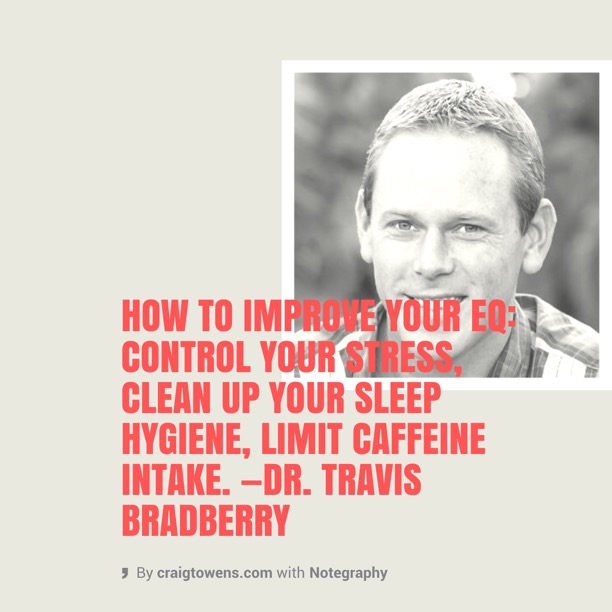
  1. Control stress—stress under control is healthy; chronic stress is unhealthy. Gratitude reduces the stress hormone cortisol.
  2. Clean up my sleep hygiene—sleep cleans up toxic hormones in the brain. To get better sleep: (1) Don’t take any kind of sleeping pill; and (2) Reduce “blue lights” in the evening.
  3. Reduce my caffeine input—especially after noon.
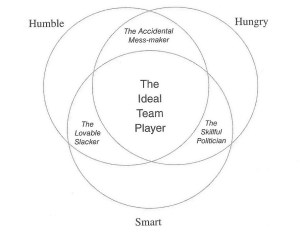
Ideal team playerPatrick Lencioni—Author

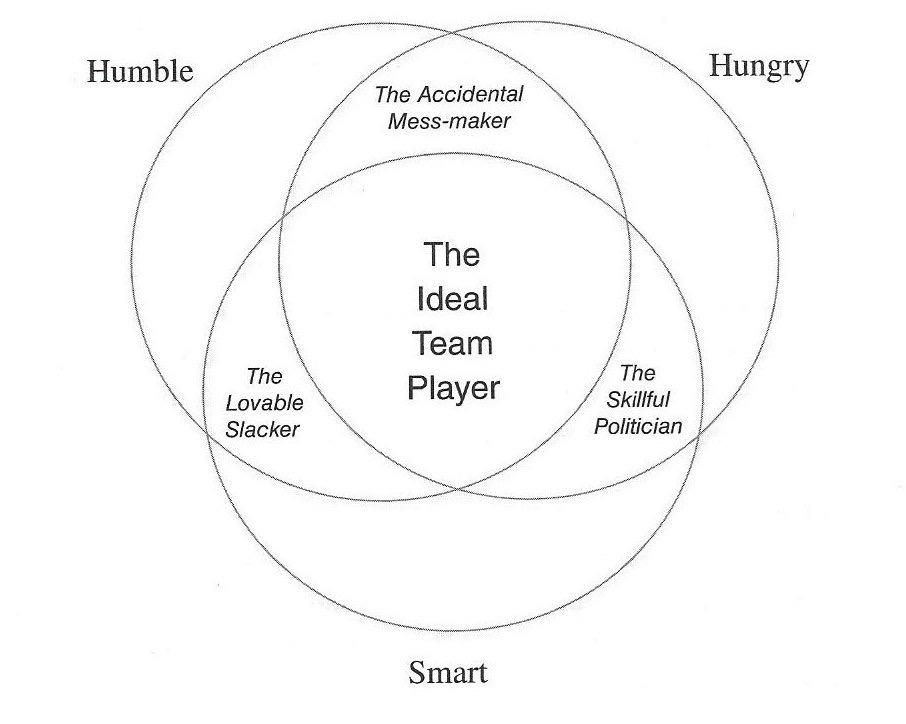
Three qualities of an ideal team player:

1.   Humble

  • Lacking self-confidence is not humility.
  • “Denying skills and downplaying abilities is not humility.”

2.   Hungry

  • Strong work ethic
  • Driving hard

3.   Smart

  • Not intellectual smarts, but people smarts = EQ

“To develop people, we have to have the courage to humbly and constantly talk to people about their ‘stuff.’”
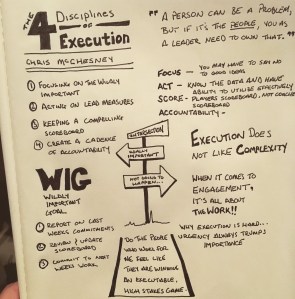
McChesney - execution disciplinesChris McChesney—Franklin Covey

Rahm Charan asked:

  • Q: Do leaders struggle more with strategy or execution? A: Execution.
  • Q: Are leaders more educated in strategy or execution? A. Strategy.

“The hardest thing a leader will ever do is drive a strategy that changes someone’s behavior.”

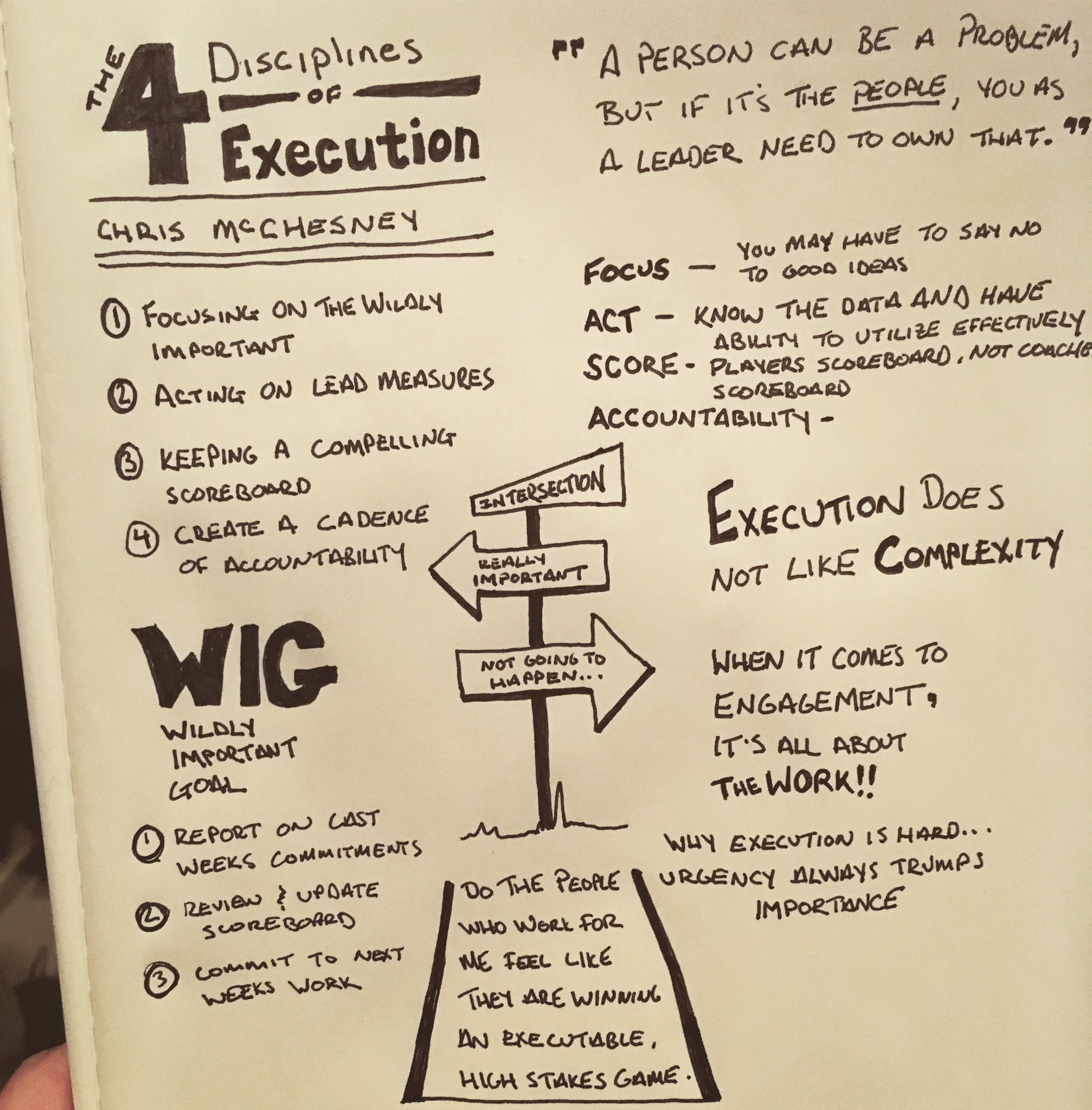
There are four disciplines for making changes in human behavior:

1.  Focus

  • “Focus on the wildly important.”
  • If a team focuses on 2-3 goals, they are likely to get them done. But if there are 4-10 goals, momentum is killed. At 11+ goals, the team is going backward.
  • We narrow the focus by coming up with a WIG: wildly important goal (this lives at the intersection of ‘really important’ and ‘not going to happen’).

2.  Leverage

  • “What are the fewest number of battles necessary to win the war?”
  • “When you want to go big, don’t think big, think narrow.”
  • One WIG per team at the same time. Everything else is in sustainment mode.
  • Make goals like this—“From x to y by when.”

3.  Engagement

  • “The biggest driver of engagement is when people feel like they’re winning.”
  • “Do the people who work for me feel like they’re playing a winnable game?”

4.  Accountability

  • Everyone needs to answer: “What are the things I do that have the biggest impact on the WIG?”
  • After sharing the scoreboard, allow people to determine what they need to do next. The people need to determine their own next moves, not the leader. The leader pulls this out of people.
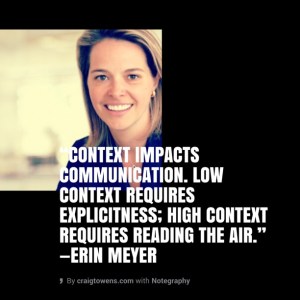
Erin Meyer - contextErin Meyer—INSEAD

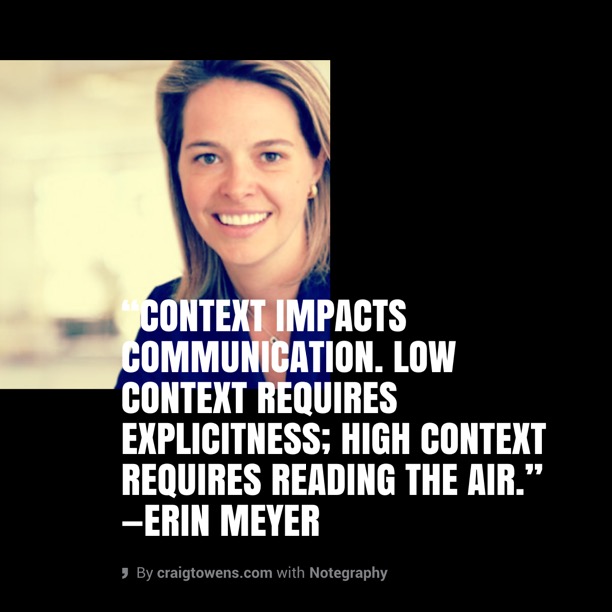
On The Culture Map communication is divided into Low vs. High Context:

  • Low = feel we don’t have the same context or relationship. We feel we need to explain things very simply and explicitly.
  • High = we assume we have a larger body of shared reference points. We feel communication is more implicit or nuanced.

Anglo-Saxon countries are typically low context.

Latin American are mid-low.

Asian countries are usually high context.

In low context we tend to nail things down in writing, where in high context we leave things more open to later interpretation.

“Context impacts communication. … We need to read both the messages ‘in the air’ as well as the explicitly stately messages.”

“In a high context culture, repeat things less, ask more questions, learn to ‘read the air.’”
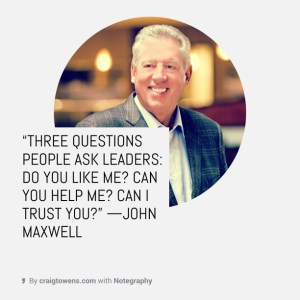
 

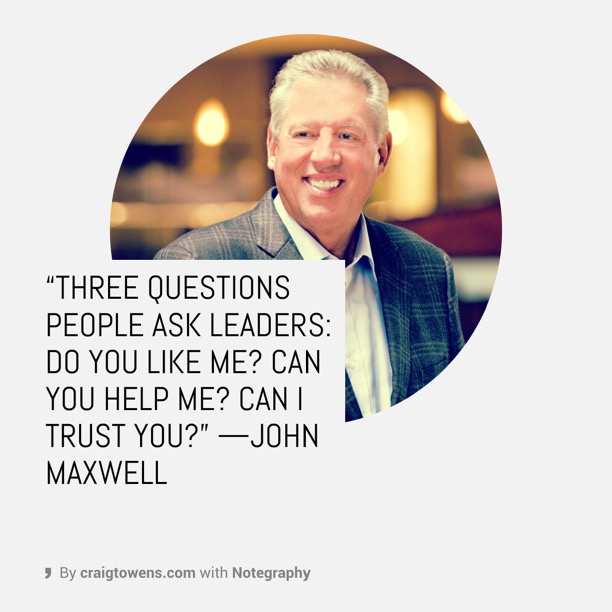
Maxwell - 3 questionsJohn Maxwell—Author 

“Good leaders lift.”

“You have to find the people before you lead the people.”

“The one thing leaders have to get right—they must intentionally add value to people every day.”


Five things that intentionally adds value to people:

  1. Value people—“God values people I don’t know; He even value people I don’t like.” “Are we going to spend our lives connecting with people, or correcting them?”
  2. Think of ways to add value to people—“Intentional living is thinking upfront on how to help people.”
  3. Look for ways to add value to people.
  4. Do things that add value to people.
  5. Encourage others to add value to people.

If you attended the GLS, please share in the comments below something amazing / challenging / paradigm-busting that you learned. Let’s all keep on learning!

Poetry Saturday—Is It Raining?

FullSizeRender 12Is it raining, little flower?
     Be glad of rain;
Too much sun would wither one;
     It will shine again.
The clouds are very dark, it’s true;
But just behind them shines the blue.

Are you weary, tender heart?
     Be glad of pain:
In sorrow, sweetest virtues grow,
     As flowers in rain.
God watches, and you will have sun,
When clouds their perfect work have done. —Lucy Larcom

How To Get Along With Others

How To Get Along With OthersJohn Maxwell famously said, “The entire world—with one minor exception—is made up of other people.” That “one minor exception”? It’s the person staring at you in the mirror every morning! Obviously learning how to get along with all the “others” in the world is hugely important.

It’s even more important for those who call themselves Christians.

The Bible makes it quite clear that people watch how Christians treat one another to see if the message they preach is one worth living. And Jesus told one of His most well-known stories to make the point that all of the Bible is fulfilled in just two things: (1) Loving God and (2) Loving others.


To live above with the God that we love,
Oh, wouldn’t that be glory!
But to live below with the saints that we know,
Well, that’s a different story!

The Bible says a lot about “one another.” In fact, that phrase is used nearly 60 times in the New Testament! Not only is there much that the Scripture has to say to us about getting along with one another, but most of what was written has been confirmed by modern psychology.

Join me this Sunday at Calvary Assembly of God as we begin a new series called How To Get Along With Others. We’ll be learning some practical training along with biblical insights to help us excel at this vitally important life skill.

You can find directions to our church here, and if you can’t join us in person, be sure to tune in to our Periscope broadcast (follow me @craigtowens to be notified when the broadcast starts).

The American Patriot’s Almanac (book review)

The American Patriot’s AlmanacI feel so blessed to live in the United States of America! With the blessing of living in this great country comes the responsibility of knowing as much as I can about our country’s founding and guiding principles. A wonderful help on this journey of discovery is The American Patriot’s Almanac: Daily readings on America by William Bennett and John Cribb.

I am now on my second time through this book, and I’m still discovering how much there is to love about the USA. Each day Bennett and Cribb present a snapshot of a notable event in our nation’s history, that makes me so proud of our heritage all over again. There are cool stories about both the well-known and little-known folks who sacrificed and invested to make this country what it is.

At only a page a day, there’s no excuse for American patriots not to read this book through over the course of a year, and re-discover what a privilege it is to live in the land of the free and the home of the brave. We all owe it to our future generations to keep these memories alive, so that no one forgets our amazing heritage.

Year-End Review (2015 edition)

Theme for 2016The last Sunday of each year I take some time with our church family to look back to review what we’ve learned. Then we look forward to a theme God is impressing on us for the new year. Check it out here—

Links & Quotes

link quote

“What a great responsibility God has laid upon us preachers of His gospel and teachers of His Word. In that future day when God’s wrath is poured out, how are we going to answer? How am I going to answer? I fear there is much we are doing in the name of the Christian church that is wood, hay and stubble destined to be burned up in God’s refining fire. A day is coming when I and my fellow ministers must give account of our stewardship: What kind of a gospel did we preach? Did we make it plain that men and women who are apart from Christ Jesus are lost? Did we counsel them to repent and believe?” —A.W. Tozer

“Prayer pursues God’s glory by treating Him as the inexhaustible reservoir of hope and help. In prayer, we admit our poverty and God’s prosperity, our bankruptcy and His bounty, our misery and His mercy.” —John Piper

“We love beauty with simplicity, and we love the pursuit of knowledge without effeminacy. We employee wealth properly, for use rather than for noisy display, and we do not consider poverty to be a disgrace but do regard it as shameful for someone not to seek to escape poverty through labor. We citizens of Athens care for both our own domestic concerns and for the affairs of state; those of us engaged in business are not lacking in understanding of public matters. For we alone consider those who avoid engagement in public affairs not as ‘uninvolved’ but as useless. And we, as we judge and reflect carefully on matters, do not consider words to be a hindrance to actions. Rather, the real hindrance to action is to enter into whatever must be done without taking forewarning through discussion.” —Pericles, speaking about Athenian culture, quoted in the Archaeological Study Bible

The serious mental health costs of watching pornography. Don’t be fooled: porn is dangerous!

Tim Dilena talks about the difference between truth and “viral fame” in this video.

Truth! Why marriage shouldn’t end your dating life.

I like Seth Godin’s thoughts on our vocabulary. “It’s not about knowing needlessly fancy words (but it’s often hard to know if the fancy word is needless until after you learn it). Your vocabulary reflects the way you think (and vice versa). It’s tempting to read and write at the eighth-grade level, but there’s a lot more leverage when you are able to use the right word in the right moment.” Read more in Does Vocabulary Matter?

Is Capitalism Moral?

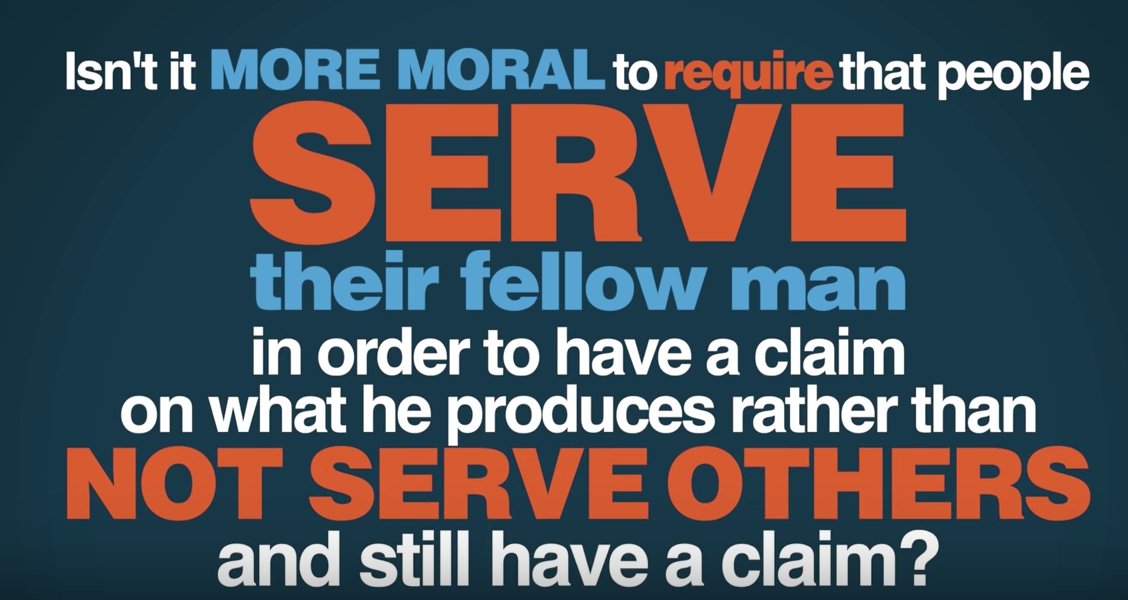
Morality of capitalismThis is an absolutely brilliant description by Professor Walter Williams of the morality and viability of free-market capitalism. Please take just 5 minutes to get educated on this.