“Years ago, I tried to top everybody, but I don’t anymore. I realized it was killing conversation. When you’re always trying for a topper you aren’t really listening.” —Groucho Marx
A reminder from a class I recently taught: you don’t have to go to a church building to be the Church of Jesus Christ—
“When the Holy Spirit is ignored or rejected, religious people are forced either to do their own creating or to fossilize completely. A few churches accept fossilization as the will of God and settle down to the work of preserving their past—as if it needed preserving. Others seek to appear modern and imitate the current activities of the world with the mistaken idea that they are being creative.” —A.W. Tozer
Dr. Kristin Collier is a professor of internal medicine at the University of Michigan and director of the school’s Program on Health, Spirituality and Religion. In a recent keynote address to medical students, she had some wise words: “The risk of this education and the one that I fell into is that you can come out of medical school with a bio-reductionist, mechanistic view of people and ultimately of yourself. You can easily end up seeing your patients as just a bag of blood and bones or human life as just molecules in motion. You are not technicians taking care of complex machines, but human beings taking care of other human beings. Let’s resist a view, of our patients and ourselves, that strips us of our humanity, and takes away from the very goal of why we went into this profession in the first place: to take care of human beings entrusted to our care in their moments of greatest need.”
This is a short clip from a full-length video I provided exclusively for my Patreon supporters. Would you prayerfully consider supporting this ministry for just $5/month? All new supporters through the end of September will get access to both my content and access to all of the content I have already published.
[0:55] What’s one of the biggest attributes that sets leaders apart from their peers?
[1:56] Check out why Stephen Covey’s definition of responsibility is so important in our discussion
[3:02] Why do people like to play “the blame game”?
[4:18] Accountability must be a partner with healthy responsibility
[4:52] Greg learned the blame game early on with his younger sister
[5:57] I worked in an unhealthy organization where the senior leader never accepted personal responsibility
[8:04] How do leaders “own it” in a healthy way?
[9:22] Exemplary leaders demonstrate how to accept consequences in a healthy way
[10:34] Responsibility and coachability strengthen a team and unleash greater potential
[11:27] Blame is “so dang easy” and makes the blamer a laughingstock
[13:27] What things contribute to blaming?
[14:14] How Greg handled the compliments and complaints from his clients
[15:11] Blaming is a spreading cancer in your organization
[15:44] Being a control freak isn’t the same thing as taking responsibility
[17:01] There is a balance for leaders so they don’t “fall on their swords”
[18:49] Team sports give us a good analogy of what shared responsibility looks like
[21:07] What’s on the other side of responsibility and blame?
[21:47] Leaders can enhance the benefits of responsibility through self-reflection
[23:51] Greg has a memorable and disarming way of helping people accept responsibility
[24:27] Our coaching huddles can help you learn to enhance the benefits of responsibility in your personal leadership
Check out this episode and subscribe on YouTube so you can watch all of the upcoming episodes. You can also listen to our podcast on Spotify and Apple.
Listen to the podcast of this post by clicking on the player below, and you can also subscribe on Apple, Spotify, or Audible.
I had a great time on the Thriving In Ministry podcast with Kyle Willis while his podcast partner Dace Clifton was on sabbatical.
Kyle and I wanted to help pastors get a better understanding of the value of a sabbath rest, but also an understanding of the challenges that come with trying to sabbath. Throughout the Old Testament, we read of God taking the Israelites to task for their unwillingness to rest, which ultimately led to them having to take a forced rest.
As I mentioned in this interview, just because the calendar says “Sunday” doesn’t automatically mean that it’s a sabbath day. This is especially true for pastors who are busily engaged in ministry activities on Sundays. But I take comfort in the example of Jesus who showed shepherd leaders how to make sabbathing an active and integral part of effective ministry.
I have a chapter in my book Shepherd Leadership called “A Healthy Shepherd’s Sabbath,” and then I have a follow-up chapter called “Can’t, Won’t, or Don’t” which addresses some changes pastors can make to ensure they are getting the vital rest they need. If you are a church leader, I encourage you to pick up a copy of my book Shepherd Leadership: The Metrics That Really Matter.
I’ll be sharing more clips from this Thriving In Ministry interview soon, so please stay tuned. Shepherd Leadership: The Metrics That Really Matter is available in print or ebook, and in audiobook through either Audible or Apple.
[19:17] You don’t have it all, so don’t act like it!
[19:43] Greg would love to help your organization develop an abundance mindset.
Check out this episode and subscribe on YouTube so you can watch all of the upcoming episodes. You can also listen to our podcast on Spotify and Apple.
T.M. Moore wrote to pastors, “Effective ministry and fruitful Christian living are not automatic. They don’t just happen. Each requires that we receive the gifts of God, develop them according to His Word, and put them to proper use day by day. We must work out our salvation and work at our calling with focus and vigor.” Check out the rest of his post.
Speaking of pastors: In order for us pastors to be at our peak, we need to take care of ourselves. Here is a short video where I talk about the principle of sabbathing (a topic I explore in-depth in my book Shepherd Leadership: The Metrics That Really Matter).
This study from PennMedicine tells us that our brains can continue to learn new things until the day we die. So apparently you can teach an old dog new tricks!
My friend Greg and I have always tried to combine work and play. We’ve found that fun can really help leadership lessons stick. Check out this clip from a recent Craig And Greg Show leadership podcast.
This is a weekly series with things I’m reading and pondering from Charles Spurgeon. You can read the original seed thought here, or type “Thursdays With Spurgeon” in the search box to read more entries.
Listen to the podcast of this post by clicking on the player below, and you can also subscribe on Apple, Spotify, or Audible.
Froth Or Substance?
Many of you will read a novel from beginning to end, and what have you got? A mouthful of froth when you have done. But you cannot read the Bible—that solid, lasting, substantial, and satisfying food goes uneaten, locked up in the cupboard of neglect, while anything that man writes, as a catch of the day is greedily devoured. ‘I have written for him the great things of My law, but they were considered a strange thing’ [Hosea 8:12].
From The Bible
The Bible is the most important book anyone can read, contemplate, and apply to their lives. Yet far too many people say, “I just don’t have enough time to sit down to read the Bible.” Sadly, these same people take a lot of time on much less meaningful activities.
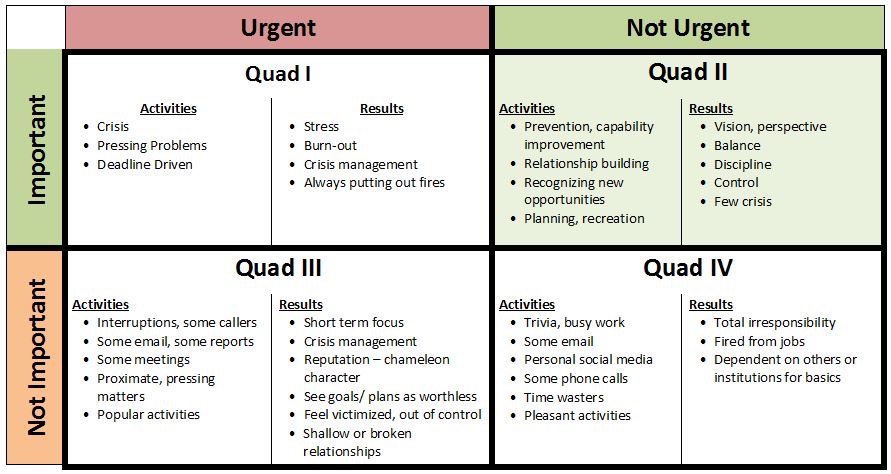
One thing that has been immensely helpful to me is the Urgent/Important grid Stephen Covey talks about in his book The Seven Habits Of Highly Effective People. Your Bible reading is never urgent—that is, an alarm will not go off to tell you it is time to read. However, your Bible reading is hugely important.
Covey discusses how we can put all of our activities into one of the four quadrants in this chart:
Your Bible reading time is definitely a Quadrant II activity, and the best place to find time for this activity is by eliminating things in Quadrant IV—the activities Spurgeon would call froth. In my book Shepherd Leadership: The Metrics That Really Matter, I discuss how leaders can use this grid to increase their leadership effectiveness.
The bottom line: We all must make sure we are eliminating the froth so that we have time for the great Substance that can only be found in God’s Word.
And then check out chapter 10 in Shepherd Leadership—“Can’t, Won’t or Don’t”—to learn how to use this grid to help you make the time for those important Quadrant II activities.
[11:02] Greg’s first business venture was only an entry point to his career
[13:37] Another decision further refined Greg’s niche in business
[15:03] The unforeseen changes that brought me to West Michigan where I met Greg
[15:59] One of the first ministries that we worked on together
[20:00] A leadership lesson we tried to teach to the students at an urban youth center
[20:40] The dream list for us going forward
[22:40] What do we do as consultants?
[24:02] Greg has some cool keynote addresses that he presents
[25:53] How we can help you grow your leadership capacity
Check out this episode and subscribe on YouTube so you can watch all of the upcoming episodes. You can also listen to our podcast on Spotify and Apple.
According to Romans 12, all Christians have been given a unique gift package by God. We are to use these motivational gifts to make God’s Kingdom more visible and more desirable.
This week we discuss the gifts of teaching and exhortation. You may download the participant’s notes and the gifts assessment I use in this lesson:



 We have been studying the different sets of gifts listed in the New Testament. These gifts are to bring maturity and health to the church. Previously we have looked at the motivational gifts in Romans chapter 12, the operational gifts of the Holy Spirit in 1 Corinthians 12-13, and the leadership gifts in the church in Ephesians 4.





 Craig T. Owens