What Are You Looking At?

LookingIn the feeding of the vast multitude, Jesus had very little in the way of natural resources: five loaves of bread and two fish. He also had the skepticism of His closest followers.

But all three synoptic gospels record a very telling phrase—Jesus looked up to heaven.

Jesus didn’t look at what He didn’t have; He looked up to His Father in heaven.

Jesus took His eyes off the limited and put them on the Limitless.

Then Jesus taught us to pray: “Your kingdom come, Your will be done on earth as it is in heaven.”

Are you looking at your poverty, or the Provider? 

Are you looking at your sickness, or the Healer?

Are you looking at the skeptics, or the Promise?

Are you looking at your confusion, or the All-Knowing?

What are you looking at?

Run To The Pain

Listen to the podcast of this post by clicking on the player below, and you can also subscribe on AppleSpotify, or Audible.

We have become a numbed culture: we try to soften every blow, water down each negative report, ask only surface questions in the hopes that no one will really tell us how much they’re hurting, and then medicate away every symptom. But these symptoms are screaming to be noticed!

Dr. Paul Brand the renown hand surgeon and missionary to leprosy patients in India, wrote:

     “Pain contributes daily to a normal person’s quality of life…. Every normal person limps occasionally. Sadly, leprosy patients do not limp. Their injured legs never get the rest needed for healing…. This inability to ‘hear’ pain can cause permanent damage because the body’s careful responses to danger will break down. … A body only possesses unity to the degree that it possesses pain…. We must develop a lower threshold of pain by listening, truly listening, to those who suffer. … The body protects poorly what it does not feel.” —Dr. Paul Brand & Philip Yancey, In His Image

The Gospels often talk of the compassion of Jesus. His compassion led Him to teach the confused, feed the hungry, and heal the sick. The phrase usually used in the NKJV is descriptive: Jesus was moved with compassion. In other words His feelings moved Him to action.

The Old English way of describing compassion was to say someone was “moved in his bowels.” This is because when someone else is suffering it should be like a kick in my gut too.

Jesus gravitated toward the hurting, but in one story He told, Jesus related something different about His Father’s compassion. It’s the story we now call the story of the prodigal son. In this story Jesus said His Father watched the horizons every day to see if His wayward child would return. When He saw this child coming into view, God saw his slumped shoulders, He could detect his heavy heart and worn-out body. Then Jesus says something amazing, “The Father was moved with compassion and He RAN TO HIS SON!

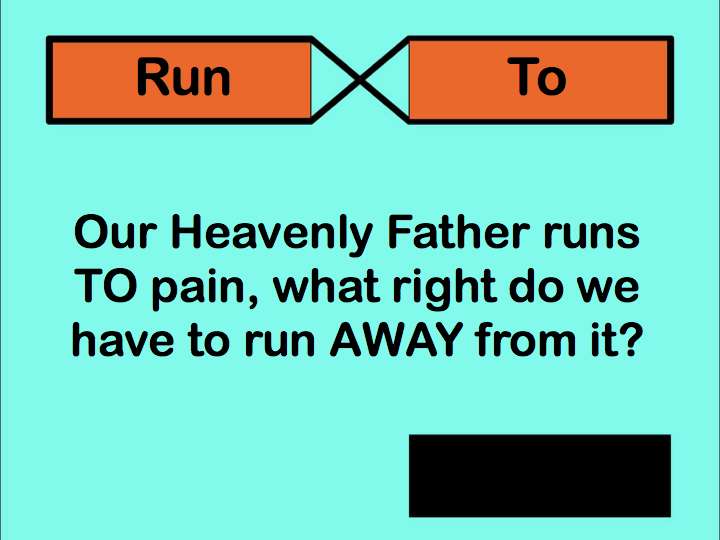
If our Heavenly Father runs TO another’s pain, what right do we have to ever run AWAY from it? 

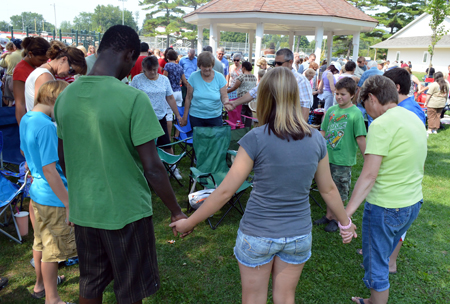
If we are to be God-honoring in our interaction with others, we need to—as Dr. Brand says—lower our threshold of pain. We need to feel what others feel, to feel it like a kick in our own gut, and then move toward the pain with help and healing and restoration.

Christians—if we are truly Christ-like—should be known as the most compassionate people of anyone.

So we need to always be asking: What am I doing to let this compassion be seen in my life?

Check out all of the other messages in our series Live Together by clicking here.

►► Would you please prayerfully consider supporting this ministry? My Patreon supporters get behind-the-scenes access to exclusive materials. ◀︎◀︎

At Last!

Jesus is our atonementThe Day of Atonement was a very special day for the Jewish people. It was called by some the Sabbath’s Sabbath, as it was the most holy day of the year. It was the day everyone looked forward to, because finally they could have forgiveness for their sins.

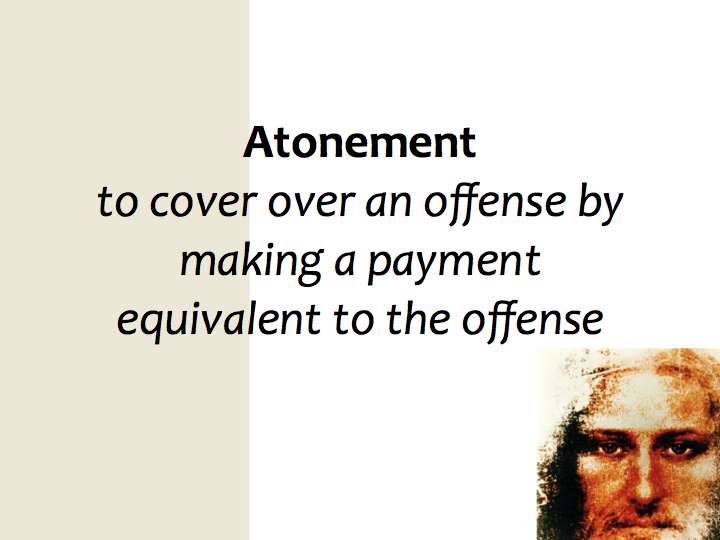
The word atonement in the Hebrew meant that a payment was made that was equivalent to the offense that was committed. The offense was huge: Sin was open rebellion against Almighty God, it was to spit in the face of our Heavenly Father, it was to slap away His hands that were reaching out to embrace us. Nothing short of a death could atone for that sort of offense!

So the high priest would go through an elaborate ceremony of washing himself and putting on special garments that were only to be worn on this Day of Atonement. Because the high priest was also a sinner himself, his first sacrifice was a bull. The blood from this sacrifice was taken by the high priest into the Most Holy Place of the temple to cover his own sins, before he could even approach God to ask for the forgiveness of the sins of anyone else.

After having completed this step, the high priest could then proceed. He would sacrifice a goat as a sin offering for the people. As he did with the bull’s blood, he would take the goat’s blood back into the Most Holy Place to ask God to show mercy toward people who had sinned, to turn away His holy wrath against their rebellion. Then the priest would lay his hands on a second goat, one that was still alive, and confess all of the sins of the people. This goat (called the scapegoat) was then taken out into the desert. This symbolized the removal of the people’s guilt, making it possible for them to be in relationship with God once again.

This was repeated year after year after year. It was repeated because the people continued to sin. It was repeated because these rituals were only a shadow of what God really wanted to accomplish. David wrote about the futility of these sacrifices—

Sacrifice and offering You did not desire—but a body You have given me—burnt offerings and sin offerings You did not require. Then I said, “Here I am, I have come—it is written about me in the scroll. I desire to do Your will, my God; Your law is within my heart.” (Psalm 40:6-8)

A beautiful thing happened through the ministry of Jesus on earth. Jesus came to be both the perfect high priest (one without sin, who did not need to purify Himself), and the perfect sacrifice. Jesus is called the once for all sacrifice of atonement for us, as He embodied the cry David made nearly 1000 years earlier. Hebrews 10:5-7 says that the words uttered by David prophetically were repeated by Jesus: “Here I am, I have come—it is written about me in the scroll. I desire to do Your will, my God; Your law is within my heart. I will be the once for all sacrifice.”

When Jesus told us the the new covenant was in His shed blood on Calvary’s Cross, He was saying that no longer would we have to wait until the Day of Atonement to find forgiveness; no longer would we have to wait upon an imperfect earthly priest to offer a sacrifice for us; no longer would we have to carry around the guilt of our sin and feel separated from God’s presence while waiting for a special ceremony. AT LAST! We can have immediate forgiveness, eternal redemption, and an everlasting relationship with God because of what Jesus did for us once for all!

As you celebrate Holy Week, be thrilled with the truth that Jesus’ death on the Cross makes it possible for you to have complete atonement. Our Savior has redeemed us AT LAST!

If you have missed any of the messages in this series called Who Is Jesus?, you can find them all here.

Intercession

Listen to the podcast of this post by clicking on the player below, and you can also subscribe on AppleSpotify, or Audible.

Intercession is prayer for others. How it must please our Heavenly Father when we long for—and pray for—the advancement of others.

Since the day we heard about you, we have not stopped praying for you. (Colossians 1:9)

The apostle Paul prayed that the Colossians would grow in the knowledge of God’s will, in spiritual wisdom, and in godly understanding. He knew that with these tools they would be able to live a life worthy of the Lord and [be able to] please Him in every way (v. 10). The outward signs of this worthy life, Paul explains, are:

  • Doing good works
  • Knowing God more intimately
  • Developing greater endurance, patience, and empathy
  • Overflowing in thankfulness
  • Building up other saints (vv. 11-12)

Did you catch that last point: building up other saints. One of the “other saints” would be Paul himself!

So when my prayers shift from petition (praying for what I need) to intercession (praying for what others need), as other people grow in God, they build me up!

What an amazing thought:

The way I get what I need from God is to stop thinking about myself and praying for myself, and to start interceding for others.

That is the power and the blessing of intercessory prayer!

►► Would you please prayerfully consider supporting this ministry? My Patreon supporters get behind-the-scenes access to exclusive materials. ◀︎◀︎

Remaining

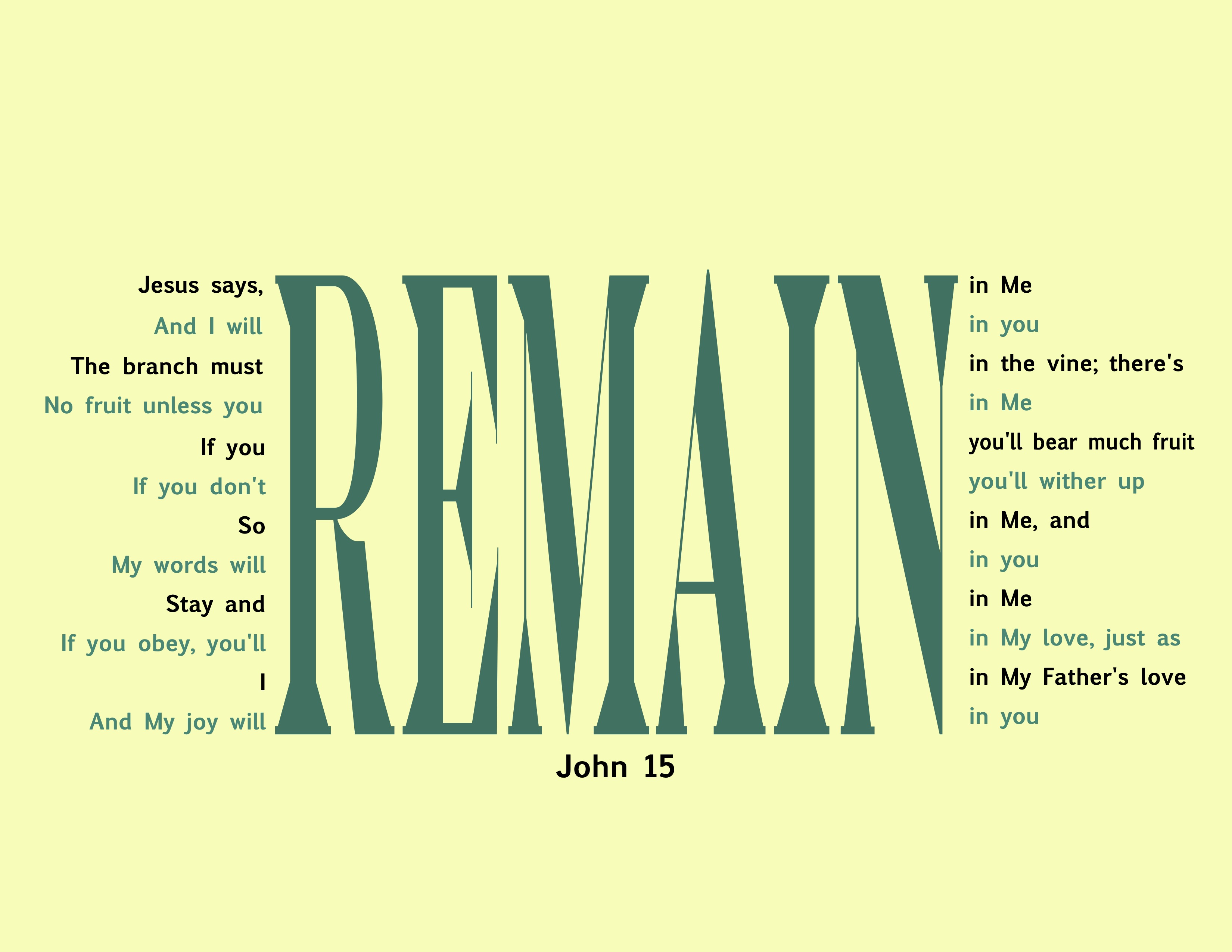
In John 15, Jesus uses a Greek word that gets translated in the English as remain fifteen times. If anyone uses a single word that many times, you know it must be important. The same Greek word is also translated in and last in this same passage. The word means:

  1. continually present (in reference to time), and
  2. not leaving a certain orientation (in reference to state or condition).

The big idea Jesus is trying to convey here is connectedness. So I’m asking myself, Is my life so connected and reliant on Christ’s life, that it is nearly impossible to perceive two? Do we look and operate like one? Is my life completely sustained by His life? When people look at me, can they tell I am remaining in Jesus?

This same Greek word is translated living in (John 14:10) when Jesus says, “It is the Father living in Me, Who is doing His work.” When we see Jesus, we see the oneness—the remaining—between Father, Son, and Spirit.

This same remaining oneness is possible for me because of the promise of a Helper. Jesus said the Counselor (the Holy Spirit) would be with you (John 14:16). This is the exact same Greek word. The word is used again in the following verse: He lives with you and will be in you.

The Holy Spirit helps me look more and more like Jesus. He helps me remain. He develops the oneness.

Oh, marvel of marvels! To be one with Jesus! To remain—to last! To have Him in me, and I in Him!

I want to remain more deeply, more “one-ly,” that God may be glorified in the lasting fruit that my remaining will allow Him to produce.

Battling Depression

Have you ever been depressed? I have. I know all too well how depression robbed me of sleep, sapped joy from my day, kept me from smiling and on the verge of tears all the time, made sunny days seem cloudy, caused me to sigh all the time and lose interest in the things that used to bring me pleasure, and brought such a sense of loneliness and isolation.

Did you know that Jesus felt the crushing load of depression too? As He was praying in the Garden of Gethsemane just before His arrest, listen to these words—

  • He began to be sorrowful and troubled
  • He became anguished and distressed
  • He began to show grief and distress of mind and was deeply depressed
  • He said to them, “My soul is overwhelmed with sorrow to the point of death”
  • He prayed more fervently, and He was in such agony of spirit that His sweat fell to the ground like great drops of blood
  • “Abba, Father,” He cried out, “everything is possible for You. Please take this cup of suffering away from Me. Yet I want Your will to be done, not Mine.” (see Matthew 26:37-38; Mark 14:36; Luke 22:44)

The writer of Hebrews wrote this about Jesus—

While Jesus was here on earth, He offered prayers and pleadings, with a loud cry and tears, to the One who could rescue Him from death. And God heard His prayers because of His deep reverence for God. Even though Jesus was God’s Son, He learned obedience from the things He suffered. In this way, God qualified Him as a perfect High Priest, and He became the source of eternal salvation for all those who obey Him. (Hebrews 5:7-9)

We learn something in suffering that we can’t learn any other way. Jesus learned how to experience all of the grief, anxiety, and depression that you and I will ever feel. And that is what qualifies Him to be a perfect High Priest for us.

Our part is to pray. Time and time and time again, not only did Jesus pray, but He encouraged His disciples to pray as well. As you continue to pray, Jesus is your High Priest praying for you. Only He truly knows how to translate the cry of your heart into a language Abba Father can understand.

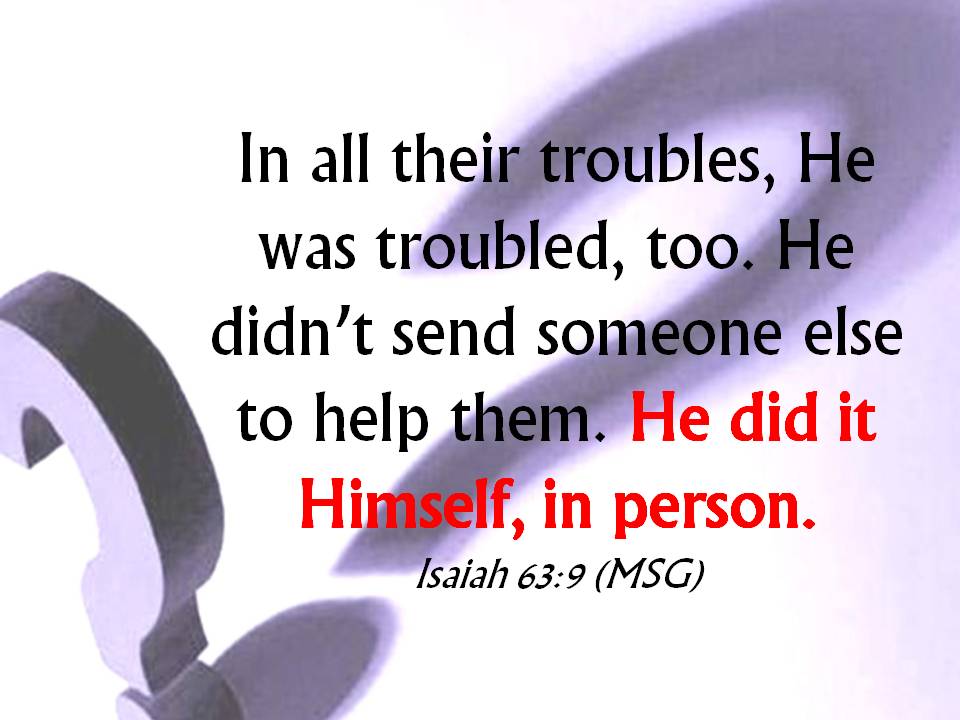
In all their troubles, He was troubled, too. He didn’t send someone else to help them. He did it Himself, in person. (Isaiah 63:9)

If you’ve missed any of the messages in this series called Where’s God, please check them all out by clicking here.

Even Before You Ask

A couple of weeks ago a lady in our church asked me to pray for a need in her life. She is a single Mom, as well as a caregiver for her bed-bound grandmother, which means money is tight.

She knew her car needed some repairs, so she took the car to the mechanic on Thursday afternoon. His initial estimate was $400. On Sunday we prayed about this, and joined our faith that God would either provide the funds, or provide another way for her car to be repaired.

Here’s a powerful verse of Scripture—

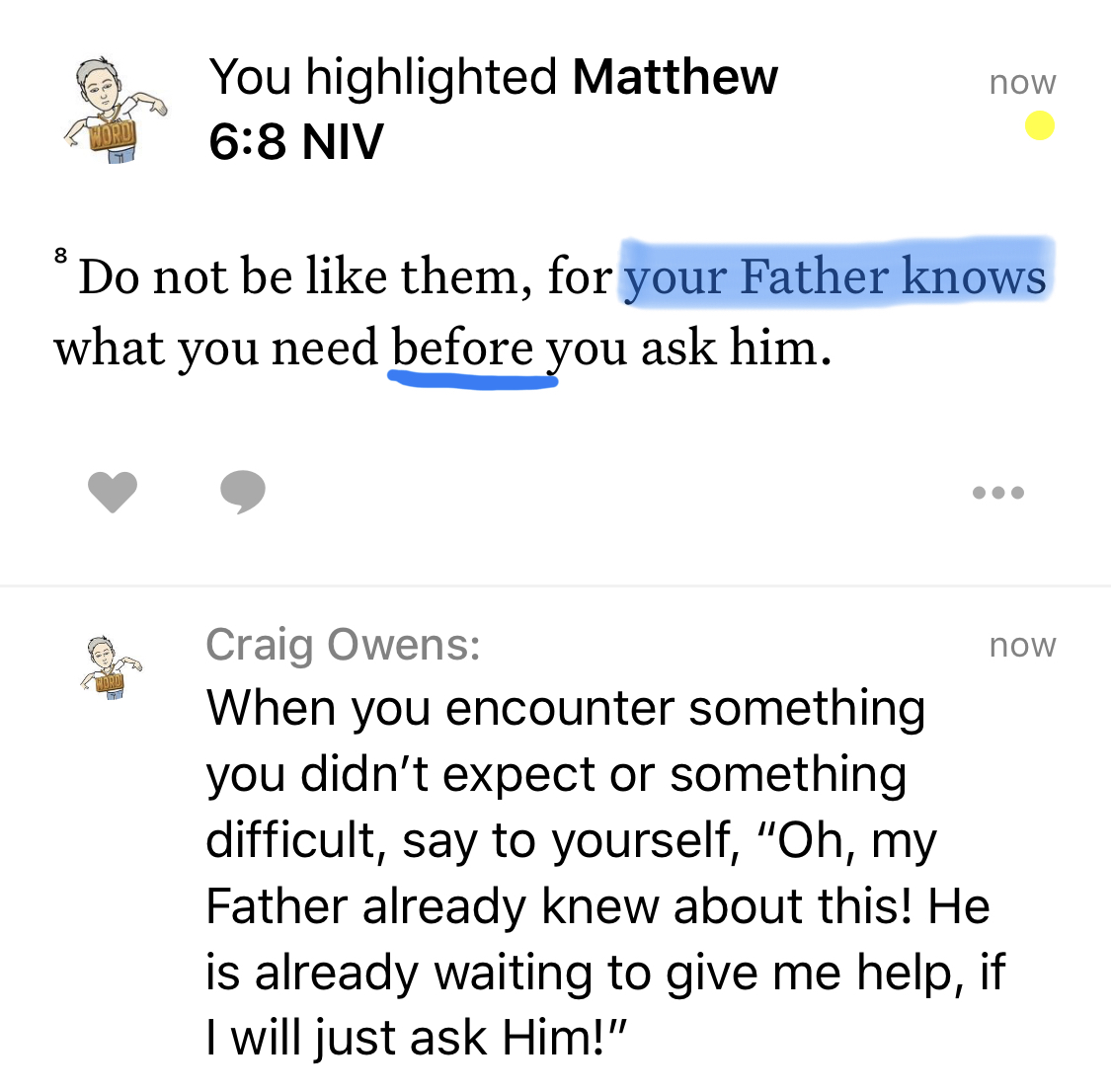
…Your Father knows exactly what you need even before you ask Him! (Matthew 6:8)

This lady returned to her mechanic the next day, and he told her the repairs had been completed. But the repairs were not as extensive as he originally thought, so the bill was only $105.

Now, here’s the best part—on Thursday, this lady had looked at her financial situation and had set aside all the money she could afford for this repair: $125!

So not only did God provide for her even before she asked, but she even gave the mechanic a $20 tip!

I love the fact that God knows what we need even before we ask Him!

What Are You Whispering?

Wise King Solomon gave us this advice:

Never say anything that isn’t true. Have nothing to do with lies and misleading words. (Proverbs 4:24)

Most decent people don’t have an issue with this one. We would never dream of whispering to someone we care about things like…

  • …you’re a loser.
  • …you can’t seem to do anything right.
  • …hey, stupid, nice job. Not!

But the verse just before says this:

Be careful how you think; your life is shaped by your thoughts. (v. 23)

I wonder how many times we whisper words like loser, failure, or stupid to ourselves. The things we’d never say to someone else, we seem all too ready to say to ourselves!

What are you whispering to yourself? Listen closely. Are you whispering things to yourself that you would never whisper to someone else? Then it’s time to start whispering something new.

Solomon preceded this with these words of affection that seem to come right from our Heavenly Father’s mouth:

My child, pay attention to what I say. Listen to my words. Never let them get away from you. Remember them and keep them in your heart. (vv. 20-21)

God’s Spirit will never, ever, EVER speak cutting, hurtful, unkind, or untrue words to you. God loves you as if you were the only person on earth to love! He loves you so much that He sent His Son to rescue you.

Listen closely because He’s saying it right now, “I love you!

Yeah, whisper that to yourself instead!

Can You Have Too Much Blessing?

I seldom turn on religious TV shows, because when I do I typically hear the same two messages: (1) God wants you to be rich; (2) God wants you to be healthy. I believe God is good all the time, but that doesn’t mean those who follow Him always get wealth and health.

Consider this:

After Rehoboam’s position as king was established and he had become strong, he and all of Israel with him abandoned the law of the Lord.

Notice: When Rehoboam was healthy and wealthy, he abandoned God. When things looked bleak—when the future for Rehoboam was very much in doubt—Rehoboam was “walking in the ways of David and Solomon” (2 Chronicles 11:17). When the Egyptians attacked, Rehoboam and his court officials “humbled themselves before God” (12:6).

Health and wealth derailed Rehoboam, but difficulties kept him close to God.

Maybe a better prayer than “Bless me” would be “Build Your character in me.” Or as it says in Proverbs:

Give me neither poverty nor riches, but give me only my daily bread. Otherwise, I may have too much and disown You and say “Who is the Lord?” Or I may become poor and steal, and so dishonor the name of my God.

The prayer that Jesus taught us to pray is perfect: Give us today our daily bread—no more, no less. That keeps me focused on my Heavenly Father.

Unhappiness Makes Me Happy

I’m not a sadist. Nor am I a pessimist.

But I am a child that is still learning that I cannot always get my way.

We’re getting ready to start 2011 with a week of prayer, and I’m going to open 2011 with a series of Sunday messages on prayer: The Perfect Prayer. But in studying more about prayer, I’m always confronted by this: Why are some prayers unanswered.

As I pondered that today, I thought about saying “No” to my kids. I love my children and I want them to be happy. They love pop (or “soda” for some of you, or “Coke” for others), and would drink it all the time if I said “Yes.”

Saying “Yes” to this beverage choice may make them happy now, but it would make them very unhappy later in life when they developed osteoporosis (from a lack of calcium), or had skin and eye disease (from a lack of vitamin D), or were losing teeth (from too much carbonation), or had developed diabetes (from too much sugar).

Our Heavenly Father sees my future even more clearly than I can see it for my children. He wants me to be blessed, which is why He must say “No” at times. I’m a child who doesn’t know what is best for me.

“Getting all you want would bring incalculable damage and grief to you. Be thankful for unanswered prayer. It may be a sign of God’s favor.” —R.T. Kendall

So as I’m growing in God I can say, “Father, I’m willing to trust you with the ‘No’ now, because I believe you have a better ‘Yes’ for me in the future.”

My temporary unhappiness with unanswered prayer makes me happy because I know God has something better for me. I’m going to keep on asking, seeking, and knocking, but I’m also going to keep on trusting my Heavenly Father for His very best.