5 Quotes On Law & Grace From “Transforming Grace”

Transforming GraceJerry Bridges wrote a book that was an eye-opener for me called Transforming Grace. I’ve shared a couple of other posts with quotes from this book (you can read them by clicking here and here), but these quotes zero-in on the battle some people have in their minds between law and grace.

“Under a sense of legalism, obedience is done with a view to meriting salvation or God’s blessing on our lives. Under grace, obedience is a loving response to salvation already provided in Christ, and the assurance that, having provided salvation, God will also through Christ provide all else that we need.”
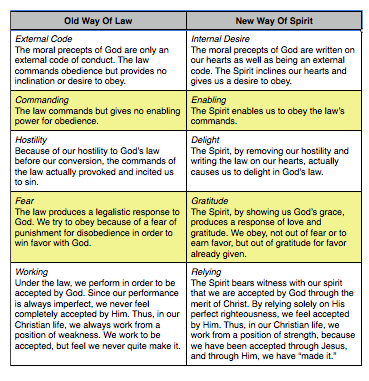
(click for a larger view)

(click for a larger view)

You can download a PDF version of this chart here → Law and Grace  ←

“Do you view God’s moral precepts as a source of bondage and condemnation for failure to obey them, or do you sense the Spirit producing within you an inclination and desire to obey out of gratitude and love? Do you try to obey by your own sheer will and determination, or do you rely on the Spirit daily for His power to enable you to obey? Do you view God as an ogre who has set before you an impossible code of conduct you cannot keep, or do you view Him as your divine Heavenly Father who has accepted you and loves you on the basis of the merit of Christ? In other words, in terms of your acceptance with God, are you willing to rely solely on the finished perfect work of Jesus, instead of your own pitifully imperfect performance?”

“We are much more concerned about someone abusing his freedom than we are about his guarding it. We are more afraid of indulging the sinful nature than we are of falling into legalism. Yet legalism does indulge the sinful nature because it fosters self-righteousness and religious pride. It also diverts us from the real issues of Christian life by focusing on external and sometimes trivial rules.” 

“That is the way a lot of manmade ‘dos and don’ts’ originate. They begin as a sincere effort to deal with real sin issues. But very often we begin to focus on the fence we’ve built instead of the sin it was designed to guard against. We fight our battles in the wrong places; we deal with externals instead of the heart. … For all of us, it may be good to have some fences, but we have to work at keeping them as just that—fences, helpful to us but not necessarily applicable to others. … I’m not suggesting you jump over fences just to thumb your nose at the people who hold on to them so dearly. We are to ‘make every effort to do what leads to peace and mutual edification’ (Romans 14:19). Use discretion in embracing or rejecting a particular fence. But don’t let others coerce you with manmade rules. And ask God to help you see if you are subtly coercing or judging others with your own fences.”

“Spiritual disciplines are provided for our good, not for our bondage. They are privileges to be used, not duties to be performed. … I do think we should actively promote spiritual disciplines. They are absolutely necessary for growth in our Christian lives. And since ours is a largely undisciplined age, many believers are losing out on the benefits of those disciplines that could help them grow to maturity in Christ. But we should promote them as benefits, not as duties.” 

You can read my full book review of Transforming Grace by clicking here.

12 Additional Quotes From “Transforming Grace”

Transforming GraceI already shared a few quotes from Transforming Grace by Jerry Bridges (you can read them by clicking here). Bridges also extensively quoted other authors in this amazing book, so I wanted to share a few of those quotes as well.

“Grace ceases to be grace if God is compelled to bestow it in the presence of human merit…. Grace ceases to be grace if God is compelled to withdraw it in the presence of human demerit…. Grace is treating a person without the slightest reference to desert whatsoever, but solely according to the infinite goodness and supper and purpose of God.” —Dr. C. Samuel Storms

“The most shining deeds and valuable qualities that can be found among men, though highly useful and truly excellent, when set in their proper places, and referred to suitable ends, are, as to the grand article of justification treated as nonentities…. For divine grace disdains to be assisted in the performance of that work which peculiarly belongs to itself, by the poor, imperfect performances of men. Attempts to complete what grace begins, betray our pride and offend the Lord; but cannot promote our spiritual interest. Let the reader, therefore, carefully remember, that grace is either absolutely free, or it is not at all: and, that he who professes to look for salvation by grace, either believes in his heart to be saved entirely by it, or he acts inconsistently in affairs of the greatest importance.” —Abraham Booth

“Perhaps the most difficult task for us to perform is to rely on God’s grace and God’s grace alone for our celebration. It is difficult for our pride to rest on grace. Grace is for other people—for beggars. We don’t want to live by a heavenly welfare system. We want to earn our own way and atone for our own sins. We like to think that we will go to heaven because we deserve to be there.” —R.C. Sproul 

“A lawdriver insists with threats and penalties; a preacher of grace lures and incites with divine goodness and compassion shown to us; for he wants no unwilling works and reluctant services, he wants joyful and delightful services of God.” —Martin Luther, commenting on Romans 12:1

“The great mistake made by most of the Lord’s people is in hoping to discover in themselves that which is to be found in Christ alone.” —Arthur W. Pink

“In the person of Christ God beholds a holiness which abides His closest scrutiny, yea, which rejoices and satisfies His heart; and whatever Christ is before God, He is for His people.” —Arthur W. Pink

“Only what God has commanded in His Word should be regarded as binding; in all else there may be liberty of actions.” —John Owen

“Let us never surrender our judgments or our consciences to be at the disposal and opinions of others, and to be subjected to the sentences and determinations of men. … It is my exhortation therefore to all Christians to maintain their Christian freedom by constant watchfulness. You must not be tempted or threatened out of it; you must not be bribed or frightened from it; you must not let either force or fraud rob you of it. … We must not give up ourselves to the opinion of other men, though they be never so learned, never so holy, merely because it is their opinion. The apostle directs us to try all things and to hold fast that which is good (1 Thessalonians 5:21). It often happens that a high esteem of others in respect of their learning and piety makes men take up all upon trust from such, and to submit their judgments to their opinions, and their consciences to their precepts. This should not be so.” —Samuel Bolton (1645)

“So God supplies perfectly measured grace to meet the needs of the godly. For daily needs there is daily grace; for sudden needs, sudden grace; for overwhelming needs, overwhelming grace. God’s grace is given wonderfully, but not wastefully; freely, but not foolishly; bountifully, but not blindly.” —John Blanchard

“For men have no taste for God’s power till they are convinced of their need of it and they immediately forget its value unless they are continually reminded by awareness of their own weakness.” —John Calvin

“Yet the duties God requires of us are not in proportion to the strength we possess in ourselves. Rather, they are proportional to the resources available to us in Christ. We do not have the ability in ourselves to accomplish the least of God’s tasks. This is a law of grace. When we recognize it is impossible for us to perform a duty in our own strength, we will discover the secret of its accomplishment. But alas, this is a secret we often fail to discover.” —John Owen

“Christian humility does not consist in denying what there is of good in us; but in an abiding sense of ill-desert, and in the consciousness that what we have of good is due to the grace of God.” —Charles Hodge

You can read my full review of Transforming Grace by clicking here.
13 Quotes From Jerry Bridges In “Transforming Grace”

Transforming GraceI think Transforming Grace by Jerry Bridges is one of the best books about God’s grace I have ever read! You can read my full book review by clicking here. There are way too many quotes for me to share from this book, so here are a few that really zero-in on grace (I’ll be posting more quotes soon).

“I think most of us actually declared temporary bankruptcy. Having trusted in Christ alone for our salvation, we have subtly and unconsciously reverted to a works relationship with God in our Christian lives. We recognize that even our best efforts cannot get us into heaven, but we do think they earn God’s blessings in our daily lives.” 

“It was because of His grace that God the Father sent His only Son to die in our place. To say it another way, Christ’s death was the result of God’s grace; grace is not the result of Christ’s death.”

“The gospel is addressed to those who have no money or good works. It invites us to come and ‘buy’ salvation without money and without cost [Isaiah 55:1]. But note the invitation to come is addressed to those who have no money—not to those who don’t have enough. Grace is not a matter of God’s making up the difference, but of God’s providing all the ‘cost’ of salvation through His Son, Jesus Christ.” 

“We can never rightly understand God’s grace until we understand our place as those who need His grace.”

“We were dead in our transgressions, but God intervened. We were in bondage to sin, but God intervened. We were objects of wrath, but God intervened. God Who is rich in mercy intervened. Because of His great love for us, God intervened and made us alive with Christ, even when we were dead in our transgressions and sins. All this is summed up in one succinct statement: ‘it is by grace you have been saved.’ Our condition was hopeless, but God intervened in grace.” 

“God’s grace, then, does not supplement our good works. Instead, His grace overcomes our bad works, which are our sins. God did this by placing our sins on Christ and by letting fall on Him the wrath we so richly deserved. … That’s the way His grace operates. It looks not to our sins or even to our good deeds but only to the merit of Christ.”

“The apostle John wrote that Jesus was ‘full of grace and truth,’ and ‘from the fullness of His grace we have all received one blessing after another’ (John 1:14, 16). The idea portrayed in verse 16 is analogous to the ocean waves crashing upon the beach. One wave has hardly disappeared before another arrives. They just keep coming from an inexhaustible supply. So it is with the grace of God through Christ. He is full of grace and truth, and it is from His inexhaustible fullness that we received one blessing after another.” 

“God often does bless people who seem to us to be quite unworthy. But that is what grace is all about, because we are all unworthy.”

“We all want grace, but we cannot enjoy grace when there is an attitude of comparing.” 

“Under a sense of legalism, obedience is done with a view to meriting salvation or God’s blessing on our lives. Under grace, obedience is a loving response to salvation already provided in Christ, and the assurance that, having provided salvation, God will also through Christ provide all else that we need.”

“All Christians look to Christ alone for their justification, but not nearly as many also look to Him for their perfect holiness before God. … Holiness should be an objective for your daily life. But to live by grace, you must never, never look to the work of the Holy Spirit in you as the basis for your relationship with God. You must always look outside of yourself to Christ. You will never be holy enough through your own efforts to come before God. You are holy only through Christ.” 

“When our Father looks at us, He does not see our miserable performance. Instead, He sees the perfect performance of Jesus.”

“We died to the observance of the law as a requirement for attaining righteousness before God. We died to the curse and condemnation that resulted from our inability to perfectly keep the law. … Being under law implies the wrath of God, whereas grace implies forgiveness and favor. Law implies a broken relationship with God, whereas grace implies a restored relationship with Him. So when Paul said we died to the law, he meant we died to that entire state of condemnation, curse, and alienation from God.” 

Transforming Grace (book review)

Transforming GraceWhen many people think of God’s grace, the most appropriate adjective they offer is amazing. I totally agree! And when I think of Jerry Bridges’ book Transforming Grace, the word amazing quickly comes to my mind again.

Truly this is one of the best books I have read addressing the topic of God’s grace. Bridges doesn’t range far and wide, but sticks to this one topic: when we truly begin to understand God’s grace, it will absolutely transform our lives.

Early in the book Bridges states the problematic paradigm many of us have about God’s grace—

“My observation of Christendom is that most of us tend to base our personal relationship with God on our performance instead of on His grace. If we’ve performed well—whatever ‘well’ is in our opinion—then we expect God to bless us. If we haven’t done so well, our expectations are reduced accordingly. In this sense, we live by works rather than by grace. We are saved by grace, but we are living by the ‘sweat’ of our own performance.” (emphasis added)

This book is jam-packed with so many paradigm-shifting thoughts, and is well grounded in the Scripture. Bridges transparently shares his own personal struggles with coming to grips with the true nature of God’s grace, and shares the quotes of many notable theologians as well. I loved this book!

If you want to live with a deeper understanding of how God’s grace can transform your life, I couldn’t recommend this book any more highly … this is a must read!

Links & Quotes

link quote

Some good reading from today…

“The mind may be compared to a garden, which it is as necessary to cultivate as any plot of earth, if order and beauty are to be manifested through it. … Ideas, as well as flowers, in order to attain their full beauty, must be kept free from encumbering influences, whatever tends to weaken or degrade or detract from planned perfection.” —Joyce Mayhew

“I thank my Master that He does not say to the sinner, ‘Come half way and meet Me,’ but He comes ‘where he is.’” —Charles Spurgeon

“On the basis of grace as taught in the Word of God, when God forgives a man, He trusts him as though he had never sinned. God did not have mental reservations about any of us when we became His children by faith. When God forgives a man, He doesn’t think, ‘I will have to watch this fellow because he has a bad record.’ No, He starts with him again as though he had just been created and as if there had been no past at all! That is the basis of our Christian assurance—and God wants us to be happy in it.” —A.W. Tozer

“Always keep in contact with those books and those people that enlarge your horizon and make it possible for you to stretch yourself mentally.” —Oswald Chambers

Links & Quotes

link quote

Some good reading from today…

“Are you allowing satan to magnify the memories of your spiritual failures? He will always keep them before you unless you take your stand and move up in faith. … Remember, the Bible does not teach that if a man falls down, he can never rise again. The fact that he falls is not the most important thing—but rather that he is forgiven and allows God to lift him up.” —A.W. Tozer

Christian leadership is not about being a lone ranger. Here are 12 benefits of team leadership.

Parents & grandparents, you should be aware of the sex education curriculum the US government has proposed.

George Whitfield was a very well-read, articulate preacher. Here are 13 powerful quotes from him.

“Away with tears and fears and troubles! United in wedlock with the eternal Godhead Itself, our nature ascends into the Heaven of Heavens. So it would be impious to call ourselves ‘miserable.’ On the contrary, Man is a creature whom the Angels—were they capable of envy—would envy. Let us lift up our hearts!” —C.S. Lewis

Pastor Saeed Abedini has been held in an Iranian prison for two years. This letter that he wrote to his daughter for her 8th birthday is both moving and convicting. I hope I could be as faith-filled as he is if I was in a similar situation.

Poetry Saturday—Thou Sweet, Beloved Will Of God

Gerhard TersteegenThe Will of God
Thou sweet, beloved Will of God,
   My anchor ground, my fortress hill,
My spirit’s silent, fair abode,
   In Thee I hide me, and am still.

O Will, that willest good alone,
   Lead Thou the way, Thou guidest best;
A little child I follow on,
   And trusting lean upon Thy breast.

Thy beautiful, sweet Will, my God,
   Holds fast in Its sublime embrace
My captive will, a gladsome bird,
   Prisoned in such a realm of grace.

Within this place of certain good,
   Love ever more expands her wings;
Or, nestling in Thy perfect choice,
   Abides content with what it brings.

Oh, sweetest burden, lightest yoke,
   It lifts, it bears my happy soul,
It giveth wings to this poor heart:
   My freedom is Thy grand control.

Upon God’s Will I lay me down,
   As child upon its mother’s breast;
No silken couch, nor softest bed,
   Could ever give me such sweet rest.

Thy wonderful, grand Will, my God
   With triumph now I make It mine,
And Love shall cry a jealous Yes,
   To every dear command of Thine. —Gerhard Tersteegen


10 Quotes From “The Furious Longing Of God”

Furious Longing Of GodI love the way Brennan Manning writes! It’s so gut-level real. His words both convict me and encourage me to go deeper into God’s love. You can read my full book review of The Furious Longing Of God by clicking here. Below are some of the quotes I especially appreciated.

“The God I’ve come to know by sheer grace, the Jesus I met in the grounds of my own self, has furiously loved me regardless of my state—grace or disgrace. And why? For His love is never, never, never based on our performance, never conditioned by our moods—of elation or depression. The furious love of God knows no shadow of alteration or change. It is reliable. And always tender.”

“The foundation of the furious longing of God is the Father who is the originating Lover, the Son who is the full self-expression of that Love, and the Spirit who is the original and inexhaustible activity of that Love, drawing the created universe into itself.”

“Pagan philosophers such as Aristotle arrived at the existence of God via human reason and referred to Him in vague, impersonal terms: the uncaused cause, the immovable mover. The prophets of Israel revealed the God of Abraham, Isaac, and Jacob in a warmer, more compassionate manner. But only Jesus revealed to an astonished Jewish community that God is truly Father.” 

“The degree of Abba’s love for me is in direct proportion to His love for Jesus. For example, I can love the mailman with twenty percent and my best friend with ninety percent. But with God, there is no division, no more and no less. God loves me as much as He loves Jesus. Wow!”

“First, if we continue to picture God as a small-minded bookkeeper, a niggling customs officer rifling through our moral suitcase, as a policeman with a club who is going to bat us over the head every time we stumble and fall, or as a whimsical, capricious, and cantankerous thief who delights in raining on our parade and stealing our joy, we flatly deny what John writes in his first letter (4:16)—‘God is love.’ In human beings, love is a quality, a high-prized virtue; in God, love is His identity. Secondly, if we continue to view ourselves as moral lepers and spiritual failures, if our lives are shadowed by low self-esteem, shame, remorse, unhealthy guilt, and self-hatred, we reject the teaching of Jesus and cling to our negative self-image.”

“Healing becomes the opportunity to pass off to another human being what I have received from the Lord Jesus; namely His unconditional acceptance of me as I am, not as I should be. He loves me whether in a state of grace or disgrace, whether I live up to the lofty expectations of His gospel or I don’t. He comes to me where I live and loves me as I am.”

“To affirm a person is to see the good in them that they cannot see in themselves and to repeat it in spite of appearances to the contrary.”

“Jesus said the world is going to recognize you as His by only one sign: the way you are with one another on the street every day. You are going to leave people feeling a little better or a little worse. You’re going to affirm them or deprive them, but there’ll be no neutral exchange.”

“The question is not can we heal? The question, the only question, is will we let the healing power of the risen Jesus flow through us to reach and touch others, so that they may dream and fight and bear and run where the brave dare not go?” 

“How is it then that we’ve come to imagine that Christianity consists primarily in what we do for God? How has this come to be the good news of Jesus? Is the kingdom that He proclaimed to be nothing more than a community of men and women who go to church on Sunday, take an annual spiritual retreat, read their Bibles every now and then, vigorously oppose abortion, don’t watch x-rated movies, never use vulgar language, smile a lot, hold doors open for people, root for the favorite team, and get along with everybody? Is that why Jesus went through the bleak and bloody horror of Calvary? Is that why He emerged in shattering glory from the tomb? Is that why He poured out His Holy Spirit on the church? To make nicer men and women with better morals? The gospel is absurd and the life of Jesus is meaningless unless we believe that He lived, died, and rose again with but one purpose in mind: to make brand-new creations. Not to make people with better morals, but to create a community of prophets and professional lovers, men and women who would surrender to the mystery of the fire of the Spirit that burns within, who would live in ever greater fidelity to the omnipresent Word of God, who would enter into the center of it all, the very heart and mystery of Christ, into the center of the flame that consumes, purifies, and sets everything aglow with peace, joy, boldness, and extravagant, furious love.”

Not A Glory-Stealer

Not A Glory-StealerNot to us, Lord, not to us but to Your name be the glory, because of Your love and faithfulness. (Psalm 115:1)

  • You are Love; I struggle with selfishness.
  • You are Faithful; I can be fickle.
  • You are Just; I am short-sighted.
  • You are Mercy; I can be petty.
  • You are Grace; I keep score.
  • You are Forgiveness; I remember hurts.
  • You are Perfection; I am flawed.
  • You are the Potter; I am a pot.
  • You are God; I am man.

Not to me—not ever to me—be any glory, but all to You. I extol You both now and forever more. Despite my flaws, may no one ever be able to say of me that I tried to steal Your glory.

Links & Quotes

link quote

Some good reading from this weekend…

“I do not agree with a big way of doing things. What matters is the individual. If we wait till we get numbers, then we will be lost in the numbers and we will never be able to show that love and respect for the person.” —Mother Teresa

For anyone struggling with an addiction to pornography, this sounds like a helpful book: 10 Lies Men Believe About Pornography.

According to Cosmopolitan magazine, if you are pro-life political candidate you are automatically disqualified from getting support from any “enlightened” woman.

Obama & ISIS[INFOGRAPHIC] This is scary … do you know how much money ISIS makes every day from selling the oil they have captured?

“It is right to pour out our whole soul before Him that careth for us. But it is good, likewise, to unbosom ourselves to a friend, in whom we can confide.” —John Wesley

“That is always the way with a truly healthy Christian; God’s grace is externally manifested. There is the inner life within, it is active, and by and by when it is in a right state, it saturates everything. You talk with the gracious man, he cannot help talking about Christ; you go into his house, you will soon see that a Christian lives there; you notice his actions and you will soon see he has been with Jesus. He is so full of sap [Psalm 104:16] that the sap must come out. He has so much of the divine life within, that the holy oil and divine balsam must flow from him.” —Charles Spurgeon

“O God, of Thy goodness give me Thyself, for Thou art enough for me, and I may ask nothing that is less and find any full honors to Thee. God give me Thyself!” —Lady Julian

“Yes—at first one is sort of concussed and ‘life has no taste and no direction.’ One soon discovers, however, that grief is not a state but a process—like a walk in a winding valley with a new prospect at every bend.” —C.S. Lewis

A great post from Dave Barringer for married couples: Faking Your Death.

“Christianity is the only world religion whose primary source documents are in a language other than the founder of the religion. In other words, the New Testament texts are not in Aramaic, but in Koine Greek. … This makes a vitally important theological statement which so dramatically contrasts, for example, with Muslims who maintain that the Qur’an is untranslatable and that the Word of Allah can be conveyed truly and fully only in Arabic. For, at the very outset of the Christian message, the translatability of the gospel is enshrined in our primary source documents.” —Dr. Timothy C. Tennent, President of Asbury Theological Seminary, The Translatability Of The Gospel