Do You Know Your Community?

Jesus called His followers to be salt and light. It’s pretty easy to figure out that the salt cannot season the food if it stays in the saltshaker, and the light cannot illuminate the darkness if it stays covered up. In order to season and shine in your community, you have to know your community.

And, pastor, that starts with you.

What you do is a much more effective sermon that what you say. Pastor, you need to know your community, so that you can be involved in your community, so that you and your church can season and shine in your community together.

So let me ask a couple of questions:

  • Do you know your Mayor / City Manager / Township Supervisor? If you don’t know them, how can you affirm their leadership (Romans 13:1-7)?
  • Do you attend City / Township Council meetings? If you don’t, how will you know what issues they’re wrestling with? If you don’t know those issues, how can you pray effectively for them (1 Timothy 2:1-2)?
  • Are you involved in your community? Don’t just assume people in your community will come to your church to sit among stranger to hear a stranger speak; instead, be so involved in your community that they will come to church to fellowship with friends and hear a friend speak (John 2:1-2).

I opened with the question, “Do you know your community?” But maybe a better way to ask this is, “Does your community know you?”

Does the community come to you to ask for help? This may be the best barometer of your involvement in your community: how often they seek your help or assistance in addressing issues within your community.

If you’re not as involved as you should be, the good news is that it’s never too late to start! Go get involved—go season and shine!


Harmless

When a story from the past is so well known, we can easily insert ourselves into it with a certain bias. When we do this, we read things into the story because of the facts we know now.

For instance, we know Judas betrays Jesus. So when we see his name in any story in the Bible, we immediately associate the word traitor with him, and we can only view him through that lens. Therefore, it’s easy for us to put ourselves in the place of one of the other eleven disciples of Jesus, and assume that they too knew Judas was a traitor.

Except they didn’t.

Look at this verse after Jesus says, “One of you will betray Me”—

His disciples stared at one another, at a loss to know which of them He meant. (John 13:22)

The Eleven were not suspicious of Judas. They didn’t say, “Well, I just knew it was him,” or “I kinda expected that from Judas.”

One of the things Jesus taught His followers was for them to be gentle as doves. I like how the King James Version says it: harmless as doves (Matthew 10:16).

Pastor, I know you especially have been hurt by people in your church. They have betrayed you, gossiped about you, turned on you. If people did that to Jesus, why would you expect anything less? And yet we are still to remain harmless as doves.

The Eleven never suspected a traitor. They were innocent. I think they were so focused on Jesus, they didn’t have time to be cynical about others. We view Judas cynically; they didn’t.

What a testimony to others when we are harmless:

That ye may be blameless and harmless, the sons of God, without rebuke, in the midst of a crooked and depraved nation, among whom ye shine as lights in the world. (Philippians 2:15)

You may have been hurt many (many, many, many…) times in the past. But being harmless means that, like the disciples, we are “at a loss” as to whom it could be when someone tells us there is a traitor in our midst.

  • Stay focused on Jesus, so you may love others as He loves them.
  • Allow God to heal the wounds others have inflicted on you.
  • Ask the Holy Spirit to reveal any cynicism in your heart.
  • Repent of your suspicion of people.
  • Be harmless toward everyone.
  • Grieve over the traitor.
  • Then stay focused on Jesus, not the traitor and not your wound.

Torn Veil

Our Where’s God? Easter drama reached its climax when the veil in the temple was torn by Christ’s death on the Cross. All three of the synoptic gospels record this—

At that moment the curtain in the sanctuary of the Temple was torn in two, from top to bottom. (Matthew 27:51; also see Mark 15:38 and Luke 23:45)

This was so significant in answering the question “Where’s God?” The veil prevented anyone from going into God’s presence (except the high priest on the Day of Atonement). This made God’s presence something of a mystery: Does God see me? Does He care about me? How do I get to God? Can I even approach Him? Would He receive me or would He reject me?

The best way to remember the definition for atonement is like this: at-onement.

In one moment, when Jesus said, “It is finished,” all that separated us from God was removed! And we can now live forgiven! We can now be at onement with God!

The veil not only literally and physically hung in the temple, but it figuratively and spiritually hangs in our hearts. This is what the Apostle Paul writes—

But their minds were made dull, for to this day the same veil remains when the old covenant is read. It has not been removed, because only in Christ is it taken away. Even to this day when Moses is read, a veil covers their hearts. But whenever anyone turns to the Lord, the veil is taken away. Now the Lord is the Spirit, and where the Spirit of the Lord is, there is freedom. And we, who with unveiled faces all reflect the Lord’s glory, are being transformed into His likeness with ever-increasing glory, which comes from the Lord, Who is the Spirit. (2 Corinthians 3:14-18)

Jesus Christ’s death on the Cross allowed the Heavenly Father to tear apart the physical veil in the temple. Have you allowed the Holy Spirit to tear apart the spiritual veil in the temple of your heart? Here’s how you can know that the veil has been torn apart—you can notice that you are being transformed more and more into Christ’s likeness.

That’s the significance of the torn veil! That’s the power of Christ’s atonement!

If you missed any of the message in our Where’s God? series, you can find them all here.

Battling Depression

Have you ever been depressed? I have. I know all too well how depression robbed me of sleep, sapped joy from my day, kept me from smiling and on the verge of tears all the time, made sunny days seem cloudy, caused me to sigh all the time and lose interest in the things that used to bring me pleasure, and brought such a sense of loneliness and isolation.

Did you know that Jesus felt the crushing load of depression too? As He was praying in the Garden of Gethsemane just before His arrest, listen to these words—

  • He began to be sorrowful and troubled
  • He became anguished and distressed
  • He began to show grief and distress of mind and was deeply depressed
  • He said to them, “My soul is overwhelmed with sorrow to the point of death”
  • He prayed more fervently, and He was in such agony of spirit that His sweat fell to the ground like great drops of blood
  • “Abba, Father,” He cried out, “everything is possible for You. Please take this cup of suffering away from Me. Yet I want Your will to be done, not Mine.” (see Matthew 26:37-38; Mark 14:36; Luke 22:44)

The writer of Hebrews wrote this about Jesus—

While Jesus was here on earth, He offered prayers and pleadings, with a loud cry and tears, to the One who could rescue Him from death. And God heard His prayers because of His deep reverence for God. Even though Jesus was God’s Son, He learned obedience from the things He suffered. In this way, God qualified Him as a perfect High Priest, and He became the source of eternal salvation for all those who obey Him. (Hebrews 5:7-9)

We learn something in suffering that we can’t learn any other way. Jesus learned how to experience all of the grief, anxiety, and depression that you and I will ever feel. And that is what qualifies Him to be a perfect High Priest for us.

Our part is to pray. Time and time and time again, not only did Jesus pray, but He encouraged His disciples to pray as well. As you continue to pray, Jesus is your High Priest praying for you. Only He truly knows how to translate the cry of your heart into a language Abba Father can understand.

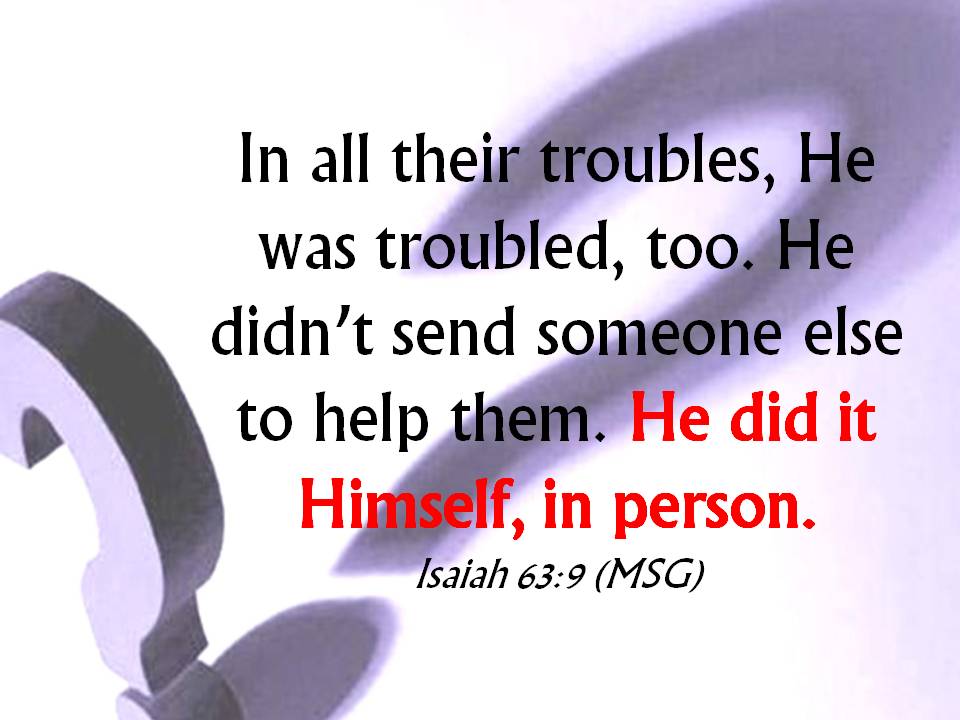
In all their troubles, He was troubled, too. He didn’t send someone else to help them. He did it Himself, in person. (Isaiah 63:9)

If you’ve missed any of the messages in this series called Where’s God, please check them all out by clicking here.

Cry Before You Confront

Listen to the podcast of this post by clicking on the player below, and you can also subscribe on AppleSpotify, or Audible.

As a pastor, one of your responsibilities is to point out what may be harmful in someone’s life. We have a word for that: confrontation.

Handled correctly, confrontation can lead to restoration and newfound maturity. Handled incorrectly, and, well, let’s just say it can get very ugly!

I just heard the story of a pastor who felt like he needed to confront one of his board members. I don’t really know this pastor, nor do I know the board member; I don’t know what was said in their meeting, but I have heard about the outcome, and it got ugly.

Samuel was going to be sent by God to confront King Saul about the sin he had committed. Look at this passage:

Then the word of the Lord came to Samuel: “I am grieved that I have made Saul king, because he has turned away from Me and has not carried out My instructions.” Samuel was troubled, and he cried out to the Lord all that night. (1 Samuel 15:10-11)

Did you catch how Samuel responded? He cried out to the Lord all that night.

Perhaps if we, as pastors, cried before we confronted the results might be more healthy.

“Tears shed for self are tears of weakness, but tears shed for others are a sign of strength.” —Billy Graham

Nehemiah was another pastoral/prophetic figure that was going to confront the inhabitants of Jerusalem about their sin.

When I heard these things, I sat down and wept. For some days I mourned and fasted and prayed before the God of heaven. Then I said: …I confess the sins we Israelites, including myself and my father’s house, have committed against You. (Nehemiah 1:4-6)

Before Nehemiah confronted the sins of the people, he tearfully took a hard look at himself, and then asked for forgiveness. Jesus shared this same concept with these words:

Why do you look at the speck of sawdust in your brother’s eye and pay no attention to the plank in your own eye? How can you say to your brother, “Let me take the speck out of your eye,” when all the time there is a plank in your own eye? You hypocrite, first take the plank out of your own eye, and then you will see clearly to remove the speck from your brother’s eye. (Matthew 7:3-5)

So before you confront your brother or sister, let the Holy Spirit confront you. Then, if it’s needed, confess your sin and ask God’s forgiveness. Let the Holy Spirit remove things in your life so that you can see clearly how to lovingly confront your brother.

Cry before you confront. Cry over your sin. Cry over the sinful state of your brother or sister. Plead with the Lord for this time of confrontation to lead to restoration and maturity.

►► Would you please prayerfully consider supporting this ministry? My Patreon supporters get behind-the-scenes access to exclusive materials. ◀︎◀︎

Thursdays With Oswald—Why Do I Go To God?

This is a weekly series with things I’m reading and pondering from Oswald Chambers. You can read the original seed thought here, or type “Thursdays With Oswald” in the search box to read more entries.

Why Do I Go To God?

     We have become so self-centered that we go to God only for something from Him, and not for God Himself. It is like saying, ‘No, Lord, I don’t want You; I want myself. But I do want You to clean me and fill me with Your Holy Spirit. I want to be on display in Your showcase so I can say, “This is what God has done for me.”’ Gaining heaven, being delivered from sin, and being made useful to God are things that should never even be a consideration in real surrender. Genuine total surrender is a personal sovereign preference for Jesus Christ Himself.

From My Utmost For His Highest

This quote smacked me right between the eyes: “We have become so self-centered that we go to God only for something from Him, and not for God Himself.”

This is one of those statements that caused me to put down my book, and take a hard look in my spiritual mirror. Why do I turn to God? Is it just so I can get something? When do I seek Him? Only when I’m in trouble?

The prayer that Jesus taught us to pray should be an everyday, heartfelt surrender: I surrender completely to You. Even Jesus Himself prayed: Not My will be done, but Yours.

My attitude as a disciple must be a daily decision to take my cross and follow Him.

How arrogant and self-centered of me to say, “God this is how I’m going to live today, and I want You to bless it. If things don’t go well, I will call on You for what I need.”

Instead I must pray: “Lord, I am totally surrendered to You today. Let me do only Your will. Let me walk more closely with You today. This is the only way I can be useful for You today.”

Why do I go to God: For His glory? Or for my comfort?

Who Are You?

This is another post especially for pastors (but I think others will find this helpful too).

John the Baptizer had no credentials, and yet people flocked to hear him speak.

He had no formal training, and yet people hung on his every word.

He had no authority from a sanctioning body, and yet he spoke with such power.

This perplexed the religious leadership. After all, they had credentials, training, and authority. So they came to John asking, “Who are you? What do you have to say about yourself?” (John 1:21-22).

If God has called you to the pastorate, He will equip you.

There’s nothing wrong with credentials, training, or sanctioning, per se. But when you think your call to preach has authority because of your title, your training, or your denominational appointment, you have missed the point! John had none of these, and yet Jesus said, “There’s never been a greater prophetic voice!”

So, pastor, who are you?

Are you the one who is credentialed, or trained, or sanctioned?

Or are you the one who has been called and equipped by God?

There’s a huge difference!

Who are you? I hope you can answer, “I am only a servant of the Most High, equipped by the Holy Spirit to make Jesus known in my city.”

UPDATE: I use John the Baptist as a prominent example in my book Shepherd Leadership: The Metrics That Really Matter.

Thursdays With Oswald—Serving Like Christ

This is a weekly series with things I’m reading and pondering from Oswald Chambers. You can read the original seed thought here, or type “Thursdays With Oswald” in the search box to read more entries.

Am I Serving Like Christ?

The Son of Man did not come to be served, but to serve… (Matthew 20:28)

     Jesus also said, ‘Yet I am among you as the One who serves’ (Luke 22:27). Paul’s idea of service was the same as our Lord’s—‘…ourselves your bondservants for Jesus’ sake’ (2 Corinthians 4:5). We somehow have the idea that a person called to the ministry is called to be different and above other people. But according to Jesus Christ, he is called to be a ‘doormat’ for others—called to be their spiritual leader, but never their superior. Paul said, ‘I know how to be abased…’ (Philippians 4:12). Paul’s idea of service was to pour his life out to the last drop for others. And whether he received praise or blame made no difference. As long as there was one human being who did not know Jesus, Paul felt a debt of service to that person until he did come to know Him. But the chief motivation behind Paul’s service was not love for others but love for his Lord.

     …The institutional church’s idea of a servant of God is not at all like Jesus Christ’s idea. His idea is that we serve Him by being the servants of others. Jesus Christ actually ‘out-socialized’ the socialists. He said that in His kingdom the greatest one would be the servant of all (see Matthew 23:11). The real test of a saint is not one’s willingness to preach the gospel, but one’s willingness to do something like washing the disciples’ feet—that is, being willing to do those things that seem unimportant in human estimation but count as everything to God.

From My Utmost For His Highest

I cannot add anything to this brilliant observation. But I can tell you the parts that the Holy Spirit is really working in my heart:

  • “…called to be a ‘doormat’ for others—called to be their spiritual leader, but never their superior.” God, help me to keep my pride in check.
  • “The real test of a saint is not one’s willingness to preach the gospel, but one’s willingness to do something like washing the disciples’ feet.” May I never shrink back from willingly serving at the lowest level of society.

UPDATE: This idea of servant-leaders plays prominently in my book Shepherd Leadership: The Metrics That Really Matter.

Even Before You Ask

A couple of weeks ago a lady in our church asked me to pray for a need in her life. She is a single Mom, as well as a caregiver for her bed-bound grandmother, which means money is tight.

She knew her car needed some repairs, so she took the car to the mechanic on Thursday afternoon. His initial estimate was $400. On Sunday we prayed about this, and joined our faith that God would either provide the funds, or provide another way for her car to be repaired.

Here’s a powerful verse of Scripture—

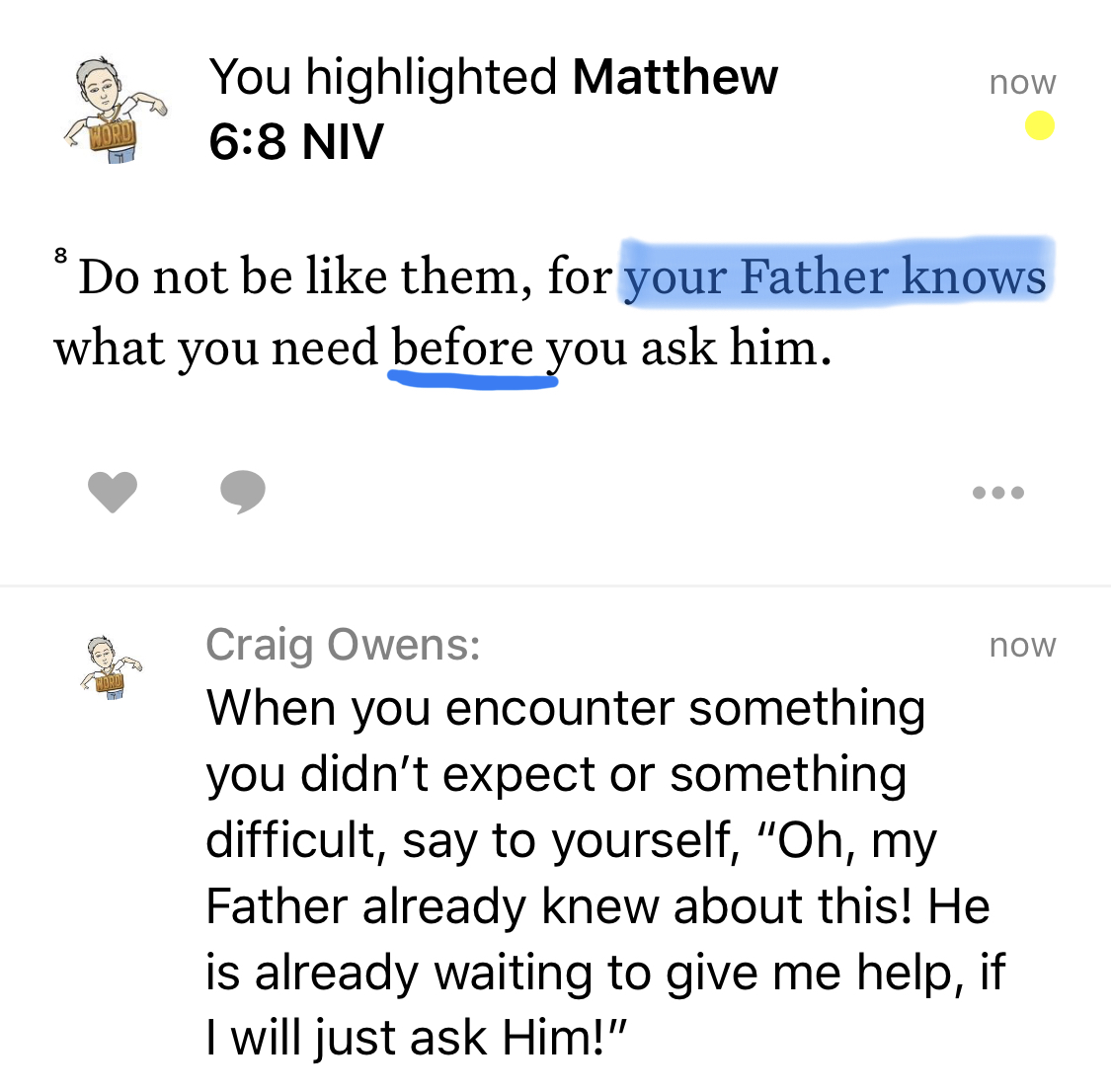
…Your Father knows exactly what you need even before you ask Him! (Matthew 6:8)

This lady returned to her mechanic the next day, and he told her the repairs had been completed. But the repairs were not as extensive as he originally thought, so the bill was only $105.

Now, here’s the best part—on Thursday, this lady had looked at her financial situation and had set aside all the money she could afford for this repair: $125!

So not only did God provide for her even before she asked, but she even gave the mechanic a $20 tip!

I love the fact that God knows what we need even before we ask Him!

Whose Plans?

Sometimes what needs to go on my To Do list seems logical. But logical to whom? If I’m not careful I can get so focused on doing the next logical thing, that I miss out on the Holy Spirit’s guidance.

Bruce Wilkinson said it this way—

“If we aren’t passionately and deliberately focused on carrying out God’s agenda with God’s heart, we’ll end up putting our own agenda first. We’ll increasingly look for the kind of missions we enjoy most. We’ll tend to ask God to bless our busyness for Him instead of asking Him to send us on the miracle mission of His choice.”

Ouch!

I don’t think the Bible is against To Do lists, but I need to make my lists the right way.

Instead, you ought to say, “If it is the Lord’s will, we will live and do this or that.” (James 4:15)

Your kingdom come, Your will be done on earth as it is in heaven. (Matthew 6:10)

With those verses in mind, this is what I’m praying:

Dear God, I want to decided right here and now that Your agenda is more important than mine. Not my “To Do” list be done, but Yours. I die to my plans so that I might live out your plans.

I am trying to Live Dead to my agenda this week.

If you’ve missed any messages in our series called Live Dead, you can find them all by clicking here.