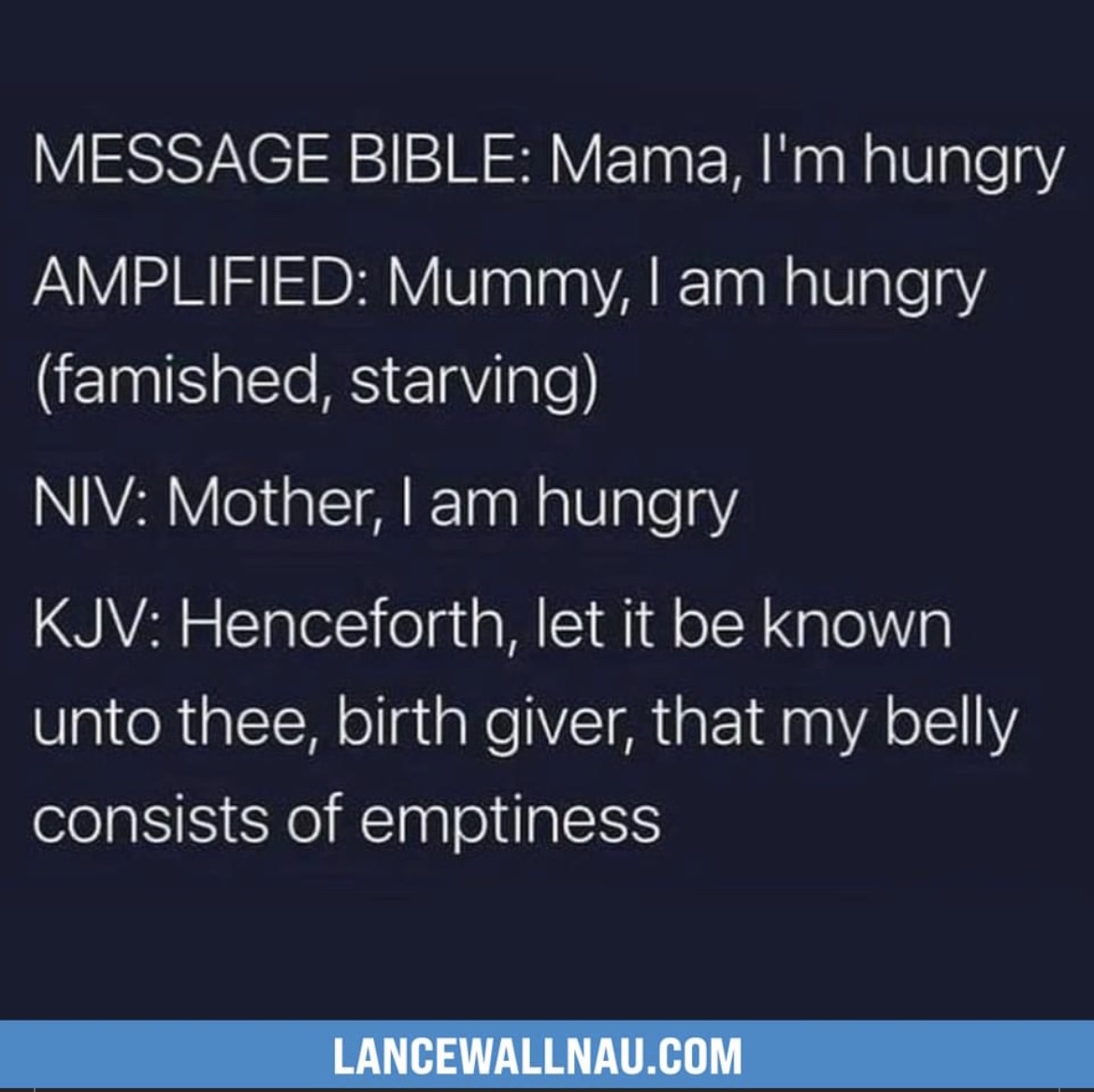
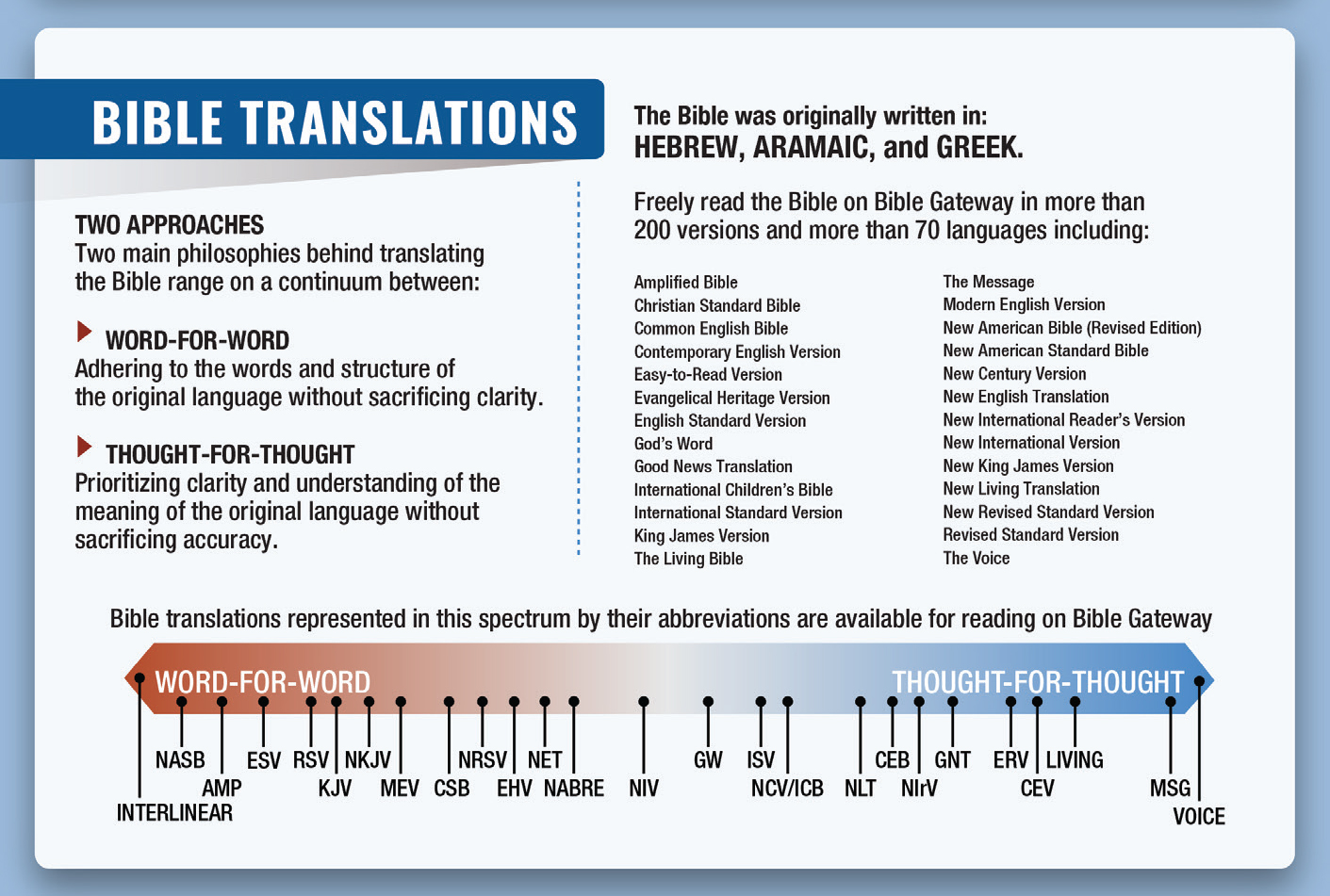
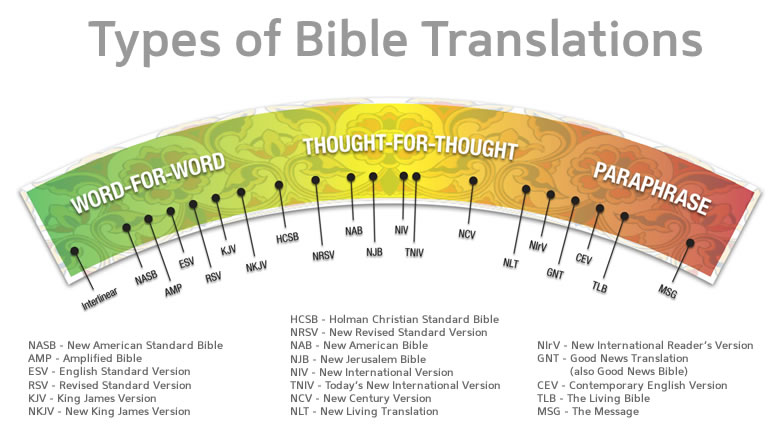
There are so many quality translations of the Bible to help us read God’s Word profitably, but many people ask me about the origin of each of these translations. I have shared three views of biblical translations below—two serious and one comical way of looking at them.
They only caution I would point out is a translation or paraphrase that is from a single person’s point of view. The Bible itself talks about success that comes from the combined wisdom of counselors, so a single-person paraphrase does open itself up more to the author’s whims than to true scholarship.
Listen to the podcast of this post by clicking on the player below, and you can also subscribe on Apple, Spotify, or Audible.
Isaiah 49 has an interesting phrase that appears twice: “But I said…” (vv. 4, 14).
Notice that first word: But. That conjunction means that “I” am saying something in contradiction to what someone else has said. Sadly, in this case the Someone Else that is speaking in this chapter is God Himself!
The phrase “this is what the LORD says” is used three times in this same chapter (vv. 8, 22, 25). Look at what God is saying to you and me:
I made you
I called you
you are My servant
I reward you
you have My favor
you have My comfort
I never forget you
I will never disappoint you
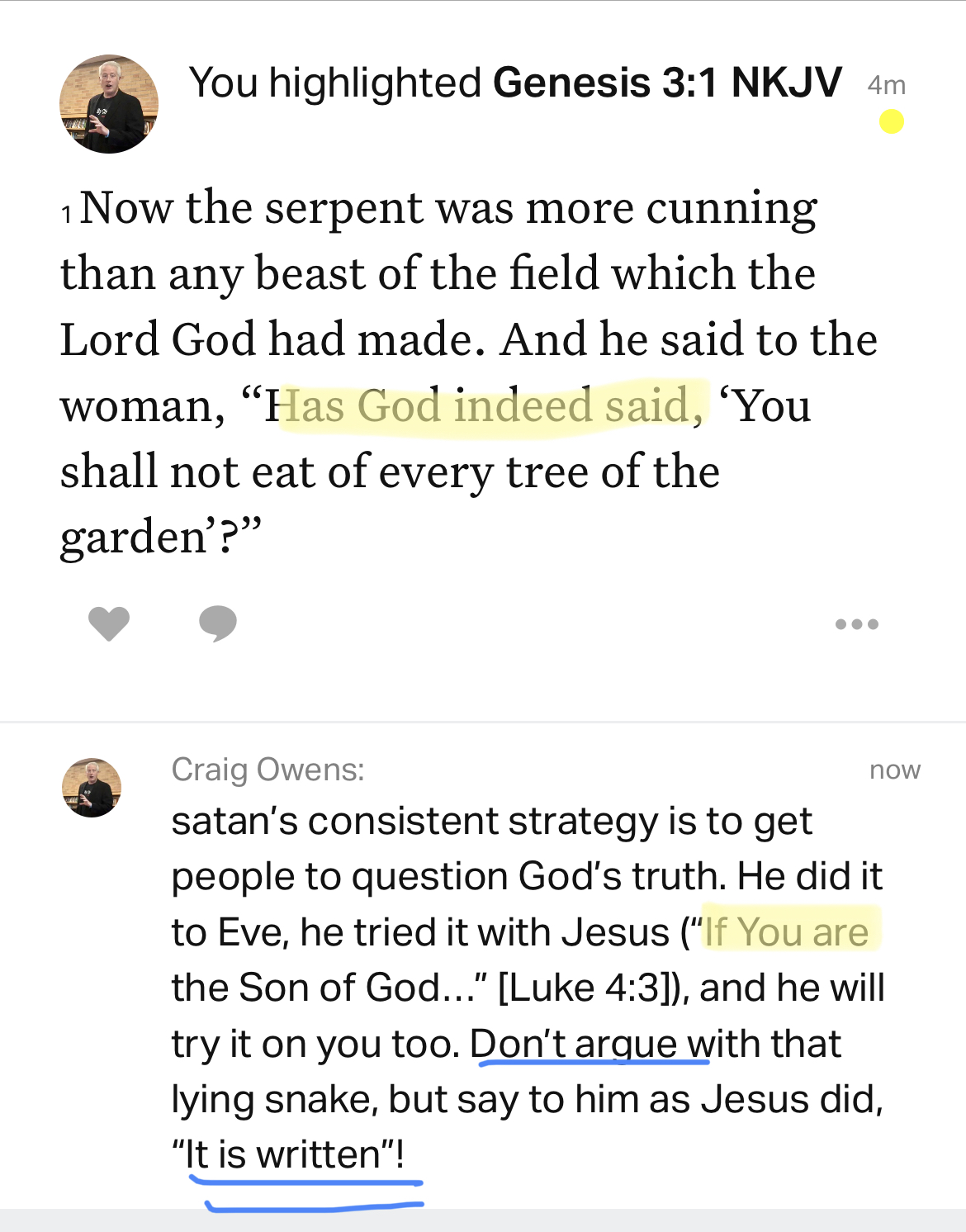
A consistent strategy of the devil is try to get us second-guessing or doubting God’s promises. He did this to Eve—“Did God really say that?”—and he tried it with Jesus—“Are You really the Son of God?”—and he’s still trying it today.
Jesus said the devil’s native tongue is lying. He lies and he slanders you. He wants you to simply listen to those lies without questioning them.
Someone once asked Smith Wigglesworth, “Smith, how do you feel?” He replied, “I never ask Smith how I feel. I tell him how he feels!”
That’s good counsel for us today!
Don’t listen to yourself, especially when you’re tired or lonely or anxious or scared, but talk to yourself. Remind yourself what God says to you and what He says about you. Remind those negative thoughts that God never lies, that He is all-loving, that He is all-powerful, and that He has a unique plan and purpose your life.
Whenever you feel like saying, “But I said,” change those thoughts around to, “But this is what God says!”
I’ve shared a couple of other posts that expand on this idea which you may want to read here and here.
Listen to the podcast of this post by clicking on the player below, and you can also subscribe on Apple, Spotify, or Audible.
“…If you do not stand firm in your faith, you will not stand at all” (Isaiah 7:9).
These words were spoken to King Ahaz and his people when they heard that enemies had allied themselves to attack. Their immediate response was, “And his people were shaken, as the trees of the forest are shaken by the wind” (v. 2). These are the people to whom God says, “If you do not stand firm in your faith, you will not stand at all.”
In Hebrew this phrase is really just the same Hebrew word repeated twice: aman aman. It amounts to this: if you don’t stand, you won’t stand.
Stand on what? Your faith.
Faith in what? Isaiah tells us, “This is what the Sovereign Lord says” (v. 7). Jehovah Adonai is the final word. He calls the two conspiring enemies “smoldering stubs of firewood,” and He states definitively of their plans, “It will not take place, it will not happen” (vv. 4, 7). Fittingly, several English translations of this verse say, “Their plans will not stand.”
When God speaks his final and decisive word, my faith-filled response should be exactly what He commanded the Israelites: “Be careful, keep calm, and don’t be afraid. Do not lose heart” (v. 4).
I must deliberately and repeatedly silence the saber rattling of the enemy by standing in faith on God’s decisive word. My faith comes from hearing God’s word (Romans 10:17).
This is why I am a huge proponent of not only reading God’s word, but turning His decisive word into prayer. Reminding myself—and repeatedly re-reminding myself—of what Jehovah Adonai has said is the only way to stand firm in faith. If I don’t stand firm in faith on His word, I will not be able to stand at all.
I recently shared some faith-filled decisive promises from God’s word in another post. If I can help you find a word of God on which you can stand in faith, please reach out to me.
Listen to the podcast of this post by clicking on the player below, and you can also subscribe on Apple, Spotify, or Audible.
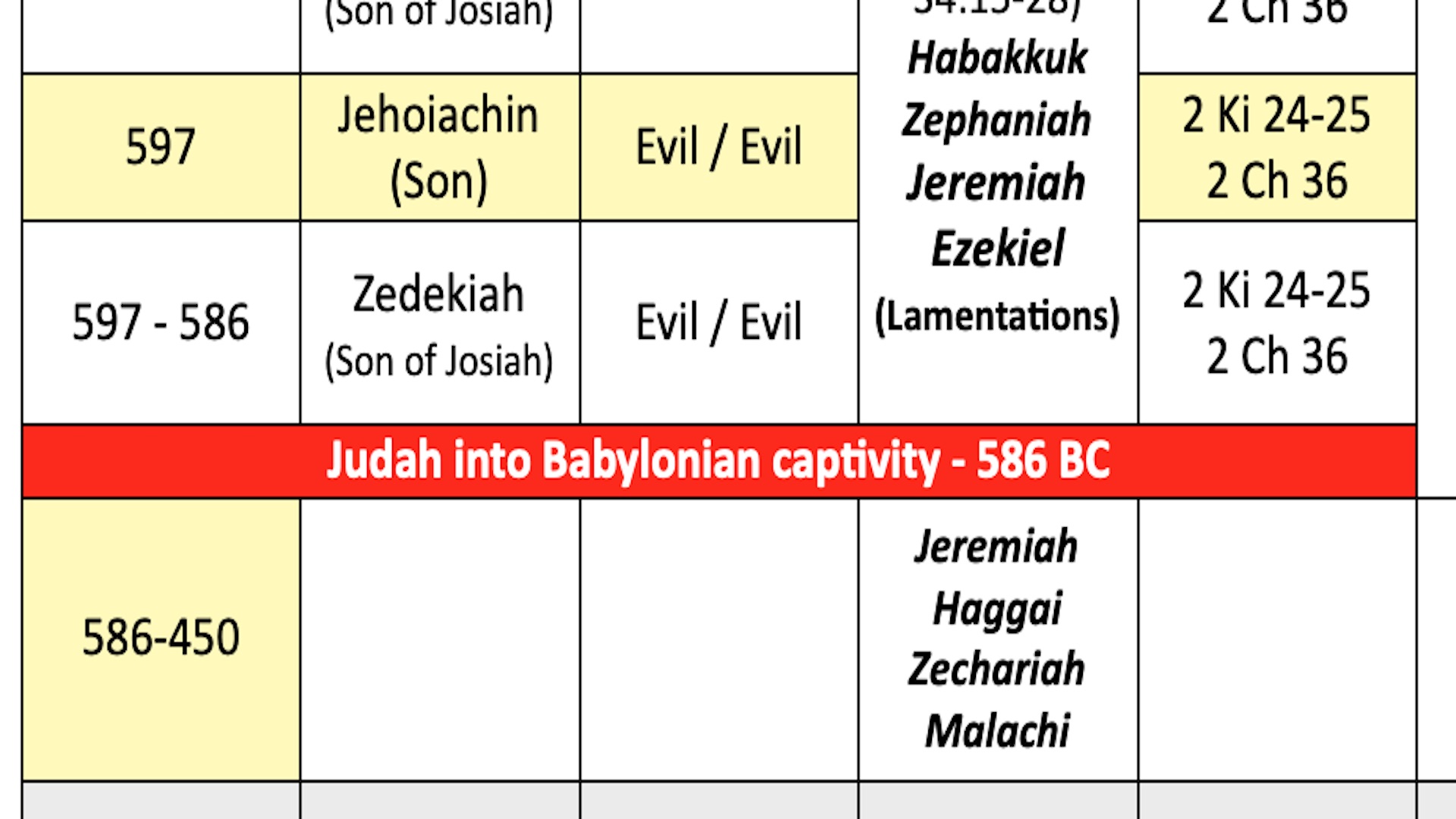
Haggai appears on the historical scene for just five months, but what a bright light he shines! He is the first of three post-exilic prophets to encourage the Israelites who have returned to Jerusalem.
Before we talk about Haggai’s ministry, we need a brief grammar lesson. Specifically, let’s look at two prefixes: un- and non-. Both of them ultimately mean “not,” but there is a distinction that we need to consider when it comes to the Bible:
unbiblical would mean something contrary to the teaching of the Bible
non-biblical is something that may or may not be correct, but it’s not specifically mentioned in the Bible
Let me give you an example from my book Shepherd Leadership: The Metrics That Really Matter. Chris asked me whether I preferred the title senior pastor or lead pastor. This is a non-biblical issue; that is, it doesn’t really matter to me because neither of those titles are found in the Bible. Technically, the word pastor isn’t in the Bible either. The word that is usually translated “pastor” is really a herdsman or a shepherd.
The problem is that if we put too much focus on non-biblical things, those things can end up becoming unbiblical pursuits. Like when Jesus took the Pharisees to task for their focus on traditions over Scripture (see Matthew 15:1-6). I wrote Shepherd Leadership mainly to get pastors and church leaders to spot non-biblical metrics which may have sneakily turned into unbiblical pursuits, so that they could return to pure biblical principles. In the Preface of my book, I wrote—
“My larger concern is that churches, parachurch organizations, and nonprofit ministries that are largely founded to fulfill a biblical mandate are straying from the simple, freeing truths found in the Bible. Or maybe I should say that they are adding things to their ministries that aren’t in the pages of Scripture. Whichever way you want to say it, the result is the same: We are using the wrong metrics to define ‘success’ for our ministries. I fear that in our focus on unbiblical practices, we are missing the joy of really doing ministry.”
Haggai calls God’s people to return to God’s Word. This is the second-shortest book in the Old Testament (at just 38 verses long), yet Haggai says something like “this is what God says” 28 times in these 38 verses!
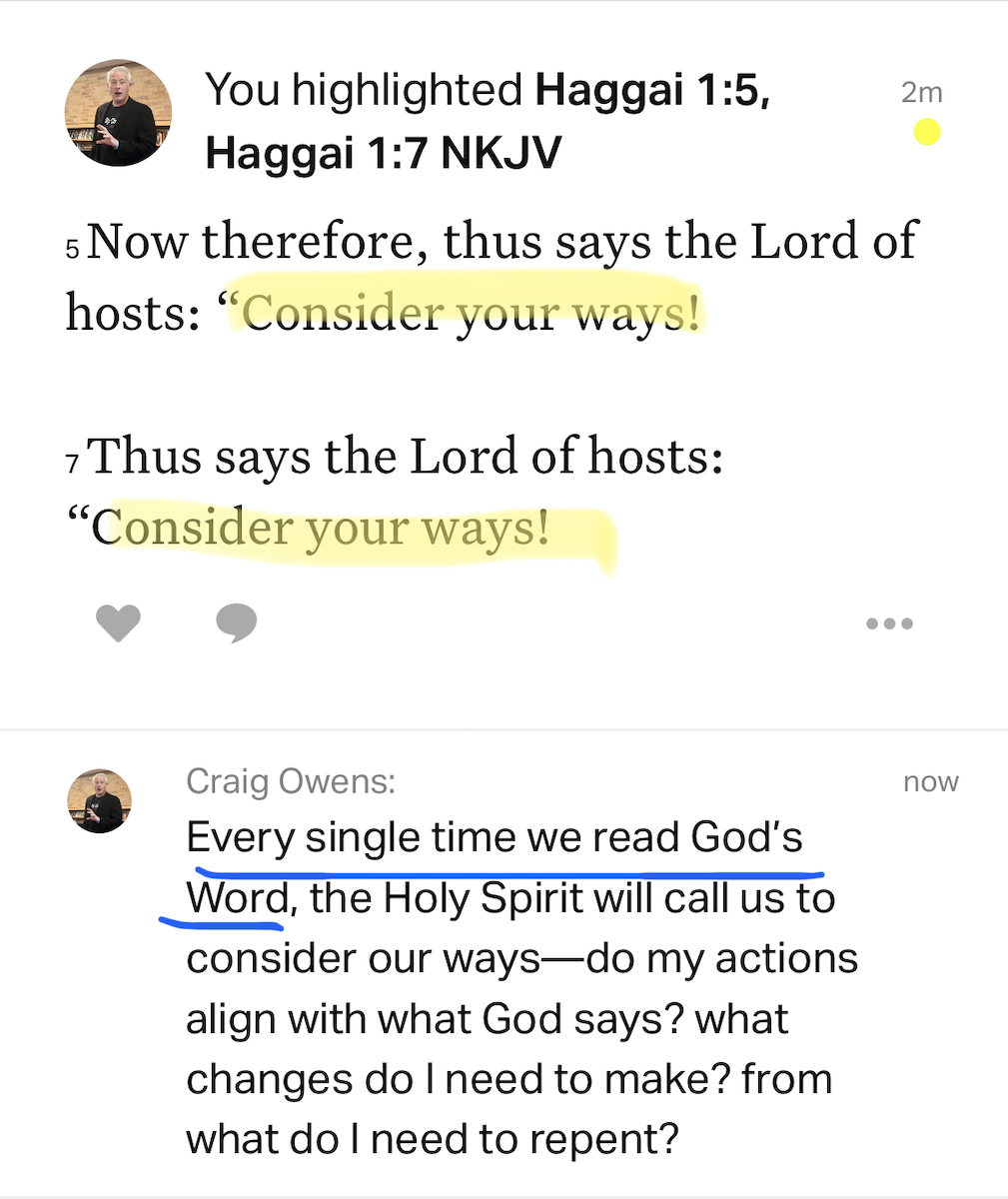
Haggai also records five times that God says, “Give careful thought to your ways.” This phrase literally means to take a strong hold on each thought and examine it intensely. This idea is always connected to a phrase like, “This is what the Lord Almighty says” (1:5, 7; 2:14-15, 17-18). In other words, we are to thoughtfully examine our lifestyle with God’s Word being THE standard of measurement.
Paul made a similar connection in the New Testament: We demolish arguments and every pretension that sets itself up against the knowledge of God, and we take captive every thought to make it obedient to Christ (2 Corinthians 10:5).
Jesus did this too. When speaking to the religious leaders, He said, “You are wrong because you know neither the Scriptures nor God’s power” (Matthew 22:29). And even with His own disciples, He had to open their minds to see how the Scriptures pointed to Him and were fulfilled in Him (Luke 24:25-27, 44-45).
Indeed, the phrase “it is written” is used 75 times in the New Testament!
That’s why Haggai’s words still ring true to us today: “Give careful thought” to how you live in light of how God says you should be living. Christians need to…
We must become people of the Word of God or else we run the very real risk of letting our non-biblical decisions spiral downward into a sinful, unbiblical lifestyle that grieves the heart of God.
Listen to the podcast of this post by clicking on the player below, and you can also subscribe on Apple, Spotify, or Audible.
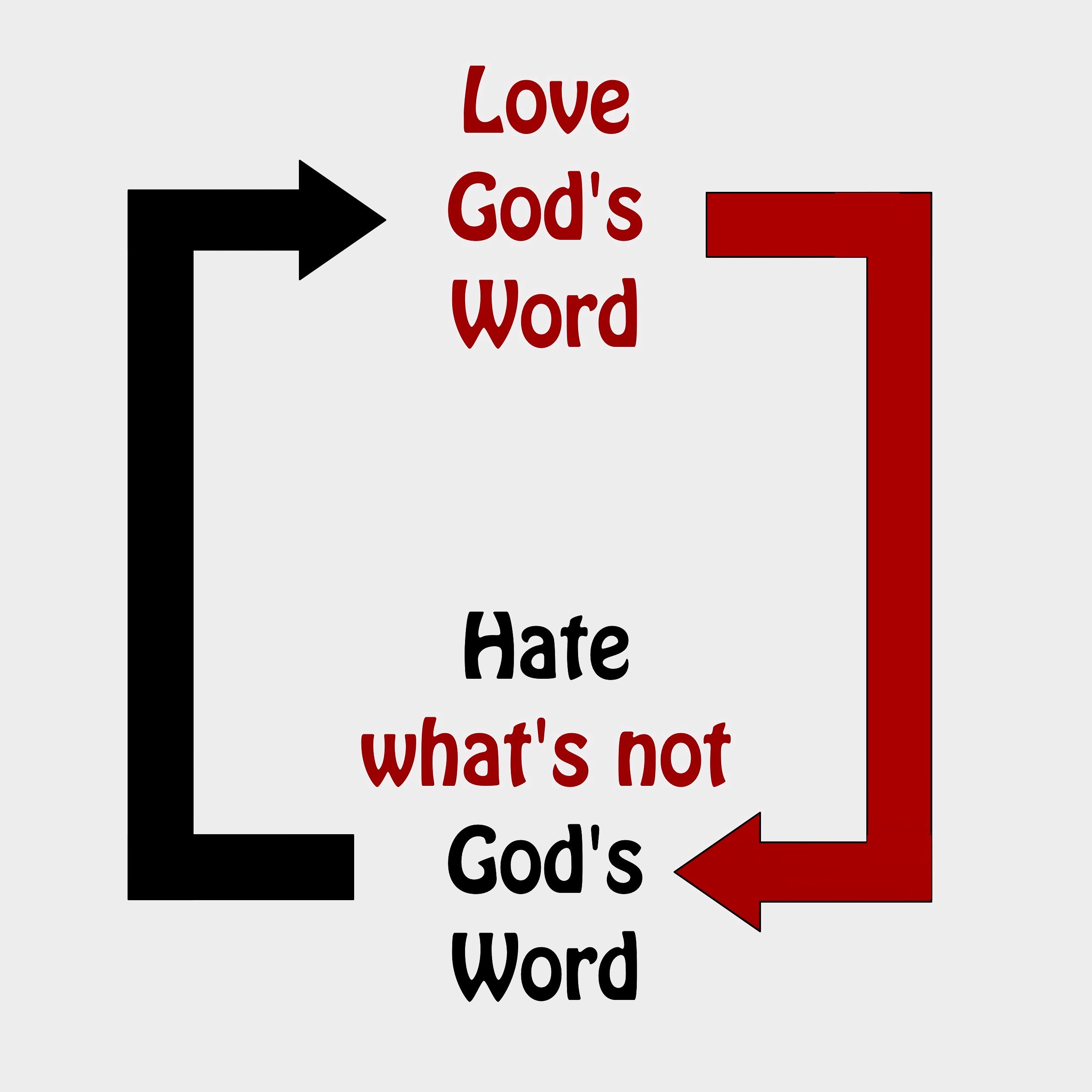
Oh, how I love Your law! … Therefore I hate every wrong path (Psalm 119:97, 104).
These bookend verses of the section called Mem form the conclusion of a logical argument, and in between are each step of the progression. Notice the word “for” (in vv. 98, 99, 100, and 102) and the words “so that” in v. 101.
This progression forms a circle from love to hate, and back to love again. Check this out—
I love Your law so I meditate on it all day.
Meditating on Your law makes me wiser than my enemies and my teachers.
This wisdom helps me obey Your laws.
Obedience keeps me on the right path.
I stay on the right path because You Yourself teach me while I’m on that path.
Because You are my Teacher, Your laws are sweet to me.
Because Your laws are sweet, I hate anything contrary to Your laws.
Hating everything that is not found in Your law helps me love Your law even more.
[Back to the top] Since I love Your law, I keep on meditating on it all day.
Listen to the podcast of this post by clicking on the player below, and you can also subscribe on Apple, Spotify, or Audible.
Psalm 119 is divided into twenty-two 8-verse segments, with each verse of the segments beginning with its own Hebrew letter. Lamedh is found in verses 89-96, and lamedh is the tallest of all the Hebrew letters, so that means it stands out.
Lamedh shows us big proportions. Words like eternal, boundless, established, enduring, and forever are prominent in these eight verses. The psalmist is inviting us to climb up into God’s Word and get a bigger view, a higher vantage point of who God is.
Consider the opening verse of this section: Your Word, O LORD, is eternal; it stands firm in the heavens.Eternal—think of the implications! If what God says—His Word—is eternal, then…
it continues through all generations (v. 90)
it endures even when everything else fades away (vv. 90-91)
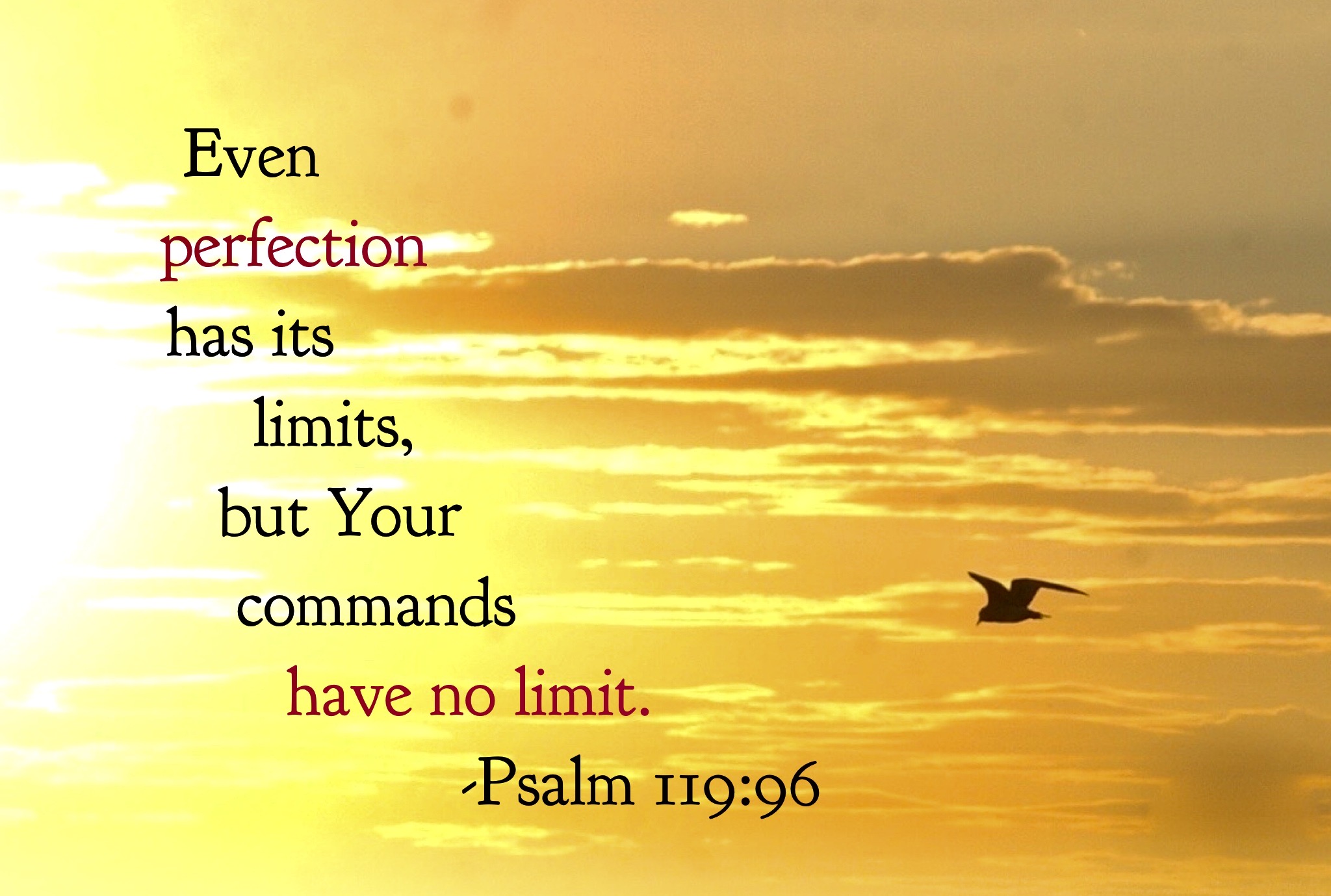
it has no limits or frontiers (v. 96)
At every single moment in my life, my eternal, enduring, limitless God knows the outcome or consequence of each option I could choose. His Word can so transform my mind that I can always choose the most Christ-glorifying option. The Spirit of Truth—my eternal Counselor—can guide me with God’s Word.
I never have to be at a loss. I am never stumped. I always have access to eternal Truth.
The psalmist got this: If Your law had not been my delight, I would have perished in my affliction (v. 92).
Through God’s firmly-established Word I have—
Eternal Counsel
Enduring Help
Limitless Strength
And you have all of this, too, through God’s Word!
Psalm 119 is a great place to start to make Bible reading a daily habit. Scientists tell us that you only need 21 days to make a new habit, and in Psalm 119 you have 22 days of daily reading that will transform your heart and mind.
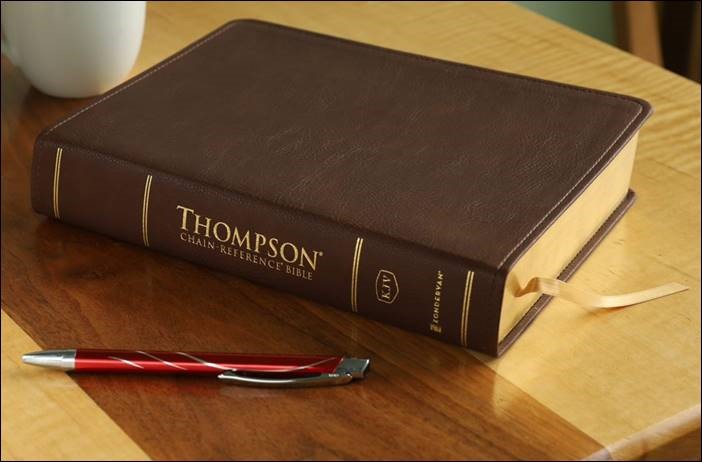
As a young person, I would hear pastors talking about their Thompson Chain-Reference Bible, so I always assumed this was merely a “preacher’s Bible,” and as a result, I never really looked into it. Now I’m kicking myself as I think about all of the rich study material I had missed out on previously.
Check this out: the back portion of this Bible contains 800 pages of cross-referenced study materials! Dr. Frank Charles Thompson (after whom this study Bible is named) spent almost 20 years compiling the notes that went into this Bible’s first printing in 1908. Since then, the improvements have only made using this study tool a richer experience. Because of Dr. Thompson’s detailed work, following the “chain” of scriptural references for a biblical character or a biblical theme is literally at your fingertips. There are even “chains” you can follow within each book of the Bible.
If you love studying the Bible as much as I do, this fascinating work is a must-have for your library.
Listen to the podcast of this post by clicking on the player below, and you can also subscribe on Apple or Spotify.
Psalm 93 opens with these powerful words: The LORD reigns.
Consider this: When we see the word LORD in all capital letters in our English translations of the Bible, we are reading God’s covenant name—Yahweh or Jehovah. This Limitless Power allows us to call Him by His personal name!
How can our finite minds even begin to fathom this? Listen to the psalmist’s words—
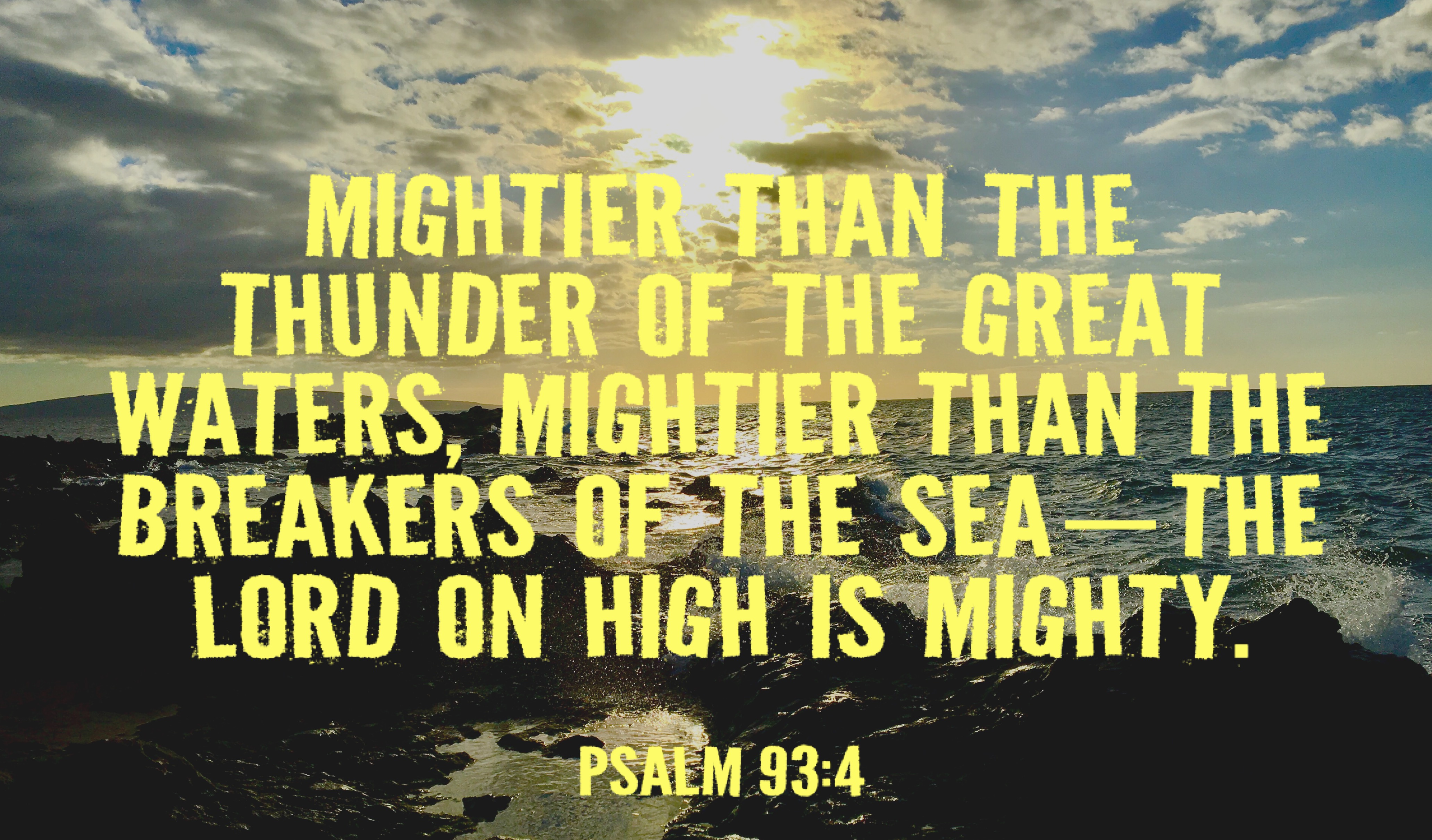
The LORD reigns, He is robed in majesty; the LORD is robed in majesty and is armed with strength. The world is firmly established; it cannot be moved. Your throne was established long ago; You are from all eternity. The seas have lifted up, O LORD, the seas have lifted up their voice; the seas have lifted up their pounding waves. Mightier than the thunder of the great waters, mightier than the breakers of the sea—the LORD on high is mighty. Your statutes stand firm; holiness adorns Your house for endless days, O LORD.
You can almost hear this psalmist struggling to help us comprehend the majesty of God. But how does a molecule comprehend the vastness of a planet? Creation sometimes roars and sometimes thunders, but even that only shows us a small glimpse of the Creator.
Do you see how established, orderly, firm, and secure this universe is? Even it had a starting point. Its Creator, however, has existed for all of eternity!
Have you ever been to the ocean and felt the pounding of the waves and heard the deafening roar of the breakers? That’s barely a toe-tapping of the might of Yahweh.
In the closing verse of this psalm, we read these words: “Your statutes stand firm.” Jehovah has given us a way to begin to comprehend Him. He has given us His statutes. This God who is unlimited in power has given us words we can live by. We can rely on them because they are backed by this limitless God! His promises stand firm forever. Nothing can shake God or His Word, so that means nothing can shake me when I stand on Him.
Standing on God’s Word means we are standing on Limitless Love and Limitless Strength.
This is a weekly series with things I’m reading and pondering from Charles Spurgeon. You can read the original seed thought here, or type “Thursdays With Spurgeon” in the search box to read more entries.
Listen to the podcast of this post by clicking on the player below, and you can also subscribe on iTunes or Spotify.
Context Is King
And the glory that You gave Me I have given them, that they may be one just as We are One: I in them, and You in Me; that they may be made perfect in one, and that the world may know that You have sent Me, and have loved them as You have loved Me. (Jesus in John 17:22-23)
Some words serve many uses and have many meanings. We are very apt to make mistakes if we give the same sense in all places to the same word. The word world throughout Scripture is used with a very remarkable variety of meaning, and one had need to have his wits about him and to read carefully in order to know what is the precise source of the term in each place where it occurs. …
I say again, the word world, therefore, has many shades of meaning ranging from that jet black meaning in which the world lies in the wicked one—‘Love not the world, neither the things that are in the world’ (1 John 2:15)—upward to the milder sense in John 1:10, ‘He was in the world, and the world was made through Him, and the world did not know Him.’ And yet higher to the bright meaning, ‘The kingdoms of this world have become the kingdoms of our Lord and of His Christ’ (Revelation 11:15). It is not in the worst sense that our text speaks of the world, but in the same manner as we find it used in such passages as these: ‘The Lamb of God who takes away the sin of the world!’ (John 1:29). ‘God was in Christ reconciling the world to Himself, not imputing their trespasses to them’ (2 Corinthians 5:19). And again in 1 John 2:2, ‘And He Himself is the propitiation for our sins, and not for ours only but also for the whole world.’
It is certain that ‘God so loved the world that He gave His only begotten Son, that whoever believes in Him should not perish but have everlasting life’ (John 3:16), and we cannot suppose that the great Redeemer would refuse to pray for those whom He was given. I understand in this particular place by the word world the whole mass of mankind upon the face of the earth who are not as yet converted. …
For the sake of the world, He would have the church in a high state of holy beauty and strength. May His gracious prayer be answered in all of us by the working of the Holy Spirit! … Our wish is to bring multitudes to the Savior and to conquer province after province of this revolted world for King Jesus. ‘Let the whole earth be filled with His glory’ (Psalm 72:19) is a prayer that we cannot, we dare not, we would not fail to pray!
From The Glory, Unity, And Triumph Of The Church
When we are studying our Bibles, we must remember that context is so vital. We have to read each inspired word in its proper context so that we know how to believe, think, live, and pray. I urge you to slow down in your Bible reading—aim for better and richer comprehension than to just try to read a lot in one sitting. Sometimes in my own personal Bible study time, I may spend several minutes just thinking about one phrase, and that may be the only part that I read on that particular morning.
However you read your Bible, make sure you are reading each part in its proper context. Pray before you begin reading and ask the Holy Spirit—Who inspired the Scriptures—to illuminate them to your heart and mind. These thoughtful Bible studies will do more to grow your spiritual maturity than simply rushing through your reading time.
This is a weekly series with things I’m reading and pondering from Charles Spurgeon. You can read the original seed thought here, or type “Thursdays With Spurgeon” in the search box to read more entries.
Listen to the podcast of this post by clicking on the player below, and you can also subscribe on iTunes or Spotify.
The Basis Of Our Hope
If there is no resurrection, apostolic preaching fails. ‘If Christ is not risen, then our preaching is empty’ [1 Corinthians 15:12-22]. … If Christ was not raised, the apostles were false witnesses. When a man bears false witness, he usually has a motive for doing so. What motive had these men? What did they gain by bearing false witness to Christ’s resurrection? It was all loss and no profit to them if He had not risen. They declared in Jerusalem that He had risen from the dead, and straightway men began to haul them to prison and to put them to death! Those of them who survived bore the same testimony. They were so full of the conviction of it that they went into distant countries to tell the story of Jesus and His resurrection from the dead. … They were brought before Roman emperors again and again, and before the proconsuls, and threatened with the most painful of deaths, but not one of them ever withdrew his testimony concerning Christ’s resurrection! …
If Christ is not raised, your faith is in vain. If it is in vain, give it up! Do not hold on to a thing that is not true! I would sooner plunge into the water and swim or wade through the river than I would trust myself to a rotten bridge that would break down in the middle. If Christ did not rise, do not trust Him, for such faith is in vain! But if you believe that He did die for you and did rise again for you, then believe in Him, joyfully confident that such a fact as this affords a solid basis for your belief! …
If [Jesus] died for you and rose again for you, that is the groundwork of your confidence, and I pray you keep to it. … Go your way and sing, ‘The Lord is risen indeed,’ and be happy as all the birds in the air, till you are, by and by, as happy as the angels in heaven through Jesus Christ our Lord. Amen.
From If There Is No Resurrection
I shared a series of messages that said, “I know Jesus is A.L.I.V.E. because of…” and each of the letters of ALIVE reminded us of a convincing proof of His resurrection. I would especially direct your attention to two of those letters.
The “L” stands for lives changed. When someone has a complete about-face life change because of their interaction with Jesus, that is pretty strong proof that their encounter was with a living Savior.
And the “E” stands for the engagement of Christ’s followers. It’s astounding to see how much of our world’s history has been positively impacted because of the influence of Christians. Their lives had become so radically different because of the life of Jesus in them that they could not help but change the culture around them.
As I said last in the last Thursdays with Spurgeon installment, always remember that the one with a personal experience is never at the mercy of the one with an argument. If your life has been changed by personal and ongoing interactions with Jesus Christ, don’t keep that good news to yourself. Let that assurance you have be a bright and winsome witness to all who are around you.