This is a periodic series with things I’m reading and pondering from Oswald Chambers. You can read the original seed thought here, or type “Thursdays With Oswald” in the search box to read more entries.
New Healthy Habits
When the Spirit of God brings a Word of God to us, are we going to wake up and lay hold [Ephesians 5:14-18] of it, or remain in the condition St. Augustine was in—“a little more worldliness; a little less intensity”? … When God tells us to do a thing He empowers us to do it, only we must do the doing. … All we need is grit and gumption and reliance on the Holy Spirit. We must bring the same determined energy to the revelations in God’s Book as we bring to earthly professions. Most of us leave the sweat of brain outside when we come to deal with the Bible. …
When in your soul’s vision you see clearly what God wants, let me advise you to do something physical immediately. If you accompany a moral or spiritual decision with a physical effort you give the necessary initiative to form the new habit. …
How are we going to find out the will of God? “God will communicate it to us.” He will not. His will is there all the time, but we have to discover it by being renewed in our minds, by taking heed to His Word and obeying it. If we are not going to be “conformed to this world; but transformed,” we must use our brains. God does the spiritual, powerful part we cannot do; but we have to work it out, and as we do the obeying we prove… “what is that good, and acceptable, and perfect, will of God” [Romans 12:1-2].
From The Moral Foundations Of Life
Everything we need to form new, healthy, God-pleasing habits has already been given to us in the Bible. Now we need to put our brains and our bodies to work—
God’s Word + Holy Spirit revelation + Concentration + Physical obedience =
New God-honoring habits
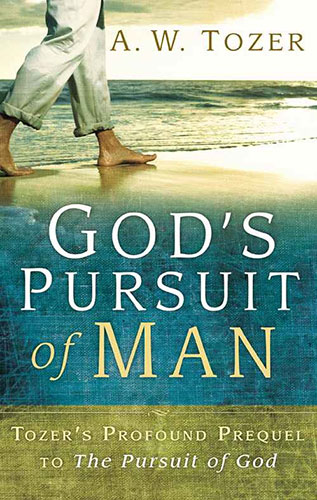
A.W. Tozer paints such a vivid picture of God’s desire for us to be in a deeper relationship with Him. I love it! You can read my full book review by clicking here. Below are some quotes I especially appreciated from God’s Pursuit Of Man.
“We habitually stand in our now and look back by faith to see the past filled with God. We look forward and see Him inhabiting our future; but our now is uninhabited except for ourselves. Thus we are guilty of a kind of temporary atheism which leaves us alone in the universe while, for the time, God is not.”
“Whatever else it embraces, true Christian experience must always include a genuine encounter with God. Without this, religion is but a shadow, a reflection of reality, a cheap copy of an original once enjoyed by someone else of whom we have heard. It cannot but be a major tragedy in the life of any man to live in a church from childhood to old age and know nothing more real than some synthetic god compounded of theology and logic, but having no eyes to see, no ears to hear and no heart to love.”
“Self-righteousness is an effective bar to God’s favor because it throws the sinner back upon his own merits and shuts him out from the imputed righteousness of Christ.”
“Every man looks to his fellow men because he has no one else to whom he can look. David could say, ‘Whom have I in heaven but Thee? and there is none upon earth that I desire beside Thee’ (Psalm 73:25). But the sons of this world have not God; they have only each other, and they walk holding to each other and looking to one another for assurance like frightened children. But their hope will fail them, for they are like a group of men, none of whom has learned to fly a plane, who suddenly find themselves aloft without a pilot, each looking to the other to bring them safely down. Their desperate but mistaken trust cannot save them from the crash which must certainly follow. … Yet in their pride men assert their will and claim ownership of the earth. Well, for a time it is true that this is man’s world. God is admitted only by man’s sufferance. He is treated as visiting royalty in a democratic country. Everyone takes His name upon his lips and (especially at certain seasons) He is feted and celebrated and hymned. But behind all this flattery men hold firmly to their right of self-determination. As long as man is allowed to play host he will honor God with his attention, but always He must remain a guest and never seek to be Lord. Man will have it understood that this is his world; he will make its laws and decide how it shall be run. God is permitted to decide nothing. Man bows to Him and as he bows, manages with difficulty to conceal the crown upon his own head.”
“The degree of blessing enjoyed by any man will correspond exactly with the completeness of God’s victory over him.”
“A thousand years of remorse over a wrong act would not please God as much as a change of conduct and a reformed life. … We can best repent our neglect by neglecting Him no more. Let us begin to think of Him as One to be worshiped and obeyed. Let us throw open every door and invite Him in. Let us surrender to Him every room in the temple of our hearts and insist that He enter and occupy as Lord and Master within His own dwelling.”
“God made man in His own image and placed within him an organ by means of which he could know spiritual things. When man sinned that organ died. ‘Dead in sin’ is a description not of the body nor yet of the intellect, but of the organ of God-knowledge within the human soul. Now men are forced to depend upon another and inferior organ and one furthermore which is wholly inadequate to the purpose. I mean, of course, the mind as the seat of his powers of reason and understanding. Man by reason cannot know God; he can only know about God.”
“The danger is that we think of ‘the power of God’ as something belonging to God as muscular energy belongs to a man, as something which He has and which might be separated from Him and still have existence in itself. We must remember that the “attributes” of God are not component parts of the blessed Godhead nor elements out of which He is composed. A god who could be composed would not be God at all but the work of something or someone greater than he, great enough to compose him. We would then have a synthetic god made out of the pieces we call attributes, and the true God would be another being altogether, One indeed who is above all thought and all conceiving.”
“Christianity takes for granted the absence of any self-help and offers a power which is nothing less than the power of God. This power is to come upon powerless men as a gentle but resistless invasion from another world, bringing a moral potency infinitely beyond anything that might be stirred up from within. This power is sufficient; no additional help is needed, no auxiliary source of spiritual energy, for it is the Holy Spirit of God come where the weakness lay to supply power and grace to meet the moral need.”
“Man, who moved out of the heart of God by sin, now moves back into the heart of God by redemption. God, who moved out of the heart of man because of sin, now enters again His ancient dwelling to drive out His enemies and once more make the place of His feet glorious.”
“To will the will of God is to do more than give unprotesting consent to it; it is rather to choose God’s will with positive determination. As the work of God advances, the Christian finds himself free to choose whatever he will, and he gladly chooses the will of God as his highest conceivable good.”
“That terrible zone of confusion so evident in the whole life of the Christian community could be cleared up in one day if the followers of Christ would begin to follow Christ instead of each other.”
“Religious contentment is the enemy of the spiritual life always.”
This is a weekly series with things I’m reading and pondering from Oswald Chambers. You can read the original seed thought here, or type “Thursdays With Oswald” in the search box to read more entries.
Thoughtful Questions
Oswald Chambers usually sprinkles questions into his lectures, but in this passage, the questions came one right after another—
From The Love Of God
Yeah, I’m going to have to ponder these for awhile…
My friend Chuck and I have a sort of shorthand when we talk. We’ve been through so many experiences together, that now just a single word can bring to our minds the fullness of that time, with all of its tears and laughter. Someone listening to one of our conversations might not get the full impact, but we sure do!
It’s the same way when we read one of the Apostle Paul’s letters. He is writing to a church or an individual with whom he had a rich, personal experience. So when he alludes to something, those friends who went through that experience with him recall all of the fullness. When reading the letter to the church at Ephesus, you can experience some of that fullness by reading about Paul’s experience in that city in Acts 19.
In Acts 19 you will meet the followers of Jesus who were already there and see them get baptized in the Holy Spirit … watch Paul teach for three months in the synagogue before the Jewish troublemakers run him out … see Paul lecture for the next three years in the Hall of Tyrannus, so that everyone in that province heard the Word of God … see how God authenticated Paul’s ministry with miracles … experience those who tried to counterfeit what Paul was doing … see many in that city turn from their witchcraft and idol worship … and finally experience the tumult of a near-riot started by the merchants who were losing their income on sales of mythological trinkets because so many were turning to Christ.
With this backdrop, you can then understand why Paul uses such specific language in the opening greeting of his letter to Ephesus (see Ephesians 1:1-3). By doing so he is contrasting the followers of Jesus with the followers of Artemis—
But the most specific language is in Ephesians 1:3—Praise be to THE God and Father of our Lord Jesus Christ (emphasis added)….
The question Paul invites the Ephesians to consider is the same question we must consider:
We will be continuing our study on the book of Ephesians next Sunday, and I would love to have you join us!
This is a weekly series with things I’m reading and pondering from Oswald Chambers. You can read the original seed thought here, or type “Thursdays With Oswald” in the search box to read more entries.
Doubting
Lord, I praise You for this place I am in; but the wonder has begun to stir in me—is this Your place for me? Hold me steady doing Your will. It may only be restlessness; if so, calm me to strength that I sin not against You by doubting.
From Knocking At God’s Door
I love the “realness” of this prayer!
I’ve been in this same place where Oswald Chambers was. Have you? I know that I know that God has called me to a certain place, but then I begin to second-guess that call. Perhaps challenges have come against me. Perhaps things aren’t moving as easily as I thought they should. Perhaps I don’t have the passion I once had.
Is this God speaking to me, or is this just my impatience? Am I restless because I’m dissatisfied, or am I restless because God is preparing to move me?
Whatever the case, I need to ask the Holy Spirit to calm me. It’s in those calm times that I am strengthened to hear God’s unmistakable Voice. I don’t want to make a rash decision based on the emotion of the moment; I want to clearly hear what God has to say to me. He will either reenergize me to stay put, or He will clearly show me it’s time to move.
This is a weekly series with things I’m reading and pondering from Oswald Chambers. You can read the original seed thought here, or type “Thursdays With Oswald” in the search box to read more entries.
The Word & The Words
The Bible is the Word of God only to those who are born from above and who walk in the light. Our Lord Jesus Christ, the Word of God, and the Bible, the words of God, stand or fall together, they can never be separated without fatal results. A man’s attitude to our Lord determines his attitude to the Bible.
The “sayings” of God to a man not born from above are of no moment; to him the Bible is simply a remarkable compilation of literature—“that it is, and nothing more.” All the confusion arises from not recognizing this.
But to the soul born from above, the Bible is the universe of God’s revealed will. The Word of God to me is ever according to my spiritual character; it makes clear my responsibility to God as well as my individuality apart from Him.
From Christian Disciplines (emphasis mine)
Do you agree with Chambers on this viewpoint?
In light of this, how will you view Scripture differently?
This is a weekly series with things I’m reading and pondering from Oswald Chambers. You can read the original seed thought here, or type “Thursdays With Oswald” in the search box to read more entries.
The Will Of God
Supernatural voices, dreams, ecstasies, visions and manifestations, may or may not be an indication of the will of God. The words of Scripture, the advice of the saints, strong impressions during prayer, may or may not be an indication of the will of God.
The one test given in the Bible is discernment of a personal God and a personal relationship to Him, witnessed to ever after in walk and conversation.
From Christian Disciplines
The will of God may or may not come to you in a thundering voice or even in a still, small impression in your heart. But the way you walk and talk will absolutely attest to what you believe the will of God is. The way you walk and talk witnesses to what you believe.
So when you look at you, do you see God’s will on display?
This is a weekly series with things I’m reading and pondering from Oswald Chambers. You can read the original seed thought here, or type “Thursdays With Oswald” in the search box to read more entries.
The time a Christian gives to prayer and communion with God is not meant for his natural life, but meant to nourish the life of the Son of God in him. God engineers the circumstances of His saints in order that that Spirit may use them as the praying-house of the Son of God. … Prayer not so much alters things as alters the man who prays, and he alters things. … The essential meaning of prayer is that it nourishes the life of the Son of God in me and enables Him to manifest Himself in my mortal flesh.
From Biblical Ethics
In every situation, I must believe that God has directed my steps. But even though I know that, it still doesn’t mean that I will grow as a result of it. God does engineer my circumstances—and sometimes makes those circumstances seem “impossible”—so that I will pray. It’s only prayer that will make the impossible possible.