Sovereign Love

Listen to the podcast of this post by clicking on the player below, and you can also subscribe on Apple, Spotify, or Audible.
Jesus is on His passionate journey toward the Cross. Every step on this journey is a step of love. 

After Jesus finished His last supper with His disciples, they all went to one of their favorite places to pray—the Garden of Gethsemane. It was a place they all knew well. Including Judas, who had been looking for an opportunity to turn Jesus over to the religious authorities when He was out of the public eye. 

Jesus knew this time was coming (Matthew 10:33-34; John 13:1, 3; 18:4), and His knowing prompted His serving. So we can say that His foot-washing service was as much a reminder to Himself as it was to His followers. 

After they entered the garden to pray, events began to unfold at a fast pace, ultimately culminating in Jesus being crucified. 

But let us never forget that through all of this horrific, inhumane mistreatment and torture, Jesus remains the King of kings, the Son of God. In fact, very God Himself.

The Jewish religious leaders knew this too (John 8:54-59; 10:31-33). And without “knowing it” the soldiers that came to arrest Jesus knew it as well.

Just look at the absolute authority of the King of kings. Grown men—religious leaders and hardened soldiers—fall to their knees at just three words: “I am He.” 

Christ’s kingdom has overruling authority. It collects no taxes, it has no standing army, it requires no checks-and-balances because its Sovereign IS Truth and Love. This unequaled, unrivaled power was contained in Jesus—“You would have no authority over Me unless it was given you from above.” 

Which makes His submission to Pilate and others even more amazing! One word from Him could have crushed legions and toppled governments—yet for love’s sake, He submitted. Let that sink in—Sovereignty submitted.

What appeared to be the cruelty of man was the sovereignty of God. 

No one can take My life from me. I sacrifice it voluntarily. For I have the authority to lay it down when I want to and also to take it up again. For this is what My Father has commanded. (John 10:18) 

“Christ’s death was not the death of a martyr, who sinks at last overwhelmed by enemies, but the death of a triumphant conqueror, who knows that even in dying He wins for Himself and His people a kingdom and a crown of glory.” —J.C. Ryle 

Christ has bought us out from under the doom of that impossible system by taking the curse for our wrongdoing upon Himself. For it is written in the Scripture, “Anyone who is hanged on a tree is cursed” (as Jesus was hung upon a wooden Cross). (Galatians 3:13 TLB) 

Sovereign love submitted to the cruelty of man SO THAT you and I could be saved from the inescapable doom that will inevitably crash down on us. Jesus loved us so much that He allowed the Cross to happen to Him. 

The question now remains—what are you doing with this sovereign love? 

Do you know Jesus as your Savior? Have you received this gift He willingly, lovingly purchased for you on the Cross? 

If you have, let me ask you another question: Christian, are you living in a way that leads others to this sovereign love too (John 13:34-35)?

Anytime you see the Cross, remember what sovereign love did there for you. 

►► Would you please prayerfully consider supporting this ministry? My Patreon supporters get behind-the-scenes access to exclusive materials. ◀︎◀︎

Poetry Saturday—Christ Jesus Lay In Death’s Strong Bands

Christ Jesus lay in death’s strong bands,
For our offenses given;
But now at God’s right hand He stands
And brings us life from heaven;
Therefore let us joyful be
And sing to God right thankfully
Loud songs of hallelujah.
Hallelujah! 

It was a strange and dreadful strife
when life and death contended;
the victory remained with life,
the reign of death was ended;
Holy Scripture plainly saith
that death is swallowed up by death,
his sting is lost forever. 
Hallelujah!

Here the true Paschal Lamb we see,
whom God so freely gave us;
He died on the accursed tree—
so strong His love!—to save us.
See, His blood doth mark our door;
faith points to it, death passes o’er,
and satan cannot harm us. 
Hallelujah! —Martin Luther

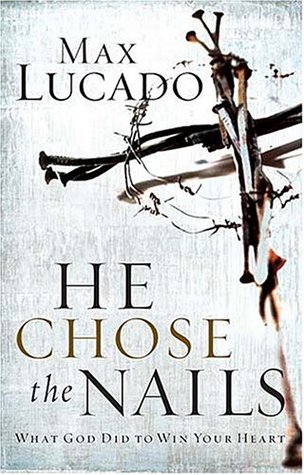
7 Quotes From “He Chose The Nails”

Max Lucado takes us in for a closer look at the Cross and all that Jesus did there for us. Please check out my full book review and then read this book—you will be glad you did! 

“Maybe you’ve never spit on anyone, but have you gossiped? Slandered? Have you ever raised your hand in anger or rolled your eyes in arrogance, have you ever blasted your high beams in someone’s rearview mirror? Ever made someone feel bad so you would feel good? That’s what the soldiers did to Jesus. When you and I do the same, we do it to Jesus too. ‘I assure you, when you did it to one of the least of these My brothers and sisters, you were doing it to Me!’ (Matthew 25:40 NLT). How we treat others is how we treat Jesus. …

“Allow the spit of the soldiers to symbolize the filth in our hearts. And then observe what Jesus does with our filth. He carries it to the Cross. Through the prophet He said, ‘I did not hide My face from mocking and spitting’ (Isaiah 50:6). Mingled with His blood and sweat was the essence of our sin.” 

“‘He canceled the record that contained the charges against us. He took it and destroyed it by nailing it to Christ’s Cross’ (Colossians 2:14 NLT). Between His hands and the wood there was a list. A long list. A list of our mistakes: our lusts and lies and greedy moments and prodigal years. A list of our sins. Dangling from the Cross is an itemized catalog of your sins. The bad decisions from last year. The bad attitudes from last week. There, in broad daylight for all of heaven to see, is a list of your mistakes. … The list God has made, however, cannot be read. The words can’t be deciphered. The mistakes are covered. The sins are hidden. Those at the top are hidden by His hand; those down the list are covered by His blood. Your sins are ‘blotted out’ by Jesus (KJV). ‘He has forgiven you all your sins: He has utterly wiped out the written evidence of broken commandments which always hung over our heads, and has completely annulled it by nailing it to the Cross’ (Colossians 2:14 Phillips).” 

“Seats at God’s table are not available to the sloppy. But who among us is anything but. Unkempt morality. Untidy with truth. Careless with people. Our moral clothing is in disarray. Yes, the standard for sitting at God’s table is high, but the love of God for His children is higher. So He offers a gift.… a seamless robe… a robe worn by His Son, Jesus.” 

“What appeared to be the cruelty of man was actually the sovereignty of God. Matthew tells us: ‘And when Jesus had cried out again in a loud voice, He gave up His spirit. At that moment the curtain of the temple was torn into from top to bottom’ (27:50-51). It’s as if the hands of heaven had been gripping the veil, waiting for this moment.” 

“Why is the Cross the symbol of our faith? To find the answer look no farther than the Cross itself. Its design couldn’t be simpler. One beam horizontal—the other vertical. One reaches out—like God‘s love. The other reaches up—as does God’s holiness. One represents the width of His love; the other reflects the height of His holiness. The Cross is the intersection. The Cross is where God forgave His children without lowering His standards.” 

“‘Just look what they did to me!’ we defy and point to our hurts. ‘Just look what I did for you,’ Jesus reminds and points to the Cross. Paul said it this way: ‘If someone does wrong to you, forgive that person because the Lord forgave you’ (Colossians 3:13). You and I are commanded—not urged, commanded—to keep no list of wrongs.” 

“Knowing His last deeds would be forever pondered, don’t you think Jesus chose them carefully? Deliberately? Of course He did. There were no accidents that day. Jesus’ last moments were not left up to chance. God chose the path; He selected the nails. Our Lord planted the trio of crosses and painted the sign. God was never more sovereign than in the details of the death of His Son. … The message: ‘I did it for you. I did it all for you.’” 

He Chose The Nails (book review)

Max Lucado has an inimitable style of writing that immediately draws us into his subject—in this book the focal point is what Jesus did for us on the Cross—gets us to look at it in a new light, and then helps us walk away with a fuller understanding. The title of this book is really the answer to the sub-title—Q: What did God do to win your heart? A: He Chose The Nails.

In keeping with the theme of God answering the book’s question of how He won your heart, all but two of the chapters use statements from God as their title. Statements like “I will bear your dark side,” and “I forgive you,” and “I understand your pain,” and “I will love you forever.” In each chapter, Max takes us nearer to the Cross and to the Savior who bled and died there to show us how much God loves us. 

This is a book that can easily be read together with your family or a group of friends; especially if you then utilize the study guide questions for each chapter at the back of the book. This is a book that could be read rather quickly, but because Max paints such a vivid picture of God’s unexpected love you will want to read slowly and savoringly. This is a book that could be read at any time, but I would recommend you read it during the days and weeks approaching Good Friday and Resurrection Sunday. 

Whether reading alone or with friends, reading quickly or slowly, reading it during the Lenten season or at another time, I can promise you that your heart will beat more strongly with the assurance of God’s overwhelming, mind-blowing love for you. 

Poetry Saturday—Unanswered Prayers

Like some schoolmaster kind in being stern,
Who hears the children crying o’er their slates
And calling, “Help me, master!” yet helps not,
Since in his silence and refusal lies
Their self-development, so God abides
Unheeding many prayers. He is not deaf
To any cry sent up from earnest hearts;
He hears and strengthens when He must deny.
He sees as weeping o’er life’s hard sums;
But should He give the key and dry our tears,
What would it profit us when school were done
And not one lesson mastered?

     What a world
Were this if all our prayers were answered. Not
In famed Pandora’s box were such vast ills
As lie in human hearts. Should our desires,
Voiced one by one in prayer, ascend to God
And come back as events shaped to our wish,
What chaos would result!

     In my fierce youth
I sighed out breath enough to move a fleet,
Voicing wild prayers to heaven for fancied boons
Which were denied; and that denial bends
My knees to prayer of gratitude each day
Of my maturer years. Yet from those prayers
I rose always regirded for the strife
And conscious of new strength. Pray on, sad heart,
That which thou pleadest may not be given,
But in the lofty altitude where souls
Who supplicate God’s grace are lifted, there
Thou shalt find help to bear thy daily lot
Which is not elsewhere found. —Ella Wheeler Wilcox

Thursdays With Oswald—The Love Behind The Warning

Oswald ChambersThis is a weekly series with things I’m reading and pondering from Oswald Chambers. You can read the original seed thought here, or type “Thursdays With Oswald” in the search box to read more entries.

The Love Behind The Warning

“Enter through the narrow gate. For wide is the gate and broad is the road that leads to destruction, and many enter through it. But small is the gate and narrow the road that leads to life, and only a few find it.” —Jesus (Matthew 7:13-14) 

     Always distinguish between warning and threatening. God never threatens; the devil never warns. A warning is a great arresting statement of God’s, inspired by His love and patience. …

     It is the great patience of God that gives the warning, “The way of transgressors is hard.” Go behind that statement in your imagination and see the love of God. God is amazingly tender, but the way of transgressors cannot be made easy. God has made it difficult to go wrong, especially for His children. … 

     If Jesus came to be a teacher only, He had better have stayed away. What is the use of teaching a human being to be what no human being can be—to be continually self-effaced, to do more than his duty, to be completely disinterested, to be perfectly devoted to God? If all Jesus came to do was to teach men to be that, He is the greatest taunter that ever presented any ideal to the human race. But Jesus Christ came primarily and fundamentally to regenerate man. He came to put into any man the disposition that ruled His own life, and immediately that is given to a man, the teaching of Jesus begins to be possible. 

From Studies In The Sermon On The Mount

The opposite of love is not hate; it’s apathy. If God didn’t love us, He wouldn’t care what road we attempted to take. But He does love us, so He tells us the one and only way to get to Him: Jesus Christ is THE way. 

Chambers is exactly right when He says that Jesus was not just a great Teacher. If that’s all that Jesus came to do, we would be miserable people because we could never walk the narrow road that He taught. But Jesus came to enable and empower us to walk that road. He came to purchase our atonement (our “at-onement” with Him) so that we could live out all that He taught. 

Jesus is a Teacher, but He is also the Enabler that makes it possible for us to obey His teaching. For that, we should be eternally grateful! 

Poetry Saturday—God, Thou Art Love

If I forget,
Yet God remembers! If these hands of mine
Cease from their clinging, yet the hands divine
Hold me so firmly that I cannot fall;
And if sometimes I am too tired to call
For Him to help me, then He reads the prayer 
Unspoken in my heart, and lifts my care.

I dare not fear, since certainly I know
That I am in God’s keeping, shielded so 
From all that else would harm, and in His power;
I tread no path in life to Him unknown;
Lift no burden, bear no pain, alone.
My soul a calm, sure hiding place has found:
The arms my life surround.

God, Thou art love! I build my faith on that.
I know Thee who has kept my path and made
Light for me in the darkness, tempering sorrow
So that it reached me like a solemn joy;
It were too strange that I should doubt Thy love. —Robert Browning

The Difficulty In Answered Prayer

“Often it is simply the answers to our prayers that cause many of the difficulties in the Christian life.

“We pray for patience, and our Father sends demanding people our way who test us to the limit, ‘because…suffering produces perseverance’ (Romans 5:3). …

“We pray to be unselfish, and God gives us opportunities to sacrifice by placing other people’s needs first and by laying down our lives for other believers. …

“We pray to the Lord, as His apostles did, saying, ‘Increase our faith!’ (Luke 17:5). Then our money seems to take wings and fly away; our children become critically ill; an employee becomes careless, slow, and wasteful; or some other new trial comes upon us, requiring more faith than we have ever before experienced.

“We pray for a Christlike life that exhibits the humility of a lamb. Then we are asked to perform some lowly task, or we are unjustly accused and given no opportunity to explain….

“We pray for gentleness and quickly face a storm of temptation to be harsh and irritable. 

“We pray for quietness, and suddenly every nerve is tested to its limit with tremendous tension so that we may learn that when He sends His peace, no one can disturb it.

“We pray for love for others, and God sends unique suffering by sending people our way who are difficult to love and who say things that get on our nerves and tear at our heart. …

“The way to peace and victory is to accept every circumstance and every trial as being straight from the hand of our loving Father.” —Lettie Cowman, in Streams in the Desert (emphasis added)

When Fear Must Go

Listen to the podcast of this post by clicking on the player below, and you can also subscribe on Apple, Spotify, or Audible.

I love the balancing thought of being humbly confident in God’s presence (or if you like: being confidently humble).

Humble to know I have nothing in myself that gives me access to God’s presence and love and power, but confident to know that God through Christ’s work on the Cross desires to have me with Him. 

C.S. Lewis wisely noted: “Humility is not thinking less of yourself, it’s thinking of yourself less.” Fear comes in when I’m thinking about me—how unworthy I am, how I messed up, how I wish I would have….

Fear leaves when I set my thoughts on Christ—how absolutely worthy He is, how He has accomplished everything for me, how He is working all things together for good. 

There is no fear in love—dread does not exist—but full-grown, complete, perfect love turns fear out of doors and expels every trace of terror! For fear brings with it the thought of punishment, and so he who is afraid has not reached the full maturity of love—is not yet grown into love’s complete perfection. (1 John 4:18)

It is humbly confident (and confidently humble) to keep my mind off me and take all my thoughts to His perfect love. That’s when fear must go!

“The mark of God’s people is not incapacitating fear, but rather contrite courageous confidence in God. … The good news of the Bible is not that we are not worms, but that God helps worms who trust Him.” —John Piper, commenting on Isaiah 41:14

►► Would you please prayerfully consider supporting this ministry? My Patreon supporters get behind-the-scenes access to exclusive materials. ◀︎◀︎
7 More Quotes From “Defiant Joy”

It may sound like an oxymoron—defiant joy—but it’s a powerful combination that Stasi Eldredge unpacks in her book. Check out my full review of Defiant Joy by clicking here. 

“Times of testing can also be times of refining and growth. The counterintuitive truth is that suffering can deepen our hope. It enlarges our hearts so that we can know the love and presence of Jesus in ways that we would not if we did not go through the stretching the process.” 

“The waiting can be hard when you are hungry, but when you know a feast is coming, you know that the waiting won’t last forever. Dear ones, the waiting is not going to last. But there is no shame in being hungry while you wait. … In our waiting God often deepens our hunger as well.” 

“We are alive. And to be alive means that we will feel. We don’t need to deny it, and we don’t need to have it rule us. We dare not marry it to cynicism, and we must not fuel it with fatalism. It is not the end of our reality. It is instead a clue that we are strangers in a strange land. And we are passing through. Sadness touches us all, but God can use it to enhance the beauty and joy of the lives we are living. Sadness can fuel our hope. It can arouse our expectancy.” 

“God displayed His fierce, constant love for us once and for all on the Cross of Calvary. The essence of His heart is no longer up for question. Because of all that Jesus won for us and our choice to receive it, God promises that we actually have nothing to fear.” 

“satan comes to rob us of our joy, our peace, and our connection to and faith in God. He whispers lies to us when we are vulnerable and does his best to warp our perception of our lives with his depressing and evil spin. His endless attacks can wear a person down if they are aware that the perceptions being suggested are coming straight from hell.

“satan is very good at stealing. He’s devoted all his malice to separating us from intimacy with our good Father and the experience of deep joy that comes straight from Jesus’ heart. The evil one uses the circumstances of our lives and of the world to bring discouragement and despair. That is why we must remember that though happiness is rooted in our circumstances, joy is rooted in eternity.” 

“Depth of character doesn’t come easily. It doesn’t come at all to those who refuse to admit the difficulties in their lives are painful. It comes when we fix our gaze on Jesus and the reality that this life is only part of the grand scheme of things.” 

“There is something forged in all of us that can only be forged through fire. Perhaps intense periods of struggle, pain, betrayal, persecution, and rejection are the times when the baptism by fire that Jesus talks about occurs. When we cling to Jesus and proclaim He is good in the midst of the licking flames, our spirits rise in a strength that is proven unshakable, and God is glorified beyond reckoning. Our pain becomes the terrain of God. It becomes sacred.” 

Check out some more quotes I shared from Defiant Joy here.