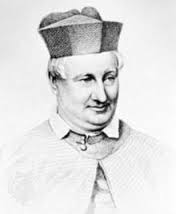
Thursdays With Spurgeon—All The Trinity In Salvation

This is a weekly series with things I’m reading and pondering from Charles Spurgeon. You can read the original seed thought here, or type “Thursdays With Spurgeon” in the search box to read more entries.

All The Trinity In Salvation

     We are, alas, too apt to forget that while there are distinctions as to the persons in the Trinity, there are no distinctions of honor—and we do frequently ascribe the honor of our salvation, or at least the depths of its mercy and the extremity of its benevolence, more to Jesus Christ than we do to the Father. This is a very great mistake.

     What if Jesus came? Did not His Father send Him? If He were made a Child, did not the Holy Spirit beget Him? If He spoke wondrously, did not His Father pour grace into His lips that He might be an able minister of the new covenant? If His Father did forsake Him when He drank the bigger cup of gall, did He not love Him still? And did He not, by and by, after three days, raise Him from the dead and at last receive Him up on high, leading captivity captive?

     Ah, beloved, he who knows the Father, the Son, and the Holy Spirit as he should know them never sets one before another. He is not more thankful to one than the other; he sees them at Bethlehem, at Gethsemane, and on Calvary all equally engaged in the work of salvation.

From The Incarnation And Birth Of Christ

All of the Godhead is involved in our salvation. God doesn’t separate Himself—He is One. 

God the Father planned our salvation and sent His Son (Micah 5:2; Matthew 10:40; Ephesians 1:4-5).

God the Son proclaimed the Father’s good news and purchased our salvation (Mark 10:45; John 3:17; Ephesians 1:9-10). 

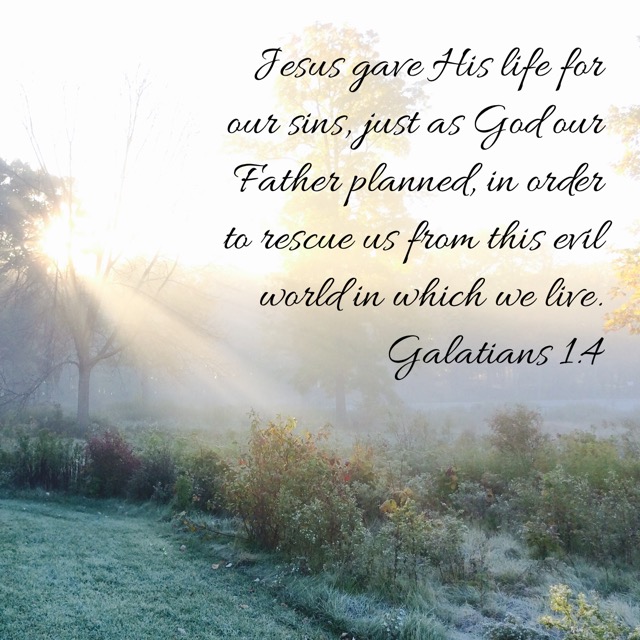
God the Holy Spirit seals and confirms our salvation (Galatians 4:4-6; Ephesians 1:13-14). 

We come to the Father, through the Son, by the drawing of the Spirit. We need the full Trinity to bring us fully into His presence forever and ever! 

Poetry Saturday—Majesty Divine

Full of glory, full of wonders,
Majesty Divine! 
‘Mid Thine everlasting thunders 
How Thy lightnings shine! 
Shoreless Ocean! who shall sound Thee? 
Thine own eternity is round Thee, 
Majesty Divine!

Timeless, spaceless, single, lonely,
Yet sublimely Three, 
Thou art grandly, always, only 
God in Unity! 
Lone in grandeur, lone in glory, 
Who shall tell Thy wondrous story, 
Awful Trinity?

Speechlessly, without beginning,
Sun that never rose! 
Vast, adorable, and winning, 
Day that hath no close! 
Bliss from Thine own glory tasting, 
Everliving, everlasting, 
Life that never grows!

Thine own Self forever filling
With self-kindled flame, 
In Thyself Thou art distilling 
Unctions without name! 
Without worshipping of creatures, 
Without veiling of Thy features, 
God always the same!

In Thy praise of Self untiring
Thy perfections shine; 
Self-sufficient, self-admiring,—
Such life must be Thine;—
Glorifying Self, yet blameless
With a sanctity all shameless
It is so Divine!

‘Mid Thine uncreated morning,
Like a trembling star 
I behold creation’s dawning 
Glimmering from far; 
Nothing giving, nothing taking, 
Nothing changing, nothing breaking, 
Waiting at time’s bar!

One with life and love diurnal
See myself in Thee, 
All embalmed in love eternal, 
Floating in Thy sea: 
‘Mid Thine uncreated whiteness 
I behold Thy glory’s brightness 
Feed itself on me.

Splendors upon splendors beaming
Change and intertwine!
Glories over glories streaming
All translucent shine! 
Blessings, praises, adorations
Greet Thee from the trembling nations
Majesty Divine! —Frederick Faber

Soul And Spirit

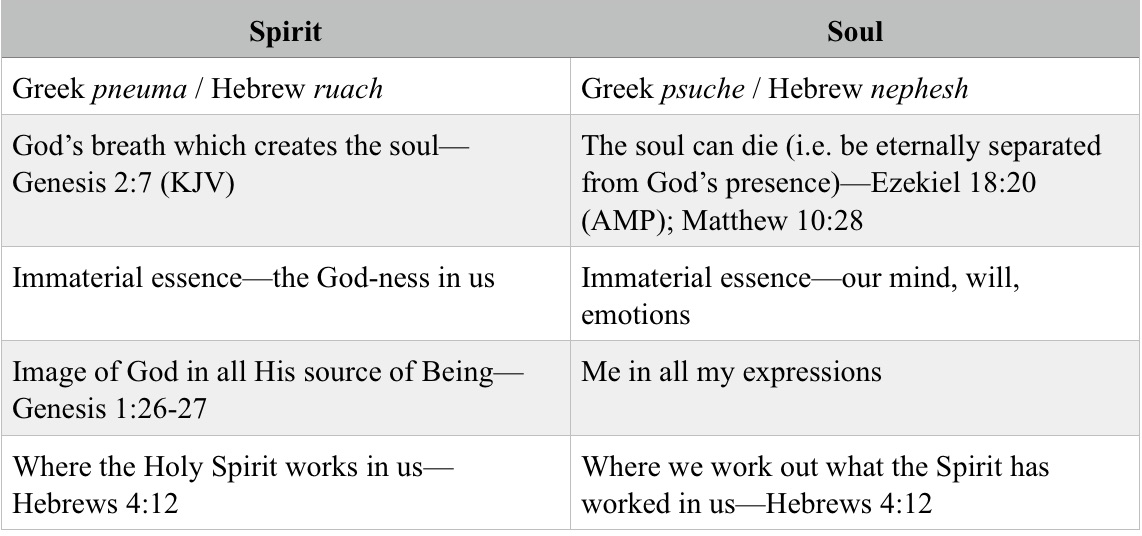
If I were to ask you to define the material/physical part of you versus the immaterial part of you, it probably wouldn’t be too difficult. Obviously, we can touch the physical part but we cannot touch the immaterial part. 

But human as a three-part being—we have a body, a soul, and a spirit. So if I were to now ask you to describe the “dividing line” between the two immaterial parts of us (the soul and the spirit), you would probably have a more difficult time coming up with a definition. 

Both terms are used throughout the Bible. Sometimes it seems the words soul and spirit are almost used interchangeably, but they are most assuredly two separate parts of what makes us us. 

Please check out this chart that I shared with my friends at Calvary Assembly of God, and perhaps even take a few minutes to watch the video below. If you would like to download a PDF version of this chart, you may do so by clicking here → Soul and spirit side-by-side

Verses referenced—Genesis 1:26-27, 2:7; Ezekiel 18:20; Matthew 10:28; Hebrews 4:12

Poetry Saturday—Love In Triplets

The Father says, “I love you, child.”
But those by baser things beguiled
ignore the witness of things wild.

The Son extends His hands to say,
“I love you, child; come, walk My way.”
 We nail His hands, then turn astray.

The Spirit, armed with saving grace,
“I love you!” says, right in your face
and takes your heart in His embrace.

So when that small, bright bloom you see,
that lure waved by the Deity,
then from those leaflets, one in three,
receive God’s love, unhurriedly. —T. M. Moore, Bricks and Rungs

An Ordinary Simple Christian

“An ordinary simple Christian kneels down to say his prayers. He is trying to get into touch with God. But if he is a Christian he knows that what is prompting him to pray is also God: God, so to speak, inside him. But he also knows that all his real knowledge of God comes through Christ, the Man who was God—that Christ is standing beside him, helping him to pray, praying for him. You see what is happening. God is the thing to which he is praying—the goal he is trying to reach. God is also the thing inside him which is pushing him on—the motive power. God is also the road or bridge along which he is being pushed to that goal. So that the whole threefold life of the three-personal Being is actually going on in that ordinary little bedroom where an ordinary man is saying his prayers. The man is being caught up into the higher kinds of life—what I called Zoe or spiritual life: he is being pulled into God, by God, while still remaining himself.” —C.S. Lewis

No, Virginia, Pentecostals Do Not Swing From Chandeliers

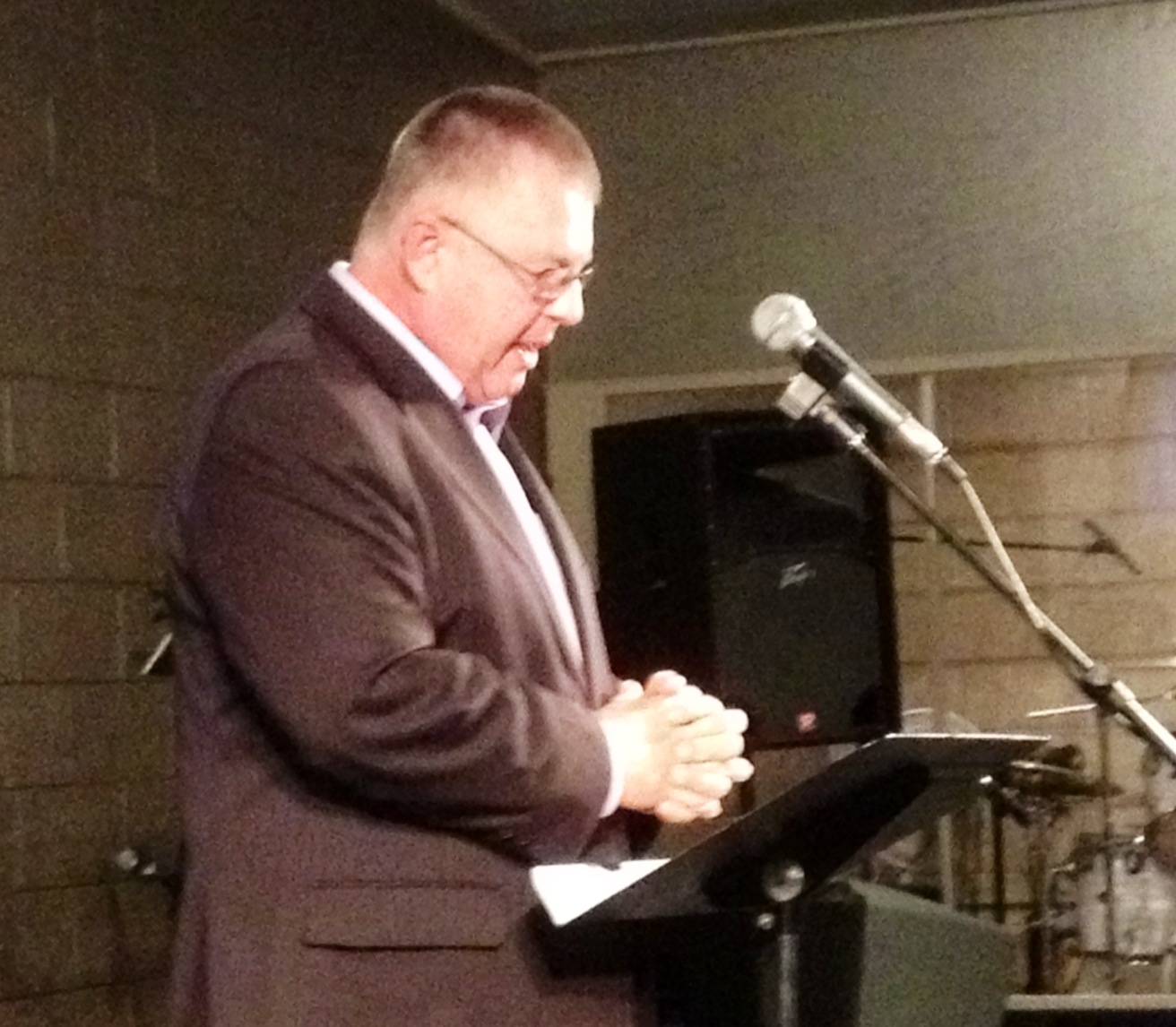
Pastor Bill LeachWow! We had an absolutely amazing service yesterday morning at Calvary Assembly of God! All throughout the service we could feel that the Holy Spirit was moving, and we were all blessed by His presence.

Pastor Bill Leach was our guest speaker, and he used Acts 2 as his text to talk about some of the misconceptions people have about the baptism in the Holy Spirit, and the correct biblical perspective of this empowerment for a Christian’s life. I tried to take notes as fast as I could, so below are the thoughts which especially caught my attention. Pastor Leach’s message was entitled “No, Virginia, Pentecostals Do Not Swing From Chandeliers.”

Our Pentecostal experience must be firmly established in the Word of God. Peter made this clear in his Day of Pentecost sermon (Acts 2:16, 25, 30, 34). This experience is not a fad, but we are involved in the eternal plan of God. So it is an important movement for us to be a part of (Acts 2:39).

When Jesus said “stay in the city until you have been clothed with power from on high” (Luke 24:49; Acts 1:4), He said it in the form of a command. Our Savior commands us to receive this Holy Spirit empowerment.

Luke describes the followers of Jesus as being “all together in one place” (Acts 2:1). In other words they were together together. This is a characteristic of followers of Jesus.

God’s temple is not a house, but people. Just as the fire was to be kept burning in King Solomon’s temple, God’s eternal fire fell on His followers on the day of Pentecost (Acts 2:3), symbolizing His abiding presence in Christians.

The whole Godhead continually points to and glorifies the other aspects of the Godhead—“This is My Son in Whom I am well pleased”; “The Holy Spirit will testify about Me; and “I have come to glorify the Father.” When man was created God said, “Let Us make man in Our image—worshiping along side Us and enjoying Us!” The baptism in the Holy Spirit empowers us to do this!

Impossible obstacles must give way to the Spirit-anointed trod of the Spirit-baptized Church.

Pentecostals do not swing from chandeliers, but they have yielded their lives to the Holy Spirit’s empowerment, to be Christ’s witnesses and to display God’s glory throughout His creation.

This coming Sunday (May 24) is Pentecost Sunday, and I will be launching a new series about the Holy Spirit called simply The Counselor. Check back on my blog later this week for more details.

Are You Grace-full?

The order that words and phrases are listed in the Scripture is not haphazard nor random; each word is divinely inspired, even the order in which they appear. So look at the order in these verses:

  • But grow in the grace and knowledge of our Lord and Savior Jesus Christ. (2 Peter 3:18)
  • The Word became flesh and made His dwelling among us. We have seen His glory, the glory of the One and Only, Who came from the father, full of grace and truth. (John 1:14)

Do you see it? Grace then truth/knowledge.

FullOur human tendency is to switch this order: we want truth and knowledge first. But the Bible never teaches this, and the One Who delivered the greatest words ever spoken never said this. Our tendency is to want to get the facts, and then choose which ones we’ll embrace because they “fit” with what’s comfortable to us. Then we argue with others over what we claim to be “truth” and get labeled as judgmental and haters.

Bottom line―We cannot know what “truth” is without first having received grace. 

To fix this, we need to pursue grace, not more knowledge. We need to pursue Jesus. Look at the order again: IF you hold to My teaching, you are really My disciples. THEN you will know the truth, and the truth will set you free. (John 8:31-32).

Why can’t we know what truth is without having first received grace?

  • Jesus said this about the devil, “He was a murderer from the beginning, not holding to the truth, for there is no truth in him. When he lies, he speaks his native language, for he is a liar and the father of lies.” (John 8:44)
  • The god of this age has blinded the minds of unbelievers, so that they cannot see the light of the gospel of the glory of Christ, Who is the image of God. (2 Corinthians 4:4)

Jesus never talks about grace. Why? Because He IS grace.

For IN Him the whole fullness of Deity (the Godhead) continues to dwell in bodily form giving complete expression of the divine nature. (Colossians 2:9, AMP)

...I am IN My Father, and you are IN Me, and I am IN you … Remain IN Me, and I will remain IN you… (John 14:20; 15:4)

And you are IN Him, made full and having come to fullness of life IN Christ you too are filled with the Godhead—Father, Son and Holy Spirit—and reach full spiritual stature… (Colossians 2:10, AMP)

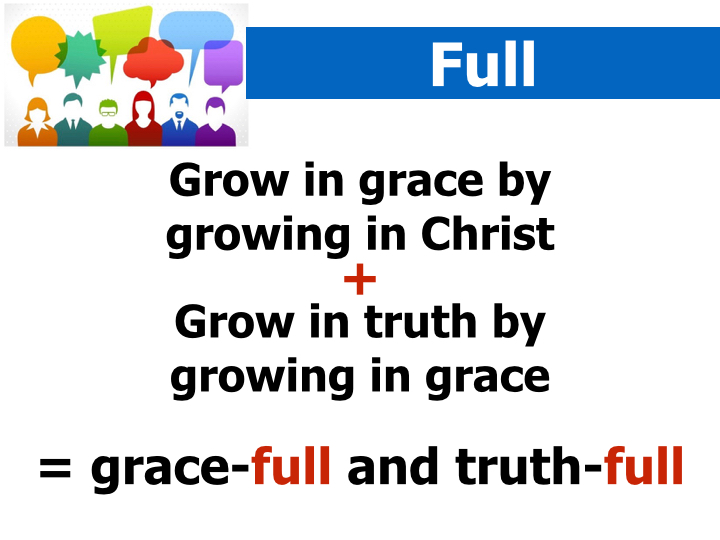
You grow in grace by growing in Christ. You grow in truth by growing in grace. When you are full of Christ―when He is IN you and you remain IN Him―then you are grace-full, and therefore you can also be truth-full. This is how you can reach full spiritual stature.

So here’s a question for you: How grace-full are you?

If you are around Cedar Springs this coming Sunday, I would love for you to join with us as we continue our series answering your questions with the greatest words ever spoken.

Who Is Jesus?

JesusSome call Him Savior. Some call Him a moral teacher. Some call Him a prophet. Some only call His name as a curse word. Regardless of what people call Him, Jesus is almost universally known.

Despite what people call Him, and as much as people claim to know about Jesus, there are still so many questions that swirl around—

  • Who is this Man?
  • How can someone be both God and Man at the same time?
  • Did Jesus just show up in Bethlehem, or was He around earlier?
  • Was He really perfect? Could He really live His whole life without sinning once?
  • How could He die and yet come back to life?
  • Better yet: why did He have to die at all?
  • Does it really matter whether or not He was resurrected from the dead?

As we approach this Easter season, more and more people’s thoughts will be turning toward this Man. Please join me as we consider this simple, yet profound question: Who Is Jesus? The answer to that one simple question will be life-changing!

Check out all of the sermons in this series:

Furious Longing

Furious longingThere is a passage of Scripture in the Book of James which has caused many people to propose many different explanations. I’m not a theologian, but here’s my take on this—

Or do your think the Scripture says without reason that the spirit He caused to live in us envies intensely? (James 4:5)

Envy in the Greek is a neutral word; it becomes a virtue or a vice depending on its context. I could long for a deeper relationship with my wife (virtue), or I could long for a drug that gives me a temporary escape (vice).

The Greek word for envy can mean pursue with love (virtue), or lust after forbidden desires (vice).

“The spirit [God] caused to live in us” came from a loving Creator, and was intended for us to long for Him. When God created man in His image, He said, “Let Us create man like Us” (Genesis 1:26). In the Triune God there is a furiously intense longing among Father, Son, and Spirit. Each part of the Godhead longs for the entire Godhead to be glorified—this makes the Godhead indivisibly and gloriously One. This is the same spirit God placed in man.

Of man God said, “It is not good for man to be alone” (Genesis 2:18). The God-implanted spirit of man longs to give love and to receive love. Our God-implanted spirit longs to connect.

But for what do we long? We were made to long for intimacy with God. If we substitute or exchange this with a longing for temporary worldly things, we are rightly called by James “adulterous people” and “an enemy of God” (James 4:4).

“But God gives more grace” (James 4:6) that we will turn from our temporary longings to long after Him. James almost seems to be saying that those in the church have their hearts hanging in the balance. Of the other eight times this Greek word for envy is used in the Bible, they are in the positive (or virtuous) connotation.

James is imploring us—longing for us—to not be the exception. Longing for us to humbly admit our need for God and to receive even more divine grace. Longing for us to tip our hearts toward God and renew the passionate, furious longing for which we were created.

O God, I want my passion to burn furiously for You alone. Jesus, may I follow Your example to only do what pleases the Father. Holy Spirit, may I hear Your voice if my heart ever begins to turn toward anything but my Beloved.

(I explored this idea further in a whole series of messages called Craving.)

Challenging Concepts

Part two of our Spiritual Self-Defense series went well last night. Considering this was a difficult concept to wrap our finite, human brains around, I felt that everyone was tuned in. Trying to wrestle with the concepts of God as omnipresent, the unique Three-in-One arrangement of the Trinity, or Jesus as fully God and fully Man are not easy. But it is so important to keep learning and keep growing in our understanding of who God is.

Some people bail out too quickly. “It’s too hard,” they complain, and then walk away. But we have to keep stretching.

A couple of thoughts I’m pondering today:

“If you believe what you like in the gospels, and reject what you don’t like, it is not the gospel you believe, but yourself.” —Augustine

“It seems that when we encounter a hard truth about God, we either bend our understanding to Him or bend Him to our understanding.” —Chris Tomlinson

I want to believe the Bible more, so I’m asking the Holy Spirit to continue to bend me and shape me to the deeper truths about God.