Atomic Spiritual Power

Atomic spiritual powerI was so excited while listening to Tom Kaastra’s message in our series on Ephesians yesterday! To really reflect on the power God wants to see operating in our lives is almost mind-blowing! 

In Paul’s lengthy prayer for the Christians in Ephesus, he three times says he is praying, “For this reason” (Ephesians 1:15; 3:1; 3:14). And every one of the reasons has to do with power or strength. In fact, Paul uses four Greek words for power in his prayer to try to convey the magnitude of God’s awesome power. This power can be summed up two ways:

  • Quantity (resurrection power): That power is the same as the mighty strength He exerted when He raised Christ from the dead (1:19-20).
  • Quality (love power): And I pray that you, being rooted and established in love, may have power… to grasp how wide and long and high and deep is the love of Christ, and to know this love surpasses knowledge (1:17-19).

Notice that this power only comes to me through the Holy Spirit, and resides in my “inner being” (3:16) and “within us” (3:20). It is power waiting to be released! 

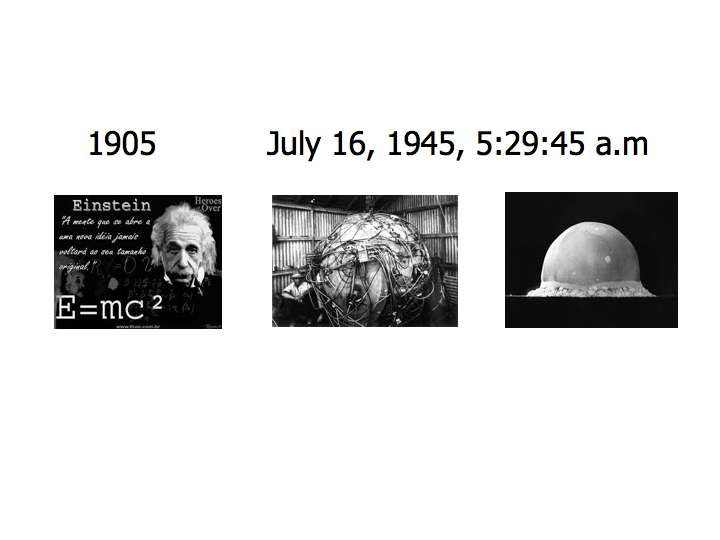
Think of this Holy Spirit power in terms of atomic energy power. The awesome power in the atom has been around since Genesis 1:1, but it was hidden from human awareness until July 16, 1945, at 5:29:45 AM, when the first atomic bomb was detonated. People couldn’t release the power because they didn’t know that it was there! In similar fashion, Paul wants us to know what sort of atomic spiritual power is available to us.

Paul’s prayer is that we will intimately know this power (1:18), and that we will release this power (Ephesians 3:20; Colossians 1:29; Philippians 2:12-13). The Holy Spirit is not released through dormant people, but through people who are moving toward Him and willing to let Him move through them.

There are three kinds of people in the world. Those who are…

1. …designed by God to be adopted into His family and to do great things, but are dead apart from Him.

2. …designed by God to be adopted into His family and to do great things, adopted into His family, but not using the power He has provided.

3. ..designed by God to be adopted into His family and to do great things, adopted into His family, and fully operating in His awesome atomic-like power.

In what category are you? What’s holding you back for all that God has planned for you?

Hyper-Mega Dynamite

Ephesians 1-19One of my favorite scenes in the movie Elf is when Buddy is discovering all the amazing human things in New York City. In a public restroom he stands up on the toilet in his stall to shout to the person occupying the stall next to him, “Have you seen these toilets? They’re ginormous!” It was so amazing to him that gigantic wouldn’t cut it, and neither would enormous, so he combined them together … it’s ginormous!!

When I read Paul’s prayer for the Christians in Ephesus (see Ephesians 1:17-23), I get the sense that even the well-educated apostle was having difficulty finding enough adjectives to describe the amazing inheritance we have in Christ. He mentions things like…

  • Out-of-this-world wisdom,
  • divine revelation,
  • deep and intimate knowledge of God,
  • a flooding of heavenly light,
  • supernatural hope, and
  • an overflowing, incalculable, inestimable, eternally-compounding inheritance!

But then he comes to God’s power and his vocabulary almost fails him. Like Buddy the elf, he starts putting words together to try to convey the vast majesty of this power.

Most Bible translations say something like incomparably great power. But when you look at the Greek you see prefixes like hyper! and mega! and you realize that Paul is saying it’s so beyond gigantic or enormous … it’s ginormous!! 

The word for power is “dynamis,” and many people have said that God’s power is like dynamite. But they have it exactly backwards! Dynamite has only been around for 200 years. When dynamite was created it was named after Christians who were living in the hyper-mega, ginormous, dynamic power of Jesus Christ. Christians’ power wasn’t named after dynamite; dynamite was named after empowered Christians!

This is the power in which Christians can live everyday in every way! This is the power God has for you! If you’re living in anything less than hyper-mega dynamite power, perhaps you should pray for yourself the prayer that Paul prayed for us! 

We’ll be continuing our series in Ephesians this coming Sunday, and I’d love for you to join us.

Adopted By God

Adopted By GodWe have been working through our series on the Book of Ephesians, and I am so excited to share the speaking responsibilities with Tom Kaastra. Tom pastored a church in the Detroit area for nearly 40 years, and he is bringing such a richness of knowledge to this series!

“If you had one son in whom you found unspeakable delight, would it not be normal as a father to want many more? It is exactly so with the Eternal Father, Who by nature and choice, has desired and purposed to have a vast family of human-divine sons who are just like His Only Begotten Son.” —DeVern Fromke

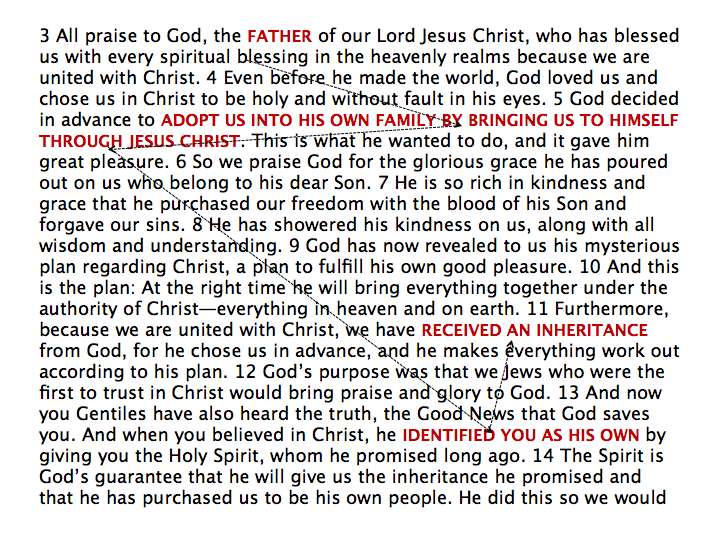
The opening section of Ephesians 1 is just loaded with words of God’s delight:

  • …it gave Him great pleasure… (v. 5)
  • …the glorious grace He has poured out on us… (v. 6)
  • …He is so rich in kindness and grace… (v. 7)
  • …He has showered His kindness on us… (v. 8)
  • …His own good pleasure… (v. 9)

Not only is God’s delight so ample in this section, but so is be the praise toward God which should be bursting out from us:

  • …all praise to God… (v. 3)
  • …so we praise God… (v. 6)
  • …we bring praise and glory to God… (v. 12)
  • …we would praise and glorify Him… (v. 14)

What is this thing in which God is so delighted, and for which we should be so filled with praise?

It is quite simply this: God has revealed Himself to us as a loving Father, His Son has made it possible for us to come into God’s family, and the Holy Spirit has given us the assurance that we have been adopted by our Heavenly Father.

That’s right … God’s plan was to adopt you into His family. When did He come up with this idea?

  • …before He made the world… (v. 4)
  • …God decided in advance to adopt us… (v. 5)
  • …a plan to fulfill His own good pleasure… (v. 9)
  • …He choose us in advance and He makes everything work out according to His plan… (v. 11)
  • …He promised long ago… (v. 13)

God loves YOU so much that He had a plan from before the beginning of time to adopt YOU into His family. That’s what Jesus made possible through His death on the Cross, and what the Holy Spirit is constantly trying to reveal to YOU!! WOW!!

Please join us next Sunday as we continue our study on this amazing book in the Bible.

What God Will You Choose?

What God:godMy friend Chuck and I have a sort of shorthand when we talk. We’ve been through so many experiences together, that now just a single word can bring to our minds the fullness of that time, with all of its tears and laughter. Someone listening to one of our conversations might not get the full impact, but we sure do!

It’s the same way when we read one of the Apostle Paul’s letters. He is writing to a church or an individual with whom he had a rich, personal experience. So when he alludes to something, those friends who went through that experience with him recall all of the fullness. When reading the letter to the church at Ephesus, you can experience some of that fullness by reading about Paul’s experience in that city in Acts 19.

In Acts 19 you will meet the followers of Jesus who were already there and see them get baptized in the Holy Spirit … watch Paul teach for three months in the synagogue before the Jewish troublemakers run him out … see Paul lecture for the next three years in the Hall of Tyrannus, so that everyone in that province heard the Word of God … see how God authenticated Paul’s ministry with miracles … experience those who tried to counterfeit what Paul was doing … see many in that city turn from their witchcraft and idol worship … and finally experience the tumult of a near-riot started by the merchants who were losing their income on sales of mythological trinkets because so many were turning to Christ.

With this backdrop, you can then understand why Paul uses such specific language in the opening greeting of his letter to Ephesus (see Ephesians 1:1-3). By doing so he is contrasting the followers of Jesus with the followers of Artemis—

  • Christians for whom God has a specific plan (“by the will of God” [1:1a]; see also 1:4 and 2:10) versus Artemis’ followers who felt like they had no choice (Acts 19:26).
  • Christians who are called saints (set apart for God’s special use) and faithful (trusting Jesus implicitly [1:1b]) versus those followers of Artemis who are self-serving (Acts 19:24, 25).
  • Christians who experience God’s grace and peace (1:2) versus those followers of Artemis who did not even know why they were there (Acts 19:32).

But the most specific language is in Ephesians 1:3—Praise be to THE God and Father of our Lord Jesus Christ (emphasis added)….

  • Not “a” god, but “THE” God.
  • Not a god that needs to be appeased, but THE loving Father.
  • Not a god that may or may not be able to respond, but OUR Lord Jesus Christ Who overcame death, hell and the grave so that our sins can be forgiven!

The question Paul invites the Ephesians to consider is the same question we must consider:

What God / god will you choose?

We will be continuing our study on the book of Ephesians next Sunday, and I would love to have you join us!

The Journey Begins

Tom KaastraAs Tom Kaastra introduced our study of Ephesians he said, “There is no other book in the Bible that is as exalted in its thought and yet as earthly practical.” Our series is called Sit Walk Stand (three words that Watchman Nee gave to the overview of Ephesians), and Tom shared what those mean.

Sit—(1) to be in a place of authority (Ephesians 2:4-7; Hebrews 1:3); or (2) a rest from work. We sit down to enjoy what Christ has done for us, we don’t work to try to achieve it for ourselves. “God works and then He rests. We are invited to rest and then work” (Watchman Nee). Look at the Creation story: God’s seventh day of rest after working six days was man’s first day of rest before he started working.

Walk—an act of progression modeled by Jesus (Ephesians 4:1-3). A typical rabbi built a synagogue and invited people to come to where he was. Jesus always went to where the people were, and He invites us to follow Him in this walk. We cannot have a “just Jesus and me” mindset. If Peter wanted to walk with Jesus, he had to walk with Matthew too; there are no Lone Ranger followers of Christ.

Stand—firmly in place for spiritual battle (Ephesians 6:10-17). Ephesians deals with our warfare against satan more than any other book in the Bible. Sadly, George Barna reported that 60% of Christians think satan is a only a “force,” not an actual person. Paul uses this word stand as a military term to place our feet in a position ready for action.

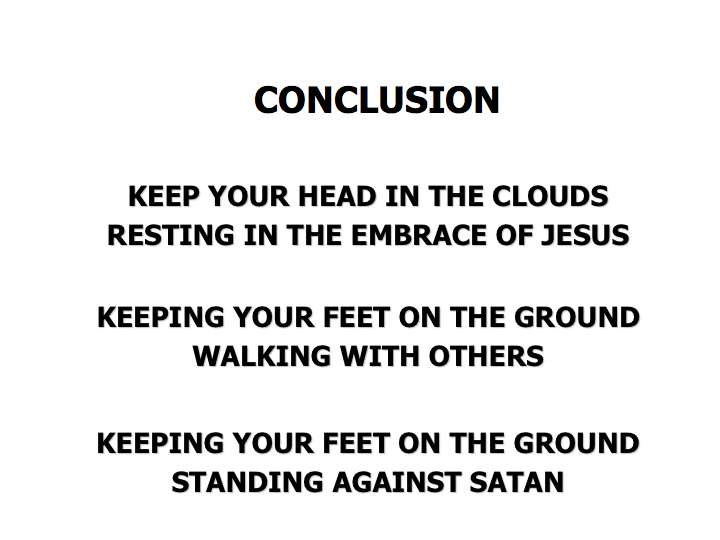
ConclusionsConclusions:

  • Keep your head in the clouds resting in the embrace of Jesus, while you are
  • Keeping your feet on the ground walking with others, and
  • Keeping your feet on the ground standing against satan.

Join us next Sunday as we continue our look at this amazing book.

Sit Walk Stand

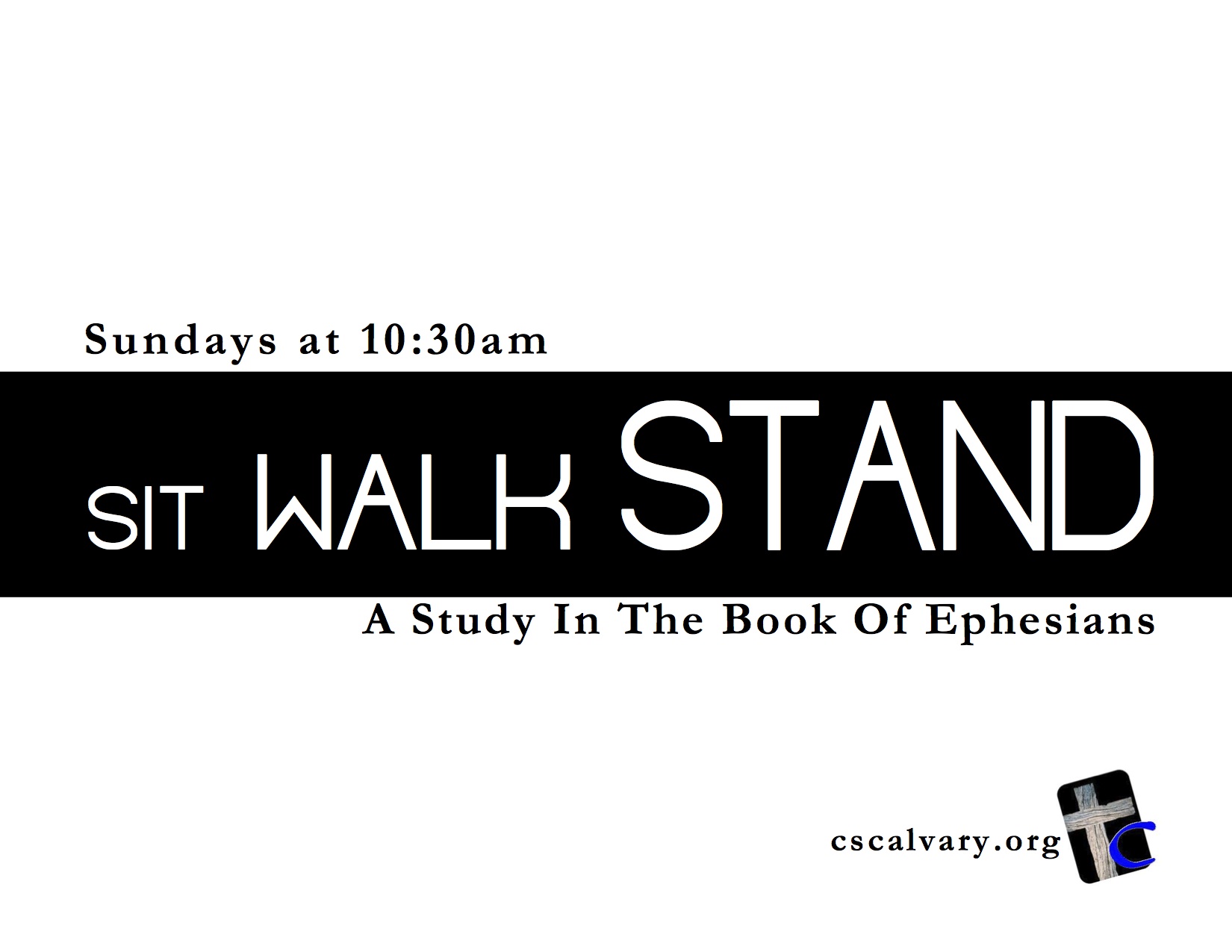
Sit Walk StandThis coming Sunday we begin a new series at Calvary Assembly of God called Sit Walk Stand: A Study In The Book Of Ephesians.

Why Ephesians? Dr. Martin Lloyd-Jones, who preached 232 sermons on this book to his packed-out church, said, “It is very difficult to speak of Ephesians in a controlled manner because of its greatness. Many have tried to describe it. One writer has described it as the crown and climax of Pauline theology. Another has said that it is the distilled essence of the Christian religion, the most authoritative and most consummate compendium of our holy Christian faith. What language! And it is by no means exaggerated.”

It is my desire that the congregation of Calvary Assembly of God be as biblically literate as I can encourage and resource them to be. So Tom Kaastra, a 38-year veteran pastor, is going to co-teach with me, and we’re going to spend the next 6-weeks mastering this powerful epistle. Then we’ll pick it up again around this same time next year, as we continue our way through the entire letter.

The name of our series—Sit Walk Stand—comes from Watchman Nee, who wrote, “Of all Paul’s epistles, it is in Ephesians that we find the highest spiritual truths concerning the Christian life. The letter abounds with spiritual riches, and yet at the same time is intensely practical.”

Please join us this Sunday at 10:30am.

Don’t Exasperate Them

Pastoring is not for the faint of heart. Nor those easily offended. Nor those lacking in patience…. You get the idea!

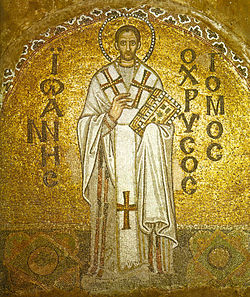
ChrysostomJohn Chrysostom (347-407) gave this counsel to pastors—

Thus then must the Priest behave towards those in his charge, as a father would behave to his very young children; and as such are not disturbed either by their insults or their blows, or their lamentations, nor even if they laugh and rejoice with us, do we take much account of it; so should we neither be puffed up by the promises of these persons nor cast down at their censure, when it comes from them unseasonably.”

The Bible tells fathers not to irritate and provoke your children to anger [do not exasperate them to resentment], but rear them [tenderly] in the training and discipline and the counsel and admonition of the Lord. (Ephesians 6:4, Amplified Bible)

Instead we should follow the example of Jesus, the Great Shepherd—

When He saw the throngs, He was moved with pity and sympathy for them, because they were bewildered (harassed and distressed and dejected and helpless), like sheep without a shepherd. (Matthew 9:36, Amplified Bible)

Ask our Shepherd to give you His patience, and compassion, and tenderness, and wisdom to carry His sheep in your arms. After all, it’s His flock that we’ve been given the privilege and responsibility to care for!

Myth Buster

Dick BrogdenGuest Blogger: Dick Brogden

Currently there is an inordinate emphasis on size and speed when it comes to the development of the church. Church history soberly shows that orthodoxy tends not to spread as swiftly as heresy and that bad teaching outpaces good. It is the slow, steady repeated truth of God that builds the enduring church. The largest church at the end of the first century was found in Rome, thought by most scholars to be around two hundred members. The churches in Ephesus, Corinth, Philippi, Colosse, and Thessalonica (among others) were most probably between fifteen and fifty. The record of Acts takes place over about fifty years. Biblical precedent indicates that it takes about a generation to get a few churches to what we now consider modest size. One myth is that the church has to grow quickly; another that a strong church is a big church. The best churches tend to grow slowly and steadily, and the normal first century church comprised less than fifty people.

Disciples, too, are forged over time. If a church is but a collection of disciples, then it makes sense that strong churches require time to become solid. Another common myth today in mission is that all new disciples need is the Bible and the Holy Spirit. As appealing as this sounds, it has never been true in history, and if we are honest, it has not been true for any of us experientially. Consider how many books, sermons, mentors, friends, and external inputs help shape and form our spirituality over time. None of us grew to where we are without multiple sources of input over disparate seasons, all the input submitted to the authority of Holy Spirit and the Word. Biblically there always remains the need for an outside catalyst to help correct our biases and heresies. A group of people studying the Scriptures can just as easily end up pooling ignorance as illumining one another. Acts 15 is a classic example of ongoing external input necessary for the formation of strong disciples and churches. The negative example of external input (requiring circumcision) does not negate the massive, ongoing positive external input.

Paul and Barnabas report the wonderful turning of the Gentiles to Jesus. They also report the negative external pressure. James and the counsel respond by correcting the error and reinforcing what is necessary. In Acts 15:20, James delineates what they should not do–former religious forms and rituals. Paul reminds the council that coming to Jesus demands conversion (v. 3) and James cites Peter that the Gentiles must come out of false religion (v. 14). In Acts 15:32, Judas and Silas “exhort and strengthen the brethren with many words.” In verse 35, Paul and Barnabas teach and preach to the Gentiles and in verse 36, Paul and Barnabas commit to revisit their converts to ensure they are walking correctly. Disciples and churches are forged over time. Let us continue to believe that God will do great things and bring millions into His church. Let us continue to understand that it is slow, steady, life-on-life work to make disciples and build churches.

Perfect

Listen to the podcast of this post by clicking on the player below, and you can also subscribe on AppleSpotify, or Audible.

Look up.

See all those stars? Even all the stars our most sophisticated telescopes can see don’t even come close to showing us all the stars in our universe.

And yet of all the stars and all the planets, our Earth is perfectly positioned by our Sun. If our Sun was any bigger, we’d get too much radiation and heat. If our Earth was any farther away, we’d be too cold to survive.

God placed Sun, Earth, moon, and stars perfectly.

Look down.

Way down. All the way to the sub-atomic level.

Neutrons, protons, electrons all arranged perfectly. Too many protons or electrons—or too few—and matter wouldn’t hold together properly.

God placed those components of our atoms together perfectly.

Look in.

Right into your heart.

Gifts, talents, passions, insight, personality, temperament. All of those things in a perfect blend to make you.

You are unique. There’s never been anyone like you before, and there never will be another like you in the future.

God placed those attributes together in a perfect mixture to make you. Too much of this, or too little of that, and you wouldn’t be you.

What are you going to do with your you-ness? How about letting your Creator tell you exactly why He made you the way He did:

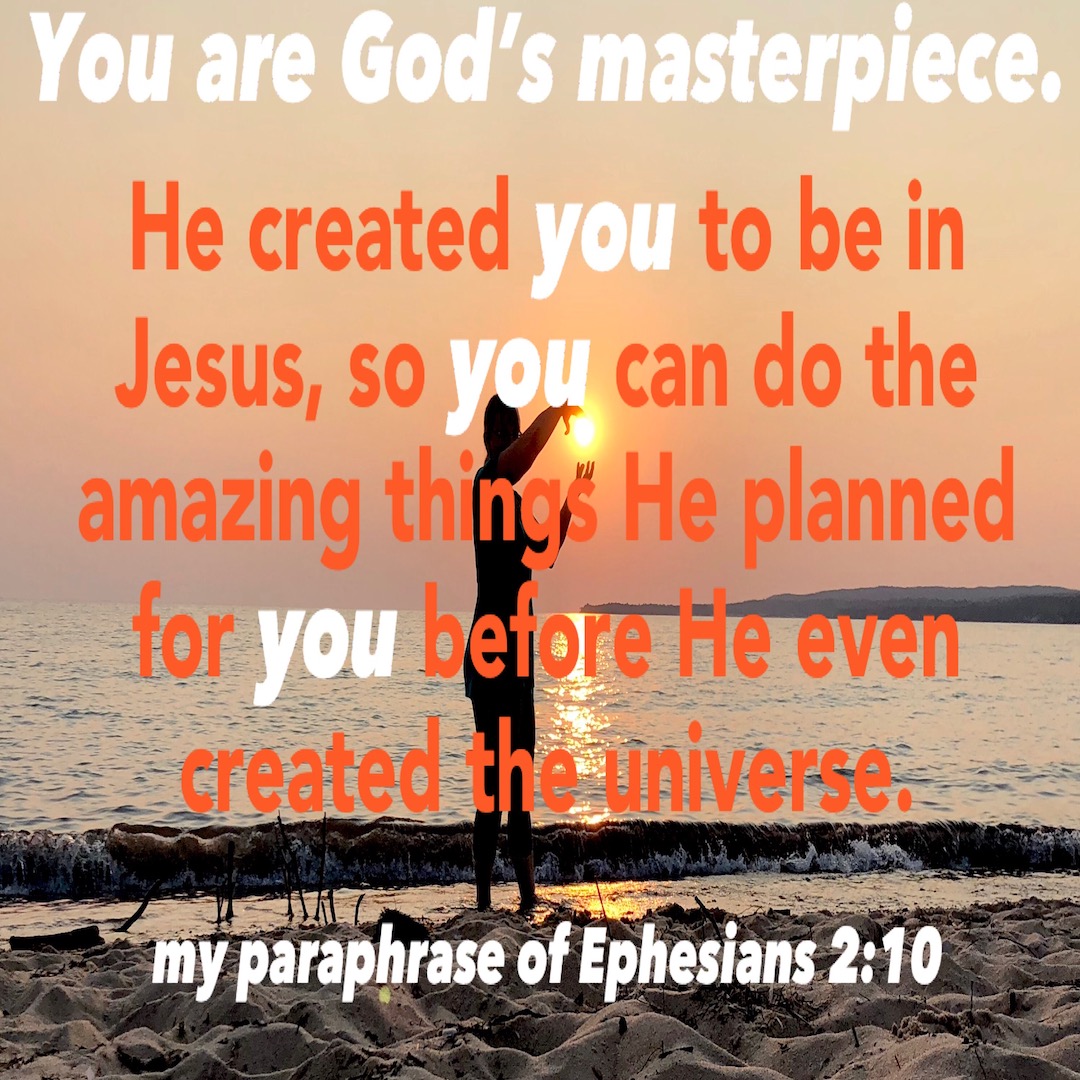
For YOU are God’s handiwork, perfectly created in Christ Jesus to do good works, which God prepared in advance for YOU to do. (Ephesians 2:10, with a slight change to personalize it)

God knows what He’s doing. He created the big universe perfectly. He created the sub-atomic universe perfectly. And He also created you perfectly.

►► Would you please prayerfully consider supporting this ministry? My Patreon supporters get behind-the-scenes access to exclusive materials. ◀︎◀︎

Growing Pains

Listen to the podcast of this post by clicking on the player below, and you can also subscribe on AppleSpotify, or Audible. 

I remember when I was a teenager having such an ache in my legs at night. I’d be laying on my bed trying to sleep, but I couldn’t get comfortable because of that dull, unrelenting ache in my legs. I’d go ask my Mom what was going on, and her reply was simple: “Those are growing pains.”

In order to grow in any area of our lives—physically, emotionally, mentally, relationally—we have to go through a certain amount of pain.

No pain, no gain.

The process is not always a lot of fun, but that’s why we have to keep our eyes on the goal. The process may not be something we like, but the end results will make the pain worth it.

For instance, you may not like dieting but you like the weight loss or lower cholesterol numbers, so you stick with it. You may not like saying, “I’m sorry, I was wrong, please forgive me” but you like the healed relationship, so you say it.

Throughout the New Testament the phrase one another is frequently used to address how members of the Body of Christ should relate to each other. God desires that all of us operate interdependently with one another. In order to get there, we must get ready for some growing pains!

In Ephesians 4:2, Paul tells us what is required to get to a place of unity and maturity in the Church:

  • Be completely humble (the King James Version says lowliness). This Greek word means not letting our thoughts rise far from the ground. In other words, we are thinking of ourselves as God thinks of us, not independently as a self-made man or woman, but viewing all of my success as God-appointed. This process toward interdependence starts in our thoughts—in our attitudes about ourselves and about others.
  • Gentle means strength under control. Gentleness says, “I could do this, but for your sake I won’t.”
  • Patient interaction (KJV: longsuffering) with others is allowing them the freedom to grow just as others allowed me the freedom to grow.
  • Bearing with one another in love. Think of a load-bearing wall in a building that is holding up the weight of the roof and walls. When we bear with one another we are helping to share the burdens.

Being humble with ourselves and gentle and patient with others is the way we go through the growing pains of bearing with one another in love. The process may not be a lot of fun, but the end result is something that glorifies God, that’s why we must stick with one another through all our growing pains.

Check out all of the other messages in our series Live Together by clicking here.

►► Would you please prayerfully consider supporting this ministry? My Patreon supporters get behind-the-scenes access to exclusive materials. ◀︎◀︎