Links & Quotes

link quote

These are links to articles and quotes I found interesting today.

“Truth wears well. Time tests it, but it right well endures the trial. … What a poor thing is the temporary triumph of falsehood!” —Charles Spurgeon, commenting on Proverbs 12:19

The “stimulus” that wasn’t: CBO Again Repeats Faulty Methodology

“The word ‘mercy’ here is extracted from misericordia, the Greek word for ‘misery.’ The full meaning of this word is: ‘to take to heart the misery of another, with the intention of giving him comfort and relief.’ So being merciful means taking on another person’s hurt!” Read more from David Wilkerson.

[PHOTOS] Amazing story captured in Life magazine of a 1950s nurse Maude Callen.

[VIDEO] Largest Lunar Impact Caught By Astronomers

What the IRS is trying now even has the ACLU upset: Stop The Assault

Wow! Check out this tweet from Russian chess champion Garry Kasparov

Teach Compassion

Compassion means to not only feel what someone else is feeling, but then to make a move toward that person to help. In the life of Jesus you will often see the phrase “He was moved with compassion” and then Jesus taught or healed or acted to alleviate someone’s discomfort.

Pastors, we need to teach our congregations to be people of compassion: to feel the needs of those around them and then move to act in the love of Christ.

A.W. Tozer

A.W. Tozer

“The multitudes that were so dear to Christ shall not be less dear to me. If I cannot prevent their moral suicide, I shall at least baptize them with my human tears. I want no blessing that I cannot share. I seek no spirituality that I must win at the cost of forgetting that men and women are lost and without hope. If in spite of all I can do they will sin against light and bring upon themselves the displeasure of a holy God, then I must not let them go their sad way unwept. I scorn a happiness that I must purchase with ignorance. I reject a heaven that I must enter by shutting my eyes to the sufferings of my fellow men. I choose a broken heart rather than any happiness that ignores the tragedy of human life and human death. Though I, through the grace of God in Christ, no longer lie under Adam’s sin, I would still feel a bond of compassion for all of Adam’s tragic race, and I am determined that I shall go down to the grave or up into God’s heaven mourning for the lost and the perishing. —A.W. Tozer (emphasis added)

Run To The Pain

Listen to the podcast of this post by clicking on the player below, and you can also subscribe on AppleSpotify, or Audible.

We have become a numbed culture: we try to soften every blow, water down each negative report, ask only surface questions in the hopes that no one will really tell us how much they’re hurting, and then medicate away every symptom. But these symptoms are screaming to be noticed!

Dr. Paul Brand the renown hand surgeon and missionary to leprosy patients in India, wrote:

     “Pain contributes daily to a normal person’s quality of life…. Every normal person limps occasionally. Sadly, leprosy patients do not limp. Their injured legs never get the rest needed for healing…. This inability to ‘hear’ pain can cause permanent damage because the body’s careful responses to danger will break down. … A body only possesses unity to the degree that it possesses pain…. We must develop a lower threshold of pain by listening, truly listening, to those who suffer. … The body protects poorly what it does not feel.” —Dr. Paul Brand & Philip Yancey, In His Image

The Gospels often talk of the compassion of Jesus. His compassion led Him to teach the confused, feed the hungry, and heal the sick. The phrase usually used in the NKJV is descriptive: Jesus was moved with compassion. In other words His feelings moved Him to action.

The Old English way of describing compassion was to say someone was “moved in his bowels.” This is because when someone else is suffering it should be like a kick in my gut too.

Jesus gravitated toward the hurting, but in one story He told, Jesus related something different about His Father’s compassion. It’s the story we now call the story of the prodigal son. In this story Jesus said His Father watched the horizons every day to see if His wayward child would return. When He saw this child coming into view, God saw his slumped shoulders, He could detect his heavy heart and worn-out body. Then Jesus says something amazing, “The Father was moved with compassion and He RAN TO HIS SON!

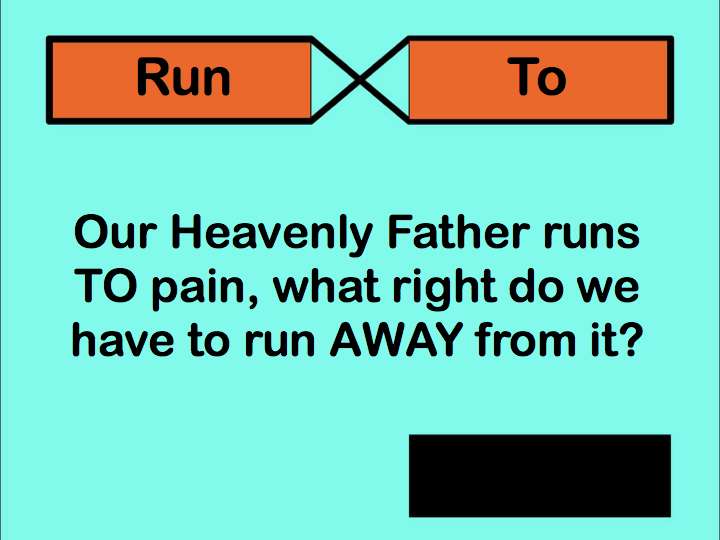
If our Heavenly Father runs TO another’s pain, what right do we have to ever run AWAY from it? 

If we are to be God-honoring in our interaction with others, we need to—as Dr. Brand says—lower our threshold of pain. We need to feel what others feel, to feel it like a kick in our own gut, and then move toward the pain with help and healing and restoration.

Christians—if we are truly Christ-like—should be known as the most compassionate people of anyone.

So we need to always be asking: What am I doing to let this compassion be seen in my life?

Check out all of the other messages in our series Live Together by clicking here.

►► Would you please prayerfully consider supporting this ministry? My Patreon supporters get behind-the-scenes access to exclusive materials. ◀︎◀︎

Quotes From “From Santa To Sexting”

If you are a parent of children middle school age or younger, or if you are a teacher or youth pastor that works with this age group, I cannot urge you strongly enough to read From Santa To Sexting (you can read my review here).

These are some quotes from this book that really got me thinking…

Sexual Activity & Sexual Roles

“What helps young adolescents accept a heterosexual sex role identity? Psychiatrist David P. Ausubel, the author of Theory And Problems of Adolescent Development, writes that accepting a heterosexual sex role is aided by the following: 1) witnessing a happy marriage between parents; 2) having positive experiences with the opposite sex; and 3) possessing a strong, positive identification with the parent of the same sex. …In addition, Ausubel believes that parents exert a strong influence on their adolescent’s adoption of a particular biological sex role. For example, if the parent of the opposite sex is negative about the sex role of his child, the child will find it difficult to identify with that role. Suppose a father, for example, put his wife down and is negative about women. Then his impressionable young daughter will find it hard to embrace her femininity and identify with her own sex. The converse is true for boys. According to Ausubel, the preadolescent, depending on the ‘psychological climate’ of his home, may adopt one of three attitudes toward gender: 1) acceptance, leading to heterosexuality; 2) rejection, leading to homosexuality or asexuality (the renunciation of all sexual expression); and 3) ambivalence, resulting in bisexuality, perversion, or sexual delinquency.”

“The evidence is that early sexual experience has consequences for both boys and girls. Joe McIlhaney, MD, an obstetrician and coauthor of the book Hooked: New Science on How Casual Sex is Affecting Our Children, told us that ‘sex is a primary stimulator and molder of the brain. When we have sex, the body secrets the hormone dopamine, and that makes us want to do it again and again. That’s one of the primary reasons to abstain from sex when you’re young, because it becomes addictive.’ He adds, ‘The body also secrets the hormone oxytocin, that some label the love hormone—a hormone that seems to contribute to a girl’s trusting a man she is intimate with and also bonding to him emotionally.’ Then comes the breakup. McIlhaney continues, ‘When young people break up, MRIs show that the pain center of the brain lights up. Emotional and physical pain are felt in the same brain center.’ McIlhaney believes that when kids have multiple breakups, they seem to contribute to their losing their ability to forge lasting connections or attachments with the opposite sex. In addition, they sometimes become depressed and some become suicidal.”

Empathy 

“Sensing what others feel without their saying so captures the essence of empathy. Others rarely tell us in words what they feel; instead, they tell us in their tone of voice, facial expressions, or other nonverbal ways. The ability to sense these subtle communications builds on more basic competencies, particularly self-awareness and self-control. Without the ability to sense our own feelings—to keep them from swamping us—we would be hopelessly out of touch with the moods of others.” —Daniel Goleman 

“Empathy has twin components—one in the affective or emotional area and the other in the cognitive. On other words, we feel the distress of others from birth, but as we grow and our brain develops, we begin to think about what they are feeling and can decide how to help the poor, the distressed, and the handicapped.” 

“If you’re in a relationship, the relationship is a part of you, there’s no way around it. You get an empathetic child not by trying to teach the child and admonish the child to be empathetic; you get an empathetic child by being empathetic with the child. The child’s understanding of relationship can only be from the relationships he has experienced.” —Alan Sroufe 

“If empathy is caught, not taught, then the effect of training students to be empathetic is only skin-deep. The training is focused on a cognitive-behavioral approach; it does not take into account the emotional aspect of empathy and the fact that empathy emerges from an intimate relationship or emotional bond.”

School

“Dr. Robert Balfanz, a research scientist at Johns Hopkins University who studies risk factors for dropping out of school, has found that future dropouts can be identified as early as sixth grade. …Dr. Balfanz’s study of fourteen thousand students in Philadelphia, Pennsylvania, found that sixth grader with just one of the following distress signals had ‘at least a three in four chance’ of dropping out when they reached high school. Here are the four areas he says parents and teachers should monitor:

  • A final grade of F in mathematics;
  • A final grade of F in English;
  • Attendance below 80 percent for the year;
  • A final ‘unsatisfactory’ behavior mark in at least one class.”

“Parents are the first and best anti-bullying program around.”

Video Games & Media

“Scientifically speaking, the notion that media violence harms kids is an open-and-shut case; research has found that violent video games increase levels of aggression hormones in teen players. While their onscreen personas kicked, punched, cut, and shot their way through enemies, testosterone and adrenaline levels rose significantly in the bodies of the players behind the controls…. The strength of the evidence linking media violence to youth aggression is stronger than the evidence linking lead poisoning with mental retardation and more definitive than the case linking secondhand smoke with cancer.” —Dr. David Walsh, Why Do They Act That Way? 

Home Life

“We found that we could actually measure how parents were getting along in two ways. We could either ask them how happy they were—how much conflict they were having—or we could take a 24-hour urine sample from their kids and measure how many stress hormones, particularly adrenaline, were getting secreted in the children’s bodies. So if you’re fighting, your kids are secreting adrenaline. And if they’re secreting adrenaline because they’re stressed out, one of the things that happens to them is that the first and most sensitive system to reflect this stress is the attentional system—the kid’s ability to focus attention, the kid’s ability to shift attention when they want to, and the kid’s ability to sustain attention. And part of what we’re seeing in all of this diagnosis of hyperactivity is, in part, a reflection of increased family stress, increased stress between parents. So the attentional system is really a very sensitive indicator of whether kids are stressed out.” —Dr. John Gottman

“People who become Christians before their teen years are more likely than those who are converted when older to remain ‘absolutely committed’ to Christianity.” —Barna Group

“Revolutionary parenting, which is based on one’s faith in God, makes parenting a priority. Those who engage in revolutionary parenting define success as intentionally facilitating faith-based transformation in the lives of their children, rather than simply accepting the aging and survival of the child as a satisfactory result.” —George Barna

The Hard Word

As a pastor, you are going to have to deliver the hard word from time to time. You will have to address touchy subjects, both corporately and privately. It is very instructive to see how the apostle Paul approached the hard word.

In Romans 9, Paul is getting ready to address one of the most sensitive subjects of his day. The Jews felt they were “in” with God just because they were Jews, and the Gentiles were “out” with God just because they weren’t Jews. Paul is going to have to deliver the word that both Jews and Gentiles can be accepted by God because of what Jesus did on the Cross.

So notice how he begins:

I speak the truth in Christ—I am not lying, my conscience confirms it in the Holy Spirit—I have great sorrow and unceasing anguish in my heart.

1. I speak the truth in Christ. It wasn’t his opinion, but the word from God. I must settle this matter before delivering the hard word. Far too often we can put our preferences on par with God’s Word. I cannot do this!

2. My conscience confirms it in the Holy Spirit. Before I speak a hard word that people may not like to hear, I need to make sure my conscience is right before the Holy Spirit. He alone confirms His Word. The reaction of the audience, however, may or may not confirm what God says.

3. I have great sorrow and unceasing anguish in my heart. It should be a major red flag if I looked forward to delivering a painful/challenging/correcting word. I need to put myself in their place, not try to put someone else in their place!

My job as a pastor is not to condemn, nor even to convict; the Holy Spirit will do that. My job is to (a) hear God’s truth, (b) get my conscience right with the Spirit, and (c) empathize with people as I lovingly speak the truth to them.

Be A People Person (book review)

John Maxwell’s insights into leading people perpetually astound me. He always finds such simple ways to explain what I know I should already be doing. In one of his earliest books, Be A People Person, I (re)discovered some more great people principles.

Be A People Person perfectly describes this book: It’s all about being a person who is trusted and accepted by other people. This, in turn, puts this people-person in a place to be an effective leader. So Dr. Maxwell talks about confidence, motivation, encouragement, empathy, trustworthiness, mentorship, and so many other people principles.

Because this was one of his earlier books, I see many of the seed thoughts that have become books in their own right later on. But that still didn’t take away from the refreshing insights that I uncovered.

Unless you are a solitary hermit, there is so much to discover in this book to help you grow stronger and more effective relationships with family members, coworkers, and friends.

Help! I’m A Single Parent!

I believe God brings us to certain places and experiences in our lives to develop more of His nature in us. One of the aspects of God’s nature is His empathy. That word literally means to be in suffering with someone. Throughout all of history, God continually tells humanity, “I feel what you feel. When you suffer, I suffer too.” The Bible also tells us that Jesus experienced everything we will ever experience, and knows just how we feel.

So this week I’m experiencing what it’s like to be a single parent. Betsy is visiting her family in California, so I’m home with our kids. Granted this is not even close to what true single parents have to cope with. They do it for years, and I’m struggling with just a week. But my week-long experience is developing greater empathy in me.

I’ve got my usual slate of activity for this week, and then I come home to a crying child who is dealing with a rough relationship issue at school. And then I’m trading texts with a coach, trying to work out details for a practice schedule for another child. And then I’m juggling how to get my kids to three different activities, which all start at almost the same time. And then I’m trying to figure out the family meals, and squeezing in a trip to the grocery store. And then I’m having a discussion with my kids about a housekeeping issue. And then … and then … and then …

God’s design was for our kids to have two parents: a Mom and a Dad. When one parent is missing, I believe God gives extra grace to the remaining parent to operate in both roles. But that isn’t God’s ideal. Into this void, Christians are supposed to step in.

  • Support organizations that assist single parents.
  • Better yet: volunteer at one of these organization.
  • Invite a single-parent family over to dinner at your house.
  • Be a mentor.
  • If your kids are going somewhere a single parent’s kids are, offer to help carpool.
  • Guys, be a father-figure to fatherless kids.
  • Ladies, be a mother-figure to motherless kids.
  • Let a single parent drop off his/her kids at your house so that parent can have some alone time.
  • Take a single parent out for coffee and let them vent.
  • Provide a scholarship to a camp for single-parent kids.

The cliché said, “It takes a village to raise a child.” I think it’s even better this way: It takes a loving Church to raise a healthy, well-balance FAMILY.

It’s time for Christians to be that Church!

Thursdays With Oswald—Don’t Explain; Pray

This is a weekly series with things I’m reading and pondering from Oswald Chambers. You can read the original seed thought here, or type “Thursdays With Oswald” in the search box to read more entries.

Don’t Explain; Pray

     Eliphaz claimed to know exactly where Job was, and Bildad claims the same thing. Job was hurt, and these men tried to heal him with platitudes. The place for the comforter is not that of one who preaches, but of the comrade who says nothing, but prays to God about the matter. The biggest thing you can do for those who are suffering is not to talk platitudes, not to ask questions, but to get into contact with God…. Job’s friends never once prayed for him; all they did was to try and make coin for the enrichment of their own creed out of his sufferings.

From Baffled To Fight Better

Great reminder: The biggest thing you can do for those who are suffering is…get into contact with God on their behalf. 

Bringin’ It!

Everywhere you go today, you will be bringing something.

What is it?

Compassion … Empathy … Servanthood … Encouragement … A smile?

…or…

Disinterest … Apathy … Selfishness … Discouragement … A frown?

Lord, make me a channel of Thy peace, that
where there is hatred, I may bring love;
where there is wrong, I may bring forgiveness;
where there is discord, I may bring harmony;
where there is error, I may bring truth;
where there is doubt, I may bring faith;
where there is despair, I may bring hope;
where there are shadows, I may bring light;
where there is sadness, I may bring joy. —Francis of Assisi

So what are you going to bring today?

Responding For Those Who Can’t

Do you know what empathy is? It’s not the same thing as sympathy. Sympathy is just wallowing with someone who is hurting, but empathy goes beyond that. Empathy is a compound word:

em- + -pathos = joined + feeling 

I feel what you feel, but I can respond like you should even when you think you can’t.

Sometimes people get paralyzed by their deep hurts, or crushing depression, or infuriating anger. Someone in sympathy feels the pain, the depression, the anger, but their involvement stops at the feeling stage.

Someone in empathy feels the hurt AND responds in an appropriately healthy way.

Check out what Paul wrote:

Who is weak without my feeling that weakness? Who is led astray, and I do not burn with anger? (New Living Translation)

When someone gets to the end of his rope, I feel the desperation in my bones. When someone is duped into sin, an angry fire burns in my gut. (The Message)

Paul took those feelings his friends and loved ones were experiencing and he turned them into positive action. This is challenging and desperately needed.

Sympathy is easy; empathy is hard work.

Sympathy keeps people paralyzed; empathy helps them move forward.

Sympathy enables people to remain unchanged; empathy gives people a healthy way to respond.

If you want to help your hurting, discouraged, or angry friend, don’t sympathize with her hurt, empathize to help her heal. By responding in a healthy way—a way she isn’t able to yet—and you will help her move to a place of wholeness.