Paths To Power (book review)

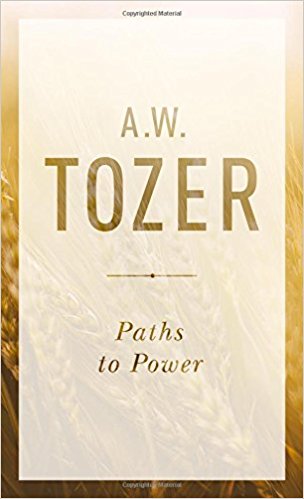
As I read A.W. Tozer’s words I find myself saying two things: (1) “Ouch!” and (2) “Amen!” Tozer’s Paths To Power is a continuation in those responses as he outlines what robs the Church and individual Christians of the power God wants them to have.

Right at the outset, Tozer identifies a key element robbing the Church of power: a lack of obedience in the things God has commanded us. “A knowledge of the truth is not enough,” he writes. “The truth must be followed if we would realize in actual experience the blessedness which is here described.”

Another power-blocker is an unwillingness to let God confront us and help us change. We get stuck in a this-is-how-it’s-always-been rut and then shut our eyes to the times of refreshing God wants to send to us. Other blockers include poor doctrine, putting the Holy Spirit in a box, justifying our sin, and not unleashing our faith, to name just a few.

Thankfully, Tozer also points us to the straightforward cures for all of the blockages to power. If we are willing to open our eyes, ears, and hearts to God’s voice, His unlimited blessings could flow uninterrupted into our lives and churches.

Paths To Power contains only seven short chapters, but the digestion, contemplation, and implementation of Tozer’s cures will be something that will involve a lifetime commitment for those ready for God’s fresh power to be poured into their lives.

I am a Moody Publishers book reviewer.

4 BIG Lessons From Esther

One of my favorite stories in the Bible shows God’s role in world events, and how the obedience of His people fits into God’s plan. Yet this story doesn’t even mention God by name!

It’s an important reminder that we don’t have to say, “God’s at work here” for God to be at work here. We don’t have to say, “I’m a Christian” to live in a Christlike way.

Have you ever read the story of Queen Esther and her cousin Mordecai? Let me tell you, this is a real page-turner of a story! If you already know the story, skip to the four lessons below. Here’s a quick recap (but you really should read this for yourself)…

  • King Xerxes is the ruler of the most powerful nation on earth
  • Queen Vashti (Xerxes’ wife) defies him and is deposed
  • When the king is looking for a new queen, a young lady named Hadassah catches his eye
  • Hadassah went by her Persian name of Esther, so the king didn’t know he married a Jewess
  • Mordecai was Esther’s cousin, her legal guardian, and a palace worker
  • Mordecai uncovered a plot to assassinate Xerxes, which he shared with Queen Esther, who told the king, who investigated and had the plotters killed
  • King Xerxes had a prime minister named Haman, who was really full of himself
  • Mordecai wouldn’t bow down to Haman because Haman thought of himself as a deity
  • Haman wanted to show Mordecai, and all the other Jews like him, who was boss so he deceived King Xerxes into signing a law that would allow for all the Jews to be killed on a set date
  • Mordecai again told Queen Esther about the plot, but the queen was scared to go before the king unsummoned (where the penalty for doing so could be death)
  • Esther finally had the courage to approach Xerxes and invite him and Haman to dinner
  • At dinner, the king asked Esther why she really invited him to dinner, and Esther said, “Come back to dinner tomorrow night and I’ll tell you then”
  • King Xerxes couldn’t sleep that night so he asked for the royal chronicles to be read to him
  • The king discovered that Mordecai had never been rewarded for uncovering the assassination attempt
  • Xerxes asked Haman what he should do for a man he wanted to honor; Haman thought the king was talking about him, so he gave an elaborate plan of recognition, to which the king replied, “Excellent! Go do all that for Mordecai!”
  • Haman was so ticked off that he built a 75-foot tall gallows on which to hang Mordecai
  • At the second dinner, Esther asked for her life to be spared; the king wanted to know who would presume to attack her and the Jews, and she called out Haman
  • The king stormed from the room while Haman stayed to beg for his life
  • As the king returned, Haman was pawing at the queen in desperation, so the king’s bodyguards grabbed him
  • The king found out about the gallows built for Mordecai and gave orders for Haman to be hanged on those very same gallows
  • Mordecai became prime minister and wrote another law to help save the Jews from annihilation

4 BIG Lessons From Esther for Christians living in a pagan culture today

  1. All of History is His Story. God’s timing to bring all of the key players on the scene at just the right moment is obvious. Even giving the king insomnia at just the right time was a part of God’s plan!
  2. God gives us favor and we win favor by obeying God. The word “favor” is all throughout this story. God-fearing people are given God’s favor which leads to man’s favor as well.
  3. God-following people do make a positive impact on their culture. Esther becoming queen pleased the people, as did Mordecai’s just laws.  
  4. Pride humiliates and destroys; humility elevates the person and glorifies God. Just look at the contrast between Haman and Mordecai!

Do you have any other takeaways from this story? If so, please share them in the comments below.

Thursdays With Oswald—Where Are Your Feet?

This is a weekly series with things I’m reading and pondering from Oswald Chambers. You can read the original seed thought here, or type “Thursdays With Oswald” in the search box to read more entries.

Where Are Your Feet?

“Where did Jesus placed His feet? He placed them by the sick and the sorrowful, by the dead, by the bad, by the twisted and by the good. He placed His feet exactly where we have to place ours…, in the ordinary rough and tumble of human life as it is. ‘I will make the place of My feet glorious [Isaiah 60:13].’” 

From Run Today’s Race

Run Today’s Race contains short statements from Oswald Chambers intended to stimulate Christians to ponder things like:

  • All of Isaiah 60 is about God’s glory being revealed on earth through Jesus Christ. Am I letting Christ’s glory shine through my life?
  • Do I only look for “super-spiritual” moments, or am I aware that God can make wherever I place my feet a glorious place?
  • Am I willing to go wherever God needs me to go?

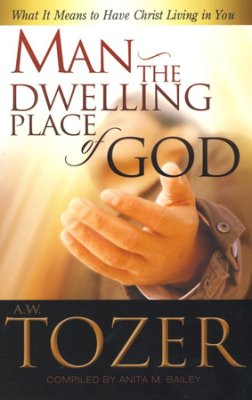
11 Quotes From “Man—The Dwelling Place Of God” by A.W. Tozer

A.W. Tozer’s 50-year-old publication Man—The Dwelling Place Of God still rings with timely truth for today. You can check out my full book review by clicking here.

“I long ago decided that I would rather know the truth than be happy in ignorance. If I cannot have both truth and happiness, give me truth. We’ll have a long time to be happy in heaven.”

“Shakespeare may be enjoyed without penitence; we may understand Plato without believing a word he says; but penitence and humility along with faith and obedience are necessary to a right understanding of the Scriptures.”

“Faith and morals are two sides of the same coin. Indeed the very essence of faith is moral. Any professed faith in Christ as personal Savior that does not bring the life under plenary obedience to Christ as Lord is inadequate and must betray its victim at the last. The man that believes will obey; failure to obey is convincing proof that there is not true faith present.”

“There are two kinds of love: the love of feeling and the love of willing. The one lies in the emotions, the other in the will. Over the one we may have little control. It comes and goes, rises and falls, flares up and disappears as it chooses, and changes from hot to warm to cool and back to warm again very much as does the weather. Such love was not in the mind of Christ when He told His people to love God and each other. … The love the Bible enjoins is not the love of feeling; it is the love of willing, the willed tendency of the heart.

“Let no one interpret the Scriptures for you in such a way as to rule out the Father’s gift of the Spirit. Every man is as full of the Spirit as he wants to be. Make your heart a vacuum and the Spirit will rush in to fill it.”

“I am among those who believe that our Western civilization is on its way to perishing. It has many commendable qualities, most of which it has borrowed from the Christian ethic, but it lacks the element of moral wisdom that would give it permanence. Future historians will record that we of the twentieth century had intelligence enough to create a great civilization but not the moral wisdom to preserve it.”

“The church today is suffering from the secularization of the sacred. By accepting the world’s values, thinking its thoughts and adopting its ways we have dimmed the glory that shines overhead. We have not been able to bring earth to the judgment of heaven so we have brought heaven to the judgment of the earth. Pity us, Lord, for we know not what we do!”

“David Brainerd once compared a man without the power of the Spirit trying to do spiritual work to a workman without fingers attempting to do manual labor. The figure is striking but it does not overstate the facts. The Holy Spirit is not a luxury meant to make deluxe Christians, as an illuminated frontispiece and a leather binding make a deluxe book. The Spirit is an imperative necessity.”

“I do not believe that it is the will of God that we should seek to be happy, but rather that we should seek to be holy and useful. The holy man will be the useful man and he’s likely to be a happy man too; but if he seeks happiness and forgets holiness and usefulness, he’s a carnal man.”

“That religion may be very precious to some persons is admitted, but never important enough to cause division or risk hurting anyone’s feelings. In all our discussions there must never be any trace of intolerance; but we obviously forget that the most fervent devotees of tolerance are invariably intolerant of everyone who speaks about God with certainty. And there must be no bigotry, which is the name given to spiritual assurance by those who do not enjoy it.”

“The truly spiritual man is indeed something of an oddity. He lives not for himself but to promote the interests of Another. He seeks to persuade people to give all to his Lord and asks no portion or share for himself. He delights not to be honored but to see his Savior glorified in the eyes of men. His joy is to see his Lord promoted and himself neglected.”

Now More Than Ever Christians Must Exalt The Cross

“Think for a moment what the power of the gospel accomplished in the early centuries. With no political base in the Roman government, without any majority in the culture, the gospel changed the spiritual and moral climate of the Roman Empire. Christianity competed with paganism and, for the most part, won the hearts and minds of the populace. Christians were radicals in the best sense of the word—radically committed to community in worship, radically committed to serving their pagan neighbors, and radically committed to living out the implications of their redemption.

“Without freedom of religion, without a media presence, and without the ability to redress the wrongs against them, the Christians discovered that the gospel had the power to change individuals, families, and the culture.” —Dr. Erwin Lutzer, in When A Nation Forgets God (emphasis added)

Please check out my review of When A Nation Forgets God by clicking here, and then get a copy for yourself. You can also read other quotes I have shared from this book by clicking here and here.

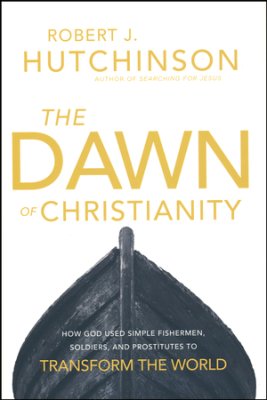
6 Quotes From “The Dawn Of Christianity”

Robert J. Hutchinson makes the history around the birth, life, death, and resurrection of Jesus, as well as the history of Christ’s followers after His resurrection, come to life in The Dawn Of Christianity. Check out my full review by clicking here.

“Skeptics make much of the fact that historians have no independent corroboration from outside sources of most of the events described in the Gospels, but this is common with ancient history and hardly unique to Christianity. For example, virtually everything historians know about the Three Hundred, the Spartan warriors who held off a Persian invasion at the mountain pass of Thermopylae in 480 BC, comes from the writings of a single Greek author, Herodotus. What’s more, the earliest copy historians have of Herodotus’s chronicle of this event, The Histories, dates to the tenth century AD—or more than 1,350 years after it was written! In comparison, historians have a cornucopia of historical sources and archaeological evidence about Jesus of Nazareth and the early Christian community. For example, more than fifty papyrus manuscripts of New Testament texts exist that date before AD 300. The earliest of these manuscripts, a papyrus fragment from the Gospel of John known as P52, dates to around AD 125 or just thirty years after the original was likely written.”

“Around 20 BC, the half-Jewish King Herod the Great set himself the task of renovating and expanding the temple and surrounding area. There had been a small natural plateau there before, fixed atop the ridge in the northeastern corner of Jerusalem; but Herod wanted something far more spectacular. He therefore enclosed this natural plateau on all sides with four immense retaining walls, some more than one hundred feet high, made up of massive rectangular ashlars, or cut stones, that weighed as much as 415 tons each. These stones are so large that even modern cranes and bulldozers would have some difficulty moving them. Herod then filled in this entire quadrangle with stones and dirt, creating an artificial hilltop plaza—roughly 1,500 feet long by 1,000 feet wide—of more than thirty-five acres. In modern terms, Herod’s Temple Mount is so large that about twenty-six American football fields could fit in the space available. This massive engineering marvel has endured for two thousand years and still stands today, almost wholly intact.”

“Simon the Rock continued to loudly protest that he was willing to die, if need be, but would never deny Jesus. The other disciples said the same. This is one of those incidents that even many skeptics believe must be historical under the ‘criterion of embarrassment,’ which means that the Christian community was unlikely to invent a story that cast such a bad light on its leaders; therefore, it must have actually happened.” 

“Recent archaeological discoveries are showing that the New Testament in general, and the Gospels in particular, are far more reliable historical sources than previous generations of New Testament experts realized.”

“All four Gospels report that this board, what the Romans called the titulus, held the inscription ‘The King of the Jews.’ John’s Gospel alone reports that Jesus’ name was also on the titulus, ‘Jesus of Nazareth, the King of the Jews,’ and that it was written in Hebrew, Latin, and Greek (19:19-20). In Latin the charge read Iesus Nazarenus Rex Iudaeorum, which is why, to this day, the letters INRI appear at the top of crucifixes.”

“In 1968, archaeologists uncovered a first-century tomb at Giv’at ha-Mivtar, northeast of Jerusalem. Inside the tomb they found in ossuary containing the skeleton of a crucified man—the first and only relic of a crucified man found in Israel. Inscribed on the ossuary was his name in Hebrew: Yehochanan. On top of the bone of his right heel was a wooden board, and through the board, and his heel, was a 4.5-inch iron nail.”

Thursdays With Oswald—Take The Initiative

This is a weekly series with things I’m reading and pondering from Oswald Chambers. You can read the original seed thought here, or type “Thursdays With Oswald” in the search box to read more entries.

Take The Initiative 

     In every place you are in, insist on taking the initiative for God.

     Looking for opportunities to serve God is an impertinence; every time and all the time is our opportunity of serving God.

From Run Today’s Race

Run Today’s Race contains short statements from Oswald Chambers intended to stimulate Christians to ponder things like:

  • Do I think I can only do big things for God in special moments?
  • Do I realize that I am always salt and light wherever I go and whatever I am doing?
  • Instead of looking for opportunities, am I seizing the opportunities God is continually giving me?

Christianity In Practical Working Order

“God has loved me to the end of all my sinfulness, all of my self-will, all of my stiff-neckedness, all my pride, all my self-interest; now He says—‘Love one another, as I have loved you.’ I am to show my fellow men the same love that God showed me. That is Christianity in practical working order.” —Oswald Chambers, in Run Today’s Race

Is The Christian Life Difficult?

“We find the Christian life so difficult because we seek for God’s blessing while we live in our own will. … We make our own plans and choose our own work, and then we ask the Lord Jesus to come in and take care that sin shall not conquer us too much, that we shall not go too far wrong; we ask Him to come in and give us so much of His blessing. But our relationship to Jesus ought to be such that we are entirely at His disposal.” —Andrew Murray, in Absolute Surrender

10 Quotes From “The Servant As His Lord”

Whenever I read an Oswald Chambers’ book, I know I’m going to get exceptional content that is really going to make me think. The Servant As His Lord lived up to my expectations! I have shared several passages from this book already in my weekly “Thursdays With Oswald” posts (more about that in a moment), but here are a few more quotes I wanted to pass along to you.

“I continually come across people with rusty ‘thinkers,’ they think about their business but about nothing else, and the forces within have become desperately weak; consequently when tribulation comes their minds are confused, and the result is that errors come into the life. If the forces within are strong and healthy they give us warning and enable us to crush in a vice on the threshold of the mind everything that ought not to come there. God can impart to a man the power to select what his mind thinks, the power to think only what is right and pure and true.”

“God has no favorites, but when we let Him have His right of way through us He begins to unveil something more of His purposes in our lives. … Is tribulation making you wilt? making you swoon for sympathy? making you stagnate? It is an easy business to want to get away from tribulation, but fighting makes us strong, gloriously strong.”

“God grant we may be so filled with the Holy Spirit that we listen to His checks along every line. No power can deceive a child of God who keeps in the light with God. I am perfectly certain that the devil likes to deceive us and limit us in our practical belief as to what Jesus Christ can do. There is no limit to what He can do, absolutely none. ‘All things are possible to him that believeth.’ Jesus says that faith in Him is omnipotent. God grant we may get hold of this truth.”

“Look at the world either through a telescope or a microscope and you will be dwarfed into terror by the infinitely great or the infinitely little. Naturalists tell us that there are no two blades of grass alike, and close inspection of a bee’s wing under a microscope reveals how marvelously it is made. What do I read in the Bible? I read that the God of heaven counts the hairs of our heads. Jesus says so. I read that the mighty God watches the sparrows so intimately that not one of them falls on the ground without His notice. I read that the God who holds the seas in the hollow of His hand and guides the stars in their courses, clothes the grass of the field. Through the love of God in Christ Jesus we are brought into a wonderful intimacy with the infinitely great and the infinitely little.”

“The great need today amongst those of us who profess sanctification is the patience and ability to work out the holiness of God in every detail of our lives.”

“We are only safe in taking an estimate of ourselves from our Creator, not from our own introspection.”

“There is no one in the world more easy to get to than God. Only one thing prevents us from getting there, and that is the refusal to tell ourselves the truth.”

“God does not do what false Christianity makes out—keep a man immune from trouble, there is no promise of that; God says, ‘I will be with him in trouble.’ … No matter what actual troubles in the most extreme form get hold of a man’s life, not one of them can touch the central citadel, that is, his relationship to God in Christ Jesus.”

“The afflictions after sanctification are not meant to purify us, but to make us broken bread in the hands of our Lord to nourish others.”

“If we are self-willed when God tries to break us and will do anything rather than submit, we shall never be of any use to nourish other souls; we shall only be centers of craving self-pity, discrediting the character of God.”

“Thursdays With Oswald” is a weekly feature where I share a longer section from an Oswald Chambers book, along with a thought or two of my own. You can subscribe to my blog and get notified each time I share one of these posts, or you can type Thursdays With Oswald in the search box.

You can read my review of The Servant As His Lordclicking here by .