Listen to the podcast of this post by clicking on the player below, and you can also subscribe on Apple, Spotify, or Audible.
There is a sportswear company called ActiveFaith. I have a warmup shirt I wear sometimes in preparing for my workout. The front of the shirt says, “I can do all things,” and on the back it says, “through Christ.” I think that phrase is supposed to help me muscle through when I want to back off in my workouts. Perhaps reminding myself, “I can do all things through Christ” will help me persevere.
As we continue our series asking, “Is that in the Bible?” we have come to statement #8—I can do everything through Christ. Is that in the Bible? Yes, but.…
Yes, this verse is in the Bible in Philippians 4:13, but we need to as what exactly is the “everything” Paul is referencing.
Remember that context is king, so we need to look at this whole letter to the church at Philippi, and especially the verses surrounding this statement. Let’s consider verses 10-19.
In verse 10, Paul says he is glad that the Philippian Christians have had an opportunity to meet his material and financial needs again. This church was famous for its generosity (see 2 Corinthians 8:1-4), and when they heard Paul was in prison, they wanted to help.
Prison was actually house arrest for Paul. He wasn’t allowed to leave the house, but he was responsible for all of his living expenses. Quite simply put: no money, no food. Epaphroditus brought the necessary funds from Philippi to Rome. He so invested himself in this mission to help Paul that he nearly died in the process (Philippians 2:25-30).
Paul expresses his gratitude for the way these friends supplied for his needs, and he tells them twice that he has learned contentment during this ordeal. He says that he knows what it is to have plenty, and he knows what it is to have nothing.
Did you catch that: Paul says that contentment is a learned attitude. It is learned through appetites satisfied and appetites thwarted, it is learned by looking back to recall God’s past mercies and then reassuring an anxious mind—that may become a discontented mind—that God is still God and that His future grace has not diminished one iota (see Philippians 4:4-7).
Bottom line: Contentment is learned by being assured (or reassured) that I can get through this season of life by my unwavering faith in Christ’s ability to supply my needs. So Paul concludes, “I can do everything through Him who gives me strength.”
I like the way the Amplified Bible translates this verse: I have strength for all things in Christ Who empowers me—I am ready for anything and equal to anything through Him Who infuses inner strength into me; I am self-sufficient in Christ’s sufficiency.
Contentment is keeping my eyes on Jesus regardless of the circumstances. Contentment brings an assurance to my heart to keep trusting God regardless of my circumstances. And contentment then helps me pray for others.
How does contentment help us pray—or intercede—for others?
Before I answer that, let me have you consider another “Is that in the Bible” statement. Statement #9—My God will meet all my needs according to His glorious riches in Christ Jesus. Is that in the Bible? No!
Paul is not praying for himself, but for his friends. Listen carefully to the pronouns in this verse: And my God will meet all YOUR needs according to the riches of His glory in Christ Jesus (Philippians 4:19).
So back to my earlier question: How does contentment help us intercede for others?
It’s hard for me to pray for others to be blessed and have their needs supplied when my heart is discontented, isn’t it? When I have learned contentment—especially when I learned it by having all my needs supplied in a time of want—then I know how to both empathize with my friends who are in need and how to intercede for them.
To the church at Corinth Paul said, “Praise be to the God and Father of our Lord Jesus Christ, the Father of compassion and the God of all comfort, who comforts us in all our troubles, SO THAT we can comfort those in any trouble with the comfort we ourselves receive from God” (2 Corinthians 1:3-4).
The Holy Spirit teaches me contentment through these difficult circumstances SO THAT I am strong, and SO THAT I can pray for that strength for others in their difficult circumstances. My contentment helps me empathize and intercede for my brothers and sisters.
According to 1 Corinthians 12-14, the Holy Spirit operates in nine different gifts to both evangelize the sinner and edify the saints. The apostle Paul says that these gifts are available to all Christians who will allow the Holy Spirit to operate through them.
Listen to the podcast of this post by clicking on the player below, and you can also subscribe on Apple, Spotify, or Audible.
A meme that makes me chuckle every time I see it is a “quote” attributed to Abraham Lincoln in which he says, “The problem with quotes found on the internet is that they are often not true.”
(Not to spoil the joke for you, but unless Lincoln knew how to time travel to the future, I don’t think he knew about the modern internet! 😂)
I love this meme because it captures something that so many people fall into: a quick acceptance of a statement without verifying its source or thinking through the implications of the statement’s truthfulness.
Some insightful comments sound Shakespearean, but William never wrote them.
Some pieces of wisdom sound Socratic, but Socrates never taught them.
Some religious maxims sound godly, but the Bible never recorded them.
I would like to invite you to join me as we relaunch this series called Is That In The Bible? I think you may be surprised to discover just how many phrases we call biblical aren’t, and how many phrases there are that we never realized are actually in the Bible.
By the way, if you have a phrase that you would like to have us explore in this series, please leave it in a comment below. You may want to check out the questions we addressed in both the first installment and second installment of this series.
In this installment of this series, we asked: Is this in the Bible…
Listen to the podcast of this post by clicking on the player below, and you can also subscribe on Apple, Spotify, or Audible.
We have looked at all of the psalms with a Selah pause, but there is one bonus message that we need to consider, and I think it’s a perfect wrap up to this series.
Outside the book that bears his name, there is no other mention of Habakkuk anywhere else in the Bible. The author himself gives us no biographic information, nor does he give us dates as most of the other prophets do. However, there is enough information inside his short book that allows us to make some solid inferences:
based on his instructions in 3:19 we can infer he is a Levite and a worship leader—notice that he says “my instruments”
we know for certain he is a song writer and a prophet (1:1; 3:1)
he is a prophet with a heavy message—the word oracle in in the opening verse is probably better translated a “burden”
he is a contemporary of Jeremiah, who spoke to backsliders, but Habakkuk speaks to the godly remnant to help them make sense of what’s happening in their crumbling culture
Habakkuk does something that isn’t seen anywhere in the Bible except in the Psalms: he calls godly people to Selah—not once, but three times!
In our look at the Selahs of Psalm 55 we noted how David’s Selahs almost came as an interruption of his anxious thoughts. Habakkuk’s Selahs follow this same theme. That’s because Habakkuk’s culture (like ours today) was increasingly unrighteous, unstable, and unsure. This prophetic worship leader wants righteous people trying to stand strong in their unrighteous culture to know that our surety and stability must come from our unshakable relationship with our righteous God.
We’ve said that one of the definitions for Selah is “pause and calmly think of that,” but for Habakkuk’s Selahs I want to modify it slightly: Pause to interrupt your doubtful thoughts and consider this…. What he wants us to consider, I believe, comes from the opening words of his song in chapter 3—
Lord, I have heard of Your fame; I stand in awe of Your deeds, O Lord. Renew them in our day, in our time make them known; in wrath remember mercy (v. 2).
We are to pause to consider that God has already shown His unrivaled power in the past, and then we stand firm to see Him move again “in our day, in our time” so that the unrighteous will have an opportunity to repent and turn to Him.
The first Selah is after v. 3 in which Habakkuk references Mount Paran. How did God show His fame there? Moses recorded it this way:
The Lord came from Sinai and beamed upon us from Seir; He flashed forth from Mount Paran, from among ten thousands of holy ones, a flaming fire, a law, at His right hand. (Deuteronomy 33:2)
Selah—pause to interrupt your doubtful thoughts and consider this: God did this before and He can do it again. His glory will cover the heavens, His praise will fill the earth, His power will be so evident that the earth will quake and nations will tremble (vv. 4-6). All of this to reassure the righteous and arrest the attention of the wayward unrighteous.
The second Selah is after v. 9 where Habakkuk is still describing all that God will do personally to rescue His righteous ones. Selah—pause to interrupt your doubtful thoughts and consider this: God did this before—see the almost identical language David uses in Psalm 18:3-17—and He can do it again. All of this to reassure the righteous and arrest the attention of the wayward unrighteous.
The final Selah is at the end of v. 13 where Habakkuk describes what God will do to the enemies of His people. He uses words of decisive victory—crushed, stripped, pierced, trampled.
Once again, Selah—pause to interrupt your doubtful thoughts and consider this: God did this before and He can do it again. More specifically, Jesus is the Decisive and Ultimate Victor over sin and death! Check this out:
Then the end will come, when [Jesus] hands over the kingdom to God the Father after He has destroyed all dominion, authority and power. For He must reign until He has put all His enemies under His feet. The last enemy to be destroyed is death. (1 Corinthians 15:24-26)
And having disarmed the powers and authorities, He made a public spectacle of them, triumphing over them by the Cross. (Colossians 2:15)
Do not be afraid. I [Jesus] am the First and the Last. I am the Living One; I was dead, and now look, I am alive for ever and ever! And I hold the keys of death and Hades. (Revelation 1:17-18)
When our culture is becoming increasingly unrighteous, unstable, and unsure, what an unshakable surety and security we have standing on Christ the Solid Rock. As the old hymn reminds us—when all around my soul gives way, He then is all my hope and stay!
According to 1 Corinthians 12-14, the Holy Spirit operates in nine different gifts to both evangelize the sinner and edify the saints. The apostle Paul says that these gifts are available to all Christians who will allow the Holy Spirit to operate through them.
Listen to the podcast of this post by clicking on the player below, and you can also subscribe on Apple, Spotify, or Audible.
I just came back from California where drought-like conditions cause residents a lot of concern—wildfires, crop failure, what happens if too much rain falls too quickly? Being dry causes people a lot of stress.
Most people live under-hydrated, if not dehydrated. Depending upon the size of the person, the amount of water in the human body makes up 55-75%. That means that when we don’t get enough water, many complications can arise. So if you struggle with…
…headaches, don’t take a Tylenol, but trying drinking more water
…bad breath, don’t swish mouthwash, but trying drinking more water
…being tired, don’t guzzle caffeine, but trying drinking more water
…gut problems, don’t pop an Alka-Seltzer or milk of magnesia, but trying drinking more water
…bags under your eyes, don’t get botox, but trying drinking more water
The introduction to Psalm 143 only says, “A psalm of David,” but nothing about his actual predicament. But we can see the things that were weighing heavy on David:
he pleaded for mercy, which means not getting the punishment he deserved (vv. 1-2)
enemies were pursuing him (v. 3)
he felt faint in spirit and dismayed in heart (v. 4)
he had a failing spirit (v. 7)
he was lost, asking God to “show me the way” (v. 8)
he prayed for God to “preserve my life…bring me out of trouble” (v. 11)
he felt the slander of his enemies (v. 12)
All of this must have led to David feeling emotionally and spiritually—if not even physically—dehydrated.
We have said there are three definitions for Selah, but I think the context of this chapter clearly limits it to just one definition: a pause to reflect. David’s Selah in this psalm is actually a quadruple Selah! A dehydrated David reminds himself and us to…
remember or recall to mind
meditate or speak to yourself (also see Psalm 42:5-6)
consider—some translations use the word “muse,” a word meaning an inner conversation, including airing our complaints
Selah—the call to “pause and calmly think of that,” as the Amplified Bible defines that word
All of these things pressing in on David were getting his full attention, so he forgot to drink deeply of the Living Water of God. As a result, David was dehydrated. This is why he calls for that quadruple Selah to be refreshed.
But what if there are so many problems around us that we cannot even think of anything that we can “drink” from God? What if there are so many troubles that we don’t know what to thank Him for?
Let me point you to a tiny preposition: IN in vv. 8, 9 (and also in Psalm 42:5-6). David is not saying he has to get a drink, but that he has to go IN to the Source of Living Water.
Rejoice IN the Lord (Philippians 4:4) and Trust IN the Lord (Isaiah 26:4). As a result, God will then keep us IN His peace (Isaiah 26:3; Philippians 4:7).[Check out all of these verses by clicking here.]
This is what I think David spoke to himself in his remembering, meditating, and considering—in his inner conversations. Let the morning bring me word of Your unfailing love, for I have put my trust IN You. Show me the way I should go, for to You I entrust my life (Psalm 143:8).
When you’re dehydrated, it’s hard to think of things to be thankful for, but we can look to the unchangeable attributes of God. David did this and it helped him with his actions and attitude:
God’s love is unfailing so we can rely on Him (v. 8a)
God’s omniscience is infinite so we can trust His leading (v. 8b)
God’s omnipotence is unmatched so we can be secure in Him (v. 9)
God’s sovereign wisdom is unrivaled so we can confidently obey and follow Him (v. 10)
God’s eternal glory is unending so we can have eternal hope (v. 11)
Again David notes that God’s love is unfailing so we can continue to fearlessly serve Him (v. 12), which takes us right back to the opening two verses of this psalm
The Selah time allowed David to make these connections, or rather, it allowed him the quiet time to drink in the Holy Spirit’s reminders of these attributes of God. David always knew who God was, but in his time of dehydration his Selah re-reminded Him of who God was to him.
When we are feeling dehydrated, we must Selah to drink deeply of the Living Water. This Selah pause plunges us INTO God’s presence and allows us to make His attributes personal.
God is doing something in me through wicked people and evil times.
But there is one more Selah in this chapter that we need to consider—Do not grant the wicked their desires, O Lord; do not let their plans succeed, or they will become proud. Selah. (v. 8)
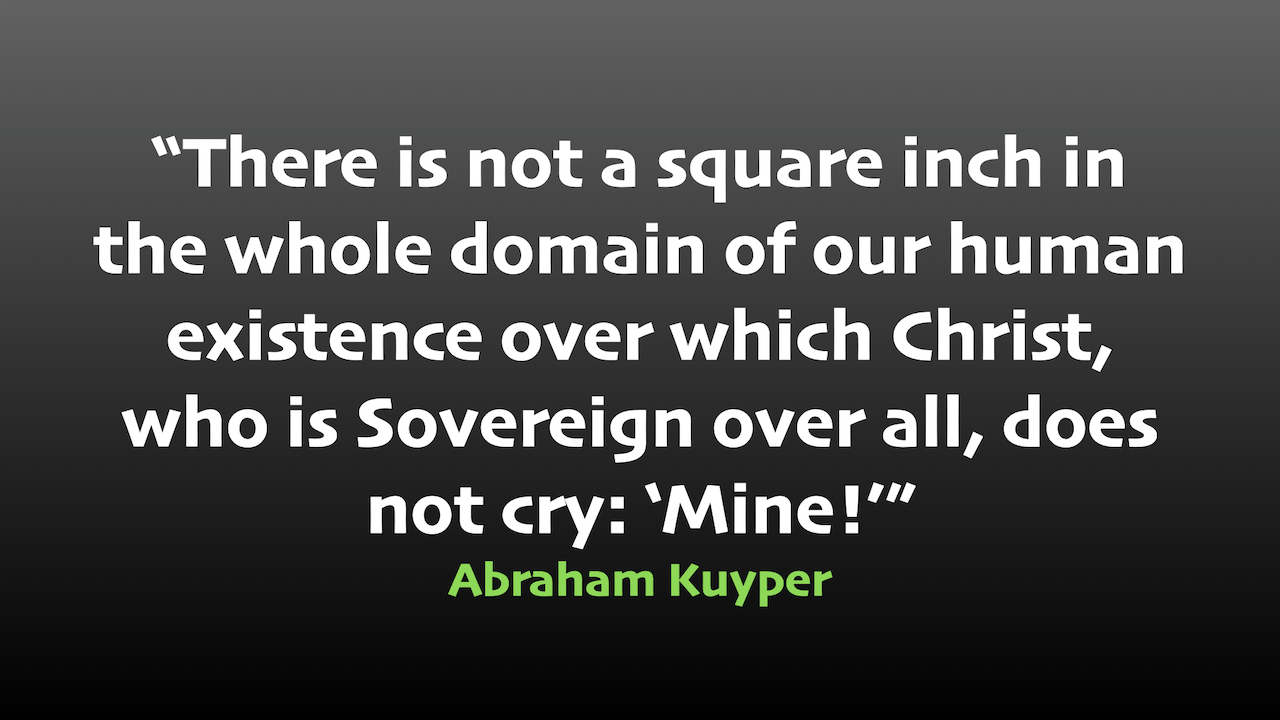
Most ofus would probably agree with Abraham Kuyper who said, “There is not a square inch in the whole domain of our human existence over which Christ, who is Sovereign over all, does not cry: ‘Mine!’”
But the amazing thing here is that God allows David—and you and me—to call Him mine! “O LORD, I say to You, ‘You are MY God’” (v. 6). David goes on to say that God is my strong deliverer who shields me against evildoers (v. 7).
But isn’t David’s God also the God of the wicked? Aren’t they a part of “the whole domain of human existence” that is His? Yes!
So that must mean that God wants even wicked people to call Him, “My God”!
This is exactly what Jesus told us: For God so loved the world [including wicked people] that He gave His one and only Son, that whoever [including wicked people] believes in Him shall not perish but have eternal life. For God did not send His Son into the world to condemn the world, but to save the world [including wicked people] through Him (John 3:16-17).
Just before this third Selah in verse 8 David prays that the plans of the wicked might be thwarted so that proud people don’t become even more proud. That seems okay. But after the Selah David seems to be asking God to let everything that wicked people have planned to boomerang back on them (vv. 9-11).
Hate isn’t the opposite of love, but apathy is the opposite of love. Hate is a very strong emotion that usually comes out when something we love or desire is thwarted or kept from us.
Just as we learned last week that God allows evil people and their slander and wickedness to prune us and make us more fruitful, can’t God give back to evil people exactly what they need to get their attention? Can’t He use their own evil plans for them just as He used them for us? Yes!
If God loves us—and He does—then He must hate anything that keeps us from Him.
If God loves wicked people—and He does—then He must also hate anything that keeps them from accepting the atoning work Jesus did for them on the Cross.
God is love. There is nothing you can do to make God love you any more. There is nothing an evil person can do to make God love them any less.
David’s third Selah is really his reminder that he must leave evil people to the only One who can discipline them in perfect measure. We have to leave evil people to God’s care—the only One who can rescue them. That’s why Jesus told us to “love your enemies and pray for those who persecute you” (Matthew 5:44).
David’s prayer in verses 9-13 does leave evil people in God’s hands, and it’s a prayer you and I can personalize for those whom we desire to know Jesus as their Savior.
It’s not God’s desire that any should perish. So let’s Selah to call God, “My God,” but to also pray that even the wicked people around us will come to the realization that through faith in Jesus, they too can cry out, “My God!”
God gave me a unique story when I was walking through a challenging time with a friend that I needed to leave to God’s care. I called the story The Parable of the Lifeguard. You can watch it in the video below, or you can read it by clicking here.
According to 1 Corinthians 12-14, the Holy Spirit operates in nine different gifts to both evangelize the sinner and edify the saints. The apostle Paul says that these gifts are available to all Christians who will allow the Holy Spirit to operate through them.
If you would like to join us in person for this class, here is where you can find us. If you have missed any of the classes in this series, check them out here:
Jeff and I talked about my unique background and how that contributed to not only the book I wrote but also to the activities in which I am presently involved.
God took me on a long journey before I came to be a shepherd in Cedar Springs, MI. There were times in my younger life when I questioned why my path didn’t look like a straight line that was heading toward a career or vocation, but God showed me the truthfulness of the promise in Romans 8:28—He is using ALL THINGS to accomplish what He needs for me and for His Kingdom.(Check out the short video below where I share a bit of my autobiography.)
I hope this is a word of encouragement for you too. God IS directing every single one of your steps, He IS using all of your education and experiences to accomplish His purpose. Don’t bail out of this process, and don’t ever get discouraged that your path seems different than those around you. God is being as unique with you as He is with everyone else.
If you are a church leader, I encourage you to pick up a copy of my book Shepherd Leadership: The Metrics That Really Matter. I believe you will find many more encouraging thoughts that will keep you engaged in the work to which God has called you.
I’ll be sharing more clips from this 200churches interview soon, so please stay tuned. Shepherd Leadership: The Metrics That Really Matter is available in print or ebook, and in audiobook through either Audible or Apple.



 We have been studying the different sets of gifts listed in the New Testament. These gifts are to bring maturity and health to the church. Previously we have looked at the motivational gifts in Romans chapter 12 and the operational gifts of the Holy Spirit in 1 Corinthians 12-13.





 Craig T. Owens