Good Friday—It Is Finished

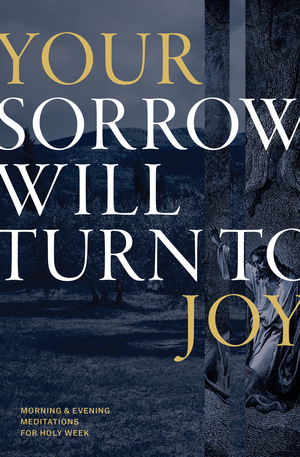
Your Sorrow Will Turn To JoyThis is from a chapter in Your Sorrow Will Turn To Joy, and is probably one of the best depictions of Good Friday I have read. Jon Bloom writes—

It is Friday, April 3, A.D. 33. It is the darkest day in human history, though most humans have no clue of this. In Rome, Tiberius attends to the demanding business of the empire. Throughout the inhabited world, babies are born, people eat and drink, marry and are given in marriage, barter in marketplaces, sail merchant ships, and fight battles. Children play, old women gossip, young men lust, and people die. 

But today, one death, one brutal, gruesome death, the worst and best of all human deaths, will leave upon the canvas of human history the darkest brushstroke. In Jerusalem, God the Son, the Creator of all that is (John 1:3), will be executed. 

The Garden 

The Jewish day dawns with night, and never has it been more fitting, since today the hour has come and the power of darkness (Luke 22:53). Jesus is in Gethsemane, where He has prayed with loud cries and tears, being heard by His Father (Heb. 5:7) whose will will be done. Jesus hears noises and looks up. Torches and hushed voices signal the arrest party’s arrival. 

Jesus wakes His sleepy friends who are jarred alert at the sight of their brother, Judas, betraying his Rabbi with a kiss. Soldiers and servants encircle Jesus. Peter, flushed with anger, pulls out his sword and lunges at those nearest Jesus. Malchus flinches, but not enough. Blinding pain and blood surge where his ear had been. Voices speak, but Malchus only hears the screaming wound, which he’s grabbed with both hands. He feels a hand touch his hands and the pain vanishes. Under his hands is an ear. Stunned, he looks at Jesus, already being led away. Disciples are scattering. Malchus looks down at his bloody hands. 

The Sanhedrin 

Jesus is led brusquely into the house of Annas, a former High Priest, who questions Him about His teaching. Jesus knows this informal interrogation is meant to catch Him disoriented and unguarded. He is neither, and gives this manipulative leader nothing. Rather, He refers Annas to his hearers and is struck with irony by a Jewish officer for showing disrespect. Frustrated, Annas sends Jesus on to his son-in-law Caiaphas, the current High Priest. 

At Caiaphas’s house the trial gets underway quickly. Morning will come fast. The Council needs a damning verdict by daybreak. The examination proceeds as bleary-eyed Sanhedrin members continue to file in. 

The trial has been assembled hastily and witnesses haven’t been screened well. Testimonies don’t line up. Council members look disconcerted. Jesus is silent as a lamb. Irritated and impatient, Caiaphas cuts to the quick: “I adjure You by the living God, tell us if you are the Christ, the Son of God” (Matt. 26:63). The hour has come. Charged in the name of His Father to answer, Jesus speaks the words that seal the doom for which He had come to endure (John 12:27): “You have said so. But I tell you, from now on you will see the Son of Man seated at the right hand of Power and coming on the clouds of heaven” (Matt. 26:64). 

In a moment of law-breaking (Lev. 21:10) politically religious theater, Caiaphas tears his robes in feigned outrage and thinly concealed relief over Jesus’s blasphemy. He declares the trial’s end with, “What further testimony do we need? We have heard it ourselves from His own lips” (Luke 22:71). 

As the sun breaks over Jerusalem’s eastern ridge, Judas swings from his own belt, Peter writhes in the grief of his failure, and Jesus’s face is streaked with dried blood and saliva from the pre-dawn sport of the temple police. The Council’s verdict: guilty of blasphemy. Their sentence: death. But it’s a sentence they cannot carry out. Rome refuses to delegate capital punishment. 

The Governor 

Pilate’s mood, already sour over the Sanhedrin’s sudden insistent intrusion so early in the morning, worsens as he grasps the situation. They want him to execute a Galilean “prophet.” His seasoned instincts tell him something isn’t right. He questions Jesus and then tells the Council, “I find no guilt in this Man” (Luke 23:4). 

A game of political chess ensues between Pilate and the Sanhedrin, neither realizing that they are pawns, not kings. Pilate makes a move. As a Galilean, Jesus falls under Herod Antipas’s jurisdiction. Let Herod judge. Herod initially receives Jesus happily, hoping to see a miracle. But Jesus refuses to entertain or even respond. Antipas, disappointed, blocks the move by returning Jesus to Pilate. 

Pilate makes another move. He offers to release Jesus as this year’s annual Passover pardoned prisoner. The Council blocks the move. “Not this man, but Barabbas!” they cry (John 18:40). Pilate is astounded. The Sanhedrin prefers a thief and murderer to this peasant prophet? 

Pilate tries another move. He has Jesus severely flogged and humiliated, hoping to curb the Council’s blood thirst. Again the move is blocked when the Council insists that Jesus must be crucified because “He has made Himself the Son of God” (John 19:7). Check. Pilate’s fear grows. Jesus’s divine claim could threaten Rome. Worse, it could be true. Roman deities supposedly could take on human form. His further questioning of Jesus unnerves him. 

One last move. Pilate tries to persuade the Sanhedrin to release Jesus. One last block and trap. “If you release this Man, you are not Caesar’s friend. Everyone who makes himself a king opposes Caesar” (John 19:12). The Council has Pilate where they want him: cornered. Checkmate. 

And the triune God has the Council, Pilate, and satan where He wants them. They would have no authority over the Son at all unless it had been given them from above (John 19:11). Fallen Jews, Gentiles, and spiritual powers unwittingly collaborate in executing the only innocent death that could possibly grant the guilty life. Checkmate. 

The Cross 

Morning wanes as Jesus stumbles out of the Praetorium, horribly beaten and bleeding profusely. The Roman soldiers had been brutal in their creative cruelty. Thorns have ripped Jesus’s scalp and His back is one grotesque, oozing wound. Golgotha is barely a third of a mile through the Garden Gate, but Jesus has no strength to manage the forty-pound crossbar. Simon of Cyrene is drafted from the crowd. 

Twenty-five minutes later, Jesus is hanging in sheer agony on one of the cruelest instruments of torture ever devised. Nails have been driven through His wrists (which we only know about because of the doubt Thomas will express in a couple days—see John 20:25). A sign above Jesus declares in Greek, Latin, and Aramaic who He is: the King of the Jews. 

The King is flanked on either side by thieves and around Him are gawkers and mockers. “Let Him save Himself, if He is the Christ of God, His Chosen One!” some yell (Luke 23:35). One dying thief even joins in the derision. They do not understand that if the King saves Himself, their only hope for salvation is lost. Jesus asks His Father to forgive them. The other crucified thief sees a Messiah in the mutilated man beside him, and he asks the Messiah to remember him. Jesus’s prayer is beginning to be answered. Hundreds of millions will follow. 

It is mid-afternoon now and the eerie darkness that has fallen has everyone on edge. But for Jesus, the darkness is a horror He has never known. This, more than the nails and thorns and lashings, is what made Him sweat blood in the garden. The Father’s wrath is hitting Him in full force. He is in that moment no longer the Blessed, but the Cursed (Gal. 3:13). He has become sin (2 Cor. 5:21). In terrifying isolation, cut off from His Father and all humans, He screams, “Eli, Eli, lema sabachthani,” Aramaic for “My God, My God, why have You forsaken Me?” (Matt. 27:46; Ps. 22:1). No greater love (John 15:13), humility (Phil. 2:8), or obedience (Heb. 5:8) has ever or will ever be displayed. 

Shortly after 3:00 P.M., Jesus whispers hoarsely for a drink. In love, He has drained the cup of His Father’s wrath to the dregs. He has born our full curse. There is no debt left to pay and He has nothing left to give. The wine moistens His mouth just enough to say one final word: “It is finished” (John 19:30). And God the Son dies. 

It is the worst and best of all human deaths. For on this tree He bears our sins in His body (1 Pet. 2:24), “the righteous for the unrighteous, that He might bring us to God” (1 Pet. 3:18). And now it is finished.
The Emblem Of Suffering And Shame

Listen to the podcast of this post by clicking on the player below, and you can also subscribe on AppleSpotify, or Audible.

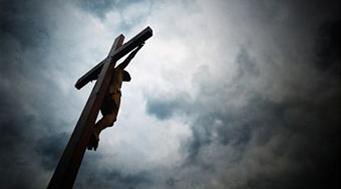
Tomorrow we celebrate Good Friday—the day Jesus died a horrific death on Calvary for my sins and your sins. The apostle Paul said Christ’s crucifixion was a stumbling block to many, because it was unimaginable that anyone—especially the perfect Son of God—could be subject to the torturous death reserved for the worst of offenders. But when Jesus became sin for us, that’s just what He was in that moment: the worst of offenders in Holy God’s eyes.

Christ on the Cross    “In the ancient world crucifixion was seen as a particularly disgraceful and grievous form of execution. Assyrian battle reliefs depict a precursor to crucifixion—impaling victims on poles outside the walls of conquered cities. The Persians made wide spread use of crucifixion, although sometimes the crucifixion took place only after the victim had been executed by other means (Herodotus, Histories, 3.125.2-3). There are also reports that crucifixion was used by peoples as varied as the Assyrians, Scythians, Celts, Germans, Britons and inhabitants of India, although the reliability of some of these accounts is questionable. Common to most of these cultures was the perspective that crucifixion was a form of execution reserved for the worst offenders, as well as for slaves.

     “The practice of crucifixion became widespread under Alexander the Great (356-323 B.C.). It became the common form of execution for traitors, defeated armies and rebellious slaves. Later, under the Roman Empire, only non-citizens, lower-class Romans and violent offenders could be crucified. The only possible exceptions were in cases of high treason or desertion during wartime. Slaves were particularly vulnerable to the imposition of crucifixion. Latin literature reflects the dread slaves felt at the prospect of this fate. It was officially accepted as the most painful and disgraceful form of capital punishment, more so than decapitation, being thrown to wild animals or even being burned alive. For these reasons this heinous penalty was often imposed upon foreigners who were seen as threats to Roman rule.

     “There are also accounts of crucifixion being practiced among Jews. Josephus wrote that the Sadducees and high priest Alexander Janneus (in the office from 103 to 76 B.C.) committed the following atrocity against his enemies, the Pharisees: ‘While dining in a conspicuous place with his concubines, he commanded that about 800 of them be crucified, and while they were still alive before their eyes he had the throats of their children and wives cut’ (Josephus, Antiquities, 13.14.2).

     “Victims were often scourged or otherwise tortured prior to crucifixion. Crucifixions were carried out on either a single vertical stake or on a vertical stake with a crossbeam near or on its top. Sometimes blocks were attached to the stake as a seat, footrest or both. Depending upon the presence of these blocks, the victim might linger, alive, for up to three days. The blocks allowed a victim to rest some of his weight, increasing the chance of breathing and proper circulation. Without the blocks a victim’s weight would rest totally upon his arms, which were attached to the crosspiece by ropes, nails or both. This would prohibit breathing and circulation and lead to both brain and heart failure. To end the torture, a victim’s legs could be broken, after which death would quickly follow. Oftentimes the charge against the guilty party would be written out and nailed to the cross above his head. As a deterrent to would-be rebels and criminals, crucifixions were usually carried out in highly visible locations.

     “During Jesus’ lifetime crucifixion was used by the Romans to exercise and gruesomely display their authority over others. This torturous execution was viewed by the Jews as a cursed form of death. Deuteronomy 21:23 states that ‘anyone who is hung on a tree is under God’s curse.’ Documents discovered at Qumran reveal that many Jews of Jesus’ time applied this text to Roman crucifixion. This perspective of crucifixion demonstrates why the apostle Paul wrote that the Cross of Christ was ‘a stumbling block to Jews and foolishness to Gentiles’ (1 Corinthians 1:23). Who would have imagined that the Holy One of God would voluntarily take upon Himself the curse that should have been ours? This emblem of shame has thus become the symbol of our salvation.” —Archaeological Study Bible, “Crucifixion” (page 1757)

As you remember what Jesus did for you on the Cross atop of Golgotha, may you be overwhelmed by the love which held Him fast to such a horrific instrument of death. He endured the suffering and shame of the Cross because He loves you and wants you to be with Him forever.

May we cherish that old rugged Cross and the Savior who suffered and died for us. As we place our faith in His death and resurrection three days later, may we be able to live each day in celebration of the victory Jesus won over hell, death, and the grave!

►► Would you please prayerfully consider supporting this ministry? My Patreon supporters get behind-the-scenes access to exclusive materials. ◀︎◀︎

4 Ways To Evaluate Biblical Evidence

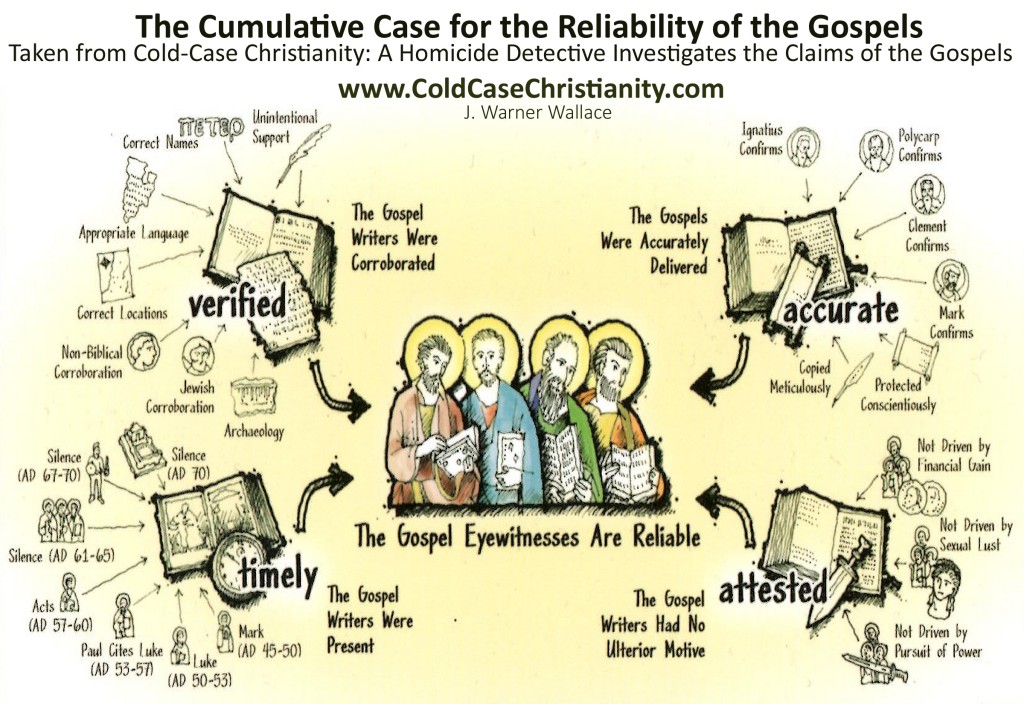
Reliability of the GospelsTo be honest, if someone hasn’t heard the biblical account of the life of Jesus Christ before, it can sound quite fantastic! Jesus was born of a virgin, lived a sinless life, performed miracles no one had seen before, died a horrific martyr’s death, was raised back to life three days later, and then ascended back into heaven until He returns to Earth again.

But as fantastic as this sounds, there is still enough evidence to reasonably believe it’s all true. An unreasonable faith believes in something in spite of the evidence; a blind faith believes in something without any evidence; and reasonable faith believes in something because of the evidence.

The Bible gives us eyewitness testimony about the life of Jesus which we can matter-of-factly evaluate. 

In a modern-day court of law, eyewitness testimony is evaluated on…

  • …the determination that the witnesses were actually present.
  • …the ability to corroborate their testimony.
  • …the consistency of their testimony over time.
  • …any biases they have that would cause them to exaggerate or misrepresent their testimony.

Let’s consider the testimony of the four Gospel writers: Matthew, Mark, Luke and John.

(1) Were The Eyewitnesses Present?

  • Luke is considered a credible historian, even by modern standards. He wrote the book of Acts following the ascension of Jesus into Heaven. Because he did not mention three major events in Jewish history (the Jewish uprising, the Roman siege of Jerusalem in response to that uprising, and the Roman destruction of the temple), we can determine that Acts was written before 61 AD.
  • Luke wrote the Gospel that bears his name before he wrote Acts. The Apostle Paul referenced portions of Luke’s Gospel in letters we can date by Paul’s Roman imprisonment, which means Luke was written prior to 53-57 AD.
  • Luke uses the Gospel of Mark as one of his references, which means Mark was probably written in 45-50 AD, just 10-15 years after the events of Christ’s life.
  • Mark was closely associated with the Apostle Peter, who was most assuredly Mark’s “source” in writing his Gospel, and Peter was one of the original twelve apostles called by Jesus.
  • Matthew and John were both apostles of Jesus, living and working closely with Jesus for over three years.

(2) Is Their Testimony Corroborated?

  • Archeological finds continually demonstrate the accuracy of the people, titles, places and details the Gospel writers mention.
  • Outside—or extra-biblical—sources like Josephus (a Jewish historian who wanted to preserve the purity of Judaism), Tacitus (a Roman historian), and Mara Bar-Serapion (a Syrian historian)—all who wrote between 40-70 AD—affirm things like where Jesus lived, the miracles He performed, the manner of His death, His resurrection, and the changed lives of people who believed in Jesus Christ.
  • In addition, Paul wrote of the “five hundred of the brothers” who were also eyewitnesses to the resurrected Christ (1 Corinthians 15:3-8).

(3) Has Their Testimony Remain Unchanged Over Time?

  • The history and accuracy of the scribes had already been demonstrated in the preservation and transmission of the Old Testament over a period of 1400 years.
  • These same scribal techniques were not only used in the transmission of the New Testament, but in subsequent years the Masoretic scribes became even more meticulous in the techniques they used.
  • The “chain of custody” of evidence can be absolutely traced from the Gospel authors, to their students, and to the writings of the Church Fathers.
  • In fact into the third-century AD, the writings of the Church Fathers contain so many direct quotations from the New Testament, that we can almost completely reconstruct the New Testament from their writings.

(4) Is Their Testimony Unbiased?

  • These eyewitnesses didn’t gain anything financially by their testimony. In fact, many of them lost or gave up all their possessions to tell others about Jesus.
  • They didn’t gain political power or influence that could save their own lives. All of the original apostles (except John) died a gruesome martyrs’ death.
  • In short, they had nothing to gain by making up and reporting a false story about Jesus.

All of these points make it reasonable to believe the evidence presented in the Bible about Jesus Christ is true. Check out this video where I elaborate a little more on each of these points—

If you live in the Cedar Springs area and don’t have a home church, I would love for you to visit with us Easter Sunday morning at 10:30am. We’ll be examining the evidence for Christ’s resurrection from the dead. Click here to get more details.

8 Must-Have Bible Study Tools

Bonhoeffer - study the BibleIt’s been said that if the only tool a man has in his toolbox is a hammer, he tends to see every problem as a nail. In other words, we try to force every project to be handled in the exactly same way.

Sadly, for many Christians, the same is true with our knowledge of the Bible. If we have limited tools, we try to make every situation look like something we can fix with that smaller toolbox. It’s not enough for us to know only a couple of verses or a few biblical principles, and then try to use those tools to handle all of life’s situations. So let me share some basic tools that will help you expand your biblical toolbox.

Time and cultureThink about how much your culture has changed just in the 70-80 years since your grandparents were born. Think about how wardrobes have changed, and technology, and manners and customs. The earliest book of the Bible was written about 1400 BC, and the most recent book was written about 100 AD. To better understand the things I read in the Bible, here are some tools I like to use:

LanguageEven the English language has changed a lot since William Shakespeare penned his famous plays. But consider that the Bible was written in languages that are even older (not to mention they’re languages other than English!). To really get the full meaning of a passage, here are some tools I use:

Chain of pearls—The Bible is not a collection of isolated, independent stories or concepts, but it is a beautiful string of pearls. Every part connects to the rest of the Scripture. So some resources I use to help me discover how the pearls are strung together include:

What did I miss? What are your favorite Bible study tools? In the comments, please share books, commentaries, or online resources that you use to maximize your study of God’s Word.

This Sunday I’ll be sharing some different styles of Bible studies we can all do. If you live in the Cedar Springs area, please come join a really great group of people at Calvary Assembly of God. Otherwise, watch us on Periscope.

Links & Quotes

link quote

“Build God-centered anticipation and expectancy and excitement into your home—especially for the children. If you are excited about Christ, they will be too. If you can only make Christmas exciting with material things, how will the children get a thirst for God? Bend the efforts of your imagination to make the wonder of the King’s arrival visible for the children.” —John Piper

“The only people whose soul can truly magnify the Lord are people like Elizabeth and Mary—people who acknowledge their lowly estate [Luke 1:43, 48] and are overwhelmed by the condescension of the magnificent God.” —John Piper

“I try to read every book—Christian and secular—touted as ground-breaking. None of them are. We are driven by a reality placed in us by the Creator God with legitimate ways, context, and relationship to express our sexuality. If we don’t find those legitimate outlets, we will spend our lives searching for fulfillment in self-destructive ways to fill that God-given need for community, intimacy, relationship, and meaning. We cannot live without intimacy, and here I don’t mean sex. Sex is simply one of the most powerful forms of intimacy. We are not asexual beings. Being Christ-followers, striving for integrity in all things, doesn’t neuter us.” —Becky McDonald, founder and president of Women At Risk (WAR) International

“We must discipline our minds in all things to submit to the Word of God. We have the mind of Christ (1 Corinthians 2:16), and we are commanded to let His mind hold sway in all our thinking (Philippians 2:5). What the Scripture teaches concerning the disciplined life may not always seem the reasonable thing to do—because we cannot square its teaching with our experience or logic—but it is always the Word of God. Our duty is to get behind it and order all our steps accordingly.” —T.M. Moore

“Life is better when we act like we might see someone again soon, isn’t it?” —Seth Godin

This is scary (but typical of how abortion providers operate): a 911 call reveals that a teenager is held against her will and is being forced to have an abortion!

BREAKING NEWS: The US Senate has voted to repeal Obamacare, and defund Planned Parenthood!

Guillaume Bignon, a former atheist, has become a Christian. Here is Sean McDowell’s interview with him.

Archeologists in Israel have found a seal purported to belong to King Hezekiah. You can read about other verified archeological finds every day in the Archeological Study Bible.

[VIDEO] John Maxwell on the value of imagination—

https://youtu.be/Af_xS1DmsEg

Links & Quotes

link quote

“It is the consistent teaching of the Scriptures that Christian faith is not genuine until it comes to expression in good works. Jesus taught this (Matthew 7:20), as did the apostles Paul (Ephesians 2:10), James (James 2:14-17), John (1 John 2:1-6), Peter (2 Peter 1:5-11), and the writer of the book of Hebrews (Hebrews 6:10-12; 10:24).” —T.M. Moore

Fascinating question: Did the New Testament authors know they were writing Scripture?

[VIDEO] Why do Christians follow some biblical commands, but not others?

Live Action reports: Yes, defunding Planned Parenthood will affect low-income women. It will help them!

True: Thanksgiving starts on Sunday.


Links & Quotes

link quote

“Remember it is God, and not man, that must have the glory. It is not much speaking, but much faith, that is needed.” —Robert Murray McCheyne

“That very church which the world likes best is sure to be that which God abhors.” —Charles Spurgeon

Mark Atteberry asks a good question: “Aren’t we out-of-touch, narrow-minded, sexually-repressed Christians supposed to be the only ones who are bothered by rampant sexuality? Why, then, are these such big stories Jared Fogle, Ashley Madison, Larry Flynt], worthy of reporting on national newscasts?” Check out his post A Big Day For Sexual Sin.

Reminder: There is no such thing as free pornography. “The simple truth is that porn always costs us dearly, and it is never a victimless crime. Peer-reviewed research suggests that porn is highly addictive, negatively affects our behavior, and functionally operates as a destructive drug.”

Eric Metaxas shares some cool archeological findings about Jesus Christ’s hometown of Nazareth.

“Believing in your heart that God raised Jesus from the dead is much more than accepting a fact. It means being confident that God is for you, that He has closed ranks with you, that He is transforming your life, and that He will save you for eternal joy.” —John Piper

12 Quotes From “In Light Of Genetics”

Dr. John SanfordDr. John Sanford’s ebook In Light Of Genetics is fascinating reading. It’s a bit technical in certain places, but I think Dr. Sanford does a good job making the genetic concepts accessible to almost anyone. Check out my book review by clicking here. Below are some quotes from this work.

“Forensic evidence is never conclusive, and so scientific claims about the distant past must always contain an element of belief. The direction of genetic change is down, not up. Humanity is devolving due to mutation.”

“We feel biological similarities between different kinds of life are better explained by a Common Designer than by common descent.”

“We are unique and alone now in the world. There is no other animal species that truly resembles our own. A physical and mental chasm separates us from all other living creatures. There is no other bipedal mammal. No other mammal controls and uses fire, writes books, travels in space, paints portraits, or prays. This not a question of degrees. It is all or nothing; there is no semi-bipedal animal, none that makes only small fires, writes only short sentences, builds only rudimentary spaceships, draws just a little bit, or prays just occasionally.” —Juan Arsuaga, writing in The Neanderthal’s Necklace

“Man is a singular creature. He has a set of gifts which make him unique among the animals: so that, unlike them, he is not a figure in the landscape—he is a shaper of the landscape.” —Jacob Bronowski

“From a genetic point of view, the genes that enable our unique capabilities, gifts, and talents (i.e., science, art, love, relation to God) could not arise by any series of random mutations filtered by natural selection—not in any amount of time. There is no credible mechanism that could lead to spontaneous origin of mind, consciousness, intelligence, soul, or spirit. Indeed, while these human traits are found within a biological context (i.e., within an animal-like body/brain), they clearly transcend mere biology. We are exquisitely programmed to be more than animals, and our bodies are well-designed vessels that house our immaterial being: mind, soul, and spirit.”

“Leading human geneticists agree that in mankind deleterious (bad) mutations are accumulating faster than they are being selected away, and so the human genome is degenerating. … The data are highly consistent. The coefficient of determination (matching the curve to the data) is very high: 0.96. Due to the consistency of the decay rate, we can also rule out the idea that there were hundreds (or thousands) of missing generations that were not recorded. We conclude that the genealogical record must either be complete or very nearly complete. This validation of the genealogical record very powerfully points to the historicity and reliability of the book of Genesis.”

“Mounting evidence shows that natural selection is not a creative force, but is a stabilizing force that helps preserve the various kinds of life (i.e., it culls out the most dysfunctional individuals). It is very clear that natural selection cannot create our genome, let alone our mind and soul. At best, natural selection can only slow down the rate of genetic degeneration. … Because of the great abundance of deleterious mutations and the extreme rarity of beneficial mutations, it is not possible for mankind to achieve a net gain of genetic information.”

“Our latest numerical simulations show that in the type of pre-human population that supposedly gave rise to modern man, billions of years would be required just to create and establish a new genetic text string as small as six or seven letters, such as ‘GTCGCT’ or ‘GAGTTCA.’ Yet such a string would be just a drop in the ocean of new information needed to transform an ape into a man.”

“In the biblical model, humanity begins with Adam and Eve, who descendants rapidly multiply, and then, went through a one-generation bottleneck at the time of the Flood, then the population once again rapidly increased, followed by rapid divergence at the Tower of Babel event, creating today’s people groups.”

“If Adam’s genome was intelligently designed, it would obviously have had a great number of designed genetic variants. Otherwise all people would essentially be clones of Adam and Eve, which would be bad design, for many obvious reasons. … Even though many mutations have accumulated in the genome during human history, it is reasonable to conclude that most observable human genetic variation was created by God. The biblical perspective has unique explanatory power in terms of giving a credible explanation for the amazing range of human traits and abilities. There is no single ‘superior genotype.’ We all have unique sets of gifts and talents, which very reasonably reflect good design, and for which we can give thanks to God.”

“We have statistically analyzed over 800 human mitochondrial sequences and have been able to reconstruct and publish a very close approximation of Eve’s mitochondrial sequence. We found that the average human being is only about 22 mutations removed from the Eve sequence, although some individuals are as much as 100 mutations removed from Eve. Can we account for this amount of mutation in a biblical timeframe? Easily. The most recent estimate of the mutation rate in human mitochondria is about 0.5 per generation. Thus, even for the most mutated sequences, it would only require 200 generations (less than 6,000 years) to accumulate 100 mutations.”

“Now, by God’s grace, we do not have to choose between faith in God’s Word vs. faith in science, we can embrace both. There is now very strong genetic evidence that strongly supports Scripture and refutes evolution.”

In Light Of Genetics (ebook review)

Dr. John SanfordWhen I went to college, I went as a biomedical chemistry major. I began my collegiate education at a Christian liberal arts university, and then transferred to a very secular state university. Ever since that time, I have always been deeply interested in the scientific fields, especially biology. So I was excited to read Dr. John Sanford’s paper In Light Of Genetics: Adam, Eve and the Creation/Fall.

In my Christian education experience, the scale was slightly weighted in favor of a biblical view of Creation. In my state university experience, the scale was overwhelming tipped toward an evolutionary paradigm. At both universities, I had rather intense conversations with my professors and classmates about hard science viewed through a biblical paradigm. Dr. Sanford’s paper was an encouraging study to read because of its balance between science and the Bible.

You can read Dr. Sanford’s full paper by clicking here, but here are a few highlights for me:

  • Genetic evidence is pointing more and more toward the biblical description of Creation.
  • The “junk DNA” claim that Darwinists need to support their theories of evolution are being proven invalid.
  • There is clearly a “Mitochondrial Eve” whose DNA sequence is evident in living human beings today.
  • There is also a “Y Chromosome Adam” whose DNA sequence is equally as evident.
  • Molecular clocks point to a young genome for biological life.
  • The Y chromosomal differences between man and chimp are far greater than evolutionist theories predicted.
  • The genetic differences/similarities seen today fit perfectly with the account of the biblical Flood.

For all my geeky science friends, I will post some quotes from this paper soon.

Whether you are a geek or not, this is fascinating reading! I encourage my friends who hold Darwinist views to read this, and then let’s talk. I also encourage my Creationist friends to read this too, and use these studies to strengthen your apologetics.

Read more about Dr. Sanford and his work here.

Links & Quotes

link quote

“When you bounce your eyes away from a sexual image, immediately pull from your memory a pure image. Maybe a wedding picture, or a vacation experience with your family, or your buddies. There are thousands of positive images you can pull from your memory within seconds to replace the sexual images you’re tempted with.” —Steve Arterburn

“satan shows the best, but hides the worst, because his best will not [counterbalance] his worst; but Christ’s will abundantly.” —Matthew Henry

William Wilberforce said something about slavery that could just as easily apply to abortion today: “It naturally suggested itself to me, how strange it was that providence, however mysterious in its ways, should so have constituted the world as to make one part of it depend on its existence for the depopulation and devastation of another.” Check out this Live Action post: Lessons From Wilberforce.

“But do you want to get better? It seems like a stupid question. Of course we want our organization, our work and our health to improve. But often, we don’t. Better means change and change means risk and risk means fear.” —Seth Godin

Our worldview makes a huge difference in the way we live. Check out this post from Stand To Reason on how Christianity improved the lives of women.

A recent Pew Research Center survey showed that the number of people in America identifying themselves as Christians has dropped. Check out the results of the survey here, and then listen to what John MacArthur has to say in this video—