Growth Problems

…the number of disciples was increasing… (Acts 6:1).

Growth is a nice problem to have. But it is still a problem that needs to be addressed, or else the growth can implode an organization. 

In this instance, the early Christian church was growing rapidly and attempting to address the need for getting food to widows. Apparently, some of the widows were being overlooked in that food distribution. 

To start the ball rolling on solving this growth problem, the apostles gave some simple parameters: We will focus on preaching, the rest of you should select administrators to oversee the food ministry (vv. 2-4). The job description was pretty simple too—they must have a good reputation, be full of the Holy Spirit, be wise, and (this is implied) be willing to serve.

Notice the trust the church leaders placed in that congregation: 

  • seek out from among you
  • they chose
  • they set them [the candidates] before the apostles

The congregation was pleased by both the apostles’ plan and the level of trust that was conferred on them. It appears that seven men were the unanimous selection of both the congregation and the church leaders. 

After these men were installed in their new administrative roles, look at the results:

  • more preaching
  • more salvations
  • more inroads into the Jewish religious leadership sect
  • more people fed
  • more miracles performed
  • and more persecution from those threatened by the church’s rapid growth

It’s interesting to note that Luke uses the word added to talk about the church’s growth in chapters 1-5, but after this growth problem is successfully resolved, Luke stops using added and only uses multiplication terminology. 

When handled the right way, growth problems—or any problems, for that matter—lead to more growth. 

A mark of a godly leader is one who handles growth problems correctly. 

This is part 36 in my series on godly leadership. You can check out all of my posts in this series by clicking here.


The Infographic Bible (book review)

I love studying the Bible! I enjoy reading it in different translations, consulting my atlas to see where certain events took place, studying the culture of the biblical settings, and even diving in to the Hebrew and Greek definitions of words. But I’ve never seen the biblical story portrayed as uniquely and so visually beautiful as Karen Sawrey has done it in The Infographic Bible.

The subtitle of this work is “visualizing the drama of God’s Word,” and Karen does this in ways you have never seen before. 

The Infographic Bible flows in the same order as the Biblical text, except that there is very little text involved. You will see how the biblical books were compiled and then walk through God’s story in both the Old and New Testaments.

In graphics that typically span the full two-page spread (and sometimes even more), you will see in vivid colors, bold designs, and memorable graphics how God set about to redeem His people and tell His story. You will see the two Genesis accounts of Creation portrayed side-by-side, you will understand genealogies better by seeing their timelines flow through generations, you will appreciate the biblical themes and fulfilled prophesies, and you will look forward to the hope of things to come in Revelation. 

There is so much to discover in this book! The Infographic Bible is a coffee-table-size book, and the beautiful graphics inside will definitely make it a conversation piece to leave on display for your guests. I commend Karen Sawrey for her outstanding work, and I highly recommend this book to you.

Thursdays With Oswald—Hear And Do

Oswald ChambersThis is a weekly series with things I’m reading and pondering from Oswald Chambers. You can read the original seed thought here, or type “Thursdays With Oswald” in the search box to read more entries.

Hear And Do

     The emphasis in these verses [Matthew 7:24-29] is laid by our Lord on hearing and doing. … We hear only what we listen for. Have we listened to what Jesus has to say? Have we paid any attention to finding out what He did say? Most of us do not know what He said. If we have only a smattering of religion, we talk a lot about the devil; but what hinders us spiritually is not the devil nearly so much as inattention. We may hear the sayings of Jesus Christ, but our wills are left untouched, we never do them. … 

     Pay attention to His words, and give time to doing it. Try five minutes a day with your Bible. The thing that influences us most is not the thing that we give most time to, but the thing that springs from our own personal relationship, that is the prime motive that dominates us. … 

     “Build up your character bit by bit by attention to My words,” says Jesus, then when the supreme crisis comes, you will stand like a rock. … If a man has built himself up in private by listening to the words of Jesus and obeying them, when the crisis comes it is not his strength of will that keeps him, but the tremendous power of God. … All you build will end in disaster unless it is built on the sayings of Jesus Christ; but if you are doing what Jesus told you to do, nourishing your soul on His word, you need not fear the crisis whatever it is. … 

     There is a tendency in all of us to appreciate the sayings of Jesus Christ with our intellects while we refuse to do them. … 

     The Holy Spirit’s voice is as gentle as a zephyr, the merest check; when you hear it do you say, “But that is only a tiny detail, the Holy Spirit cannot mean that, it is much too trivial a thing”? The Holy Spirit does mean that, and at the risk of being thought fanatical you must obey. … What does it matter what anyone thinks of us as long as Jesus Christ thinks we are doing the right thing, as long as we can hear Him say, “Well done, good and faithful servant”?” 

From Studies In The Sermon On The Mount

Hear/read God’s Word → Listen to how the Holy Spirit tells me to apply it to my life → Then apply it to my life → Repeat this process again tomorrow… 

Studies In The Sermon On The Mount (book review)

Many people have called Christ’s Sermon on the Mount the most profound sermon ever preached. It would be hard to argue that conclusion! Reading the Sermon is one thing, but living it out is something entirely different. Oswald Chambers helps us live out these amazing words in his book Studies In The Sermon On The Mount. 

Not only did Chambers provide us with an excellent commentary on this Sermon, but his life showed his devotion to practicing what he preached. At a memorial service for Chambers in December 1917, a close friend described Oswald’s life as “the finest commentary on the Sermon on the Mount I know.” May that be said of all Christians! 

This is one of the finest commentaries I have read on this life-patterning sermon that Jesus gave us. It’s a great read, but it is also quite challenging at times. To be honest, Chambers’ thoughts are so deeply profound at points that it takes several readings to grasp the implications. But it is worth your effort! 

A colleague of Chambers—J.F. Knapp, who founded God’s Bible School in Cincinnati, OH, where Chambers taught for seven months in 1907—described it better than I could: 

“‘But,’ says some simple soul, ‘I don’t understand [Chambers].’ The more is the pity. Leave then the evening newspaper, the book of religious wonder-tales, the high-flown writing watered with adjectives, but empty of thought or power, and read these pages again and again until the truth soaks through to your innermost consciousness. … To heed the words of our Lord’s Sermon on the Mount as interpreted by Oswald Chambers will transform holiness people into holy people, and faithless verbosity into Christian humility. Unto which glorious result God speed the day!”

To Knapp’s words I can only add “Amen!” If you want to understand the Sermon On The Mount better, you shouldn’t miss out on this premier Oswald Chambers book. 

Resurrection Appearances

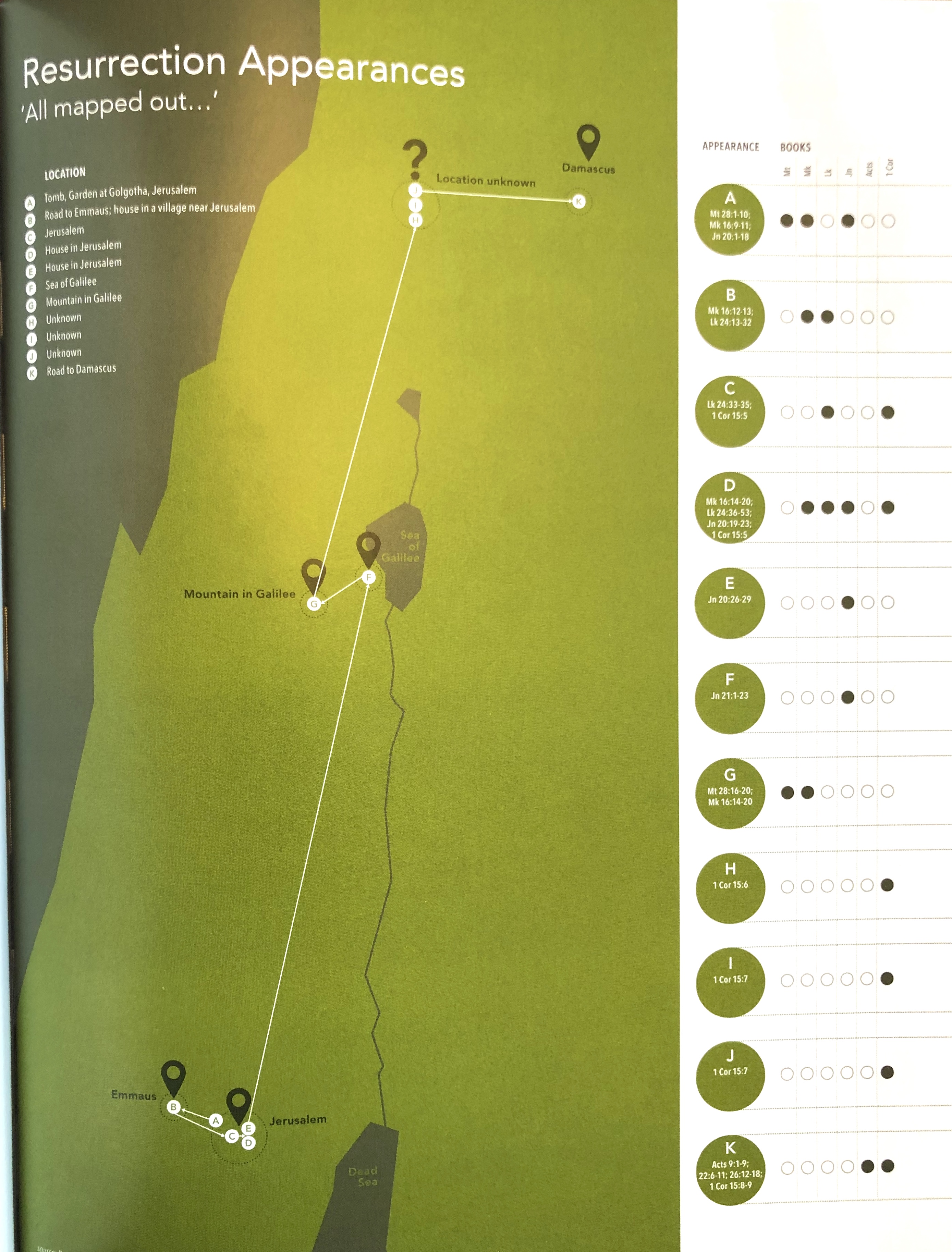
The appearances of Jesus after His resurrection aren’t just limited to the four Gospels (Matthew, Mark, Luke, and John), but also in the books of Acts and 1 Corinthians. Check out this infographic from The Infographic Bible by Karen Sawrey. 

(click the image to zoom in)

Jesus appeared at…

  • A—an empty tomb in the Garden at Golgotha in Jerusalem (Matthew 28:1-10; Mark 16:9-11; John 20:1-18)
  • B—on the road to Emmaus (Mark 16:12-13; Luke 24:13-32)
  • C—in Jerusalem (Luke 24:33-35; 1 Corinthians 15:5)
  • D—at a house in Jerusalem (Mark 16:14-20; Luke 24:36-53; John 20:19-23; 1 Corinthians 15:5)
  • E—at a house in Jerusalem (John 20:26-29)
  • F—by the Sea of Galilee (John 21:1-23)
  • G—on the Mount of Galilee (Matthew 28:16-20; Mark 16:14-20)
  • H—location unknown (1 Corinthians 15:6)
  • I—location unknown (1 Corinthians 15:7)
  • J—location unknown (1 Corinthians 15:7)
  • K—on a road to Damascus (Acts 19:1-9, 22:6-11, 26:12-18; 1 Corinthians 15:8-9)

Thursdays With Oswald—Do You Have The Goods Or Just The Label?

This is a weekly series with things I’m reading and pondering from Oswald Chambers. You can read the original seed thought here, or type “Thursdays With Oswald” in the search box to read more entries.

Do You Have The Goods Or Just The Label? 

     Our Lord makes the test of goodness not only goodness in intention, but the active carrying out of God’s will. Beware of confounding appearance and reality, of judging only by external evidence. …  

     The baptism of the Holy Ghost turns men into the incarnation of what they preach until the appearance and the reality are one and the same. … He does in us what Jesus did for us. … 

     Human nature is fond of labels, but a label may be the counterfeit of confession. It is so easy to be branded with labels, much easier in certain stages to wear a ribbon or a badge than to confess. Jesus never used the word testify; He used a much more searching word—confess. ‘Whosoever therefore shall confess Me before men…’ [Matthew 10:32-33]. The test of goodness is confession by doing the will of God. ‘If you do not confess Me before men,’ says Jesus, ‘neither will your Heavenly Father confess you.’ Immediately we confess, we must have a badge, if we do not put one on, other people will. Our Lord is warning that it is possible to wear the label without having the goods; possible for a man to wear the badge of being His disciple when he is not. Labels are all right, but if we mistake the label for the goods we get confused.

From Studies In The Sermon On The Mount

Some people only wear the labels—they use the name “Christian” without ever surrendering to the lordship of Jesus. Oswald Chambers reminds us that these are the people to whom Jesus will say, “I never knew you” (Matthew 7:21-23). 

Listen to the Holy Spirit. He can make sure that your preaching your living are one and the same. You and I don’t want to just testify that we are disciples of Jesus, but we want to be the living incarnation of all that Jesus did and taught.

Labels are fine (if other people put them there), but just make sure you have the goods! I’ll say it again: Listen to the Holy Spirit and immediately obey what He points out to you.

Undeniableness

…we cannot deny it (Acts 4:16)

The healing of a 40-year-old man who has been lame from birth is truly undeniable! But the Sadducees (the truly religious elite) took issue with the fact that Peter and John were then telling people about God’s resurrection power (which they did not believe).

It was undeniable that…

  • … the lame man was healed
  • … Peter spoke boldly with the help of the Holy Spirit
  • … Peter and John’s eloquence in spiritual matters was not bookish learning but divine illumination
  • … Peter and John had been with Jesus
  • … Peter and John could not be silenced by threats
  • … the admiration of the crowd following the healing and Peter’s sermon
  • … God was glorified

So what did the church do? They prayed for more “undeniableness” to be demonstrated by God through their lives!

They knew none of these threats took God by surprise, but they all happened as God had “determined before to be done” (v. 28). So they said, “We are Your servants in this—do more undeniable things through us. Enable us to speak Your Word boldly, and empower us to do signs and wonders in the name of Jesus” (vv. 29, 30).

And God answered that prayer!

What about us? Are we willing to pray that prayer today? Will we allow God to do undeniable things through us? Persecution may follow, but so will God’s glory, and saved souls, and healed people!

For more evidence of the unmistakable evidence that follows Spirit-baptized Christians, check out this post.

Thursdays With Oswald—Do You Pass The Tests?

Oswald ChambersThis is a weekly series with things I’m reading and pondering from Oswald Chambers. You can read the original seed thought here, or type “Thursdays With Oswald” in the search box to read more entries.

Do You Pass The Tests?

     In these verses [Matthew 7:15-20] Jesus tells His disciples to test preachers and teachers by their fruit. There are two tests—one is the fruit of the life of the preacher, and the other is the fruit of the doctrine. The fruit of a man’s own life may be perfectly beautiful, and at the same time he may be teaching a doctrine which, if logically worked out, would produce the devil’s fruit in other lives. It is easy to be captivated by a beautiful life and to argue that therefore what he teaches must be right. Jesus says, “Be careful, test your teacher by his fruit.” The other side is just as true, a man may be teaching beautiful truth and have magnificent doctrine while the fruit in his own life is rotten. We say that if a man lives a beautiful life, his doctrine must be right; not necessarily so, says Jesus. Then again we say because a man teaches the right thing, therefore his life must be right; not necessarily so, says Jesus. Test the doctrine by its fruit, and test the teacher by his fruit.

From Studies In The Sermon On The Mount

Yes, we should test our teachers and preachers by: (1) the fruit of their life, and (2) the fruit of their doctrine. But all Christians should also make sure our own lives pass the same test. 

Chambers goes on to share these thoughts—

“It is appallingly easy to pretend. If once our eyes are off Jesus Christ, pious pretense is sure to follow. … We have to beware of pretense in ourselves. It is an easy business to appear to be what we are not.” 

“If we say we are right with God, the world has a perfect right to watch our private life and see if we are so. … Fruit-bearing is always mentioned as the manifestation of an intimate union with Jesus Christ (John 15:1-5). … Jesus Christ makes publicity the test; He lived His own life most publicly (John 18:20). … It is God’s law that men cannot hide what they really are. If they are His disciples it will be publicly portrayed.” 

“God’s spiritual open air is the Bible. The Bible is the universe of revelation facts; if we live there our roots will be healthy and our lives right.” 

We need to always listen to the voice of the Holy Spirit when we ask, “Am I passing these two tests of true fruitfulness?” 

Love Securely

Jesus is journeying toward the Cross. On Thursday, it’s His last opportunity to impart His most important thoughts to His disciples. He is about to be arrested, and everything is about to go sideways for the disciples—“this isn’t the way this is supposed to happen!”—and Jesus needs to prepare them with the truth they will need to sustain them through this. 

“I have eagerly desired to eat this Passover with you before I suffer,” Jesus says (Luke 22:15).  

So Peter and John are sent to make arrangements for the Passover meal, but one of the arrangements that they overlooked was the host duties—washing the feet of each guest, anointing them with perfume, and giving them a welcoming kiss. 

As they are eating dinner, Jesus makes four important statements:

  1. “One of you will betray Me”
  2. “All of you will abandon Me”
  3. “I will rise again and restore you”
  4. “I have prayed for you”

These statements get the disciples arguing about who’s going to betray Jesus—“It’s not me, is it?!”—and over how faithful they are—“I would never abandon Him!” Ultimately they begin to argue over who is the greatest disciple among them. 

Jesus not only explains to them how the servant is greater than the master in God’s sight (Luke 22:24-27), but He then becomes the living example of that when He washes their feet (John 13:1-5, 12-17). 

Here’s an important principle—Only secure people can lovingly serve others. 

Insecure people don’t like to serve others because they feel they are being misused, or taken advantage of, or that others will look down on them. 

Jesus “knew” (John 13:1, 3) how much power His Father had given Him, making Him secure enough to serve. Security really means, “I am loved by God, and I know who I am in Him.”

Jesus served out of love: the profound love that He knew His Father had for Him. He gave His disciples the same mandate: Serve others out of love for Me and show the world that you are My disciples (see John 13:34-35).

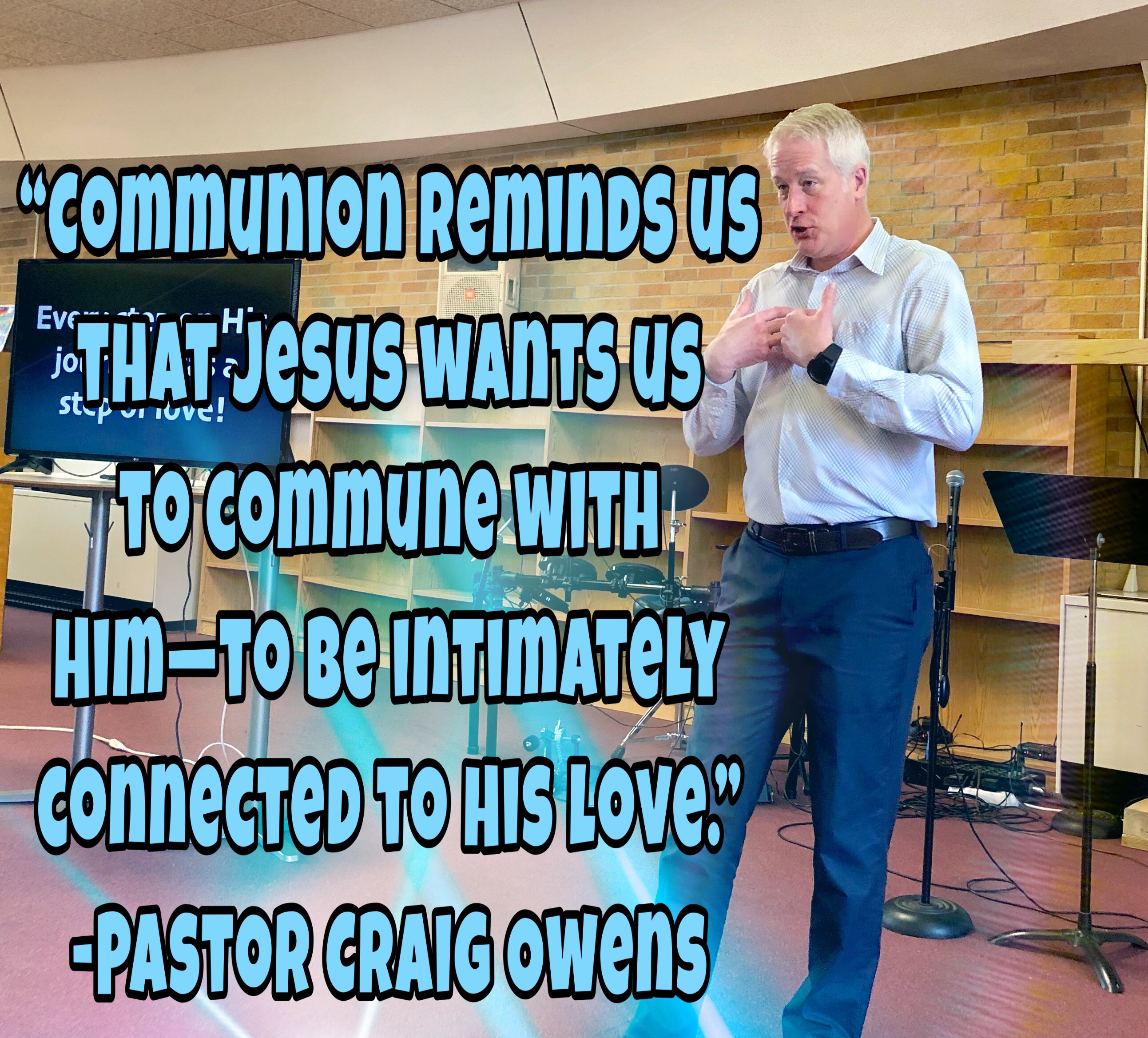
When Jesus ate this last supper with His disciples, He instituted a remembrance celebration that we now call Communion. The root word is “commune” which the dictionary defines as a “conversation with profound intensity and intimacy.” 

This is the type of intimate relationship Jesus had with His Father, and this is the type of relationship He calls us to with Him. The broken bread of Communion reminds us that Jesus can make whole any broken area that would keep us from communing with Him. The cup of Communion reminds us that Jesus can instantly and fully forgive any sin that would keep us from communing with Him. 

Jesus set the example—we are to commune with our Heavenly Father through the way He made by His broken body and His shed blood. It’s out of this communion that we are empowered by His love, and then feel secure enough to serve others in love too. 

Thursdays With Oswald—Spiritual Grit

Oswald ChambersThis is a weekly series with things I’m reading and pondering from Oswald Chambers. You can read the original seed thought here, or type “Thursdays With Oswald” in the search box to read more entries.

Spiritual Grit

     Salvation is God’s “bit,” it is complete, we can add nothing to it; but we have to bend all our powers to work out His salvation. It requires discipline to live the life of a disciple in actual things. “Jesus knowing…that He was come from God, and went to God,…took a towel…and begin to wash the disciples’ feet” [John 13:1, 4]. It took God Incarnate to do the ordinary menial things of life rightly, and it takes the life of God in us to use a towel properly. … And we can do it every time because of the marvel of God’s grace. …  

     A stoot hairt tae a stae brae (i.e. a strong heart to a difficult hill). The Christian life is a holy life; never substitute the word “happy” for “holy.” We certainly will have happiness, but as a consequence of holiness. Beware of the idea that so prevalent today that a Christian must always be happy and bright, “keep smiling.” That is preaching merely the gospel of temperament. If you make the determination to be happy the basis of your Christian life, your happiness will go from you; happiness is not a cause but an effect that follows without striving after it. … 

     There is something in us that makes us face temptation to sin with vigor and earnestness, but it requires the stout heart that God gives to meet the cares of this life. I would not give much for the man who had nothing in his life to make him say, “I wish I was not in the circumstances I am in.” “In the world you will have trouble; but be of good cheer! I have overcome the world” [John 16:33]—“and you will overcome it too, you will win every time if you bank on your relationship to Me.” Spiritual grit is what we need.

From Studies In The Sermon On The Mount

If you have placed your faith in what Jesus did for you on Calvary, and if you have asked the Father to forgive you of your sins, then His Holy Spirit resides in you. 

Therefore, you have all that you need to be successful every single time. The question is: Am I using the spiritual grit that God gives me to be holy? Or am I merely looking for a way to be happy?