God-ability

Listen to the podcast of this post by clicking on the player below, and you can also subscribe on AppleSpotify, or Audible. 

The last time we were together, Pastor Caleb mentioned that I was the only one he knew that put hot sauce on my eggs. But then several of you let him know that you do that too. After the service, someone told me that they like Tabasco sauce on their pizza, which isn’t something I enjoy. 

We all have different tastes. Our tastebuds are just one of the things that makes us unique creations. Unique means one-of-kind, no one else like me. We don’t need to add something like “very unique” because just by itself the word means that God made a once-in-eternity masterpiece when He made you and me. 

It’s a good thing that we are unique. I see what you don’t see, and you see what I don’t see. There are some things I know how to do well, but perhaps you struggle doing them. That’s okay because there are things you can do that I won’t have the opportunity to do. Combined together we saints make an amazing team! 

The apostle Paul understood the value of unique individuals. 

(Check out all of the Scriptures in this post by clicking here.) 

Titus was probably the one who carried Paul’s letter to the Corinthians and then had the responsibility to teach those saints how to carry out what was in the letter (2 Corinthians 2:12-13; 7:6-7, 13-15; 8:6, 16-17). Titus was the pastor that Paul sent to Crete. Paul quoted a poet who said, “Cretans are always liars, evil brutes, lazy gluttons” (Titus 1:12). Titus was confident and bold to stand his ground for what he believed (Galatians 2:1-3). 

Timothy was more soft-spoken and tenderhearted, so Paul had to encourage him more (1 Timothy 4:7, 12), but he was the one who could soothe troubled spots. Timothy stepped in to help behind the scenes (Acts 18:1-5) and he was the one Paul reached out to with his last letter form prison, asking Timothy to come to him (2 Timothy 4:12). 

What a great thing it is to have unique saints in our lives! 

One person—not matter how gifted—cannot do it all. Look at Moses in Exodus 18:13-18. Even an anointed team like the 12 apostles cannot to it all. Look at Acts 6:1-2. 

These leaders recognized the need to other uniquely gifted people to come alongside them. Moses was advised to choose capable men. In other words, those with the ability to judge disputes wisely (Exodus 18:19-25). The apostles chose those who were full of the Holy Spirit and wisdom (Acts 6:3-6). The Greek word for wisdom (sophia) means someone with heaven-sent wisdom that also has the ability to apply that wisdom effectively. 

Israel in the Old Testament and the Church in the New Testament would have been constricted if those other people hadn’t agreed to let their God-given abilities be used. 

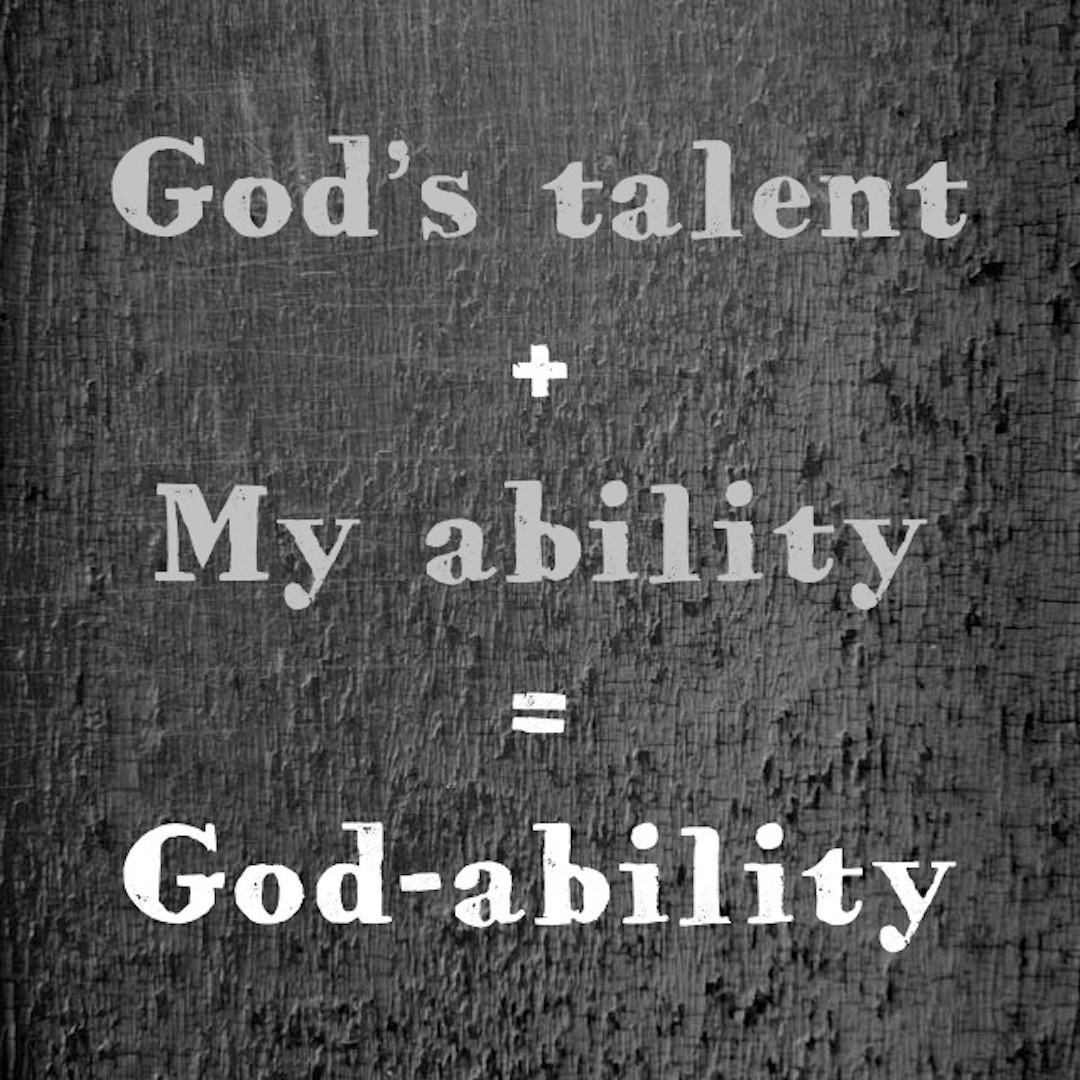
God’s talent + My ability = God-ability

In 2 Corinthians 8-9, Paul is specifically talking about the ability of people to give their offerings to help the growing church, but there is a phrase that I think is appropriate for any application of our gifts: They gave themselves first of all to the Lord (2 Corinthians 8:5). 

When what we do is a cheerful “get to” and not an obligatory “got to” it is noticed by everyone. Those two chapters in 2 Corinthians are filled with words like cheerful, eagerness, and enthusiasm. 

In our Hand2Hand food ministry, some people have…

  • Give-ability to give financially 
  • Shop-ability to find deals
  • Organize-ability to make all the parts work
  • Strength-ability to lift and move 
  • Deliver-ability to get the needed items to those who need them

But none of these work without availability. This is the attitude that makes our God-ability a blessing and not a chore. 

There is a place in ministry for every Christian. When you are available, God will allow the talent that He has given you to be a blessing to the Church. You benefit, the other saints benefit, and the watching world sees a living witness that will draw them to Jesus. 

►► Would you please prayerfully consider supporting this ministry? My Patreon supporters get behind-the-scenes access to exclusive materials. ◀︎◀︎

The Craig And Greg Show: Lead With Empathy

Listen to the audio-only version of this podcast by clicking on the player below, or scroll down to watch the video.

Empathy is an essential trait for leaders, but it’s not innate in any of us. As I joked, “behind ‘mama’ and ‘dada,’ the first word most babies learn is ‘mine.’” The skill of empathy is like a muscle, the more we practice, the stronger it gets. In this episode, Greg and I discuss why empathy is so important for leaders, and give helpful advice on how to remain proficient in your use of empathy.

  • [0:24] Empathy is a powerful leadership skill that underlines so many other leadership skills. 
  • [1:08] Empathy has to be earned.
  • [3:07] What blocks empathy in leaders?
  • [4:02] When you start learning empathy it will feel awkward, but you have to stick with it.
  • [5:06] Empathy ≠ sympathy, but it is caring.
  • [7:07] How do leaders show their empathy to their teammates?
  • [10:10] Here is an example of how to express empathy.
  • [12:22] What lessons can we learn when we misfire on empathy?
  • [14:03] Three things Greg has worked on to enhance empathy.
  • [16:32] Sometimes leaders do for one team member what they cannot do for all.
  • [19:51] Leaders need empathetic eyes, ears, and heart. There is a huge leadership power in this.
  • [21:59] Greg shares an interesting study reported in Forbes.
  • [25:15] One of the most powerful leadership attributes is simply the leader’s availability.

Check out this episode and subscribe on YouTube so you can watch all of the upcoming episodes. You can also listen to our podcast on Spotify and Apple.

The Most Effective Leadership Tool

Listen to the podcast of this post by clicking on the player below, and you can also subscribe on AppleSpotify, or Audible. 

One of the most effective leadership tools is, sadly, one of the tools that is used the least by most leaders. Let’s figure out how to make it work for you.

Check out this episode of The Podcast.

Some resources from this episode:

I shared a clip from a Craig and Greg Show episode. You can check out that full episode here.

The Scripture I referenced is John 10:3-5. I unpack this idea in much greater depth in my book Shepherd Leadership: The metrics that really matter.

My new book When Sheep Bite is available for pre-order!

Here are a bunch of ways to get in touch with me and follow along with other projects on which I am involved

►► Would you please prayerfully consider supporting this ministry? My Patreon supporters get behind-the-scenes access to exclusive materials. ◀︎◀︎

Thursdays With Spurgeon—Useful To The Master

This is a weekly series with things I’m reading and pondering from Charles Spurgeon. You can read the original seed thought here, or type “Thursdays With Spurgeon” in the search box to read more entries.

Listen to the podcast of this post by clicking on the player below, and you can also subscribe on iTunes or Spotify.

Useful To The Master  

In a large house there are articles not only of gold and silver, but also of wood and clay; some are for special purposes and some for common use. Those who cleanse themselves from the latter will be instruments for special purposes, made holy, useful to the Master and prepared to do any good work. (2 Timothy 2:20-21)

     On the vessels of honor, you can see the hallmark. What is the hallmark that denotes the purity of the Lord’s golden vessels? Well, He has only one stamp for everything. When He laid the foundation, what was the seal He put upon it? ‘The Lord knows those who are His, and, everyone who confesses the name of the Lord must turn away from wickedness’ (2 Timothy 2:19). That was God’s seal! That was the impress of the great King upon the foundation stone. Do we find it here? Yes, we do. ‘Those who cleanse themselves from the latter will be instruments for special purposes, made holy, useful to the Master and prepared to do any good work’ (2 Timothy 2:21). Do you see, then, that the man who is the golden or silver vessel departs from all iniquity, and that is the token of his genuine character. …  

     Brethren, I count it an honor to be useful to the meanest child of God, but I confess that the honor lies mainly in the fact that I am thereby serving the Master Himself. Oh, to be used by God! This is to answer the end of our being. If you can feel that God has used you, then you may rejoice indeed! 

     There are some Christians whom the Lord cannot much use because, first of all, they are not cleansed from selfishness. They have an eye to their own honor or aggrandizement. The Lord will not be in complicity with selfish aims! Some men are self-confident—there is too much of the ‘I’ about them, and our Master will not use them. He will have our weakness but not our strength!

From The Great House And The Vessels In It

The Church of Jesus Christ is made up of many members. The Bible uses pictures of a body, a building, and a bride to describe how all of the parts work together to bring strength and vitality to the whole. But Jesus is always the central object: He is the Head of the body, the Chief Cornerstone of the building, the beloved Bridegroom to the bride. 

Everyone in the Church is placed there by God Himself to fulfill a vital role. It is incumbent upon every single Christian to yield themselves to the sanctifying, maturing work of the Holy Spirit so that we can all be “made holy, useful to the Master and prepared to do any good work.” 

Don’t let either the extremes of selfishness of self-abasement limit the good work you were created to do in making the body of Christ, the building of Christ, and the bride of Christ something radiantly God-glorifying!

►► Would you please prayerfully consider supporting this ministry? ◀︎◀︎

Are You Available?

Have you ever had someone walk into your life—even if it was just for a moment—and say something you needed to hear? You might not have liked what they had to say, but it was definitely something you needed to hear. 

My hunch is that those timely messengers were not necessarily “experts” in the area in which they talked to you. They may have been a doctor talking about a medical need, or it may have been a friend talking about some health issues. Most of the time our valuable messengers are just everyday people. 

God loves using “everyday people”! 

  • You don’t have to be a trained pastor to minister to people. 
  • You don’t have to be a trained theologian to tell people what you believe about God.
  • You don’t have to be a trained counselor to encourage someone.

You just have to be who God created you to be. And you have to be available. Like Amos. 

Amos was simply taking care of his farm and his herds when God called him to deliver a timely message to His people.

Amos introduces himself as just one of the shepherds of Tekoa (1:1) and tells another priest that he was simply minding his own business when God said, “Go, prophesy to My people” (7:10-15). 

Amos’ name means burden-bearer—he had a burden for his kinsmen. He saw their sin and knew what defiance of God would mean for them. This burden made him available to hear God’s voice say, “Go.” 

“But I’m not a trained prophet,” Amos could have said. “You are telling me to ‘prophesy’ but all I really know is farming and shepherding.” 

God said, “Say what you know.” 

What did Amos know?

  1. Amos knew God’s voice—In this short book, 43 times(!) Amos uses phrases like says the Lord, declares the Lord, or hear the word of the Lord. 
  2. Amos knew his business—This book is filled with language about sheep and shepherds, farmers and farm equipment, gardens and vineyards. 
  3. Amos knew God had told him “Go and speak” so Amos had boldness. 

You can put your name in all three of those places that say Amos. You can know God’s voice through the Bible, you know your “business” (whether it’s parenting, or coaching, or your own profession), and you can hear God saying, “Go, tell people about Me.” 

God wants to use you for His glory. He just needs your availability. Will you be open to being that person? 

Join me next week as we continue to learn the major lessons from that the minor prophets teach us. 

Poetry Saturday—What Do You Have?

Moses had a staff.
David had a sling.
Samson had a jawbone.
Rahab had a string.
Mary had some ointment.
Aaron had a rod.
Dorcas had a needle.
All were used of God.
What do you have? —Max Lucado, in You!

Very Busy Or Too Busy

Over the last couple of weeks, I’ve been extremely busy. In some ways that’s a good thing: ministry is happening, relationships are developing, business is taking place.

But…

…there’s a danger when very busy becomes too busy.

How do I know I’ve crossed the line? I think this quote from Billy Graham sums it up:

“We hurt people by being too busy. Too busy to notice their needs. Too busy to drop that note of comfort or encouragement or assurance of love. Too busy to listen when someone needs to talk. Too busy to care.”

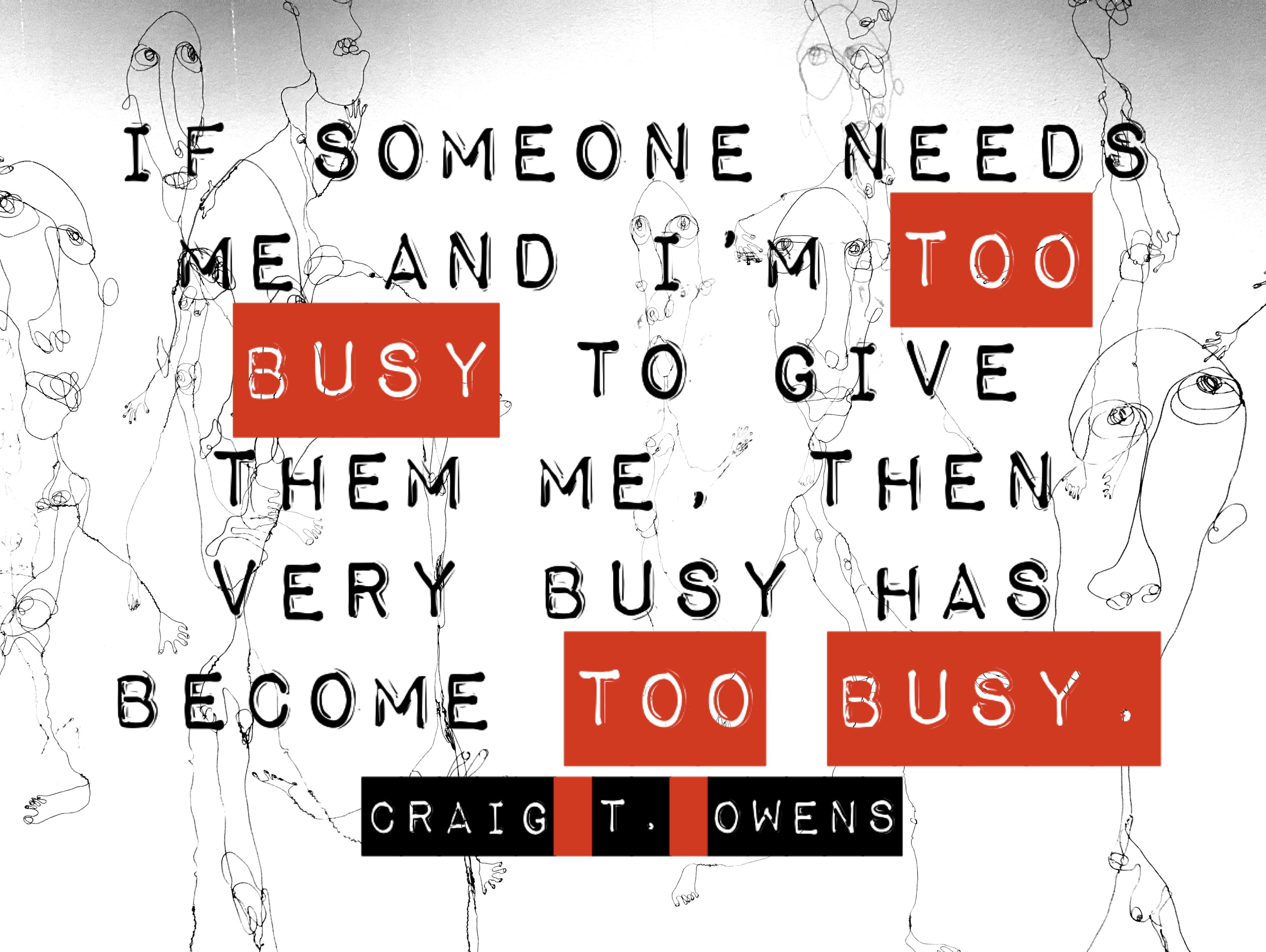
If someone needs me and I’m too busy to give them me, then very busy has become too busy.

How do you know if you’ve gotten too busy?

Yeah, But…

You know the story, or maybe you’ve even seen it portrayed on the big screen, where God appears to Moses in the burning bush. God handpicks Moses to lead His people to freedom. He assures Moses, “I AM the One who is sending you with My authority.” God shows Moses these miracles that He is going to do through him.

And how does Moses respond? “Yeah, but….” Sadly, this is how I usually respond too.

“Yeah, but who am I that You would handpick me?”

  • I don’t have the right credentials.
  • My family is dysfunctional.
  • I’m not comfortable with risk.
  • I’ve never done anything like this before.

“Yeah, but how do I really know this is You, God?”

  • I need a sign.
  • I’ve made mistakes before when I thought I was following You.
  • Have I mentioned I’ve never done anything like this before?

“Yeah, but what if this doesn’t work out?”

  • I need assurance.
  • I want to know where this is going to end up before I get started.
  • What happens next?

“Yeah, but how will I know what to say or do?”

  • I don’t want to look like a fool.
  • I don’t want to be embarrassed.
  • I want to be in control.

It’s interesting to see that God patiently answered all of Moses’ “Yeah, but” questions. It was only when Moses reached the conclusion “You’ve got the wrong guy” that God became angry.

Moses’ first response was his best response: Here I am.

This is what usually happens to me. God calls me to do something or say something for Him, and I immediately say, “Here I am.” Then I begin to think about what I just committed to. It’s then that I come up with all my “Yeah, but” reasons why I can’t be the guy God thinks I am. In other words, I think my way out of God’s plan for me.

Here’s what I need to remember: If God calls me, it’s only because He has already equipped me.

For we are God’s workmanship, created in Christ Jesus to do good works, which God prepared in advance for us to do. (Ephesians 2:10)

No more “Yeah, but” second-guessing, I’m just sticking with “Here I am.”