Anger That Crosses The Line

Last night in our Bible study we looked at some words that David penned when he was angry. He was on the run from his son Absalom, and it seemed like everywhere he turned people were after him, or slandering him, or just doing their best to make him miserable. Yet in two back-to-back Psalms David says, “I lay down every evening and get a great night of rest.”

His sweet sleep comes from a moment of reflection before dozing off. He says:

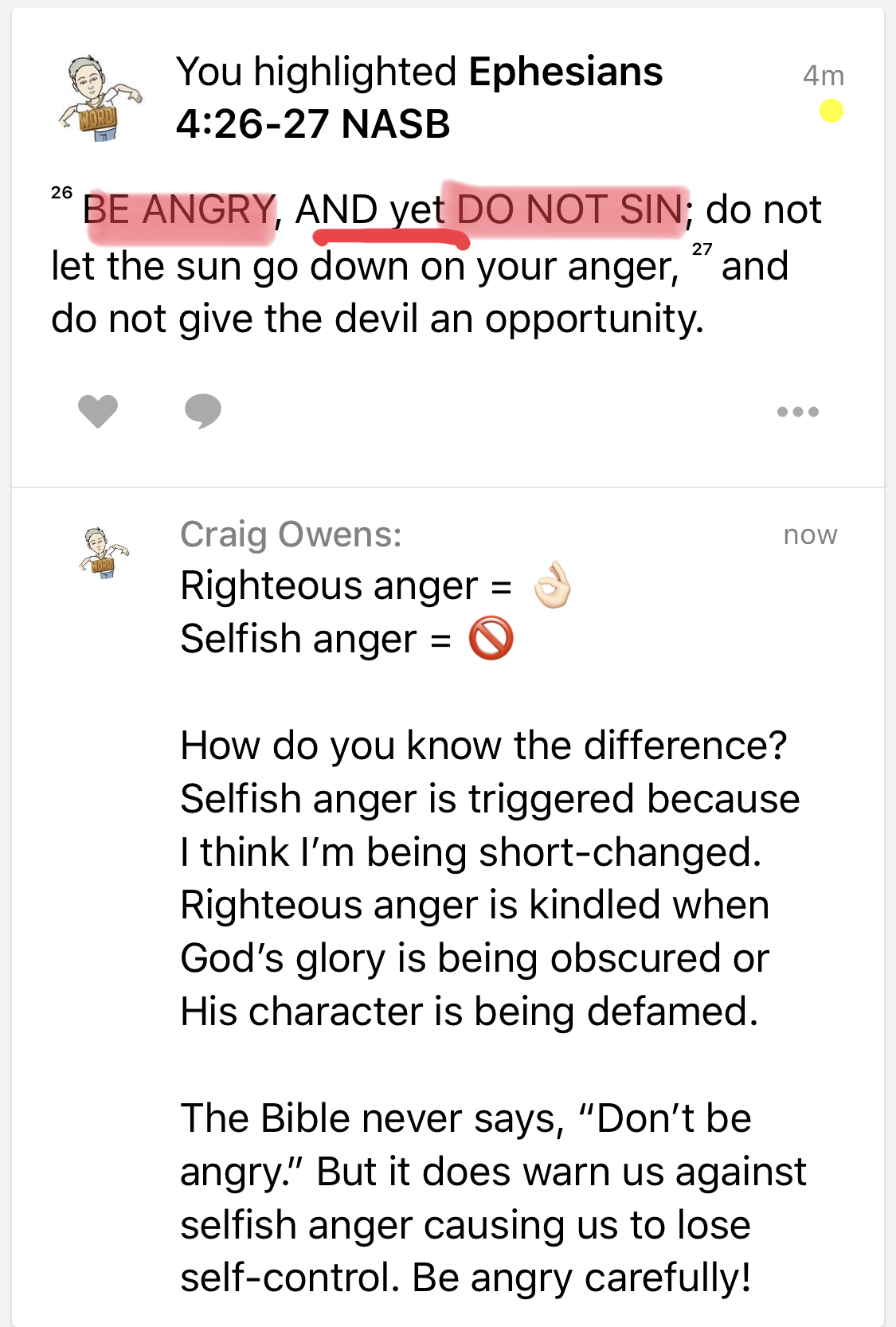
In your anger do not sin; when you are on your beds, search your hearts and be silent. Selah.

  • Did my anger today cross the line into sin?
  • Am I allowing the time for the Holy Spirit to search my heart?
  • When the Holy Spirit points out where my anger crossed the line, do I justify my anger, or am I silent?

How do we know if our anger has not crossed that line and become sin?

Aristotle wrote, “Anybody can become angry—that is easy; but to be angry with the right person, and to the right degree, and at the right time, and for the right purpose, and in the right way—that is not within everybody’s power and is not easy.”

Being angry is not the issue. David said it (and Paul quoted it in Ephesians 4:26): “Be angry; just don’t sin.” God gets angry, but He does not sin. Jesus, in His public ministry, got angry, but He did not sin. We need to search our hearts to make sure our anger has not crossed the line to sin. We have to be angry in a godly way.

I see at least four ways to become angry without crossing the line into sin:

1.  Selfless Anger = anger at sin, but not angry at the sinner.

Love is not rude, it is not self-seeking, it is not easily angered, it keeps no record of wrongs. Love does not delight in evil but rejoices with the truth. (1 Corinthians 13:5, 6)

2.  Slow Anger = lengthen your fuse a bit.

Do not be quickly provoked in your spirit, for anger resides in the lap of fools. (Ecclesiastes 7:9)

My dear brothers, take note of this: Everyone should be quick to listen, slow to speak and slow to become angry, for man’s anger does not bring about the righteous life that God desires. (James 1:19, 20)

Good advice from Thomas Jefferson: “When angry, count to ten before you speak; if very angry, a hundred.”

3.  Protective Anger = when sinners entice others to join them in their sin. God is sad when people leave Him; He is angry at them when they take others with them.

But they put God to the test and rebelled against the Most High; they did not keep His statutes. Like their fathers they were disloyal and faithless, as unreliable as a faulty bow. They angered Him with their high places; they aroused His jealousy with their idols. When God heard them, He was very angry; He rejected Israel completely. (Psalm 78:56-59)

4.  Righteous Anger = against those who are keeping others from coming closer to God.

For I endure scorn for Your sake, and shame covers my face. I am a stranger to my brothers, an alien to my own mother’s sons; for zeal for Your house consumes me, and the insults of those who insult You fall on me. (Psalm 69:7-9)

This verse was recalled by Jesus’ disciples when they saw Him get angry and clear out the Temple in Jerusalem. Jesus was angry because of the religious clutter that was keeping God’s house from being a house of prayer for all nations.

I think everyone is familiar with the acrostic WWJD = What Would Jesus Do?

I’d like to propose something similar: WGGA = Would God Get Angry?

This is a great question to ask to make sure our anger does not cross that line into sin. Get angry—in a godly way—and do not sin.

A Slight Case Of The “Ites”

As the Israelites were attempting to settle in the Promised Land, there is a repeated phrase, “They could not drive out the ites.” (The “ites” are people like Canaanites, Hivites, Jebusites, etc.) God told them that they should completely clear the land of the ites, but they didn’t. Instead, they just subjected them to forced labor.

Oops! These small ites eventually became the downfall of Israel. The ites continued to practice their pagan worship observances, and eventually enticed the people of Israel to join them. As a result, Israel was humiliated, defeated, and carried off into captivity.

Can I make a parallel to our lives?

The Promised Land is a Christ-follower’s life in Christ. The ites are our sinful tendencies.

I know the ites are there, but it seems so difficult to remove them: the Bible uses the phrase they were determined to live in that land. So the ites are allowed to coexist, and I determine to use my willpower to make sure they stay contained.

After awhile the ites have behaved themselves. They seem harmless enough. In fact, I’ve gotten so strong, so mature, in my Christian faith, I know I’ll never give in to the pull of the ites again. I can relax a little bit now.

But the ites wait. They bide their time. They find just a crack to slowly worm their way in. Then when I am at a vulnerable time, they strike. The slave becomes the master. The ites retake possession of my life.

Willpower will not work. Only complete elimination will work.

God will help you if you will let Him.

  • What ites are you trying to hold down by sheer willpower?
  • What ites do you tolerate now that you didn’t tolerate earlier in your faith walk?
  • Do you think you are immune to some ites now that you are more mature?

The Bible’s warning is loud and clear:

These are all warning markers—danger!—in our history books, written down so that we don’t repeat their mistakes. Our positions in the story are parallel—they at the beginning, we at the end—and we are just as capable of messing it up as they were. Don’t be so naive and self-confident. You’re not exempt. You could fall flat on your face as easily as anyone else. Forget about [willpower]; it’s useless. Cultivate [God-power].

A slight case of the ites is a serious thing! Don’t let it continue!

Standing On A Promise

Just before Joshua’s farewell address to the Israelites, he makes one final comment to sum up the whole campaign that secured Israel’s borders—

Not one of all the Lord’s good promises to the house of Israel failed; every one was fulfilled.

Every one.

You can trust God! You can stand on His promises. They will not fail; they will all be fulfilled.

Dr. Robert Lockyear estimates that there are 7,457 promises of God in the Bible!

Which one are you standing on today? Get into God’s Word, and let His promises get into you. Write them down. Memorize them. Repeat them again and again. Believe that not one of all the Lord’s good promises will fail.

Here are a few you can stand on:

  • He forgets your forgiven sins.
  • He will give you abundant life now, and eternal life later.
  • Nothing can separate you from His love.
  • All things are working together for the good for those who love God.
  • He will never leave or forsake you.
  • He will continue to develop the best in you.
  • He will never place you in a situation where you cannot stand.

(check out all of the biblical references for these promises by clicking here)

“We take away from this most precious promise, and, by refusing to take it in its fullness lose the fullness of its application and power. Then we limit God’s power to keep: we look at our frailty more than His omnipotence. Where is the line to be drawn, beyond which He is not ‘able’? Why should we pare down the promises of God to the level of what we have hitherto experienced of what God is ‘able to do,’ or even what we have thought He might be able to do for us? Why not receive God’s promises, nothing doubting, just as they stand?” —Frances Ridley Havergal

What promise are you standing on today?

Flight Is Your Best Fight

Listen to the podcast of this post by clicking on the player below, and you can also subscribe on AppleSpotify, or Audible. 

He was ripped and he was handsome. She was lonely and she was hungry. He followed God and she gave lip-service to the numerous gods of Egypt. He was Joseph and she was Potiphar’s wife. He was in charge of all of Potiphar’s household and she was attracted to that power.

A pretty heady place for Joseph to be. Think about it, guys, how would you feel? You’re good looking, successful, and the object of some babe’s desire. What are you going to do with all of that?

Do you know what Joseph did? He ignored her to the point of almost being rude:

And though she spoke to Joseph day after day, he refused to go to bed with her or even be with her.

Or even be with her is a rude phrase. It means she was doing everything she could think of to bring him to her, and he was thwarting her at every turn:

  • She walked into a room; he walked out.
  • She planned her path to run into him; he went out of his way to change his route.
  • She smiled; he kept a straight-faced.
  • She flirted; he ignored.
  • She was persistent; he was consistent.

There are many temptations the Bible tells us to fight. But there are two that we’re advised to flee: idolatry and sexual immorality.

Joseph chose fleeing over fighting.

Solomon said, “When you know what that sort of woman is up to, don’t even walk down her street.”

Talk to Wisdom as to a sister. Treat Insight as your companion. They’ll be with you to fend off the Temptress—that smooth-talking, honey-tongued Seductress.

Jesus said, “Don’t even entertain any thoughts about that kind of woman.”

From this type of temptation, your best fight is flight.

Guys, be like Joseph: stay away, take a different path, don’t smile at the flirty jokes, don’t hang out at her desk, don’t treat her politely. RUN AWAY.

Flight is your best fight against sexual temptation.

►► Would you please prayerfully consider supporting this ministry? My Patreon supporters get behind-the-scenes access to exclusive materials. ◀︎◀︎

Spurred On

There are times when it’s not so nice to have someone behind me who is pushing me forward. Like when I’m standing in the check-out line at the grocery store. After all, I can only go as fast as the person in front of me, right? So I start to have this imaginary conversation with the shopper behind me, “Look, you can nudge and prod and bump me all you want, but I can’t go any faster.”

But it’s a whole different story when the way in front of me is wide open. Now my imaginary conversation changes, “Okay, here we go! You’re nudging and prodding is really going to make me fly now!”

I think this is might have been what the Apostle Paul was thinking when he wrote, “Follow me as I follow Christ.” In essence, it was a thank you note to those behind him, “Thank you for spurring me on to preach better, teach better, live better, be better.”

Here’s what Jesus did for us: He was spurred on both by those of us who would be following Him and by the calling of His Heavenly Father. We do this by keeping our eyes on Jesus, the champion who initiates and perfects our faith. Because of the joy awaiting Him, He endured the Cross, disregarding its shame. Now He is seated in the place of honor beside God’s throne.

So Paul said he could follow that example in his own life. Not that I have already obtained all this, or have already been made perfect, but I press on to take hold of that for which Christ Jesus took hold of me. Brothers, I do not consider myself yet to have taken hold of it. But one thing I do: Forgetting what is behind and straining toward what is ahead, I press on toward the goal to win the prize for which God has called me heavenward in Christ Jesus.

I’m in awe of what God has called me to do.

I’m grateful for the way Jesus has opened up the way for me.

I’m thankful for those who spur me on every day. Especially my family and my congregation. You make me want to preach better, teach better, live better, be better. Thank you!

Who’s spurring you on?

Grown Up Love

Listen to the podcast of this post by clicking on the player below, and you can also subscribe on AppleSpotify, or Audible. 

My workspace in my office and even the portable office of my backpack is filled with special reminders. I have gifts from missionaries, mementos from coworkers, and souvenirs from friends. But my most precious treasures are those handmade expressions of love from my kids. They might be simple bookmarks or more elaborate statues, but they are from my kids just for me. I wouldn’t trade the world for them.

These gifts remind me how blessed I am to be loved as Daddy, and “love reminders” are good for anyone at any age.

What would happen, though, if my 15-year-old was still giving me gifts that looked like the gifts he gave me when he was a budding 5-year-old artist? What if my daughter’s gifts looked the same when she was 21-years-old as they did when she was a preschooler? Wouldn’t we say that there might be a developmental problem?

The great love chapter of the Bible contains this line:

    When I was a child, I talked like a child, I thought like a child, I reasoned like a child. When I became a man, I put childish ways behind me. (1 Corinthians 13:11)

Love is supposed to grow up.

In other words, my expressions of my love toward others should be maturing. So here are some questions I am asking myself:

  • Do I express love to God the same way I did as a “baby” Christian? Or are my expressions maturing?
  • Do I tell my wife I love her the same way I said it all those years ago when we first got married? Or am I finding new ways to say it?
  • Do I express my love to all of my kids the same way? Or am I learning each of their unique love languages?

Let me ask you a question too: Is your love—and the expression of your love to others—growing up?

Take some time to ponder that question, and then make any grown-up changes that need to be made so that your love continues to mature.

►► Would you please prayerfully consider supporting this ministry? My Patreon supporters get behind-the-scenes access to exclusive materials. ◀︎◀︎

The Importance Of Purity

Yesterday I read the Family Resource Council’s report about the devastating effects of pornography. Some highlights (or should I say “lowlights”?):

  • Married men who are involved in pornography feel less satisfied with their conjugal relations and less emotionally attached to their wives.
  • Pornography use is a pathway to infidelity and divorce and is frequently a major factor in these family disasters.
  • Pornography viewing leads to a loss of interest in good family relations.
  • Pornography is addictive.
  • Men who view pornography regularly have a higher tolerance for abnormal sexuality, including rape, sexual aggression, and sexual promiscuity.
  • Prolonged consumption of pornography by men produces stronger notions of women as commodities or as “sex objects.”
  • Child-sex offenders are more likely to view pornography regularly or to be involved in its distribution.

This is the reason my wife and I stress purity so highly with our children. Betsy is going through Every Young Woman’s Battle with our daughter, and I’m using Every Young Man’s Battle with our sons.

There are only two battles that Scripture consistently warns us to flee from: idolatry and sexual promiscuity. We cannot stress purity enough, and it’s never too early (or too late) to talk to your kids about this.

Hey, parents, don’t let their peers have the loudest voice in your kids’ ears about sexual standards. You help them set godly standards. And do it now.

Learning Tough Lessons

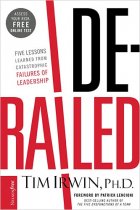
In my role as a book reviewer, I am presently reading Derailed. This book has really jolted me wide awake!

Dr. Tim Irwin is walking through the profiles of six high-profile business leaders who got derailed on their path to success. These CEOs seemed to have everything: talent, opportunity, great ideas, a proven track record of success. In short, everything they would need to be successful.

Yet they got derailed.

Here’s the wake-up call for me: The same thing can happen to me. The Apostle Paul wrote his own “derailed” story about the Israelite leaders:

These are all warning markers—danger!—in our history books, written down so that we don’t repeat their mistakes. Our positions in the story are parallel—they at the beginning, we at the end—and we are just as capable of messing it up as they were. Don’t be so naive and self-confident. You’re not exempt. You could fall flat on your face as easily as anyone else. Forget about self-confidence; it’s useless. Cultivate God-confidence.

I don’t want to get derailed, so I’m focusing on God-confidence today.

Life On Life

In my remarks at the funeral in which I was officiating on Wednesday, I quoted the great Green Bay Packers coach Vince Lombardi. He was reportedly addressing a couple of under-performing players when he said, “When all’s said and done, usually more is said than done.” In other words, don’t talk about what you’re going to do, just do it.

One of my passions is to mentor and equip other people to do great things. I’ve found that the best way to do this is not to just talk about what they should be doing, but to step into their life and do those things with them—to do more than I say.

This life-on-life mentoring is challenging but so incredibly rewarding. The Apostle Paul wrote, “Follow me as I follow Christ. C’mon, let’s pursue this relationship with Jesus together. I’m going to keep you close to me so that you can look in on what I’m doing, and I’m going to be right here for you too. Let’s draw closer to Jesus together” (see 1 Corinthians 11:1)

I love the one-on-one times with my kids … brainstorming with the young leaders-in-training at church … having challenging conversations with an accountability friend … opening our home to a young single mom. These interactions keep me focused on staying as close to Christ as I can. Because if I lose sight of Him, so might the others who are connected with me life-on-life.

It’s pretty hard to say, “Follow me while I do my own thing.” So I’m redoubling my efforts to stay close to the Master today.

Pursuing

“They followed worthless idols and became worthless themselves” (Jeremiah 2:5).

Simple principle: I become what I pursue.

Pursuing things that will not last into eternity is worthless, and the pursuit of them will make my life worthless too. Allow me to elaborate with a few modified quotes:

“For where your [pursuit] is, there your heart will be also” (Jesus).

“All [pursuits] that are not eternal are eternally useless” (C.S. Lewis).

“But more than anything else, put God’s [pursuits] first and do what He wants” (Jesus).

“The impulse to [pursue] God originates with God, but the outworking of that impulse is our following hard after Him; and all the time we are [pursuing] Him we are already in His hand” (A.W. Tozer).

“But on the judgment day, fire will reveal what kind of work each of us has [pursued]. The fire will show if a person’s [pursuit] had any value” (Paul).

“The true worth of a man is to be measured by the objects he [pursues]” (Marcus Aurelius Antoninus).

“I love those who love Me, and those who [pursue] Me always catch Me” (God).

“‘Tis the business of little minds to shrink; but he whose heart is firm, and whose conscience approves his conduct, will [pursue] his principles unto death” (Thomas Paine).

As each week wraps up, I’m trying to remember to ask myself, “Did I pursue the right things this week? Were my pursuits eternal and God-honoring?” Good questions. Perhaps you could take some time to assess your pursuits too.

Remember, you will become what you pursue, so pursue wisely.