In January 1647, Oliver Cromwell captured King Charles I during the British Revolution. Within just a few months, Charles escaped and was able to raise another army. A year later, in August 1648, Cromwell’s forces once again defeated the army Charles had raised, and once again Charles was taken prisoner.
Oliver Cromwell put Charles on trial for his crimes, and after the guilty verdict was pronounced, Charles I was executed. A total of 59 people signed the former king’s death warrant.
Fast forward eleven years and Oliver Cromwell had died and his son Richard had taken his place as Lord Protector of England. Unlike his father, there was great discontent with Richard’s leadership. As a result, the Loyalists were able to sweep Charles II into power.
After assuming the throne of England, Charles II wanted the 59 death warrant signers put on trial, but fifteen of them had already died. That little fact didn’t stop King Charles II. He ordered that their bodies be exhumed, placed on trial, convicted of their crimes, and then hung.
I’m no psychologist, but I think it’s safe to say that Charles II might have had a slight problem with unforgiveness!
This is from a chapter I entitled “The ties that no longer bind.” The insidious nature of unforgiveness is that it ties us to the one who injured or offended us.
Jesus taught us to pray, “Forgive us our debts, as we also have forgiven our debtors” (Matthew 6:12). The word He uses for “debts” means something justly or legally due, or an offense or sin that has been committed. So a debtor is one who morally or legally owes another for the wrong committed.
So for these debts, we are taught to ask for forgiveness of God and to give that same forgiveness to others. Jesus uses the same root word for both “forgive” and “forgiven,” but there are nuances that make the picture quite clear.
When we ask God to forgive our debts, it is the active voice (I have to ask for it) and it is stated in the second person (I have to receive it). When I ask my Heavenly Father for this, my offense has been paid-in-full because the legal and moral requirements aren’t due any longer. I couldn’t pay this debt on my own, but Jesus paid it for me (2 Corinthians 5:21).
When I forgive someone who has wronged me, it is again the active voice (I have to give it), but it is now in the first person (I don’t wait around for the other person to ask for forgiveness). I let it go. I don’t hinder the other person or myself with waiting for the penalty to be paid any longer.
This is the only part of this model prayer for which Jesus gives a commentary afterwards (in Matthew 6:14-15). With this, Jesus is teaching us that to say, “I’m forgiven” is also to say, “I’m forgiving.”
Unlike Charles II, when we are forgiven and forgiving, the inevitable result is freedom for both ourselves and our offenders.
If we practice this relentlessly, we are both freed ourselves and freeing others!
When we pray, “Forgive as we also have forgiven,” we are both acknowledging His power to forgive us and requesting the faith need to be forgiving people. As C.S. Lewis noted, “To be a Christian means to forgive the inexcusable, because God has forgiven the inexcusable in you.”
The Bible describes satan’s activity as stealing, killing, and destroying. He’s called the father of lies, so he uses slander to try to steal, kill, and destroy. His slander is: “God can’t forgive that” and “You shouldn’t let them off the hook for what they did to you.”
These two thoughts are linked, just as “I’m forgiven” and “I’m forgiving” are linked. If I begin tothink that what someone did to me was too big for me to forgive, then I can also believe that there is a sin I have committed that is too big for God to forgive. But when I live both receiving and giving forgiveness, I can tune out this lie from hell.
Our anxiety is usually tied to our insecurity about our needs being met. Philippians 4:6-7 counsels us to turn those anxieties into prayer. It’s not what we can provide for ourselves, but trusting what our Heavenly Father has already provided for us. Check out this amazing series on prayer. I have lots of new content every week, which you can check out on my YouTube channel.
A recent post at the Institute for Creation Research says, “despite popular perception, the impact theory of dinosaur extinction has problems and is still a source of contention among even conventional scientists.” In fact, “Despite uniformitarian claims to the contrary, these rocks and fossils are best explained by the Genesis Flood that covered the earth about 4,500 years ago. All the air-breathing, land-dwelling creatures outside the Ark perished. However, the representatives of these animals that God brought on board the Ark, including dinosaurs, survived, reproduced, and spread across the Earth after the Flood. Many ancient peoples wrote about and described what appear to be dinosaurs, even though they called them by other names, e.g., dragons. In the creation Flood model, impacts may have hit the earth during the Flood, but none of them caused the dinosaurs to go extinct.” This article is a good overview of the geological and paleontological evidence that supports the biblical account of the Flood.
“Scripture teaches us that there are two points of view from which we may regard Christ’s death upon the Cross. The one is the redemption of the Cross: Christ dying for us as our complete deliverance from the curse of sin. The other, the fellowship of the Cross: Christ taking us up to die with Him and making us partakers of the fellowship of His death in our own experience. … O Christian, when the world crucified Christ, it crucified you with Him, when Christ overcame the world on the Cross, He made you an overcomer too. He calls you now, at whatever cost of self-denial, to regard the world, in its hostility to God and His kingdom, as a crucified enemy over whom the Cross can ever keep you conqueror. What a different relationship to the pleasures and attractions of the world the Christian has who by the Holy Spirit has learned to say: ‘I have been crucified with Christ;…[the crucified] Christ lives in me!’ (Galatians 2:20).” —Andrew Murray
Sullivan and Addie Chainey were both deaf, but that didn’t stop them from becoming premier missionaries in the Assembly of God fellowship. Their work with other deaf people was amazing! I love this concluding thought in this short biography of their ministry work: “The Chaineys’ story testifies that God can empower those who are marginalized in society to do redemptive work in their own communities and beyond.”
“Earth, I think, will not be found by anyone to be in the end a very distinct place. I think earth, if chosen instead of Heaven, will turn out to have been, all along, only a region in Hell: and earth, if put second to Heaven, to have been from the beginning a part of Heaven itself.” —C.S. Lewis, in The Great Divorce
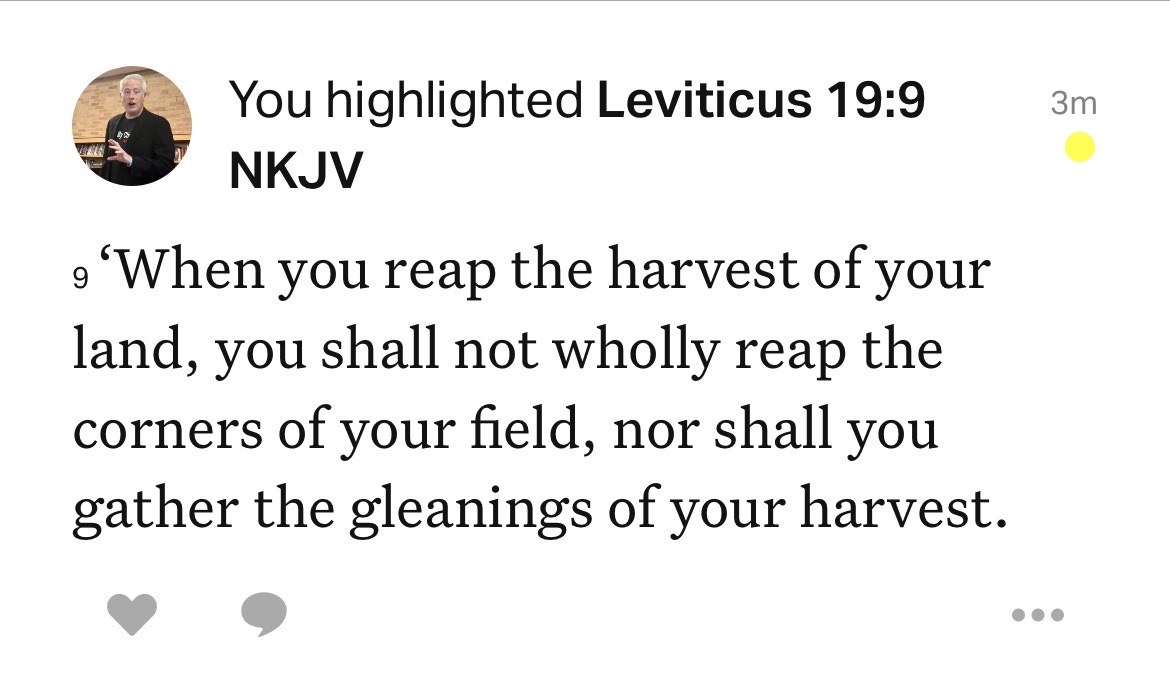
Years later, Boaz was obeying this commandment in Leviticus 19:9. That allowed Ruth to be in his field, which led to a marriage that began the family line of King David, which traces all the way to Jesus! Obedience matters. Just imagine if Boaz had been disobedient in this. The Messiah still would have come, but Boaz and Ruth (and their children and grandchildren) would have missed out on this blessing.
Listen to the audio-only version of this podcast by clicking on the player below, or scroll down to watch the video.
As leaders, we are called to set the example for our organization. As Greg and I discuss in this episode, the quickest way to make a positive change in your organization is to exhibit the traits you want to see. Do that with consistency, and your team will begin to reflect those traits back to you.
[0:00] Welcome to our new studio!
[1:06] The way a leader leads influences the way the team follows.
[3:03] A leaders team will reflect the attitude they exhibit.
[5:53] Leaders need to constantly be interacting with their team to “check the pulse.”
[7:13] Recognizing innovation in your team is a compliment to your leadership.
[9:10] If there’s a trait we want our team to embody we must exhibit it first.
[10:20] If you don’t recognize potential in teammates you will always hire low-potential individuals.
[13:04] Consistency is important to how a leader reflects values.
[15:13] Leadership vs Bossing
[17:10] Jesus set an example for us of servant leadership.
[18:26] At some point your team will test you to see if what you’re saying is real.
[22:06] If you’re going through a difficult time, a coach can help you navigate. We would love to help you!
Check out this episode and subscribe on YouTube so you can watch all of the upcoming episodes. You can also listen to our podcast on Spotify and Apple.
Listen to the podcast of this post by clicking on the player below, and you can also subscribe on Apple, Spotify, or Audible.
I think it’s safe to say that most of us would feel much more secure if we knew exactly where life was taking us. That way, perhaps we could be ready for what lies ahead. It would certainly help to decrease our anxiety if we knew we were ready for what was coming next.
In Luke 19, Jesus is on the path toward Jerusalem and Calvary. And in just a 5-verse section, the word “ahead” is used three times.
First, we read that Jesus “went on ahead” toward Jerusalem (v. 28). He knew exactly what was awaiting Him there; in fact, He had told His disciples numerous times the precise details of what was ahead. Even though His experience was going to be excruciating, for the joy that was even further ahead (see Hebrews 12:2), Jesus persevered.
Next we read that Jesus sent two of His disciples “to the village ahead of you” to retrieve the donkey colt that was awaiting Him (v. 30). What is unspoken here is that Jesus had obviously spoken to the colt’s owners aheadof time about what He would require.
Finally, we read that those two disciples “who were sent ahead” found everything just as Jesus had said it would be (v. 32).
I find this to be so comforting! What all of this means is:
I never walk an unknown path!
Jesus has already walked this path, and is fully aware of all that is ahead of me.
Jesus has already spoken to others aheadof time to help resource me along this path.
Phillip Keller pointed out, “Sheep are notorious creatures of habit. If left to themselves, they will follow the same trails until they become ruts; graze the same hills until they turn to desert wastes; pollute their own ground until it is corrupt with disease and parasites. … No other class of livestock requires more careful handling, more detail direction, than do sheep.” So Keller explains how good shepherds visit paths and pasturing areas ahead of time to make sure they know how to lead their sheep.
David gives us these reassuring words about our Good Shepherd: “He guides me in paths of righteousness for His name’s sake” (Psalm 23:3).
Listen to the podcast of this post by clicking on the player below, and you can also subscribe on Apple, Spotify, or Audible.
Jesus is teaching us to pray as citizens of the Kingdom of Heaven, and each phrase of this prayer is a reminder of how we interact with the King of Heaven—Our Father in Heaven, hallowed be Your name. Your Kingdom come, Your will be done on earth as it is in Heaven.
We all have a desire to feel secure—to feel our needs are going to be met. In fact, our anxiety level is usually tied directly to how insecure we may feel. The problem for many of us, however, is that we have mistaken wants for needs, and when those aren’t met as we think they should be, we again experience increasing levels of anxiety.
We see this on full display in Luke 12. First, Jesus addresses a man who is greedily desiring his share of his father’s inheritance. Jesus says, “Life does not consist in an abundance of possessions.”
To illustrate this point, Jesus tells a parable of a rich landowner who harvested more crops than he knew what to do with—a harvest which he calls “plenty.” His solution was to build bigger barns for his abundant harvest, to which God announced, “You fool” (Luke 12:13-21).
This man was not called a fool because he was successful. He was not called a fool because he had plenty. Rather, he was called a fool because his “plenty” caused him to forget his heavenly Father.
This is an invaluable lesson. Sadly, we tend to be a very forgetful people!
After God delivered His people from their bondage in Egypt, and they almost immediately start worrying and then complaining about whether their needs will be supplied. God tells them that He will supply every day exactly what they need (Exodus 16:1-35).
This provision of manna every single morning when they got up was intended to keep them reliant on God and thankful for His provision. But after a while they thought they deserved more—they wanted plenty (Numbers 11:4-6). Later on, Asaph would pinpoints the main culprit of the Israelites’ stumbled throughout their history: forgetfulness (Psalm 78:11, 22-25).
Jesus taught us to come to God in prayer as Our Father. Just as Jesus was daily dependent on His Father, so He teaches us to have that same level of daily abiding.
Jesus reminds us what the daily supply of manna really signified; namely, that He would be our Bread from Heaven for all of eternity (John 6:28-40)!
So that’s why we pray, “Give us today our daily bread.” Once again, this is an acknowledgement that no one else can provide for us, and it is a request that we would stay daily dependent on Him. It’s not, “Give us today our weekly bread.” Or, “Give us today our daily wants.” Or even, “Give us today plenty of things.”
We need our Father for daily bread so that we never, ever forget or vital, indispensable connection to Him!
Even when we don’t have plenty, we are told not to worry but instead to look to our Heavenly Father for His daily supply (Luke 12:22; Philippians 4:6-7).
Stop praying to yourself! God isn’t impressed with your “powerful” prayer! Jesus tells an interesting story about two men: one thought very highly of his spiritual status and the only could barely lift his eyes. Jesus said that the proud man’s prayer received no help from God, but only the humble man’s prayer was heard. This is a short clip from my series called Kingdom Praying. I have lots of new content every week, which you can check out on my YouTube channel.
“If the fetus gets in the way, ditch it. If the old person gets in the way, ditch it. If you get in the way…” —Francis Schaeffer
“The god of convenience, ruling capriciously in the hearts of men and women, and supported by worshipers of the god of wealth—greedy, self-interested profit-takers in the guise of abortionists and abortion-rights advocates—is the putative lord of life and death where children in the womb are concerned. …Christians must insist that all political candidates seeking their support, at whatever level of government, be firm in their commitment to resist the present abortion regime and expose the lie of the pro-choice agenda by every available means. …The Law of God is holy and righteous and good. Abortion is unholy, unrighteous, and evil. If we want a just and loving society, we will worship God and obey His Law, and we will work to dethrone the god of convenience and to expose the folly and self-interest of all its followers. And we will look to God to explain the nature, meaning, and value of all lives.” —T.M. Moore
Elihu is angry at Job “because he justified himself before God.” Better stated: “Job was more concerned about justifying himself—making himself look good—than he was about making God look good.” Elihu is angry at Job’s three friends because they acted like God and pronounced a guilty verdict against Job. Elihu is righteously provoked. After holding his tongue for 31 chapters, he cannot remain silent any longer!I conclude that Elihu is righteous in his response because God doesn’t have anything negative to say to or about Elihu (as He does with the three friends) at the end of the Book of Job.
Long before the term “fake news” made it into our lexicon, Charles E. Robinson wrote an article in 1934 “as a solemn warning to all Christians” about the rising tide of anti-Semitism. He was especially upset about a book that made an erroneous case blaming Jews for global economic and political turmoil. I am thrilled with the strong spiritual and intellectual legacy in the Assembly of God fellowship!
“There’s a lot of blood, sweat and guts between dreams and success.” —Paul Bear Bryant
Listen to the podcast of this post by clicking on the player below, and you can also subscribe on Apple, Spotify, or Audible.
Pastors are called to be shepherd leaders. Karl Vaters points out that some pastors get caught up in “the green room syndrome” that disconnects them from their sheep.
Here is another clip from The Church Lobby Podcast where Karl and I talk about this.
The biblical passage I reference in this interview is John 10:1-16.
Check out other parts of my interview on The Church Lobby podcast here. Or check out the full conversation Karl and I had on The Church Lobby podcast here.
Get more information on Shepherd Leadershiphere. And pre-order my newest book When Sheep Bitehere.










 Craig T. Owens