Happy Birthday, Mr. Lincoln

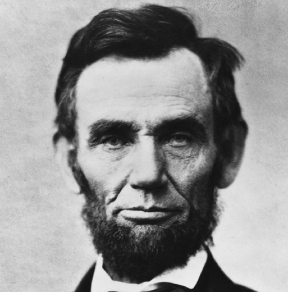
Abraham LincolnToday is Abraham Lincoln’s birthday. What an amazing man he was! Long before he became president of the United States, he had prepared himself to be a first-rate man at whatever he was going to do. How blessed we as a nation are to have a man worthy to be called “the savior of the Union” come into office at the time he did!

In honor of President Abraham Lincoln’s birthday, here are a few quotes and anecdotes from my files.

When he was a boy in Indiana, Lincoln borrowed a book about George Washington from a neighbor, Josiah Crawford. After rainwater ruined it, he went straight to Crawford, owned up to what had happened, and spent three days in Crawford’s cornfield working to pay for the book.

“I’ll prepare myself and be ready for opportunities as they come.” —Abraham Lincoln

When Lincoln was a young storekeeper in New Salem, Illinois, he accidentally shortchanged a customer by six and a quarter cents. As soon as he discovered the error, he closed the shop and walked six miles to pay the money back. Lincoln’s store was not a success. He and his partner, William Berry, went into debt trying to make a go of it. The store “winked out” anyway, as Lincoln put it, and left him owing a great deal of money, especially after Berry died. He could have done what so many others in similar situations did—simply head west for new frontiers and leave the debt behind. But he resolved to stay. For a young man of his means, it was a large burden. He called it, with grim humor, his “national debt.” It took him several years, but he paid it all back. 

“I have been driven many times upon my knees by the overwhelming conviction that I had nowhere else to go. My own wisdom and that of all about me seemed insufficient for that day.” —Abraham Lincoln

“That the Almighty does make use of human agencies and directly intervenes in human affairs is one of the plainest statements in the Bible. I have had so many evidences of His direction, so many instances when I have been controlled by some other power than my own will, that I cannot doubt that this power comes from above.” —Abraham Lincoln 

“The possibility that we may fail in the struggle ought not to deter us from the support of a cause we believe to be just.” —Abraham Lincoln

Horace Greeley, writing in the New York Tribune, wrote: “Never before did one so constantly and visibly grow under the disciplines of incessant cares, anxieties, and trials. The Lincoln of 1862 was plainly a larger, broader, and better man than he had been in ’61, while ’63 and ’64 worked his continued and unabated growth in mental and moral stature.” 

“It is more pleasing to God to see His people study Him and His will directly than to spend the first and chief of their efforts attaining comfort for themselves.” —Abraham Lincoln

“I destroy my enemies when I make them my friends.” —Abraham Lincoln 

“Surely God would not have created such a being as man to exist only for a day! No, no, man was made for immortality.” —Abraham Lincoln

Abraham Lincoln once turned down a job applicant citing, “I don’t like his face.” One of his Cabinet members let the President know that he didn’t think this was an adequate reason for turning down an applicant. To which Lincoln replied, “Every man over forty is responsible for his face.” 

“If often requires more courage to dare to do right than to fear to do wrong.” —Abraham Lincoln

“I remember my mother’s prayers and they have always followed me. They have clung to me all my life.” —Abraham Lincoln

“Die when I may, I would like it to be said of me, that I always pulled up a weed and planted a flower where I thought a flower would grow.” —Abraham Lincoln

How To Handle Persecution

Have you ever been persecuted for your faith in Jesus Christ? The dictionary defines it this way—

(1) To pursue with harassing or oppressive treatment, especially because of religion, race, or beliefs; harass persistently; (2) To annoy or trouble persistently.

I think we in the west don’t truly understand persecution, but certainly there have been times when people are harassing us or troubling us because of our faith in God.

If you are being persecuted, that is cause for rejoicing! 

Check out these passages from the apostle Peter and from Jesus, and then take a look at the flowchart below—

But even if you suffer for doing what is right, God will reward you for it. So don’t worry or be afraid of their threats. Instead, you must worship Christ as Lord of your life. And if someone asks about your Christian hope, always be ready to explain it. But do this in a gentle and respectful way. Keep your conscience clear. Then if people speak against you, they will be ashamed when they see what a good life you live because you belong to Christ. Remember, it is better to suffer for doing good, if that is what God wants, than to suffer for doing wrong! (1 Peter 3:14-17)

God blesses you when people mock you and persecute you and lie about you and say all sorts of evil things against you because you are My followers. Be happy about it! Be very glad! For a great reward awaits you in Heaven. And remember, the ancient prophets were persecuted in the same way. (Jesus in Matthew 5:11-12)

Persecution flowchart

(Click the picture for a larger view.)

Whether you are being persecuted or not, rejoice! and remember to pray for your fellow brothers and sister in Christ who are also being persecuted (Hebrews 13:3).

Draw The Circle (book review)

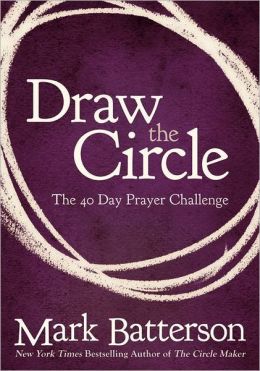
Draw The CircleA year ago I was challenged to go deeper in my prayer life by Mark Batterson’s book The Circle Maker. Now I’ve just completed a 40-day journey through Mark’s follow up book Draw The Circle and I realize how much more I still have to learn about prayer!

I love beginning each new year with a reminder on the importance and the power of prayer. For two years in a row I’ve been both challenged and encouraged by these two Mark Batterson books. Draw The Circle is intended to be read slowly, with just one prayer thought each day for 40 days. As I read each day’s entry, I was able to add another component to my prayer arsenal.

On the last page, Mark sums up the subject of prayer well when he writes—

“Prayer is the difference between appointments and divine appointments. Prayer is the difference between good ideas and God-ideas. Prayer is the difference between the favor of God and the luck of the draw. Prayer is the difference between closed doors and open doors. Prayer is the difference between possible and impossible. Prayer is the difference between the best we can do and the best God can do.” 

The Circle Maker and Draw The Circle don’t have to be read together for you to get excited about the power of prayer, but if you do read them back-to-back, it’s a powerful one-two punch! And for parents and grandparents, be sure to add Praying Circles Around Your Kids too!

Any time spent learning about prayer is an investment with huge upside potential and these books are well worth your time.

Check out some quotes from Draw The Circle here.

Love Is… (part 1)

Love is… worksheet 1The greatest definition of love in the history of mankind is given to us in 1 Corinthians 13. This is the “gold standard” to which all of us should strive to pattern our lives.

But notice that right at the beginning, Paul says, “Love IS” (verse 4). Not love feels good or even love does; but love is. Love is not love because it makes us feel good. Love is not love because we did something nice. Love is love because it measures up to this standard in 1 Corinthians.

Here are the first five attributes of love.

Love is patient

  • Patient love doesn’t lose heart, but stays hopeful.
  • It endures patiently and bravely in enduring misfortune and disappointment.
  • “It can endure evil, injury, and provocation, without being filled with resentment, indignation, or revenge.” —Matthew Henry

Love is kind

  • It is pleasant and courteous.
  • It both seizes opportunities and makes opportunities to show kindness.
  • …as far as it depends on you, live at peace with everyone. (Romans 12:18)

Love is catching others doing something good

  • The biblical phrase is love is not envious, but I want to turn the positive into a negative. Far too often we Christians are known more for what we against, not what we’re for. So the positive way of saying this: we rejoice when others succeed. Or, we catch them doing something good.

Love is complementing others

  • Again, we turn the negative love does not boast into a positive, and say love complements others.
  • Agape raises the value of the object of its love.

Love is others-focused

  • Again, turning the negative love is not proud into a positive.
  • Do nothing out of selfish ambition or vain conceit, but in humility consider others better than yourselves. (Philippians 2:3)

Here’s where the real test comes in: How will you apply these attributes of love to someone in your life? More specifically: to someone you think is “unloveable”?

I know you have someone in your life that you think is unloveable. With that person’s face clearly in mind, how will you fill in the blanks:

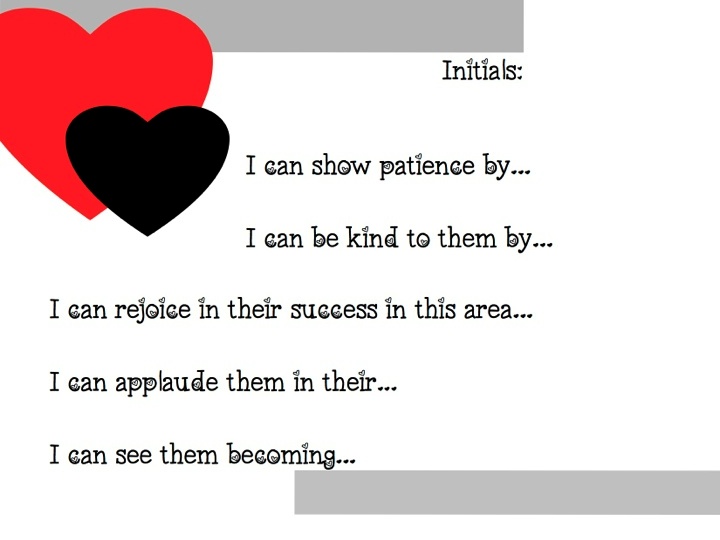
  1. I can show patience by…
  2. I can be kind to them by…
  3. I can rejoice in their success in this area…
  4. I can applaud them in their…
  5. I can see them becoming…

If you would like a downloadable PDF of this worksheet, click here –> Love is… worksheet 1

If you missed any of the messages in our Loving the Unlovable series, you can check them all our here.

God Is Here

Listen to the podcast of this post by clicking on the player below, and you can also subscribe on AppleSpotify, or Audible. 

“Jewish scholars used to debate why God appeared to Moses in a burning bush. A thunderclap or lightning bolt would have been more impressive. And why the far side of the desert? Why not the palace or a pyramid in Egypt? They concluded that God appeared to Moses in a burning bush for one simple reason: to show that no place is devoid of God’s presence, not even a bush on the backside of the desert.” —Mark Batterson, in Draw The Circle

God is Jehovah Shammah

The One Who is with us everywhere for He is Omnipresent

God is here

Wherever you are today—stuck in the snow, hard at work, playing with your kids, eating lunch with your friends, at church, reading a book, singing a song—God is there. That makes wherever you are holy ground.

We should live today and everyday like we are in the very presence of God. Because we are. 

(If you are walking through a dark time right now, perhaps wondering just exactly where God is, I have a whole series of posts and videos you should check out called Where’s God?)

►► Would you please prayerfully consider supporting this ministry? My Patreon supporters get behind-the-scenes access to exclusive materials. ◀︎◀︎

Thursdays With Oswald—The Thinking Of A Christian And An Atheist

This is a weekly series with things I’m reading and pondering from Oswald Chambers. You can read the original seed thought here, or type “Thursdays With Oswald” in the search box to read more entries.

The Thinking Of A Christian And An Atheist 

     All scientific finds have at one time been modern. Science is simply man’s attempt to explain what he knows. …

     I can explain the world outside me by thinking; then if I can explain the world outside me by my mind, there must have been a Mind that made it. That is logical, simple and clear; consequently atheism is what the Bible calls it, the belief of a fool. “The fool has said in his heart, ‘There is no God’” (Psalm 53:1). An atheist is one who says, “I can explain by my mind to a certain extent what things are like outside, but there is not a mind behind that created them.” … 

     We [Christians] have no business to be ignorant about the way God created the world, or to be unable to discern “the arm of the Lord” behind things. …

     If we [Christians] will bring our thinking into captivity to the Holy Spirit, we form what is termed “nous.” Nous is a Greek word meaning responsible intelligence. Whenever we get to this point of responsible intelligence, we have come to a sure line of thinking. Until the nous is formed in natural life and in spiritual life, we get at things by intuition, by impulse, but there is no responsible intelligence. …We have not only to be good lovers of God, but good thinkers, and it is along this line that we can “try the spirits whether they are of God.” 

From Biblical Psychology

Christians—above anyone else—should be first-rate thinkers, because we have a natural mind AND the Holy Spirit. We should constantly study, read, discuss, debate, and meditate to sharpen our thinking. The Holy Spirit will stimulate our thinking along the right lines, but we have to put some thoughts into our minds first!

“We have not only to be good lovers of God, but good thinkers.”

19 Quotes From “Who Do You Think You Are?”

Who Do You Think You AreWho Do You Think You Are? by Mark Driscoll is an insightful journey through the book of Ephesians. You can read my full book review by clicking here. Below are some of the passages that especially stood out to me.

“This world’s fundamental problem is that we don’t understand who we truly are—children of God made in His image—and instead define ourselves by any number of things other than Jesus. Only by knowing our false identity apart from Christ in relation to our true identity in Him can we rightly deal with and overcome the issues in our lives.”

“What you do doesn’t determine who you are. Rather, who you are in Christ determines what you do.”

“Our worship never starts and stops. It’s not limited to a building in which we attend sacred meetings and sing worship songs. Rather, our entire life is devoted to pouring ourselves into someone or something. Saying it another way, we’re ‘unceasing worshippers.’ We aren’t created to worship, but rather we’re created worshipping.”

“While it’s not a sin to plan and strive for a better tomorrow, it is a sin to set one’s joy and identity on who we will be, what we will do, or what we will have tomorrow in our own efforts rather than on Christ today and who He will make us, what He will have us do, and what He will give to us tomorrow.”

“While it’s true that sin has affected the totality of our persons, including our minds, wills, and emotions, we fail to say all that the Bible does regarding our identity when we place undue focus on our depravity as fallen sinners and ignore our dignity as created image bearers and our new identity as redeemed Christian saints. While a non-Christian is totally depraved, a Christian is in Christ.”

“A saint does sin. But a Christian is one who has saint as their constant identity and sinner as their occasional activity. For the Christian, there is a vital difference between having sin and being sin.”

“Sin may explain some of your activity, but it’s not your identity. Your identity is in Christ, and because of your new identity, by God’s grace through the Holy Spirit’s power, you can change your activity. Because you are a new person positionally in Christ, you can live a new life practically by the power of the Holy Spirit. This truth is deeply helpful and vitally practical.”

“Pride is our enemy and humility is our ally. Pride compares us to other sinners; humility compares us to our sinless Savior. Pride covets the success of others; humility celebrates it. Pride is about me; humility is about Jesus and other people. Pride is about my glory; humility is about God’s glory. Pride causes separation from God; humility causes dependence on God. Pride is pregnant with all sins; humility is pregnant with all joys. Pride leads to arrogance; humility leads to confidence. Pride causes me to do things in my own strength; humility compels me to do things in God’s strength. …None of us, with the exception of Jesus Christ, can ever say we’re truly humble. Instead, all we can say is that we’re proud people pursuing humility by the grace of God.”

“In Christ, you’re graced. You’re chosen by grace, saved by grace, kept by grace, gifted by grace, empowered by grace, matured by grace, and sanctified by grace. You persevere by grace, and one day will see Jesus, the best Friend you’ve ever had, face-to-face, by grace.”

“God is as equally glorified when we praise Him for His unmediated grace as when we’re thankful for those through whom He chooses to deliver it. …We’re to thank God for being faithful to His people and to thank His people for being faithful to Him.”

“Before we can understand and embrace our identity in Christ, we must first accept our identity apart from Christ. Becoming a Christian is not merely accepting the truth about Jesus as our Savior. It’s also accepting the truth about ourselves as needy sinners.”

“Because afflictions cost us so much, they are too precious to waste. Though God may not cause your affliction, He can use your affliction for His glory, others’ good, and your growth, if you are in Christ.”

“Our God didn’t suffer so that we wouldn’t suffer. He suffered so that when we do suffer, we can become more like Him and point more people to Him.”

“Too many Christians pit knowledge against experience and the head against the heart. The truth is, both are needed to grasp God’s love. The love of God is what happens when the truth in our heads captivates the affections of our hearts, which spurs us on to grasp the love of God in our lives. …As the love of God increasingly captivates our hearts and we grasp onto his love, we’re changed and become increasingly mature in Christ because our affections determine our actions.”

“Sometimes, Christians shy away from involvement in a local church because they see faults with the church. Ironically, the fact that they see a lack may indicate that there’s a need for them and their gifts. Rather than complaining, it’s better to humbly start serving to meet a church’s needs and invite others to also help.”

“Through the power of the Holy Spirit, God helps us live holy lives and enables us to obey Him. In this way, regeneration is the opposite of religion, which tragically teaches that if you obey God, He will then love you. The exact opposite is true. Regeneration reveals that because God loves us, we can obey Him by the power of the Holy Spirit. You have new power in Christ.”

“Your Father is perfect, loving, gracious, merciful, patient, holy, helpful, and generous. The more you get to know Him through Scripture, prayer, song, service, and time with your brothers and sisters in Christ, the more you will come to love and enjoy Him. Your desires will change from sin to holiness, and you’ll increasingly want to be like your Dad. You’ll love what He loves and hate what He hates.”

“As Christians, our goal is not to merely experience behavior modification by changing how we act and react. Our primary goal is getting to know, love, and trust God as our Father.”

“The last thing the church needs is cowards that treat the Bible like an artifact more fit for a museum than a weapon for the battlefield.”

Free? To Do What?

Listen to the podcast of this post by clicking on the player below, and you can also subscribe on AppleSpotify, or Audible.

At the En Gedi Youth Center, the students loved when our schedule said “free time.” To them: Free time = me time!

Is that how you see your “free time.” Is your free time your me time?

For a Christian, being free should mean something completely different. It’s not time for me, but Peter wrote:

Live as free men, but do not use your freedom as a cover-up for evil; live as servants of God. (1 Peter 2:16)

Free time is not me time, where I get to decide what to do, when I want to do it, and with whom I want to do it. That’s actually slavery to my passions or appetites.

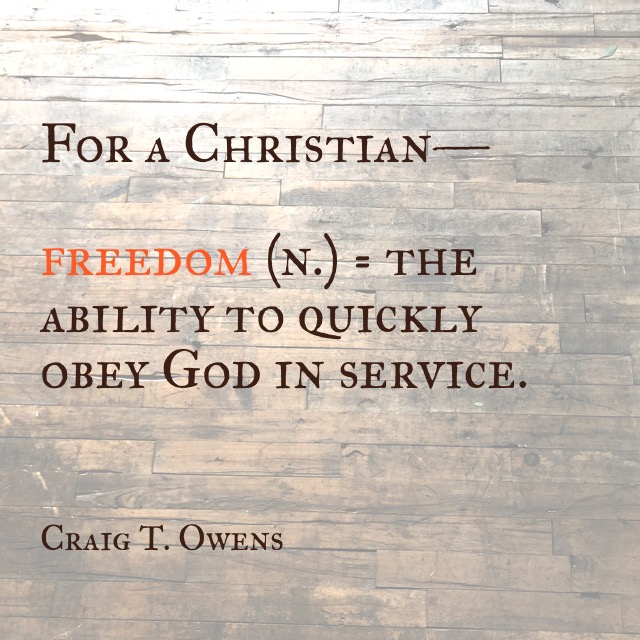
Freedom is the ability to quickly obey God in service.

Any time I delay in obeying God’s call to serve, I am really disobeying Him. If I call Jesus my Savior and my Lord, then He has freed me from the entanglements of sin so that I may quickly say “Yes” to His call to service.

I love the King James Version’s phrasing of this verse: not using your liberty for a cloak of maliciousness. I am either obedient and serving, or I am disobedient and malicious. There is no middle ground.

No excuses.

No cover-ups.

I know I am free when I am thrilled to be able to quickly and readily answer God’s call to be a servant.

►► Would you please prayerfully consider supporting this ministry? My Patreon supporters get behind-the-scenes access to exclusive materials. ◀︎◀︎

Who Do You Think You Are? (book review)

Who Do You Think You AreIf you’ve ever heard Mark Driscoll speak, you know that he pulls no punches as he unashamedly uses the Bible to address the situations we all face. Who Do You Think You Are? is no exception.

Your friends, Madison Avenue, your colleagues, even your family members are all trying to influence you. They all weigh-in on who you are, or who they think you should be. But Pastor Mark Driscoll wants to show you who the Bible says you are. So using the book of Ephesians in the Bible, Pastor Mark convincingly and lovingly will show you that you are…

  • In Christ
  • A saint
  • Blessed
  • Appreciated
  • Saved
  • Reconciled
  • Afflicted
  • Heard
  • Gifted
  • New
  • Forgiven
  • Adopted
  • Loved
  • Rewarded
  • Victorious

Pastor Mark writes in a very readable, conversational style as he uses the powerful words of Ephesians, along with some personal stories from his own life, as well as the lives of others he has known, to make sure you know how God sees you. In a world where everyone else wants to squeeze you into a different mold, how freeing it is to discover how God sees you, and to know that God loves you because you’re you!

This was a very encouraging read. I’d recommend this to anyone struggling with peer pressure or with their own self-identity. I also think this would be an excellent book to use in a small group setting, perhaps even among a recovery group.

I am a Thomas Nelson book reviewer.

I have shared some quotes from this book here.

Weighing The Positives And Negatives*

WeighingDon’t you get annoyed when an overly-religious person spouts off some pie-in-the-sky, feel-goodism that sounds religious, but doesn’t seem to have any grounding in the real world?

Like when a church leader says, “Praise be to the God and Father of our Lord Jesus Christ” when you are in the midst of a painful situation? This is one of those statements that’s great for church, but not so great for the battlefield of life, right?

Actually that statement was made by the apostle Peter (see 1 Peter 1:3).

He didn’t shout it in a church service, but in a letter to Christians who were on the run from their persecutors. Many of them had lost their homes and businesses, had to leave their hometowns, were separated from their families, and were having their very lives threatened. Peter didn’t just shout this praise, he explained its origin, too.

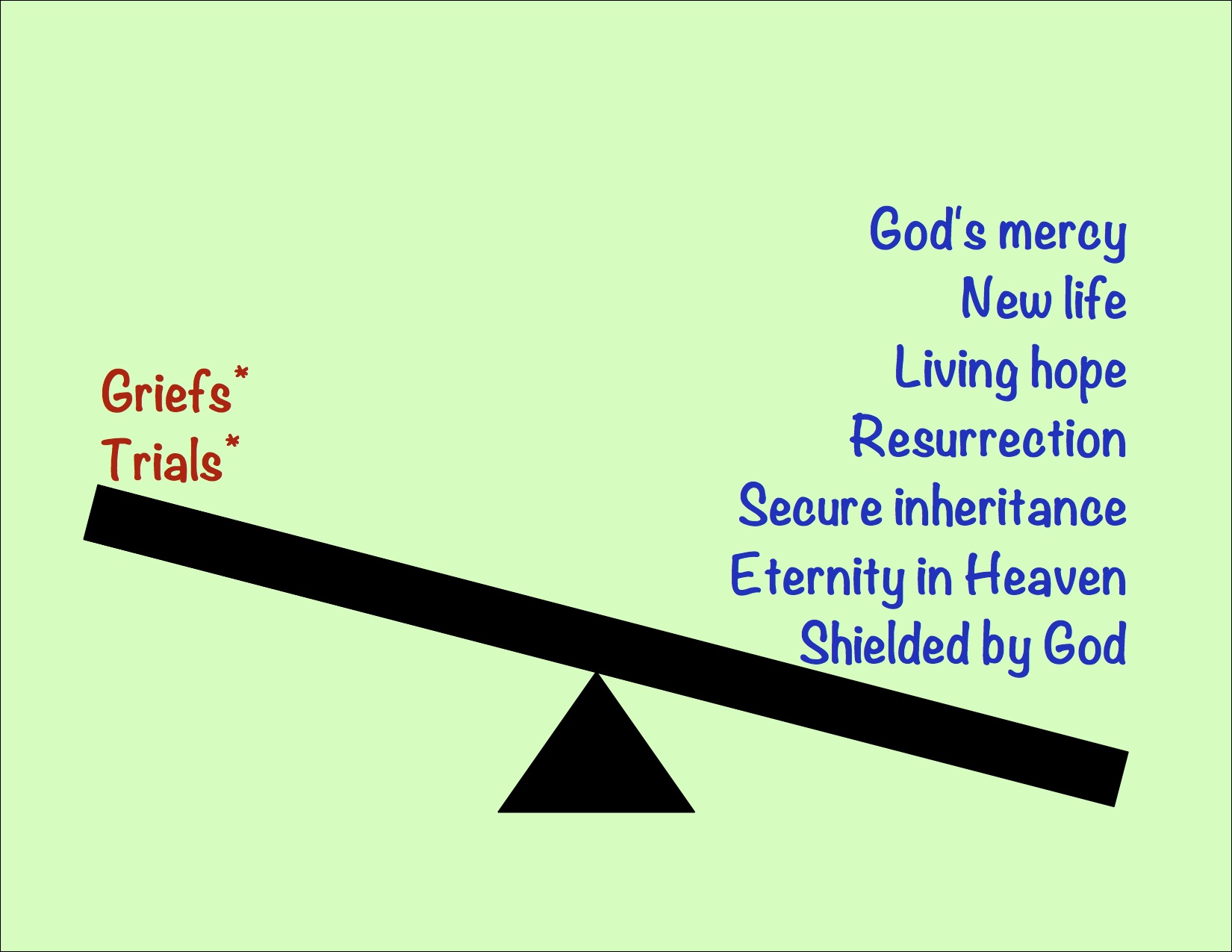
Over the next few verses he asks us to consider what a relationship with Jesus Christ would bring us, and then to put the positives and negatives on a scale—

The Positives

  • God’s mercy
  • New life
  • Living hope
  • Resurrection from the dead
  • Secure inheritance
  • An eternity with God in Heaven
  • God’s power shielding us

The Negatives*

  • Grief
  • Trials

*

So whether we look at the eternal positives or the temporary “negatives” there is cause for rejoicing. When a Christian is in a difficult situation, he must remember this:

  1. This situation is only temporary
  2. This situation will ultimately bring glory to God

Weigh the positives and negatives and you will see that what you are going through now cannot even begin to compare to the glory of God that is coming! The apostle Paul echoed Peter’s words when he wrote, “I consider that our present sufferings are not worth comparing with the glory that will be revealed in us” (Romans 8:18).

So keep your eyes on Jesus, and keep shouting your praise to Him.

Holy Spirit, please help me to look away from the temporary and keep my eyes on my eternal God and Savior.