I am becoming more and more concerned about pastors and churches who will not take a stand. So many seem apathetic to what is happening in our world, seldom taking a stand or speaking out against unbiblical cultural trends or the misdeeds of evil.
If not Christians or churches, then who will speak up for truth?
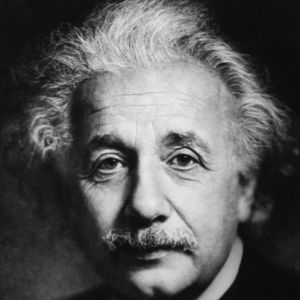
“Being a lover of freedom, when the [Nazi] revolution came, I looked to the universities to defend it, knowing that they had always boasted of their devotion to the cause of truth; but no, the universities were immediately silenced. Then I looked to the great editors of the newspapers, whose flaming editorials in days gone by had proclaimed their love of freedom; but they, like the universities, were silenced in a few short weeks. … Only the Church stood squarely across the path of Hitler’s campaign for suppressing truth. I never had any special interest in the Church before, but now I feel a great affection and admiration for it because the Church alone has had the courage and persistence to stand for intellectual and moral freedom. I am forced to confess that what I once despised I now praise unreservedly.” —Albert Einstein
Pastor, are you standing “squarely across the path” of the things “suppressing truth”? Are you teaching and arming your congregations to do the same?
Some good reading for today…
“What you do with television in your home will help determine whether you and your family will be dumbed down. Let me suggest that you not watch (or let your kids watch) shows that play to the lowest common denominator in humanity… shows that are written and produced for, yes, I’ll say it…dumb people. You might think they’re harmless and amusing, but are they really the best use of your time and, more importantly, your brain?” Read more from Mark Atteberry in his post The Dumbing Down Of America.
A great question: Where is the outrage over the bombardment of civilians in Israel?
David Wilkerson reminds us of the loving heart of Jesus our Shepherd.
A really cool story about the Cadbury family (who founded the Cadbury Chocolate company).
Tim Elmore shares the good news and bad news in his post Teen Trends.
This is a weekly series with things I’m reading and pondering from Oswald Chambers. You can read the original seed thought here, or type “Thursdays With Oswald” in the search box to read more entries.
The majority of us “hang on” to Jesus Christ, we are thankful for the massive gift of salvation, but we don’t do anything towards working it out. That is the difficult bit, and the bit the majority of us fall in, because we have not been taught that that is what we have to do, consequently there is a gap between our religious profession and our actual practical living. …
The great factor in Christian experience is the one our Lord continually brought out, viz., the reception of the Holy Spirit who does in us what He did for us, and slowly and surely our natural life is transformed into a spiritual life through obedience.
There is a process whereby the Holy Spirit brings our Christ-likeness from us; it’s called sanctification (or as I like to say it, saint-ification).
This is how the Spirit forms us into God’s saints. But here’s the key point: we have to let the Spirit do His work. If we say, “No thanks, I’d rather not work on that area of my life,” He will leave you alone.
But, oh, the rewards that we miss out on when we don’t receive all that the Holy Spirit has for us!
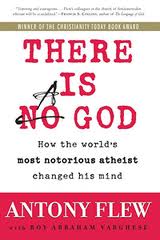
As I said in my book review of Anthony Flew’s There Is A God, the real value of this book is in the arguments which contributed to Flew’s shift from atheism to theism. You can read my full book review by clicking here.
Frankly, it’s hard to share a lot of the quotes because the context of the full argument would be lacking, but I’m going to attempt to share some of them in multiple posts. To start with, below are some of the direct quotes from Anthony Flew.
“I have said in some of my later atheist writings that I reached the conclusion about the nonexistence of God much too quickly, much too easily, and for what later seemed to me the wrong reasons. I reconsidered this negative conclusion at length and often, but for nearly seventy years thereafter I never found the grounds sufficient to warrant any fundamental reversal. One of those early reasons for my conversion to atheism was the problem of evil.”
“The presumption of atheism can be justified by the inescapable demand for grounds. To believe there is a God, we have to have good grounds for the belief. But if no such grounds are provided, there exists no sufficient reason for believing in God, and the only reasonable position is to be a negative atheist or an agnostic (by negative atheist, I meant ‘a-theist,’ parallel to such words as atypical and amoral). … This argument garnered many and varied responses. Writing as an agnostic, the English philosopher Anthony Kenny maintained that there may be a presumption for agnosticism, but not for positive or negative atheism. He suggested that it takes more effort to show that you know something than that you do not (this includes even the claim that the concept of God is not coherent). But he said this does not let agnostics off the hook; a candidate for an examination may be able to justify the claim that he or she does not know the answer to one of the questions, but this does not enable the person to pass the examination. … By far, the heaviest challenge to the argument came from America. The modal logician Alvin Plantinga introduced the idea that theism is a properly basic belief. He asserted that belief in God is similar to belief in other basic truths, such as belief in other minds or perception (seeing a tree) or memory (belief in the past). In all these instances, you trust your cognitive faculties, although you cannot prove the truth of the belief in question. Similarly, people take certain propositions (e.g., the existence of the world) as basic and others as derivative from these basic propositions. Believers, it is argued, take the existence of God as a basic proposition.”
“If there is an infinite series of books about geometry that owe their pattern to copying from earlier books, we still do not have an adequate answer as to why the book is the way it is (e.g., it is about geometry) or why there is a book at all. The entire series needs an explanation.”
“Science qua science cannot furnish an argument for God’s existence. But the three items of evidence we have considered in this volume—the laws of nature, life with its teleological organization, and the existence of the universe—can only be explained in the light of an Intelligence that explains both its own existence and that of the world.”
“My discovery of the Divine has been a pilgrimage of reason and not of faith.”
Check back soon for some additional quotes from this thought-provoking book.
Some interesting reading and watching from today…
“I call love to God the motion of the soul toward the enjoyment of God for His own sake, and the enjoyment of one’s self and of one’s neighbor for the sake of God.” —Augustine
Thom Rainer shares 6 symptoms of a dysfunctional church.
This research says that married people are healthier people.
[VIDEO] Greg Koukl addresses the “God of the Gaps” argument.
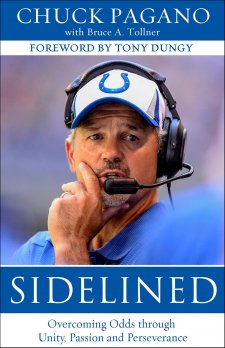
Every once in awhile I come across a book that is hard to put down. Sidelined by Chuck Pagano, the head coach of the NFL’s Indianapolis Colts, is just such a book.
Before I lose anyone who says, “Football? Not interested,” let me assure you that this is not a football book. This is a great story of near-tragedy and triumph that happens to have a football coach as its main character. This is a book about family, and faith, and teamwork, and pulling together, and overcoming. It’s a love story with a happy ending. It’s a great book!
In a nutshell, Chuck Pagano is hired as the head coach of the Colts, the first time in his career he has gotten a shot at being a head coach. Just a couple of games into his very first season, he is diagnosed with leukemia and sees his coaching responsibilities immediately halted. He enters into a life-and-death struggle with cancer, and ultimately beats it. But the real triumph of the story is the way his diagnosis pulled together a whole city, and even other NFL cities, to raise awareness of this dreaded disease.
Sidelined doesn’t really have an ending, because Coach Pagano’s career is still ongoing, and so is the fight against leukemia. After reading this book, I’m not only cheering for Coach, but I’m also cheering on those in the fight of their lives against cancer as well as those searching for a cure for this disease.
I am a Thomas Nelson book reviewer.
It’s a mark of a strong, confident person that can admit, “I was wrong. I made a mistake.” Anthony Flew is just such a strong man. His book is called There Is A God: How the world’s most notorious atheist changed his mind.
The one sentence summary of this book could be: Anthony Flew was a noted philosopher who concluded there was no God, but then was persuaded to rethink his position and came to a complete reversal. But that would sell his story short.
The real meat-and-potatoes of the book are the arguments which helped change Anthony Flew’s mind. This, I must warn you, is no easy reading. The arguments are so nuanced and metaphysical at times, that it really requires a careful reading. This was not a book I could speed read, because the chain of logic in the arguments was simply too good to miss anything.
I throughly appreciated the candor with which Flew shared his metamorphosis from atheist to Theist. The book also includes two appendices which address the current state of modern atheism, and an interview with N.T. Wright on Jesus being God Incarnate.
If you are ready to study some of the atheistic and theistic arguments that the brightest apologists for both viewpoints are presenting today, then this is the book for you! I thought the journey of discovery was fantastic and mind-expanding!
Some great reading and watching from today…
[VIDEO] Thanks to my friend Rich for telling me about the friendliest restaurant in America.
“No state is so blessed as that wherein one is free from sin, is filled with innocence, and is fully supplied with the grace of God.” —Ambrose
[VIDEO] John Maxwell has a good reminder about the power of personal discipline.
There are few who can express the love of God as Charles Spurgeon in The Glorious Love Of The Father.
Tim Elmore shares some counter-intuitive thinking for preparing our kids for success.
“If you want to hear from Heaven you must seek it on your knees.” —D.L. Moody
“Don’t be forced into this false dichotomy. Truth and love are not at odds. Rather, for the sake of love, cherish the truth. Let this love for truth and truth for love govern the use of language….” —John Piper
“Who will grant me to find peace in You? Who will grant me this grace, that You would come into my heart and inebriate it, enabling me to forget the evils that beset me and embrace You my only good?” —Augustine
Don’t buy into it when Islam is called a religion of peace: ISIS terrorists targeting Christians in Iraq.